The 8 Best Candy Thermometers of 2026

The gap between caramel that stays chewy and caramel that shatters is about five degrees Fahrenheit, and a thermometer is the only thing keeping you from finding out which one you made. An inexpensive one that lies is worse than none at all: I once cooked toffee with a thermometer that ran six degrees hot, and it looked perfect right up until it tasted like gravel.

We cooked sugar with 14 candy thermometers, from old-fashioned glass tubes to digital instant-read models with long probes and programmable alarms. What separated them wasn't a spec sheet. It was whether the probe reached far enough into the syrup to read what was actually in the pan, whether the clip held the rim while we stirred, and whether we could read the display through a column of steam.

Here's what nobody tells you before your first batch: dial and glass models register slowly, so pulling the pan the instant the needle hits the number means you're already late. And anything that lives clipped to a pot all holiday season has to survive sugar, steam, and a dunking in the sink. These eight are the ones we'd trust with a pound of butter and a bag of pistachios.

Our Top Picks

The Best Candy Thermometers

1

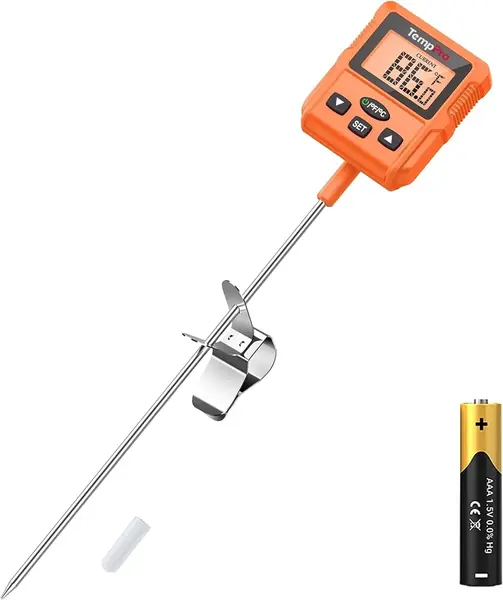
TempPro TempDip TP510 Best Overall
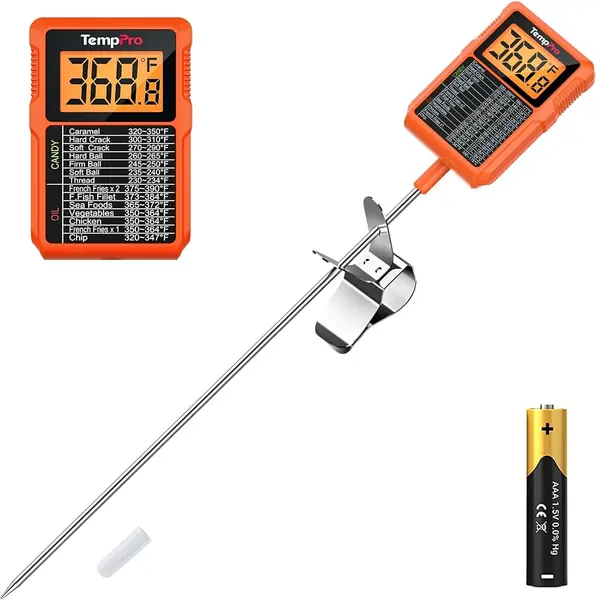
TempPro TempDip TP510 digital candy thermometer with orange body, probe clip, and backlit display

Everyday candy making

Bake Score 95/100
Probe Length
10 inches
Temperature Range
-58°F to 572°F
Response Time
1 second
Water Resistance
IPX5
View on Amazon

The number on the screen keeps up with the sugar. That is the argument for the TempDip TP510 in one line: a one-second read on a 10-inch probe, clipped to the pot so both hands stay on the spoon. We kept it in a saucepan through a full batch of caramel, stirring around the stem, and never had to stop and wait for the display to settle before pulling the pot off the heat.

The head swivels 90 degrees, and that turned out to be the detail we used most. Angle the screen toward the side of the stove you are standing on and you can read it without leaning over a pot of 300-degree sugar, and the backlight handles a dim kitchen as well as a steamy one. Once it is cool, the probe rinses under the tap, which is more than the glass-tube models here will take.

What makes it a candy thermometer rather than a general-purpose digital is the reference strip printed on the body, with candy stages and frying temperatures on one scale, plus a clip that suspends the tip mid-liquid instead of letting it rest against the pan bottom. Of the digitals here, this is the one that feels built for the pot rather than adapted to it.

The reservation is longevity. The body is plastic, and the failures that show up arrive early, within a few weeks of steady use rather than after years. Ours came through testing without trouble, but it is a fair thing to know before you spend midrange money on a tool you plan to keep in the drawer for a decade.

Worth Noting

  • Some units stop reading within weeks of regular use
Our Verdict

We recommend the TempDip TP510 as the default for anyone making candy more than once a season: fast, hands-free, and easy to read over a hot pot.

Check Latest Price

2

Taylor Candy and Deep Fry Thermometer Best Classic Analog

Taylor stainless steel candy and deep fry thermometer with black insulated handle and pan clip

Deep pots

Bake Score 94/100
Probe Length
12 inches
Temperature Range
100°F to 400°F
Display
Analog with candy stages
Care
Hand wash only
View on Amazon

The least expensive thermometer here is also the most old-fashioned, and for plenty of cooks that is the right trade. Candy stages are printed across the Taylor's face, so at the moment the syrup turns you are often reading a word rather than chasing a number, which is exactly what we want with a spoon in one hand. We like it best in a deep pot, where the 12-inch stainless stem gets the tip down into the syrup and the insulated handle stays cool while you stir.

The clip slides along the stem, so set it before the sugar goes on and check where the tip ends up. You want it hanging in the liquid rather than resting on the bottom of the pan, or you are measuring the pan and the reading will run high from the first minute.

An analog column can drift, and a thermometer that is ten degrees off will take a batch of fudge down with it. Two minutes in boiling water before your first cook tells you where yours sits, and you can carry that offset in your head for the rest of the season. Wipe it rather than washing it, too, because the printed numbers are ink and scrubbing takes them off a little at a time.

Worth Noting

  • Hand wash only; it cannot go in the dishwasher
Our Verdict

We recommend the Taylor to anyone who wants to spend the least and still get printed candy stages, a long stem, and a cool handle.

Check Latest Price
3

Polder Candy Thermometer THM-515 Best for Big Batches

Polder stainless steel candy thermometer with wide dial, pot clip, and printed temperature zones

Large batches

Bake Score 93/100
Probe Length
12 inches
Temperature Range
90°F to 400°F
Care
Dishwasher safe
Temperature Zones
6 printed zones
View on Amazon

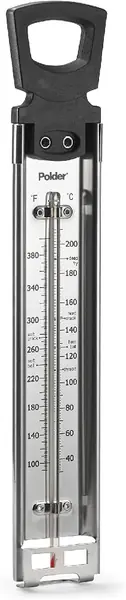
Six temperature zones are printed across the Polder's face, and the dial is wide enough to read from a step back, which is what you want when the pot is spitting. The 12-inch stem and the integrated clip make it a hands-free tool in a large vessel, and the insulated handle means you can nudge it into position without hunting for a towel.

With a wide pot and a double batch of caramel, we liked it more than any of the smaller-faced options here. It sits steady against the rim, the numbers come through steam, and the printed zones do the thinking while you keep stirring, so you are not translating 248 degrees into a stage with your hands full.

It is large, and in a two-quart saucepan that bulk turns into a nuisance: the head crowds your spoon hand and the stem eats room you need for stirring. The glass column is the other thing to respect, since it is a tube sitting in a pot of 300-degree sugar and tubes can crack, so store it where it will not get knocked around between batches.

Worth Noting

  • Bulky in a small saucepan
  • Clip can slip on some pot rims
Our Verdict

We recommend the Polder for big pots of caramel and jelly, where a wide, zone-marked face is easier to read than a small dial.

Check Latest Price
4

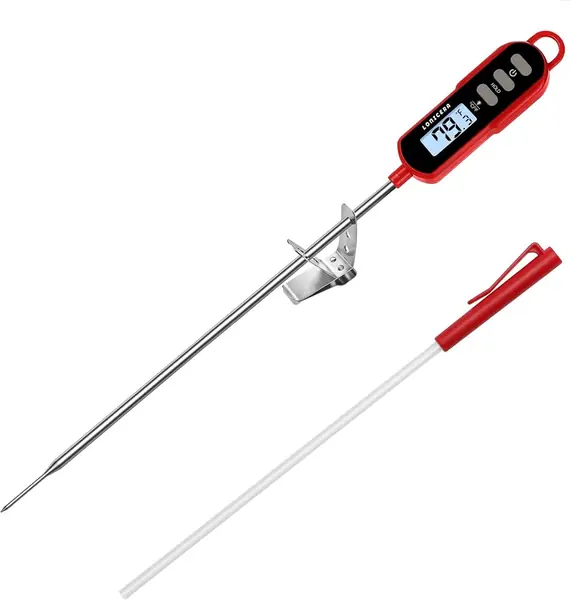
LONICERA Digital Candy Thermometer Best for Fast Readings

LONICERA red digital candy thermometer with 11-inch probe, pot clip, and backlit screen

Steamy kitchens

Bake Score 92/100
Probe Length
11 inches
Temperature Range
-58°F to 572°F
Response Time
2 to 3 seconds
Water Resistance
IPX6
View on Amazon

Most thermometers get wiped down. This one gets rinsed. The LONICERA's probe and body carry an IPX6 water-resistance rating, so once it has cooled you can hold it under the tap and flush the syrup out of the seams instead of wiping it further in. That alone makes it the least fussy tool in this group to put away.

Two to three seconds to a reading is slower than the quickest digital here, and for sugar we do not think it matters, because nothing in a candy pot moves fast enough for a two-second lag to cost you a stage. What does matter is seeing the number: the display is backlit, the digits are big, and the 11-inch probe keeps your knuckles clear of hot oil while the adjustable clip holds the business end where you set it.

The range runs from well below freezing to 572°F, which covers frying, jelly, and caramel without switching tools, and a magnet on the back means it lives on the refrigerator door instead of at the bottom of a drawer. What it does not do is name the stage for you: the screen gives you a number, and you supply the translation, so keep a stage list within reach if brittle is on the list.

Worth Noting

  • Shows a number, so you supply the candy stages
Our Verdict

We recommend the LONICERA for a bright, clear read you do not have to baby: rinse it, stick it on the fridge, repeat.

Check Latest Price
5

TempPro TempDip Elite TP511 Best for Set-And-Watch Cooking

TempPro TempDip Elite TP511 programmable candy thermometer with orange housing, 10-inch probe, and clip

Hands-off monitoring

Bake Score 91/100
Probe Length
10 inches
Response Time
1 second
Accuracy
±0.9°F
Alerts
Preset target, flashing backlight
View on Amazon

What happens if you step away from the pot? Here the answer is a preset: key in your target temperature and the backlight flashes when the syrup arrives. For tempering chocolate or taking sugar to the edge of hard crack, that turns the thermometer into something you set rather than something you watch.

The rest of the package is the most precise in this group: a claimed 0.9-degree accuracy, a one-second read, a 10-inch probe with a pan clip, and a display head that rotates 90 degrees and is built to shrug off steam. The calibration function is the part we care about most, because a tool you can true up yourself is the difference between keeping it and replacing it.

The catch is the alert itself. It is visual, a flashing screen with no beep to carry across a kitchen. Set it where you can see it, or run a separate timer alongside, and the feature works fine; wander into the next room and you will miss the whole thing.

That trade makes sense if you make candy often enough to care about a single degree, and if paying more once beats replacing a cheap thermometer every year. It is more instrument than most holiday fudge requires.

Worth Noting

  • The priciest thermometer in this group
Our Verdict

We recommend the Elite to cooks who set a target temperature and watch for the flash, with precision and calibration for serious sugar work.

Check Latest Price
6

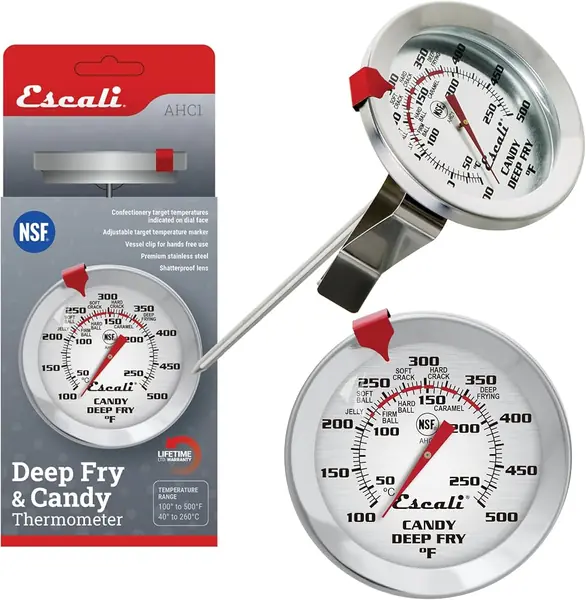
Escali AHC1 Best for Small Saucepans

Escali AHC1 stainless steel candy thermometer with round dial, target marker, and pot clip

Small saucepans

Bake Score 90/100
Probe Length
5.5 inches
Temperature Range
100°F to 500°F
Dial Size
2.5 inches
Certification
NSF certified
View on Amazon

A small metal pointer rotates around the Escali's dial, and you set it to your target before the sugar goes on. We ended up using that marker more than the numbers: at 300 degrees the graduations crowd together, and a pointer parked on the hard-crack band turns a squint into a glance.

The dial runs from 100 to 500°F with the confectionary zones printed around the face, the body is stainless, and it is NSF certified and dishwasher safe, which makes it the easiest analog here to live with. The clip holds it on the pot for hands-free reading, and a 2.5-inch dial is big enough to see from arm's length.

The 5.5-inch probe is the shortest in this group, and that is the whole story of who it suits. This is the thermometer for a saucepan of fudge or a batch of caramel in a two-quart pot, not for a stockpot where the syrup runs eight inches deep. Buy it for small-batch work and the short stem stops being a compromise and starts being the point.

Worth Noting

  • Probe too short for a deep stockpot
Our Verdict

We recommend the AHC1 for small-batch sugar work in a saucepan, where the short probe fits and the rotating marker saves you reading numbers at 300 degrees.

Check Latest Price
7

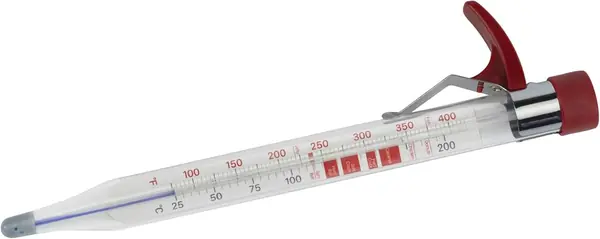
GoodCook Everyday Candy & Deep Fry Thermometer Best for First Batches

GoodCook glass-tube candy and deep fry thermometer with red body, clip, and storage sleeve

First batches

Bake Score 89/100
Temperature Range
100°F to 400°F
Display
Magnifying glass tube
Included
Protective storage sleeve
Immersion Depth
5 inches
View on Amazon

It costs about what the Taylor does, and it does one thing the Taylor cannot: the glass tube magnifies its own column, so the level reads bigger than the numbers printed beside it. What we noticed first is how much of a difference that makes at the moment of truth, when you are squinting into a pot of bubbling fudge and the difference between one stage and the next is five degrees.

The rest is sensible. It covers 100 to 400°F in both Fahrenheit and Celsius, the adjustable clip holds the tip mid-liquid and off the pan bottom, and the protective sleeve is printed with a temperature guide, so storage doubles as a cheat sheet. There is a limited lifetime warranty behind it as well.

Where it gives ground is consistency. Units that go wrong tend to go wrong early, with a tip that separates or a column that stops tracking within a month, and a thermometer that is five degrees off is worse than no thermometer at all, because you will trust it. Store it in the sleeve, keep it off the broiler and away from open flame, and it will serve a beginner well.

Worth Noting

  • Not for broiler use or open flame
  • Glass tube can chip with rough handling
Our Verdict

We recommend the GoodCook as a first candy thermometer: inexpensive, magnified, and sold with a sleeve that keeps it safe between batches.

Check Latest Price
8

Efeng Deep Fry/Candy Thermometer Best for Turkey Fryers

Efeng stainless steel deep fry thermometer with 15-inch stem, analog dial, and sliding clip

Turkey fryers

Bake Score 88/100
Probe Length
15 inches
Temperature Range
50°F to 550°F
Display
Analog dial
Accuracy
±5°F
View on Amazon

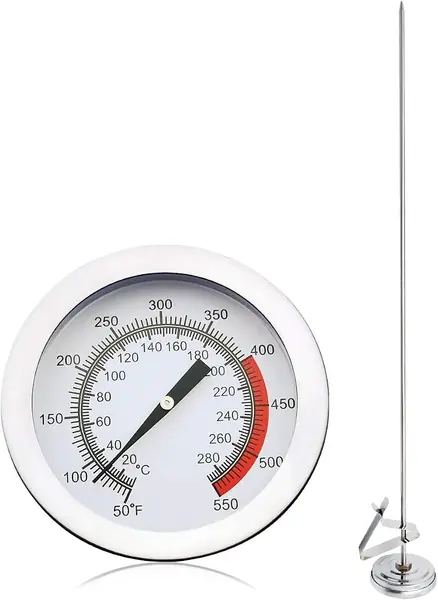
Fifteen inches of stem is a specific answer to a specific problem: reaching the oil in a turkey fryer, a crawfish pot, or a stockpot deep enough that a 10-inch probe is measuring air. The clip slides along that stem, so you can set the depth you need, and the stainless body wipes down without ceremony.

The range runs from 50 to 550°F and the dial is analog, so there is no battery to die halfway through a fry. For oil that is plenty, and we never wanted a decimal while frying, because frying happens inside a 50-degree window and a couple of degrees either way barely changes the crust.

Sugar is less forgiving. The stated tolerance is plus or minus 5°F, which is generous for a hard-crack syrup, where five degrees is the difference between brittle and a batch you throw out. Read it at eye level, give it a few seconds to settle, and treat the number as a neighborhood rather than an address.

So this is the thermometer for the fryer and the big pot, not for the fondant. In a saucepan the 15-inch stem hits the bottom before the syrup is deep enough to cover the tip, which is the cue to reach for the shorter Escali or Taylor instead.

Worth Noting

  • ±5°F tolerance is loose for candy stages
  • Long stem bottoms out in a shallow pan
Our Verdict

We recommend the Efeng for deep-frying rigs and oversized pots, where a 15-inch stem reaches liquid that shorter probes cannot.

Check Latest Price

How We Tested Candy Thermometers

We started by pulling candy thermometers from major retailers and kitchen-supply brands, then narrowed by format: glass tubes with printed temperature zones, analog dials with pan clips, and digital instant-read models with probes ranging from 5 to 15 inches. We made sure the shortlist spanned basic to programmable and covered the price range shoppers actually consider. Fourteen made the cut, and each spent six months in a working kitchen.

Accuracy came first. Every thermometer went into an ice bath and then a pot of boiling water before its first batch, and we logged how far off each one read. Then we cooked: sugar syrups taken to thread, soft ball, and hard crack; oil for fried chicken and a turkey; jam in August and fudge in December. We watched how fast the numbers climbed, whether a reading kept creeping after the pan came off the burner, and whether the probe tip sat high enough to read syrup instead of the scorched film on the bottom of the pot.

We also tested the parts that fail later. Each clip went onto a thin aluminum saucepan and a heavy Dutch oven, and we stirred for ten minutes to see if it slid, scratched, or dropped into the sugar. We read displays through steam, from arm's length, and in a dim kitchen at 10 p.m., and set each alarm to see how far past the target it actually sounded. Finally, everything got washed the way its maker allows, dunked, dropped in the sink, and checked for rust at the joint, fogged glass, and dead batteries, then re-calibrated at the six-month mark to see which ones had drifted. The least expensive models weren't the least accurate — a couple of them beat fancier ones outright.

How to Choose a Candy Thermometer

Analog or Digital: Pick the Trade You Want

An analog candy thermometer prints the stages right on the face and needs no battery, so there is nothing to fail and nothing to translate at the moment the syrup turns. What you give up is speed and easy cleanup: the column takes a few seconds to catch up, and the body is usually a wipe-only proposition. A digital deep-fry thermometer reads in a second or two, rinses under the tap, and shows a number you have to turn into a stage yourself.

Our rule of thumb: if the pot is only ever sugar, an analog with printed zones is the simpler tool. If the same thermometer is going into frying oil twice a month, buy digital. The clip, the backlight, and the rinse will matter more to you than the stage labels.

Accuracy Is the Whole Purchase

Candy stages sit five to fifteen degrees apart, so a thermometer that is ten degrees off does not make mediocre candy, it makes the wrong candy: fudge that will not set, brittle that scorches. A tolerance of plus or minus five degrees, which is perfectly fine for frying oil, is marginal for sugar.

Check any new thermometer in a rolling boil before the first batch and write down what it says. Boiling water is 212°F at sea level and a couple of degrees lower for every thousand feet of elevation, so if yours reads low by a fixed amount you can simply add that offset as you cook. If it reads several degrees off and wanders between batches, send it back.

Match the Stem to Your Pans

The trap here is assuming longer is better. A 12-inch stem dropped into a three-inch saucepan of cream stands on the bottom, which means it measures the pan rather than the cream and reads high the whole way. The tip needs to hang an inch or so above the base with the head clear of the rim.

So measure the pot you actually make candy in. A five-to-six-inch probe suits saucepans and small batches, and the Escali is our pick for that job, while anything past 10 inches belongs in a stockpot, a jelly kettle, or a turkey fryer. Clip the thermometer in place instead of holding it: a hand in the steam is how people get burned.

Read It Without Leaning In

Steam fogs a dial, splatter coats it, and sugar at 300°F is not something you want your face near. The features that solve this are unglamorous: a face wide enough to read from arm's length, a backlight for evening cooking, and a head that tilts toward the side of the stove you stand on.

We rank those above an extra digit of resolution. A thermometer that reads to a tenth of a degree but makes you lean over the pot is a worse kitchen tool than one that reads to a whole degree and can be seen from a step back.

Care, Storage, and the Numbers That Rub Off

Printed markings on an analog face are ink, and ink wears. Wipe rather than scrub, keep the body out of the dishwasher unless the maker says otherwise, and the stages will stay legible for years. Glass tubes want the same treatment plus one more rule: keep them away from broilers and open flame.

Storage is not a small thing for a tool you use four times a year. A sleeve, a magnet, or a dedicated drawer slot is the difference between a thermometer you can find on the night you need it and one you buy again.

Frequently Asked Questions

Final Verdict

If sugar is a regular thing in your kitchen, the TempPro TempDip TP510 is the thermometer we point you to: one-second readings, a head that tilts toward you, and a clip that frees both hands for stirring. The Taylor is the one for deep pots and a small budget, since the candy stages are printed on its face and it costs about half as much. And if your candy happens in a saucepan rather than a stockpot, the Escali's short probe and rotating marker are the better fit.