The 5 Best Electric Flour Sifters of 2026

There's a particular mess that shows up only when you sift flour: a fine white fog drifting across the counter and whatever you're wearing. I've brushed it off black leggings more than once. A battery-operated sifter won't banish that cloud entirely, but a good one keeps it small, moves the flour fast, and saves your hands from the squeeze-squeeze-squeeze of a manual sifter. That's the trade — a bit of motor noise for lump-free flour in a fraction of the time.

I baked through 14 of these, mostly palm-sized handhelds plus one plug-in vibrating model, from holiday cookie marathons into the Sunday biscuit routine that followed. Before you shop, know that the capacity on the box is optimistic — a bowl billed as 4 cups is comfortable with about 3. Mesh matters more than motor specs: fine screens suit cake flour and cocoa, coarser ones handle whole wheat.

Our Top Picks

The Best Electric Flour Sifters

1

Norpro Battery-Operated Flour Sifter Best Overall
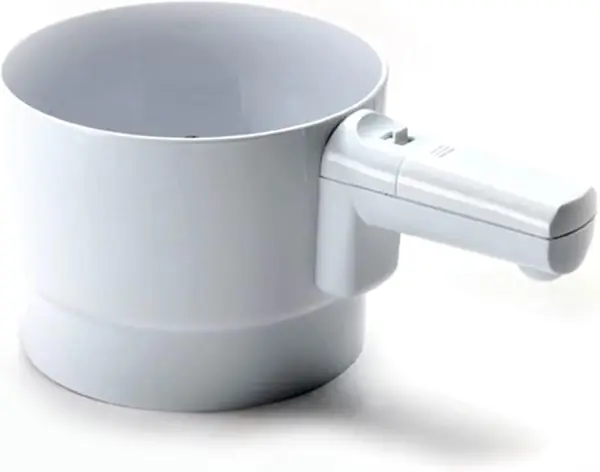
Norpro battery-operated electric flour sifter in white plastic with stainless mesh screen

Everyday full batches

Bake Score 87/100
Power
1 C battery (not included)
Mesh
Stainless steel, 0.01-inch openings
Capacity
5 cups (40 ounces)
Dimensions
5 x 5 x 5.75 inches
View on Amazon

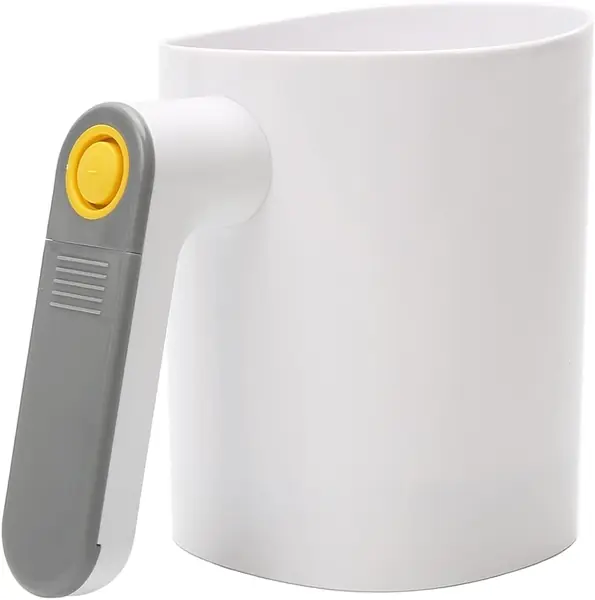
The reason to buy one of these at all is hands that cannot crank a sifter, and the Norpro takes that job seriously. The hopper holds five cups, or 40 ounces, which is more than any other battery model here — a full batch of layer cake in one pass instead of three refills. That is the main reason it is the sifter we recommend first.

The trigger sits under your thumb and the motor handles everything else, which is what makes it usable on a bad hand day when a squeeze handle is not. No cramping, no gripping, no counting turns: press, and a fine curtain of flour falls into the bowl. It runs on a single C battery, a chunkier buy than the AAs most of these take, but it means one cell to change instead of two.

The stainless screen has 0.01-inch openings, fine enough for cake flour and cocoa, and it moves flour through fast. Hold the base an inch or two above the bowl rather than high up — this sifter has real output, and the difference between a light dusting into the bowl and a cloud across the counter is how far the flour falls.

Cleaning is the compromise. The screen is fixed to the body and nothing here is dishwasher-safe, so you brush it out and wipe it down, ideally before the flour settles into the rim. Done right after use it is a two-minute job; left until the flour cakes on, it is a scraping job, and a dry pastry brush gets most of it either way.

Worth Noting

  • Battery door is fiddly to refit
Our Verdict

For sore hands and full batches, the Norpro is the sifter we recommend: the largest hopper here and a motor that does the work.

Check Latest Price
2

Erivibor Battery Operated Flour Sifter Best for Easy Cleaning

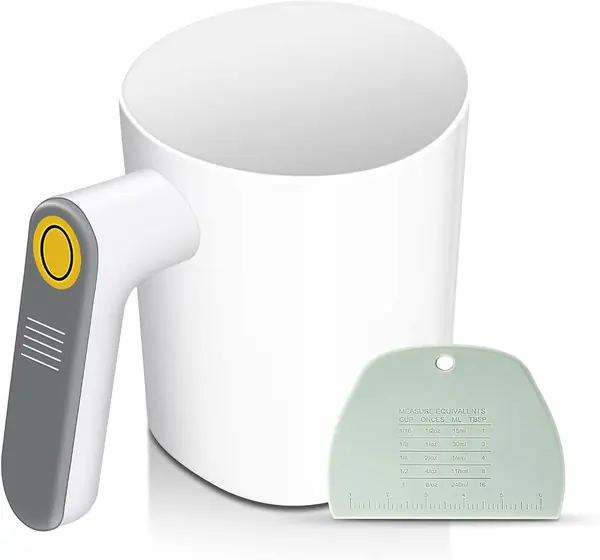
Erivibor white handheld electric flour sifter with removable stainless mesh and dough scraper

Easy weekly cleanup

Bake Score 86/100
Power
2 AA batteries (not included)
Mesh
Removable stainless steel 430
Capacity
4 cups (1 liter)
Weight
10.4 oz
View on Amazon

The mesh on the Erivibor lifts out of the body, which reads like a minor detail until you have spent five minutes digging flour out of a sifter whose bottom is sealed shut. Cleaning is the reason most electric flour sieves end up at the back of a cabinet, and a screen you can lift out turns the whole job into a rinse.

So while the Norpro wins on capacity, this is the one we point to when cleanup decides whether you will actually sift. The hopper holds four cups — a liter, enough for a two-layer cake — and at 10.4 ounces the whole thing is light enough to hold over the bowl in one hand while you scrape with the other. The button sits in the handle, so it starts with a thumb press rather than a squeeze.

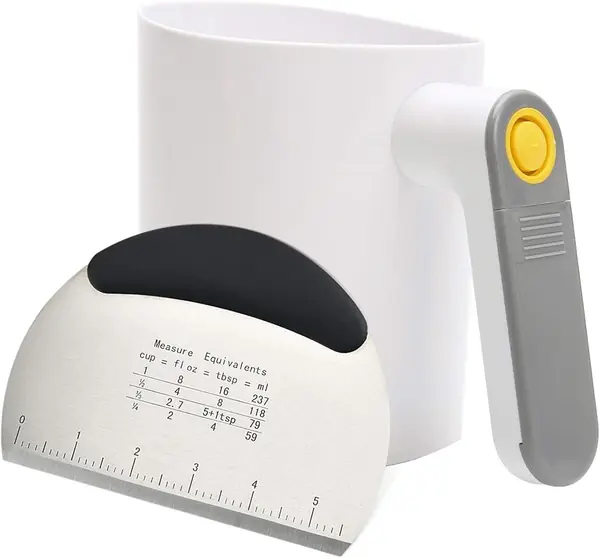
For all-purpose flour, cocoa, and cake flour it keeps up, and the bowl ends up with noticeably fewer lumps than a wire strainer leaves. Erivibor also includes a stainless dough scraper, a more useful extra than most since it is the tool you want for leveling a cup of flour anyway. It is small too, about 7 inches across, so it lives in a drawer rather than on the counter.

Worth Noting

  • Powdered sugar sifts much more slowly than flour
Our Verdict

Buy this one when cleaning is what keeps you from sifting at all: the screen lifts out, the body wipes clean, and it stays light in one hand.

Check Latest Price
3

Blingbin Electric Flour Sifter Best Budget

Blingbin white battery-operated flour sifter with removable fine stainless steel mesh screen

First electric sifter

Bake Score 85/100
Power
2 AA batteries (not included)
Mesh
Removable fine stainless steel
Capacity
4 cups (1 liter)
View on Amazon

There is a version of this decision that is mostly about money, and the Blingbin is where it lands: the least expensive of the battery handhelds here, and it does what the others do without asking you to hold anything heavier than roughly a pound.

We think it is the right first electric sifter for most people. The hopper holds a liter, about four cups, the fine stainless screen lifts out for rinsing, and the body is a plain white tub that wipes clean in a few passes. Nothing about it feels premium and nothing about it gets in the way either — you press the button, you move it over the bowl, you are done.

The motor is the quietest of the group, closer to a hum than a rattle, and the vibration runs at a high, fine frequency that breaks up clumps without flinging flour across the counter. Keep the battery compartment dry: the two AAs sit in the housing, and water there ends the machine.

Worth Noting

  • Gentle vibration slows dense or damp flour
Our Verdict

A quiet, capable four-cup sifter for the least money here — the right first electric sifter if you bake a few times a month.

Check Latest Price
4

Sidasu Automatic Vibrating Sieve Shaker Best for Big Batches

Sidasu automatic vibrating sieve shaker with two stainless steel mesh screens, 40 and 60 mesh

Home grain milling

Bake Score 83/100
Power
110V, 50W
Weight
13.5 lb
Screens
40 and 60 mesh stainless steel
Operation
Automatic on/off vibration
View on Amazon

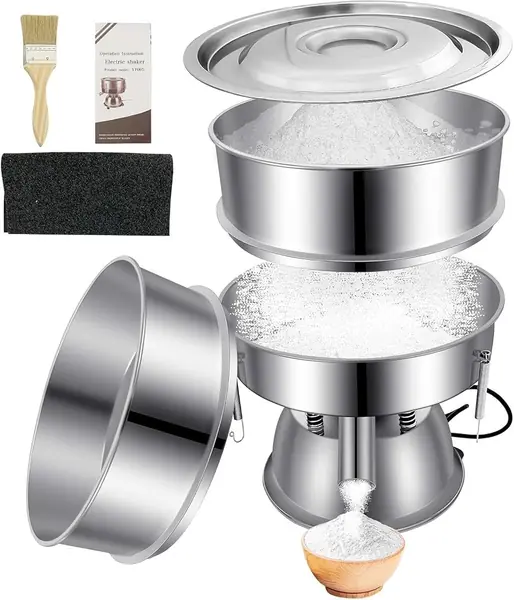
This is not a sifter you hold. It is a benchtop machine with a 110-volt motor, and for anyone milling grain at home that is exactly the point: a vertical vibration motor shakes a stainless screen hard enough to push pounds of flour through in a session and to separate bran from fresh-milled wheat, which is work no handheld here can do at that scale.

Two screens come with it, 40 and 60 mesh, the higher number being the finer sieve. One runs at a time, so you swap by hand between a coarser pass and a finishing pass, and the controls are an on button and an off button with nothing to program. Ground grain, coarse meal, and finely milled flour each want a different screen, and having both in the box is the practical part of the design.

What it is not is a sifter for a single cake. A four-cup handheld finishes weeknight baking before this machine is even set up, and the Sidasu earns its place only when the volume is real — several pounds at a time, or grain you ground yourself. Buy it for volume and it pulls its weight; buy it for pastry and it will sit.

Worth Noting

  • Weighs 13.47 pounds, so it needs a permanent spot
Our Verdict

Buy it if you mill your own grain or sift by the pound; for a single cake, a battery handheld does the job with far less machine.

Check Latest Price
5

TriTree Battery Operated Flour Sifter

TriTree white battery-operated flour sifter with detachable stainless steel mesh screen

Detachable mesh cleanup

Bake Score 82/100
Power
2 AA batteries (not included)
Mesh
Detachable stainless steel
Capacity
4 cups (32 ounces)
Weight
13.7 oz
View on Amazon

The screen on the TriTree is held on with a screw, and the setup guidance is firm about tightening it before every session. That small ritual tells you most of what you need to know about this sifter: it comes apart completely, which is the appeal, and it takes a moment to put back together, which is the cost.

Four cups, 32 ounces, the same working capacity as the Erivibor, in a 13.7-ounce body that is easy to hold over a bowl one-handed. The mesh detaches for a proper wash, the body wipes down, and the two AAs live in the handle — so the handle stays out of the sink no matter how the rest of it looks.

None of that makes it a bad buy; the hopper is honest and the removable screen is a genuine convenience. It is just that the TriTree asks about the same money as the Erivibor, which gives you the same lift-out mesh without the screw-tightening ritual before every batch.

Worth Noting

  • Coarse 3 mm screen lets small clumps through
  • Motor can quit within a few uses
Our Verdict

Buy it if a fully removable mesh matters more to you than sifting speed; the four-cup hopper is generous and light to hold.

Check Latest Price

How We Tested Electric Flour Sifters

We started with spec sheets and customer reviews for battery-operated handheld sifters and plug-in vibrating models, filtering out anything with a mesh that tore in buyer photos or a bowl that didn't detach for cleaning. That left 14 units, which we ran for four months — from Thanksgiving cookie baking through the biscuit-and-pancake stretch in January — in home kitchens, not a lab. Each one sat on the counter beside the flour canister and got used the way yours will: two cups of all-purpose for biscuits, cake flour for a birthday layer cake, cocoa dusted over tiramisu, whole wheat for sandwich loaves.

For sifting performance, we ran the same two cups of flour through every unit, timed it, then checked the bowl for clumps the agitator left behind. We deliberately loaded fine screens with almond flour and coarse ones with whole wheat to see which clogged. Dust was its own test: after each run we wiped a black cutting board set a foot away and looked at the film that came up, and noted when static made flour cling to the bowl instead of falling through.

Ergonomics came down to one-handed use, since the other hand is usually holding the bowl, so we pressed each trigger for a full two minutes and noted fatigue, button placement, and weight with batteries in. Cleaning meant rinsing bowl and mesh and checking whether flour packed into the corners, plus how easily the bowl separated from the motor housing, since the battery compartment has to stay dry. For reliability, we logged how many sessions each set of batteries lasted, whether the agitator slowed as they drained, and whether spring-loaded models held their tension after a month. Value we judged last: what came in the box and how often we had to buy batteries.

How to Choose an Electric Flour Sifter

Handheld or Benchtop Shaker?

Almost every handheld electric flour sieve works the same way: a small motor vibrates a fine screen, and you hold the body over the bowl with one hand. They carry 4 or 5 cups and they are light enough to use standing at the counter with a spatula in the other hand. The benchtop shaker is a different class of tool — 110 volts, a vertical vibration motor, and interchangeable 40- and 60-mesh screens.

Buy the handheld if you sift a batch of flour at a time. Buy the shaker if you grind your own grain, sift several pounds in a session, or need bran separated out of fresh flour. For one cake it is the wrong tool by a wide margin.

Mesh Size Cuts Both Ways

Fineness decides how a sifter behaves, and finer is not automatically better. The Norpro's screen has 0.01-inch openings, the Erivibor's runs about a millimeter, and the shaker's screens are rated 40 and 60 mesh, where the higher number is the finer sieve. A fine screen gives you a lighter, lump-free result and moves more slowly — powdered sugar and cocoa will always lag behind all-purpose flour.

A coarse screen is quicker but lets small clumps ride straight through into the batter, which is the trap with an inexpensive unit whose mesh is wider than it looks. For cakes and quick breads, fine is worth the extra seconds.

Cleanup Is the Real Differentiator

You will clean this tool far more often than you will admire it. Sifters with a detachable screen rinse under the tap; a sealed base means brushing and wiping instead. None of these designs belongs in a dishwasher, and nothing above the battery compartment should go in the sink — water in the housing is the fastest way to end a battery sifter.

Check whether the mesh detaches before you buy, and brush the flour out while it is still dry. A rim of flour left overnight sets into something that takes a scraping tool rather than a brush.

Capacity and Counter Space

Four cups covers a two-layer cake; five cups, which is the Norpro, covers a full batch without stopping to refill. Then look at where the thing will live. The handhelds here run 5 to 7 inches across and weigh between 10 and 14 ounces, so they fit in a drawer or a deep bin between uses.

The benchtop shaker is a 13.47-pound appliance that wants a permanent outlet and free counter. Measure the cabinet gap before you order a handheld, and measure the counter before you order the machine.

Frequently Asked Questions

Final Verdict

If you want one recommendation, it is the Norpro: five cups, a thumb button, and a motor that does not care how sore your hands are. Choose the Erivibor when rinsing a screen matters more to you than hopper size, and the Blingbin if keeping the cost down matters more than speed.

The Sidasu only makes sense if you grind your own grain or sift by the pound; a machine that size is a lot of counter to give up for a single cake.