The 7 Best Fondant Tools of 2026

The moment a sheet of fondant meets the cake is where most decorating projects succeed or fall apart — sometimes literally. It sticks to the counter, stretches thin at one edge, and tears where a thumbnail pressed too hard. Almost none of that comes down to skill. It comes down to whether the pin rolls an even sheet, whether the mat grips instead of sliding, and whether the small tools in your hand do the job they were shaped for.

We rolled, dusted, embossed and washed our way through 14 fondant tools and kits — adjustable rolling pins, non-stick mats, brush sets, ball tools and full beginner kits. Two things surprised us. Thickness rings do more for a clean finish than the pin's material ever will, and a lot of the brushes sold for luster dust are craft brushes that shed; food-safe synthetic bristles are worth checking the label for.

Our seven earned their spot on function and sturdiness first, value second, and cleanup last but not least — dried fondant wedged inside a ball tool is a special kind of annoying. Starter kits and single tools both belong here, so jump in wherever you happen to be.

Our Top Picks

The Best Fondant Tools

1

QUELLANCE Rolling Pin and Pastry Mat Set Best Overall
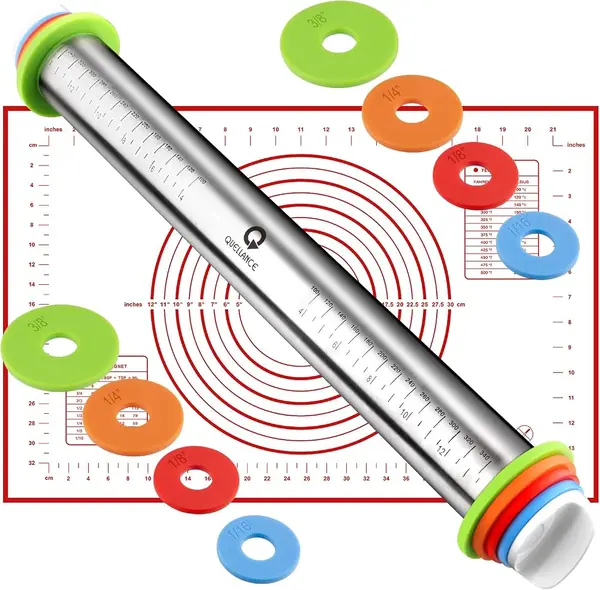
QUELLANCE stainless steel rolling pin with red pastry mat and four thickness rings

Even fondant panels

Bake Score 97/100
Material
430 stainless steel
Pin Length
17 inches
Thickness Rings
Four, 1/16 to 3/8 inch
Included
Printed pastry mat
View on Amazon

Four rings — 1/16, 1/8, 1/4 and 3/8 inch — slide onto the ends of this 17-inch steel pin and hold the barrel at a fixed height. Roll until a ring meets the mat and the fondant underneath is even, with no palm-guessing and no thin edges. That repeatability is why this set sits at the top of our list. Even thickness is the difference between fondant that drapes cleanly over a corner and fondant that leaves a ridge at every one, and it is the part of the job beginners most often get wrong.

The mat that comes with it turned out to matter almost as much as the rings. Measurements printed on the surface let you roll a strip to a set width before you pick up a cutter, and a dedicated surface means you are not fighting a floured counter or chasing parchment that slides. The 17-inch barrel spans a wide panel in one pass, which is the other place short pins fall down: overlap your strokes and you leave a seam exactly where the fondant needs to be strongest.

Stainless steel is the right material for this work. It wipes clean with a damp cloth, it does not hold onto flavors the way wood can, and it stays cool when warm hands are softening a batch. The rings lift off for a plain roll, and at 1.2 pounds the pin feels controlled in the hand rather than tiring over a long session.

Worth Noting

  • Rings stop at 3/8 inch
Our Verdict

We recommend starting with this set: the four rings hold fondant at an even thickness, and the mat gives you a measured, non-stick surface to roll on.

Check Latest Price
2

Wilton 5-Piece Decorating Brush Set Best for Dusting and Painting

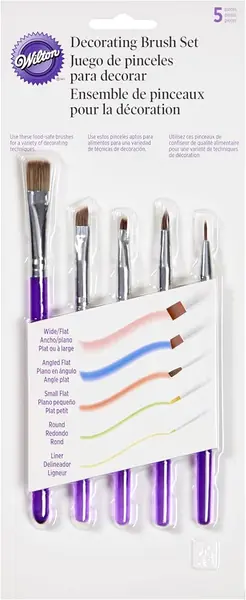
Wilton five-piece food-safe decorating brush set with purple handles and synthetic bristles

Dusting and painting

Bake Score 96/100
Pieces
5 brushes
Color
Purple
Bristles
Soft synthetic
Tip Shapes
Liner, round and flats
View on Amazon

The last thing that happens to a fondant cake is usually the thing people notice: luster worked into the folds of a rose, gold painted along an edge, a soft shadow in the hollow of a petal. All of it is brush work, and this set covers it with five shapes — a liner for fine lines, a round for heavier strokes, and small flat and angled shapes for shading and corners.

Softness is the whole point, and these are the softest bristles in this group. A stiff brush drags powder across a surface; a soft one holds the dust and lets it go where you aim. We rinsed ours between colors under warm water, reshaped the heads with our fingers, and they came back without leaving loose bristles in the sink or on the cake.

The purple handles are less a design choice than a labeling system, and that matters more than it sounds: a brush that has touched acrylic paint is a brush you cannot put back in the icing. Ours live in the cake box, and they are the first thing we hand someone who wants to try dusting for the first time.

Worth Noting

  • Small heads are slow on large panels
Our Verdict

We keep these by the finishing bench: five soft synthetic brushes that pick up luster dust and paint detail without shedding into the icing.

Check Latest Price
3

Kootek 158-Piece Cake Decorating Kit Best Kit for Beginners

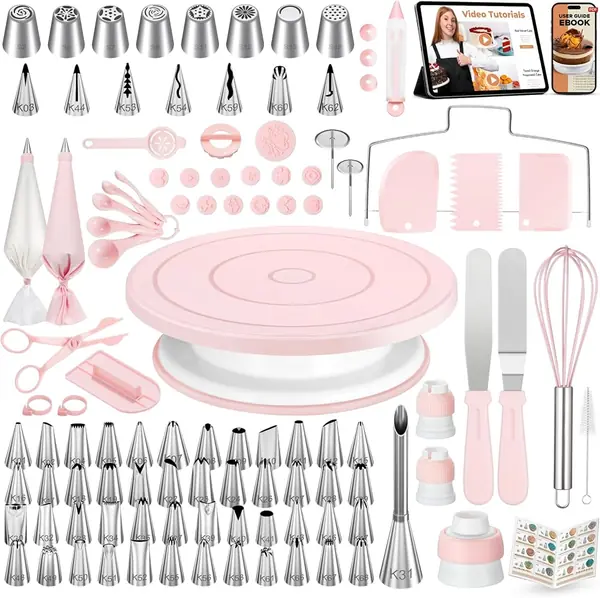
Kootek 158-piece cake decorating kit in light pink with turntable, piping tips and fondant tools

First-time decorators

Bake Score 95/100
Pieces
158
Extras
Pattern chart and e-book
Turntable
11-inch
Fondant Tools
Molds, smoother, cake pen
View on Amazon

A 158-piece kit is really a piping set with a fondant shelf inside it, and that is the honest way to read this one. Nothing in the box is junk, but not all of it is for fondant, and knowing which pieces belong to which job is the difference between a useful purchase and a drawer full of duplicates.

The fondant-specific pieces are easy to name: silicone molds for borders and flowers, a smoother for the top and sides of a covered cake, a cake pen with three interchangeable tops for drawing and dotting, and three scrapers for sharpening an edge. When we cover a cake with this kit, those are the pieces that leave the box.

Everything else is frosting gear — 49 standard tips, 8 Russian, 7 Korean, fifty disposable bags, two reusable ones, couplers, bag ties, flower nails and a lifter. The pattern chart is the surprise: it maps each numbered tip to the shape it produces, which turns a pile of metal cones into something you can plan with.

A dozen pieces carried the fondant work; the rest taught us to pipe. That is a fair trade for someone building both skills at once, and it is the reason we send first-time decorators here rather than to a box of molds alone: you get the turntable, the smoother and a full set of tips without assembling them one order at a time.

Worth Noting

  • Turntable feels light for tiered cakes
Our Verdict

We think it is the most sensible single order for a new decorator: fondant molds, a smoother and a detail pen, plus a full set of numbered piping tips.

Check Latest Price
4

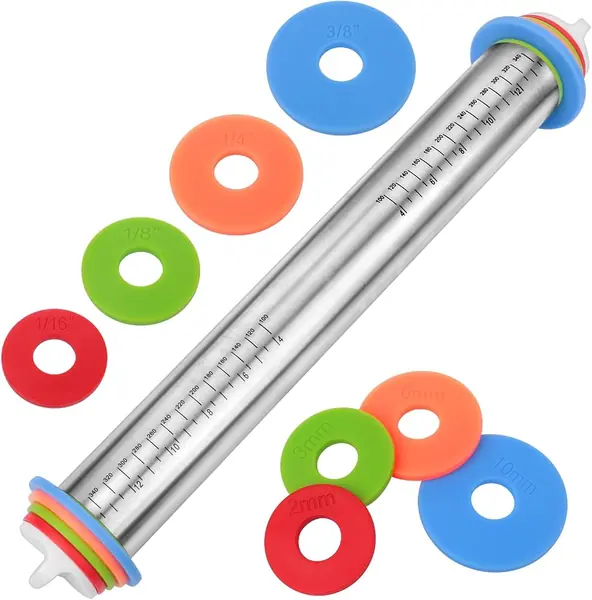
BIDFUL Adjustable Rolling Pin Best Budget Rolling Pin

BIDFUL silver stainless steel adjustable rolling pin with four removable thickness rings

Budget rolling

Bake Score 94/100
Material
Stainless steel
Pin Length
17 inches
Thickness Rings
Four, 1/16 to 3/8 inch
Barrel Width
2.75 inches
View on Amazon

This is the least expensive adjustable pin in this guide, and almost nothing about the specification changes: a 17-inch stainless barrel, four rings at 1/16, 1/8, 1/4 and 3/8 inch, and size markings on both faces so you can read a setting without hunting for your glasses.

What you give up is the mat, and only you know whether that matters. Roll on parchment or a silicone sheet you already own and it does the same job as the pricier sets here: the steel is smooth enough that a stretched panel does not tear, and the rings hold the same height from one end of the barrel to the other. Even pressure still matters, though — the rings set a ceiling, not a guarantee.

Slide the rings off and it becomes an ordinary straight pin for pie dough, cookie dough and pizza, which is why this one stays in reach between cake projects instead of getting buried in the decorating box. For a baker who already owns a silicone mat or a roll of parchment, that is the whole case: the thickness control of the top pick without paying twice for a surface you have.

Worth Noting

  • Sold without a pastry mat
Our Verdict

Our budget pick: the four rings give you the same thickness control as pricier pins, and you can roll on a mat you already own.

Check Latest Price
5

Groupcow Fondant Ball Tool Set Best for Petals and Ruffles

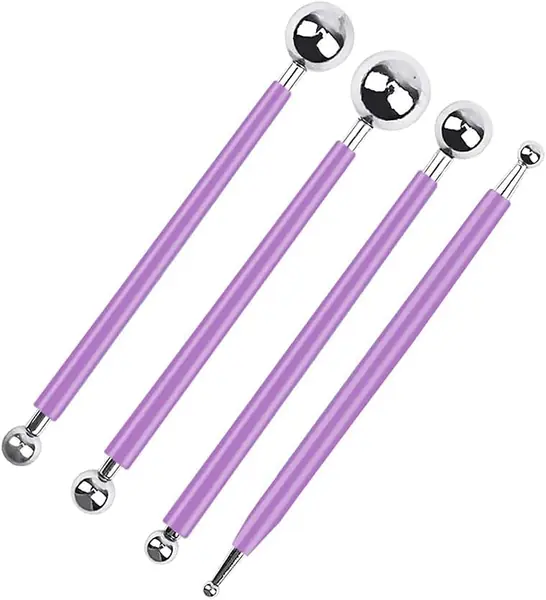
Groupcow four-piece stainless steel ball modeling tool set with purple handles in eight sizes

Flower petals

Bake Score 93/100
Pieces
4 double-ended tools
Heads
Stainless steel
Handles
Purple plastic
Ball Sizes
8
View on Amazon

A ball tool does one thing — presses a smooth curve into fondant — and the difference between a good one and a cheap one is weight. These have it. The heads are solid stainless set into plastic handles, and the heft means the ball sinks into a petal edge under its own momentum instead of needing you to press. That is the difference between a frilled edge that looks rolled and one that looks squashed.

Four double-ended tools give you eight sizes, from a ball small enough for the center of a tiny blossom to one that cups a full rose petal. The middle sizes see the most use in our kit: run one around an edge and the fondant thins into a ruffle; press one into a flower center and you get a hollow that holds while the piece dries.

They wipe clean between colors, which matters when you are moving from deep red to pale ivory in the same sitting, and the handles stay comfortable through a long stretch of petal work. They are also sturdier than the price suggests — the same tools turn up in pottery studios for shaping clay, which tells you how much pressure they take.

Worth Noting

  • Each ball size is fixed to its handle
Our Verdict

We reach for these on every flower: eight steel ball sizes, weighted so the tool thins a petal edge instead of your wrist doing the work.

Check Latest Price
6

Patelai 10-Piece Fondant Brush and Tool Set Best for Brushes Plus Tools

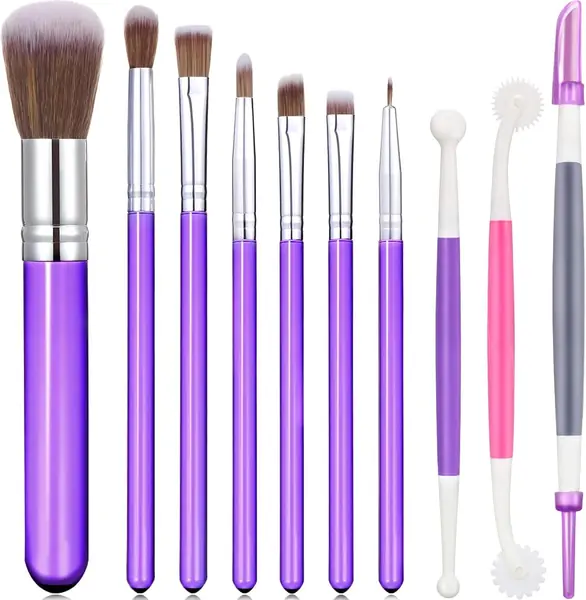
Patelai ten-piece purple food-safe fondant brush set with seven brushes and three modeling tools

Brushes plus tools

Bake Score 92/100
Pieces
10
Material
Plastic and metal
Brushes
7
Shaping Tools
3
View on Amazon

Most brush sets stop at brushes. This one pairs seven with three fondant and gum paste tools, which covers both halves of the finishing job: getting color onto a surface and putting a shape into it. For someone assembling a first fondant kit, that is a useful combination in a single purchase.

The brushes handle wet and dry luster dust, and the distinction matters more than it sounds. Dry dust needs soft, dense bristles to pick up and release; wet color needs a tip that holds a line. The smaller brushes are the ones we reach for most — veining a leaf, edging a petal, painting a thin gold line along the base of a cake.

The three shaping tools are basic, but they are the reason to choose this over a plain brush set: they let you mark and shape a small decoration without buying a separate kit. Between them and the brushes, you can finish a batch of cupcakes, a tray of cookies and a small covered cake without reaching for anything else.

Worth Noting

  • Only three shaping tools in the set
Our Verdict

A practical two-in-one: seven food-safe brushes for dusting and painting, plus three shaping tools for veins and dimples.

Check Latest Price
7

MTNZXZ Rolling Pin and Silicone Mat Set

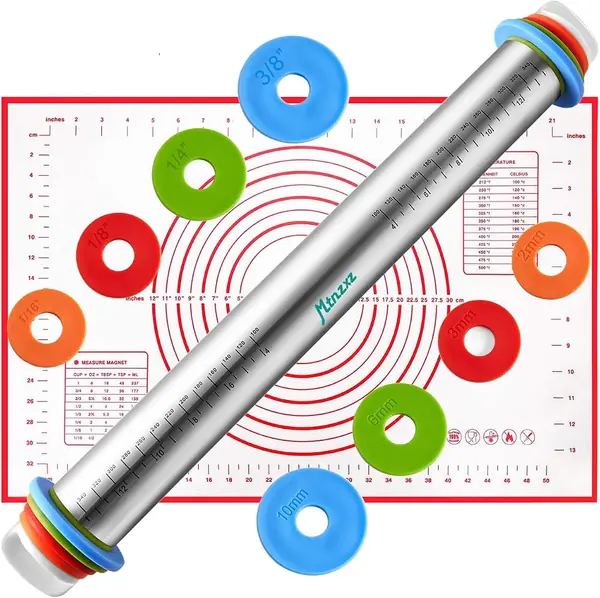
MTNZXZ stainless steel rolling pin with four rings and a large silicone pastry mat

Large mat coverage

Bake Score 91/100
Material
304 stainless steel
Pin Length
17 inches
Thickness Rings
Four, 1/16 to 3/8 inch
Mat
23.6 x 15.7 inches, silicone
View on Amazon

The mat is the reason to choose this set over the other ringed pins here. At 23.6 by 15.7 inches it takes a full cake panel with room to spare, and silicone stays where you put it on a dry counter instead of sliding the way parchment does.

The pin is 304 stainless steel, 17 inches long, with the same four rings as the rest of this group — 1/16, 1/8, 1/4 and 3/8 inch. At about a pound and a half it is heavier than the budget pins, and the mass does some of the rolling for you on a stiff batch.

Steel takes a light hand with sticking: a dusting of cornstarch on the barrel, brushed off before it cakes, keeps a soft batch moving. What we like most is the division of labor — the mat releases a fondant panel cleanly while the pin holds it steady, and that pairing is what sells the set.

Worth Noting

  • Roller ends can work loose
Our Verdict

Buy it for the mat: a large silicone sheet plus a 17-inch ringed pin covers a whole cake panel in one roll.

Check Latest Price

How We Tested Fondant Tools

We started by gathering more than 40 fondant tools and kits — rolling pins, mats, brush sets, ball tools, full starter kits — across a wide range of prices, then cut anything with vague or missing food-safety labeling, pins without adjustable rings, and kits padded with tools nobody actually reaches for. That left 14 pieces and sets, which we used for four months.

Most of the work happened on Saturday afternoons, with a few weeknights folded in before birthdays. Every pin rolled the same batch of fondant to a target thickness, and we checked each sheet corner to corner to see whether the rings held their setting or crept as we pressed down. Our least experienced tester, who had never covered a cake, used each kit cold, and we noted every point where she had to stop and figure something out.

Adhesion is what ruins a cake, so we pressed fondant onto every mat and lifted it to see whether it held or slid, then rolled on bare counter as a control. Ball tools went into firm fondant to check whether the heads dented or the shafts bent under pressure. For cleaning, we let fondant dry on the tools overnight before hand-washing them, timing how long the crevices took and watching for stains, and we washed each brush five times to see whether bristles ended up in the sink.

How to Choose Fondant Tools

Thickness Is the Whole Job

Fondant is judged on how even it is. A panel rolled to a consistent 1/8 inch drapes over a corner without a ridge; one rolled by eye shows every thick spot once it is on the cake. That is why a ringed pin comes before every other purchase: plastic rings slide over the barrel ends and set the gap between pin and surface, and you roll until the ring makes contact. The four standard settings cover most work, with 1/16 inch for delicate cutouts and petals and 1/8 inch for covering.

The trap is assuming the rings do the work for you. They set a ceiling, not a guarantee. You still press evenly, work from the center out, and stop the moment a ring touches down. Start with a lump thicker than your target and reduce it in passes rather than bearing down on the first one.

Steel, Wood, or Plastic

Stainless steel is the safest default for fondant. It is non-porous, so it does not take on flavor or hold moisture, it wipes clean with a damp cloth, and a cool barrel helps when body heat is softening a batch under your hands. Wood is warmer and needs seasoning and hand washing; a wooden pin you already own will roll fondant, but it can grab a sticky batch.

Plastic pins are light and cheap, and the stubby ones bundled into starter kits are usually too short to span a cake panel. Measure any pin against your largest cake board before you count on it.

The Surface Underneath

A mat with printed measurements does two jobs: it keeps fondant off the counter, and it lets you roll a strip to a set width before you cut it. Silicone is the practical choice because it grips a dry counter and rinses clean. Size matters more than most shoppers expect: a mat smaller than your biggest cake panel means overlapping strokes and a seam in the middle of the piece you are trying to keep seamless.

If you skip the mat, parchment works, but tape it down or it will travel with the pin.

The Small Tools Earn Their Keep

Once the fondant is rolled, the work is shaping: thinning a petal edge with a ball tool, sharpening a corner with a smoother, cutting a clean line with a wheel or a cutter. Buy by frequency, not by count. A smoother and a set of ball tools get used on nearly every project; novelty presses sit in the drawer.

The same cake decorating tools work for gum paste and marzipan, so it pays to check two things before buying: that a smoother is wide enough to run down the side of a tiered cake, and that modeling tools are stiff enough not to bend under pressure.

Kits Versus Singles

A large kit looks like the efficient way in, but count how much of it is actually fondant gear. In most big sets the molds, smoother and detail tools are a small slice of a box dominated by piping tips and bags. That is worth it if you are learning both skills, and wasteful if you already pipe and only want to cover a cake.

Our approach: buy the pin and mat as a set, then add the two or three shaping tools your projects keep asking for. You end up with less in the drawer and more of what you use.

Frequently Asked Questions

Final Verdict

Buy the QUELLANCE rolling pin and mat set first. The rings plus a measured surface fix the part of fondant work that most often goes wrong, and one order covers rolling, strip cutting and a clean work area. Add the Wilton brushes when you start dusting and painting, and the Groupcow ball tools when flowers enter the plan.

If you are outfitting a kitchen from scratch and plan to pipe as well as cover cakes, the Kootek kit is the one order that covers both. If you already own a mat, the BIDFUL pin gives you the same thickness control for less.