The 7 Best Grain Mills for Flour of 2026

Whole-grain flour is a perishable food pretending to be a pantry staple. The oils in the germ go stale within weeks of milling, which is why bagged supermarket flour tastes so flat next to a loaf made from grain you ground an hour ago. A grain mill fixes that on your own counter, in whatever amount you'll actually use.

The machines themselves differ wildly: heavy stone mills that turn slowly and stay cool, high-speed impact mills that pulverize grain in seconds, hand cranks that cost nothing to run and everything in elbow grease, and mixer attachments that put a stand mixer you already own to work. We milled with nine of them, and the gaps showed up in the first batch — grind consistency, kitchen noise, and how much flour lands on the counter instead of in the bowl.

One thing nobody tells first-time buyers: most home mills want fully dry, low-oil grain, so oily seeds gum up the burrs, and a machine advertising a hundred uses is usually best at wheat.

Our Top Picks

The Best Grain Mills for Flour

1

NutriMill Classic Grain Mill Best Overall
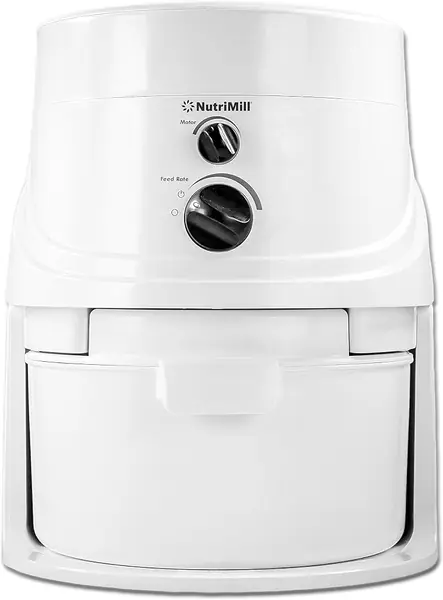
NutriMill Classic white electric grain mill with hopper and flour canister

Weekly bread baking

Bake Score 93/100
Motor
1200 watts
Warranty
Limited lifetime
Throughput
5 cups per minute
Milling Heads
Stainless steel impact
View on Amazon

Five cups of flour per minute is the figure that makes the NutriMill Classic the default here for weekly bread bakers. The 1200-watt motor and stainless steel impact heads are built for hard wheat, and the limited lifetime warranty is the kind of backup we want on a machine that runs this hard. The hopper extension also gives you room to keep a full bake moving without stopping to refill.

We found the texture control easy to trust, with a range that moves from fine bread flour to a coarser meal without a lot of guesswork. The impact heads are the reason it can handle both hard and soft wheat, and the grind stays consistent enough for everyday loaves. It is a fast, direct mill rather than a delicate one, which suits the way most home bakers actually work.

The Classic is loud. High-speed impact milling is not a quiet process, and this mill is no exception, so plan to grind before the house wakes up or after the phone call ends. That is the main compromise, and it is a fair one for the speed and warranty. What keeps it at the top is the combination: a broad texture range, hard-wheat capability, and a warranty that makes the purchase feel less like a gamble.

Worth Noting

  • Flour can cling inside the canister
Our Verdict

For weekly bread baking, the NutriMill Classic is the electric mill we recommend first: it grinds fast, handles hard wheat, and carries a limited lifetime warranty.

Check Latest Price
2

NutriMill Harvest Grain Mill Best Stone-Ground

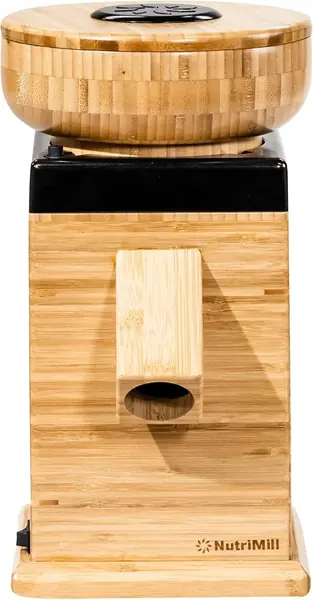
NutriMill Harvest black stone grain mill with bamboo trim and hopper

Stone-ground pastry flour

Bake Score 91/100
Motor
450 watts
Grind Control
Texture control knob
Certification
CSA listed
Milling Stones
Corundum
View on Amazon

Stone burrs are the reason to choose the NutriMill Harvest over the impact mills here. The corundum stones turn grain into flour with a texture knob that moves from pastry flour to coarse meal, and the black body with bamboo trim is handsome enough to leave out between bakes. We like that combination for a baker who wants the mill to feel like part of the kitchen rather than an appliance to hide.

The 450-watt motor is paired with a texture knob that is easy to set by feel, which matters when you switch between soft wheat and coarser grains. The stone burrs give you a wider range than the impact mills, and the grind stays consistent enough for pastry and everyday loaves. We appreciate that the controls are simple rather than fussy; you turn the knob, feed the grain, and check the flour.

What we appreciate most is the flexibility. The Harvest can move from fine pastry flour to a coarse cereal grind without changing setups, and the grind stays cool enough for delicate baked goods. That range is why it earns a place next to a faster mill. It is a countertop tool for someone who wants stone-ground texture and does not need the fastest possible batch.

Worth Noting

  • Loud motor for a countertop appliance
  • Slower than high-speed impact mills
Our Verdict

We pick the NutriMill Harvest for stone-ground bakers: its corundum stones and texture knob make pastry flour easy, and it looks good enough to leave out.

Check Latest Price
3

Lehman's Manual Grain Mill Best Manual

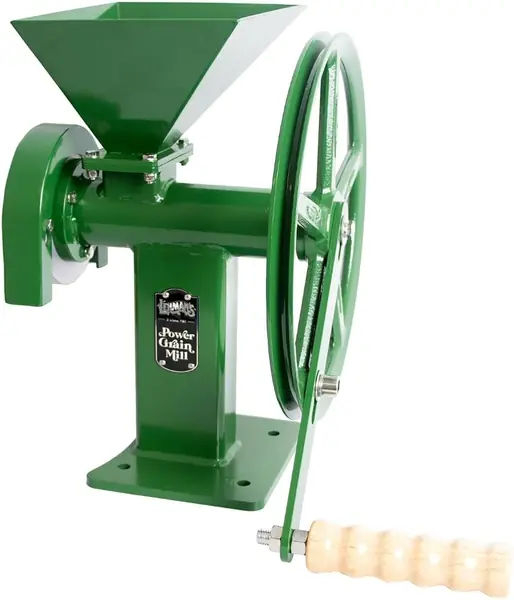
Lehman's green manual grain mill with large flywheel and six-cup hopper

Off-grid hand milling

Bake Score 88/100
Power
Manual
Burrs
Polished stainless steel
Hopper
6 cups
Flywheel
12-inch V-belt
View on Amazon

A 12-inch V-belt flywheel is the detail that makes the Lehman's worth considering when you want to grind by hand. The flywheel carries momentum through each turn, and the six-cup hopper means fewer refills than the small hand mills here. We also like the pre-drilled base, because a manual mill that shifts on the counter is miserable to use.

The stainless steel burrs are electrolytically polished and rated for dry grains from wheat to quinoa, and the mill can be motorized later if you want to take the crank out of the equation. We appreciate that kind of flexibility: it is a hand mill now and a different tool later, without replacing the whole machine. The cast iron build also feels like something you can keep repairing rather than replace.

We think the Lehman's is the right manual mill for a homesteader or a baker who wants a quiet, deliberate grind. It is a mill for someone who wants to be involved in the process, not one who wants to press a button. The hand crank is honest work, and the reward is flour you made at your own pace.

Worth Noting

  • Heavy at 26 pounds
  • May need multiple passes for pastry flour
Our Verdict

The Lehman's is our manual pick for off-grid or small-batch baking: a big flywheel and stainless burrs make hand-cranking easier, though it is a workout.

Check Latest Price
4

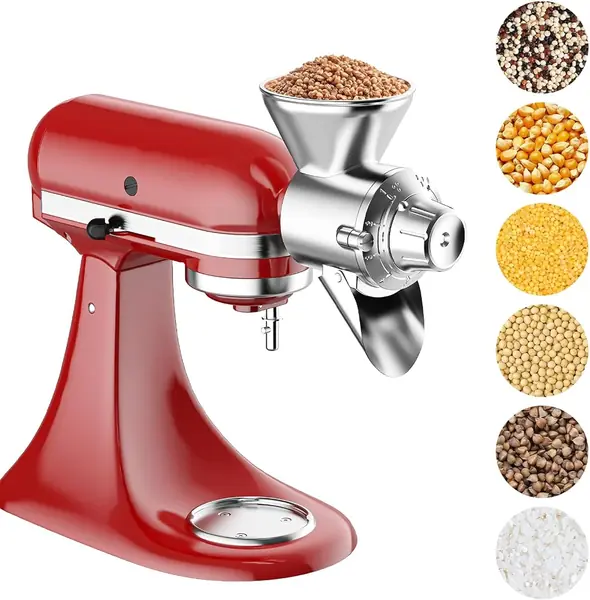
HOZODO Grain Mill Attachment Best for KitchenAid Owners

HOZODO silver aluminum grain mill attachment for KitchenAid stand mixers

KitchenAid small batches

Bake Score 87/100
Weight
2.6 lb
Material
Die-cast aluminum
Compatibility
KitchenAid stand mixers
Grind Settings
9
View on Amazon

The case for the HOZODO attachment is simple: you already have the motor, so you are buying the milling head rather than a whole appliance. It fits the KitchenAid power port, offers nine grind settings, and weighs only 2.6 pounds, which makes it easy to store between uses. For a small batch of flour for pancakes or a single loaf, that is a sensible way to start.

We like the removable grinding chamber. The cleaning tool is part of the design, not an afterthought; you brush out the chamber rather than washing it, and the removable parts make that job shorter. The nine settings start at coarse and work toward fine, and the mill is meant for fully dry, low-moisture grains. It is a simple attachment to fit and remove, which matters if your mixer lives on the counter.

We reach for this one when we want a cup or two of fresh flour without hauling out a dedicated mill. The KitchenAid motor does the work, and the attachment stores in a drawer. It is a gateway tool for someone curious about fresh flour, and it earns its place by making the first step inexpensive and uncomplicated.

Worth Noting

  • Mixer body warms during long runs
  • Not for high-volume bread baking
Our Verdict

If you already own a KitchenAid stand mixer, we recommend the HOZODO attachment as the budget route to small batches; it fits the power port, stores easily, and cleans with a brush.

Check Latest Price
5

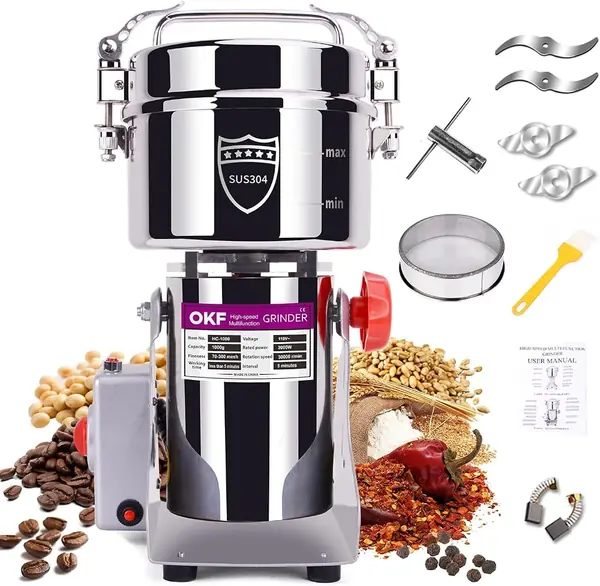
OKF 1000g Grain Mill Best Budget Electric

OKF stainless steel 1000g grain mill with covered grinding bin

Budget electric batches

Bake Score 86/100
Motor
3000 watts
Material
304 stainless steel
Capacity
2.2 lb
Grind Control
Timer
View on Amazon

A 3000-watt motor and a timer are the two features that make the OKF stand out here. You load the stainless bin, set the time, and the mill turns dry grain into flour in a burst rather than a long grind. We like that for small batches of rice flour, corn flour, or wheat for a single bake. The 304 stainless steel bin also feels more substantial than the price tier suggests.

We found the timer control simple, and the stainless bin is easy to load and empty. The mill is meant for dry ingredients, and the instructions give short time windows for grains, spices, and herbs. That makes it a different kind of tool from a stone or impact mill: you learn by watching the clock and checking the flour at the end.

What we appreciate is the simplicity: load, set, and check the flour. It is a fast, compact electric option for a baker who wants to experiment without committing to a larger mill. The 1000 g capacity is generous for the class, and the timer makes repeatable batches possible. It is a practical first electric mill for small, quick jobs.

Worth Noting

  • Fineness depends on timing, not a dial
  • Short timed runs, not continuous milling
Our Verdict

The OKF is the budget electric mill we recommend for fast, timed batches; its 3000-watt motor turns dry grain into flour quickly, but it is not a stone mill.

Check Latest Price
6

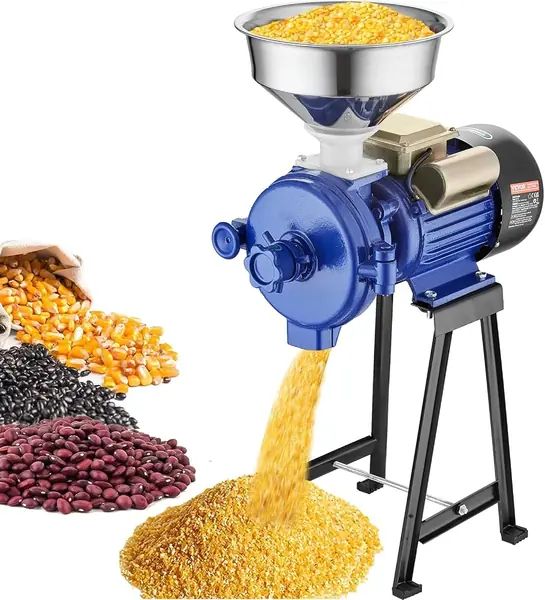
VEVOR Electric Grain Mill Best for High-Volume Grinding

VEVOR blue electric grain mill with cast iron stand and funnel hopper

High-volume grinding

Bake Score 85/100
Motor
3000 watts
Weight
46.7 lb
Capacity
1.1 lb
Grinding Plates
Cast iron
View on Amazon

The VEVOR is built like a piece of shop equipment: cast iron, a 3000-watt motor, and a funnel hopper for bulk feeding. The cast iron plates are meant for long runs rather than a single loaf, and the frame is designed to stay put while the auger works. This is a machine you plan around, not one you tuck into a cabinet.

We like the adjustable thickness control. It moves from coarse meal to fine powder, and the funnel hopper is easier to keep fed than a small six-cup hopper when you are working through a large batch. The 500 g capacity is smaller than the motor suggests, so you will still feed it in batches, but the grind itself is quick. The cast iron build feels like it can take a real workload.

The 3000-watt motor is the reason to consider it over the smaller electric mills here. It is fast on corn, wheat, rice, and other dry crops, and the adjustable plates give you control over the final texture. This is a small-production machine that happens to be sold for the home, and that is exactly how we think of it.

We think the VEVOR is the right choice for a homesteader or a small bakery that grinds sacks of grain and has a permanent spot for a heavy machine. For a home baker who bakes once a week, it is more machine than the job requires. The people who get the most from it are the ones who already know they need bulk capacity.

Worth Noting

  • Very heavy and tall for a home kitchen
Our Verdict

We see the VEVOR as a high-volume tool for a homesteader or small bakery: its 3000-watt motor and cast iron plates are built for bulk dry grain.

Check Latest Price
7

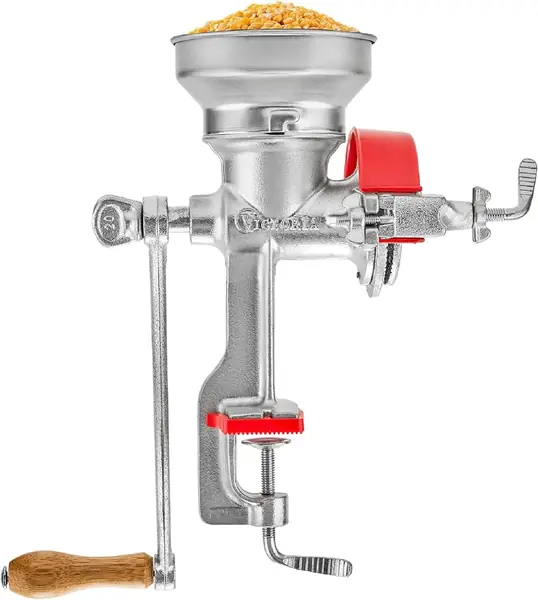
Victoria Manual Grain Mill Best for Coarse Corn Grinding

Victoria red and silver cast iron manual grain mill with low hopper

Coarse corn grinding

Bake Score 84/100
Weight
9.4 lb
Material
Cast iron
Power
Manual
Clamp Range
1/2 to 2 inches
View on Amazon

The Victoria looks like the molino para moler maiz that has been clamped to kitchen tables for generations: cast iron, a wooden crank handle, and a low hopper that leaves room for a bowl underneath. It clamps to counters from 1/2 to 2 inches thick, and the white iron discs adjust for coarse or fine grinding. We like it for cornbread, masa, and cracked grains, where its sturdy build makes sense.

The hand crank sets the pace, and the cast iron body feels substantial at 9.4 pounds. The low hopper is easy to load with a scoop, and there is no motor to overheat and no cord to manage. We appreciate that simplicity: this is a mill you can use on a porch or during a power outage, and it stores without much fuss.

What we appreciate is the simplicity of the whole setup. The parts come apart for cleaning, and the cast iron body feels like a tool that will outlast a plastic appliance. It is a legacy-style mill, and it rewards a cook who wants hands-on corn grinding rather than a motorized shortcut. For coarse meal and traditional recipes, that is the point.

Worth Noting

  • Clamp can slip on some counter edges
Our Verdict

The Victoria is a traditional molino for corn, masa, and coarse meal, not a fine-flour mill for wheat bread; we recommend it for sturdy cast iron at a budget price.

Check Latest Price

How We Tested the Grain Mills

We started by gathering every mill a home baker might realistically buy, then sorted them by how they actually reduce grain — stone burr, steel impact, manual crank, and stand-mixer attachment — along with price, hopper capacity, and how fine the grind adjustment goes. That list got cut down to nine, enough to cover each type and each price band without wasting anyone's wheat berries.

Testing ran for eight months in our own kitchens, folded into regular bread baking rather than isolated on a lab bench. Every mill ground the same pound of hard white wheat berries at medium, fine, and coarse settings; I timed each pass, watched the flour come out, and sifted a cup from every batch through a fine sieve to see what stayed behind. A decibel meter sat at arm's length for the loudest run, and I weighed the output against the input to see how much flour we actually got back.

Mess and mounting got their own sessions. After each grind I checked the counter for a dust ring, felt whether flour clung to the spout with static, and noted whether the machine walked or stayed planted; the hand mills and clamp-on models were bolted to a butcher block and cranked until my arms ached. Cleaning counted too — how many parts came apart, whether flour packed into corners, and whether the hopper could be filled without a funnel. For durability, we ran back-to-back batches and checked the housing and the flour for heat, then watched whether the grind drifted coarser after months of weekly use.

Every comparison stayed on fully dry wheat, corn, millet, and rice so the results were fair. Anything oily got ground separately, and we noted exactly what it left behind in the burrs.

How to Choose a Grain Mill for Flour

Start With the Milling Mechanism

Impact mills spin fast and produce bread flour quickly, which is why the NutriMill Classic is our default for weekly loaves. Stone mills turn more slowly and give you a wider texture range for pastry flour and coarse meal, as the Harvest does. Manual burr mills are the quiet, off-grid option, while stand-mixer attachments borrow a motor you already own. Decide first whether you want speed, texture control, or a small footprint; that choice matters more than the wattage printed on the box.

Match the Power Source to Your Batch Size

For a weekly bread baker, a standalone electric mill is the least frustrating choice: it has the hopper and throughput to keep up with a full bake. An attachment such as the HOZODO makes sense if you already own a KitchenAid and grind a cup or two at a time. A manual mill like the Lehman's suits small batches, off-grid use, or a baker who wants quiet. If you choose manual, check the mounting first; the mill needs a secure counter edge or bolt-down spot.

Look at Hopper, Weight, and Counter Space

Throughput and capacity are different numbers. A mill rated at five cups per minute can still have a small hopper, so you may spend more time refilling than grinding. Check the assembled height and weight before you choose a permanent spot; the VEVOR is a 46.7-pound heavy-bench machine, while the Harvest is a countertop mill. Measure the cabinet clearance above the hopper, not just the footprint, and leave room for the flour canister or bowl.

Plan for Noise, Heat, and Cleanup

High-speed impact mills are loud, and the harder the grain, the more you notice it. Stand-mixer attachments can warm the mixer body during long runs, so keep batches modest and let the machine rest. Cleaning is usually a brush-and-vacuum job rather than a soap-and-water one; water in the grinding chamber is a mistake. Ask before buying how the chamber comes apart, because a mill that is fussy to clean is one you stop using.

Do Not Assume a Fine Setting Makes Fine Flour

The finest setting is a starting point, not a guarantee. Hard wheat, coarse burrs, and a fast feed rate can all leave bran or grit that needs a second pass. If you want pastry flour, look for a mill with a wide texture range and a texture control that can be set fine, and be prepared to sift. Before you commit to an attachment, check whether it is meant for the grains you bake with; low-moisture, low-oil grains are the safe default.

Frequently Asked Questions

Final Verdict

Start with the NutriMill Classic if you bake bread most weeks. It has the speed, hard-wheat capability, and warranty support we want from a do-it-all electric mill, and it remains our default recommendation. Choose the Harvest when stone-ground texture and countertop looks matter more than speed, the Lehman's when you want a manual mill that can be motorized later, and the HOZODO when you already own a KitchenAid and grind small batches. The Victoria is a different tool: a traditional molino for corn and coarse meal.