The 4 Best Heavy-Duty Hand Mixers of 2026

A hand mixer only has to fail once. It's always the same moment: the dough is stiff, the beaters are buried, and the motor starts to smell like hot plastic. That's when someone decides they need a heavy-duty one — and what they need is torque that doesn't fade as the dough thickens, a slow speed that doesn't spray flour across the counter, and a beater release button that works with butter-slick hands.

I've killed two cheap mixers that way, both at the last cup of flour. So we ran 12 heavy-duty models through weekly baking, from loose cake batter to cookie dough stiff enough to fight back. Here's what nobody tells a first-time buyer: the wattage printed on the box is the least useful number on it.

Gearing and beater shape decide whether a mixer plows through or stalls, and low-speed control is what keeps your counter clean. We paid attention to storage too — a snap-on case or bag you can actually find in a drawer beats a loose whisk rattling around with the spatulas.

Our Top Picks

The Best Heavy-Duty Hand Mixers

1

CBQ 9-Speed Hand Mixer Best Overall
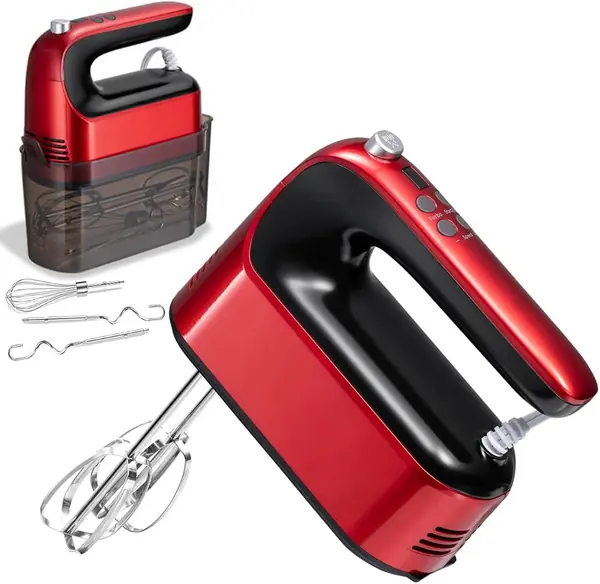
CBQ red 9-speed hand mixer with stainless steel beaters and storage case

Heavy home baking

Bake Score 91/100
Motor
400W DC
Speeds
9 plus turbo
Warranty
12 months
Attachments
Five stainless steel attachments
View on Amazon

Low-speed control is the feature that makes the CBQ our top pick. The soft-start, nine-speed touch control lets you add flour without a white cloud rising out of the bowl, then step up to a steady mix. For heavy-duty baking, that low end matters as much as the top end, and it is the part that separates a controlled mixer from a splashy one.

The 400W DC motor is not the biggest number in this group, but it delivers the kind of steady torque that keeps cookie dough and dense cake batter moving. We never felt the need to baby it through a thick batch, and the digital touch panel makes the nine speeds easy to repeat from one bake to the next. It is a more controlled experience than the high-wattage models that jump straight to a fast whir.

Five stainless steel attachments cover the basics: two flat beaters, two dough hooks, and a whisk. The snap-on storage case holds the mixer and all five pieces, which is the difference between keeping it on the counter and burying it in a cabinet. It is a genuinely useful set for cookies, cakes, and egg whites, not a box of duplicates.

What seals it for us is the balance of control and power. The CBQ is not the budget pick in this group, but it is the one we reach for when a recipe calls for a stiff dough and we do not want to haul out a stand mixer. It is the mixer we trust to finish a heavy batch without a fight.

Worth Noting

  • Attachment holder can feel loose when carried
  • Shorter warranty than some rivals
Our Verdict

We recommend the CBQ for heavy home baking because its low-speed control and steady 400W DC motor handle dense dough without the splashy starts that make hand mixers frustrating.

Check Latest Price
2

Braun MultiMix 5 Best for One-Handed Control

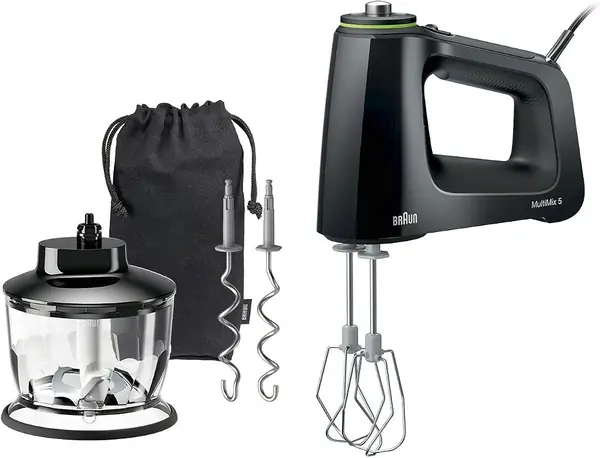
Braun MultiMix 5 black hand mixer with multi-whisk and dough hooks

One-handed control

Bake Score 88/100
Motor
350W
Speeds
9 plus turbo
Warranty
3 years
Attachments
Multi-whisk, dough hooks, chopper
View on Amazon

The motor sits in line with the beaters instead of above them, so the mass drops toward the bowl rather than fighting your wrist. That is the design decision that changes how the Braun feels in the hand. We found it makes long mixing sessions less tiring, especially when you are holding the mixer with one hand and scraping the bowl with the other.

The 350W rating looks modest next to the 500W and 660W models here, but the SmartMix gearing and nine speeds plus turbo give it more usable range than the number suggests. The VarioControl thumb dial is the feature we kept coming back to: you can slow down or speed up without moving your grip, which is exactly what you want when a dough tightens up. It handled stiff dough and meringue without the frantic, splashy start that makes hand mixing frustrating.

The attachment set is more versatile than most. The multi-whisk does the work of a whisk and beater, the dough hooks are sturdy enough for heavy dough, and the chopper turns the mixer into a small food processor for nuts and vegetables. The three-year warranty is also one of the longest in this group. It is a more complete package than the spec sheet alone suggests.

For a baker with wrist pain who still wants to mix a weekly batch of dough, this is the one we hand over without hesitation. It is the most comfortable mixer here to use one-handed, and that comfort is the reason it stays on the counter.

Worth Noting

  • Beaters can feel less sturdy than the body
  • Premium price
Our Verdict

We recommend the Braun MultiMix 5 for bakers who want precise one-handed control and a comfortable, low-effort mix, especially for stiff dough and meringue.

Check Latest Price
3

Lord Eagle DC-420 Best Digital Display

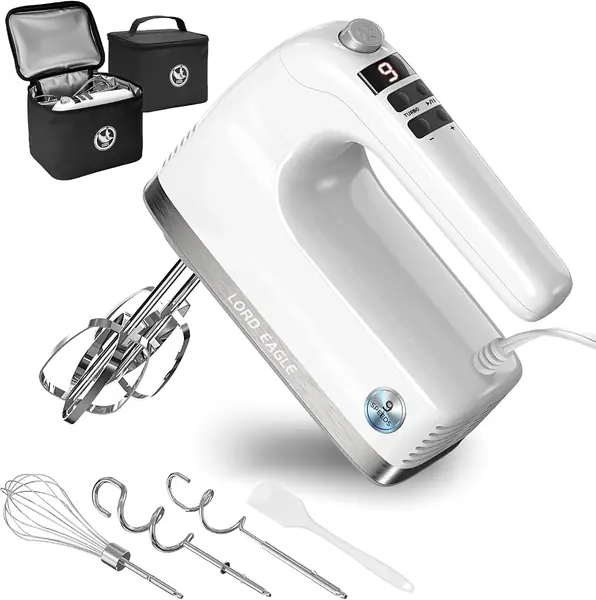
Lord Eagle DC-420 white digital hand mixer with stainless steel attachments

Digital speed control

Bake Score 87/100
Motor
500W DC
Speeds
9 plus turbo
Warranty
1.5 years
Attachments
Five stainless steel attachments plus spatula
View on Amazon

A digital speed readout on a hand mixer sounds like a gimmick until you are trying to repeat a recipe. The screen shows the speed you are in, and the nine-setting touch control plus turbo gives you a clear ladder from a gentle stir to a fast whip. We like that kind of feedback in a category where most controls are unmarked buttons.

The 500W DC motor has enough torque for cookie dough and cake batter, and the nine speeds give you a gentle first setting for dry ingredients. The 50dB rating is quiet for a hand mixer, too. The five stainless steel attachments and silicone spatula cover mixing, kneading, and scraping, and the storage bag keeps the set together without demanding a whole cabinet shelf.

The touch buttons take a light press and are easy to read at a glance, which makes it simple to adjust without looking away from the bowl. The compact body also tucks into a cabinet without a fight. For a mixer with this much power, it is a tidy package.

Worth Noting

  • Eject button can take a firm press
  • Motor can heat up on large, dense batches
Our Verdict

We recommend the Lord Eagle DC-420 for bakers who want a clear digital speed readout and a compact, easy-to-store mixer with enough power for everyday dough.

Check Latest Price
4

NARIIK Hand Mixer Best for Budget Heavy Mixing

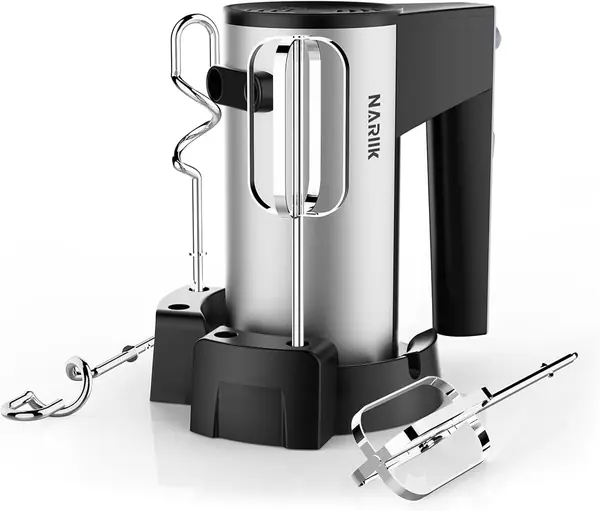
NARIIK black 660W hand mixer with beaters, dough hooks, and storage base

Budget heavy mixing

Bake Score 78/100
Motor
660W
Speeds
5 plus turbo
Warranty
3 years
Attachments
2 beaters, 2 dough hooks
View on Amazon

A 660W motor and a turbo button at the budget end of the group is the combination that makes the NARIIK worth a look. Five speeds cover the basics, and the body stays compact on the counter. For a mixer at the low end of this group, it does not feel like a stripped-down toy.

The motor has enough punch for cookie dough and dense cake batter, and the turbo burst helps when you need a little more speed at the end of a mix. The one-click eject is a welcome convenience, and the attachments are dishwasher-safe. We also like the three-year warranty, which is a longer commitment than the top pick's coverage.

The storage base is the feature that makes it easy to live with: the beaters and hooks stand upright instead of rolling around a drawer, and the whole thing stays compact on the counter. The body has a solid feel without being clumsy, and the slide control falls naturally under your thumb. It is not the mixer we reach for when a stiff double batch of bread dough is on the counter, but for a big tray of cookies or a dense cake, it is a sensible budget choice.

Worth Noting

  • Five speeds offer less fine control
  • No whisk attachment
Our Verdict

We recommend the NARIIK as a budget pick for occasional heavy batches, thanks to its 660W motor, upright storage base, and three-year warranty.

Check Latest Price

How We Picked and Tested These Hand Mixers

We built the shortlist from store listings and customer reviews, then filtered hard: metal beaters and whisks, a documented low-speed setting, and some kind of onboard storage. Anything marketed purely on wattage got set aside unless the reviews backed it up with real dough work. That left 12 mixers, which we ran for eight months.

Most of the testing happened where these actually live — a home kitchen on a weeknight, and a Saturday morning pancake batter. We made at least four batches of stiff cookie dough per mixer, timing how long cold butter took to go creamy and stopping every few minutes to feel the housing with the back of a hand. We watched whether the beaters walked up the shaft, whether the lowest speed still threw flour, and whether turbo added torque or just noise.

Then came the messy part: ejecting beaters with butter on our fingers, running the attachments through the dishwasher a dozen times to see what spotted or dulled, and packing a whisk back into its case while our hands were still sticky. Storage got its own round — snapping cases on and off, then trying to fit the whole thing into a drawer next to the spatulas. Reliability showed up in small things, like a button that needed two presses. Whipped cream and egg whites came last, since that's where a heavy mixer can feel like overkill; we timed how long each took to reach stiff peaks and whether we could hold it one-handed the whole way.

How to Choose a Heavy-Duty Hand Mixer

Look at Rated Power, Not Peak Wattage

Peak wattage is a burst number, and it can make a modest mixer look stronger than it is. The rated wattage is the better starting point, along with the motor type: a 400W DC motor can feel more controlled than a higher-wattage AC motor because it holds torque as the dough thickens. We pay more attention to how a mixer behaves at the low end than to the biggest number on the box. A peak figure can be several times the rated wattage, and that is not a heavy-duty tool for stiff bread dough.

Start with rated watts, then look for a motor description that mentions torque or a DC design. The CBQ's 400W DC motor and the NARIIK's 660W motor are different approaches, but both are built for more than a light cake batter. A handheld mixer with a strong motor can handle more than cake batter, but if the listing only gives a peak figure and no rated wattage, treat the power claim cautiously.

Prioritize Low-Speed Control

Heavy dough is not just about high power; it is about controlling the power. A mixer that starts too fast will throw flour out of the bowl before the dough comes together, and a lowest speed that is still a whirl is a daily annoyance. Soft start and a genuinely slow first setting are the features that make a hand mixer pleasant for thick cookie dough and dense batters.

Nine speeds are not automatically better than five, but a wider range usually gives you a more useful slow end. The CBQ has nine speeds and a soft start, and the Braun's thumb dial lets you adjust speed without moving your hand. If you bake a lot of dry-ingredient-heavy recipes, test the lowest speed first.

Check the Attachments and Storage

For heavy mixing, the dough hooks matter as much as the motor. Look for two sturdy hooks, two beaters, and a whisk if you make meringue or whipped cream. Stainless steel is easier to clean and less likely to bend than coated or plastic attachments. A storage case is not a luxury in a small kitchen: loose beaters disappear, and a mixer that is awkward to put away stops getting used.

The Braun's chopper adds a second job, while the NARIIK's base keeps the beaters upright but does not include a whisk. Check what is actually in the box before you buy, especially if you bake egg-white recipes. A case that holds the cord as well as the attachments is worth more than one that only holds the beaters.

Weigh Balance and Cleanup

A heavy mixer is not automatically a tiring one. Motor placement changes everything: an in-line design like the Braun's drops the weight toward the bowl, while a conventional upright body puts more mass above your wrist. If you have hand or wrist pain, that difference matters more than a fraction of a pound. Hold the mixer if you can, or look for an in-line motor and an ergonomic handle.

Cleanup is the other daily cost. A one-touch eject button should release the attachments without a fight, and the beaters and hooks should be dishwasher-safe. Wipe the motor body with a damp cloth and keep the cord away from the beaters. The easier the mixer is to clean and store, the more often you will use it for a small batch instead of defaulting to a stand mixer.

Plan for Durability and Warranty

Heavy-duty use puts stress on the motor, the gears, and the point where the beaters lock in. Metal attachments, overheat protection, and a clear warranty are the details that separate a mixer built for thick dough from one that only looks the part. A longer warranty is not a guarantee, but it is a useful signal of how much confidence the maker has in the product.

The Braun and NARIIK both carry three-year warranties, which is a meaningful advantage for heavy use. Whichever you choose, give the motor a break between stiff batches, and stop if the body gets hot or the beaters start to loosen. Register the warranty as soon as the mixer arrives.

Frequently Asked Questions

Final Verdict

The CBQ is our top pick because it pairs a genuinely useful low speed with enough torque for thick cookie dough and dense cake batters, and it keeps five attachments in one case. If wrist fatigue is your main concern, the Braun MultiMix 5's in-line motor and thumb dial are worth the premium. For the most power per dollar, the NARIIK's 660W motor and three-year warranty make it the budget choice.