The 7 Best Liquid Measuring Cups of 2026

The worst part of measuring a cup of milk isn't the measuring — it's the crouch. You set the cup on the counter, drop down to eye level, squint at the line, and second-guess yourself anyway. A good liquid measuring cup quietly removes that whole ritual: markings you can trust from where you're already standing, a spout that doesn't send a stream down the outside of the cup, and a handle that doesn't flex when the thing is full.

We cooked and baked our way through 15 of them — glass, plastic, stainless steel, and silicone, from 1-cup sizes up to 8 cups — and the differences really do come down to two things: how the markings are applied and how the cup behaves when it's loaded. Printed lines on plastic look crisp in the store and start ghosting around the tenth dishwasher run, while markings fused into the glass or molded through the wall keep going for years. Multiple scales matter more than I expected, too. Chasing a metric measurement in a recipe is a lot less annoying when you don't have to do math at the counter.

The other fork in the road is sets versus singles. A graduated set covers everything from a splash of vinegar to a whole batch of stock, but it takes up drawer space, and one chip can sideline the size you reach for most. Both approaches and every material worth considering are on the list.

Our Top Picks

The Best Liquid Measuring Cups

1

Pyrex Essentials 3-Pack Best Overall
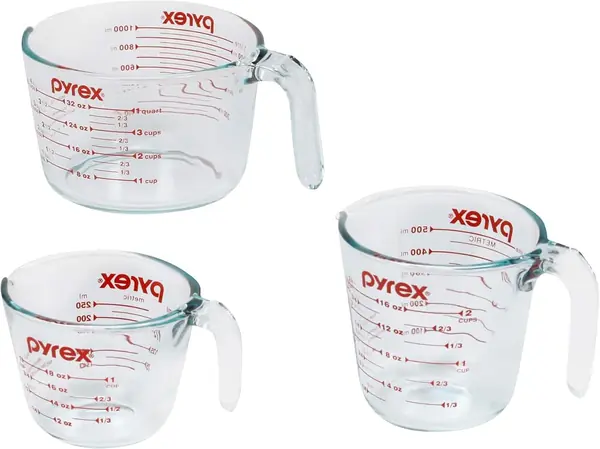
Three clear glass Pyrex measuring cups in 1, 2, and 4 cup sizes, nested, with red markings

All-purpose baking

Bake Score 98/100
Material
Tempered glass
Markings
Red, ounces and milliliters
Heat Use
Microwave, freezer, preheated oven
Sizes
1, 2, and 4 cups
View on Amazon

Nested, the 1-, 2-, and 4-cup cups stake out about the footprint of the largest one, which is the practical argument for buying a set instead of a single cup, and the reason this set is our default for a first kitchen. The 1-cup measures 6 inches across and 4.5 inches high, small enough to crack an egg into and whisk with a fork. The 2-cup takes a box of cake batter. The 4-cup handles a double batch of muffins with room left to stir.

Glass does the heavy lifting. We melt butter in the 1-cup in the microwave, watching it through the side instead of guessing, and the same cup can go into a preheated oven, which is more than most plastic cups can say. The curved spout pours cleanly at a moderate tilt; tip a full 4-cup steeply and the liquid will find the outside of the glass, so pour from the corner and keep the angle shallow.

The markings are bold, red, and dual-unit, with ounces and milliliters on the same face, so a recipe written either way is a non-event. The 2-cup is the one that ends up living on our counter; the other two come out on baking days and go back into the stack.

Worth Noting

  • Red lettering can wear with dishwasher use
Our Verdict

This is the set we point most people toward: three sizes that cover melting, mixing, and pouring, in glass that goes from the microwave to a preheated oven.

Check Latest Price
2

OXO Good Grips 4-Cup Angled Measuring Cup Best for Reading From Above

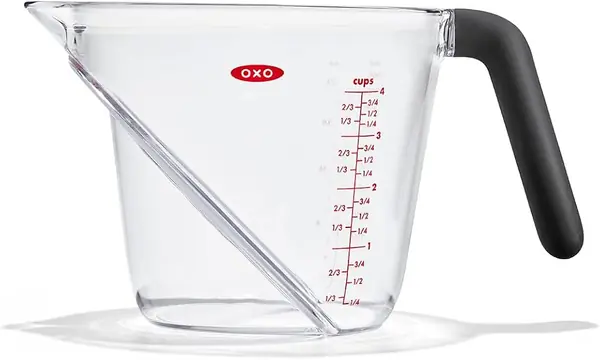
Clear plastic OXO angled measuring cup with a black soft-grip handle and overhead markings

No-bend measuring

Bake Score 97/100
Material
BPA-free Tritan plastic
Capacity
4 cups (32 fl oz)
Cleaning
Dishwasher safe
Markings
Angled, read from above
View on Amazon

The inside of this cup is a ramp. The markings climb an angled face so the level lines up with your eye while the cup sits flat on the counter, and you read it standing up instead of crouching to counter height the way a glass cup makes you do.

That sounds like a small convenience until you are pouring batter with one hand and holding a spatula with the other. The angled face is why we keep this cup in reach for anything going into a narrow opening: the spout is sharp, the handle is a soft non-slip grip that holds in a wet hand, and at 6.4 ounces empty a full four cups does not fight you.

The body is Tritan Renew, a BPA-free plastic made with certified recycled content. It will not shatter the way glass can, but it does scratch, and a scuffed wall makes those angled markings harder to read than they were when new. That is the one part of this design that ages.

It is a single 4-cup cup, so it does one job well rather than three. For a little more money the Pyrex set covers small and large measurements and takes heat; for one cup that reads without bending, this is it.

Worth Noting

  • Handle can break if the cup is dropped
Our Verdict

If you cook with a measuring cup in one hand and a skillet in the other, this is the one we hand you: you read it from above and keep pouring.

Check Latest Price
3

Newness 2-Cup Stainless Steel Measuring Cup Best Unbreakable Pick

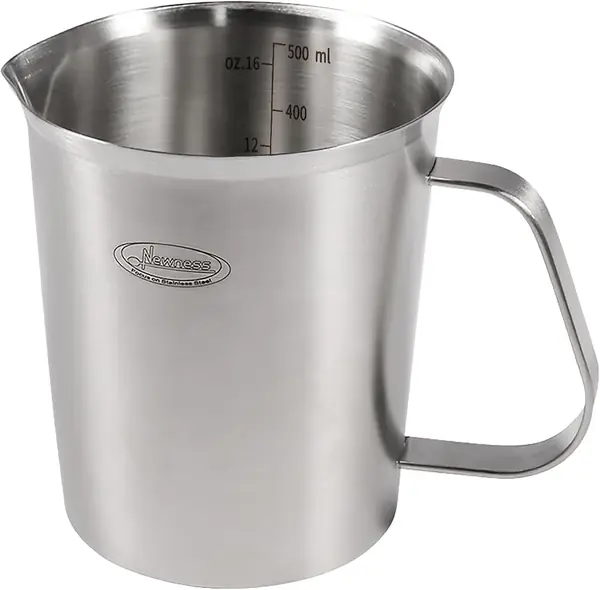
Brushed stainless steel two-cup measuring cup with an angled handle and interior etched markings

Unbreakable daily use

Bake Score 96/100
Material
304 stainless steel
Capacity
16 oz (2 cups / 500 ml)
Cleaning
Dishwasher safe
Markings
Etched, oz and ml
View on Amazon

Printed numbers are the first thing to go on a measuring cup, and a few years of hot water turns the graduations you rely on into a suggestion. This one sidesteps the problem entirely: the markings are etched into 304 stainless in ounces, cups, and milliliters, so there is no ink to wash away and nothing to read through.

We keep it by the stove. A two-cup steel vessel is the right size for stock, for deglazing a pan, for filling a coffee maker reservoir, and the insulated handle stays comfortable long enough to carry it from pot to bowl. The V-shaped spout is the other half of why it works: steel lets you pour a thin, controlled stream, and the spot-welded handle does not flex when the cup is full.

Reading it takes an adjustment. Because the scale is inside and the body is opaque, you look down into the cup rather than checking a level through the side. That is no trouble for milk or stock and a little slower for something dark and thick. What you get in return is a 16-ounce cup that shrugs off the drop that would end a glass one.

It is also the cup that does not need a careful home, which counts for more than it sounds like in a kitchen where things get knocked around. If you want one purchase that covers a whole recipe, the glass sets do more; if your cups die by chips, cracks, and faded print, this is the one that does not.

Worth Noting

  • Not microwave safe
Our Verdict

Our pick for anyone who has watched a glass cup's markings fade or a plastic one crack: it measures the same and takes a knock.

Check Latest Price
4

OXO Good Grips 1-Cup Squeeze & Pour Silicone Cup Best for Melting and Small Pours

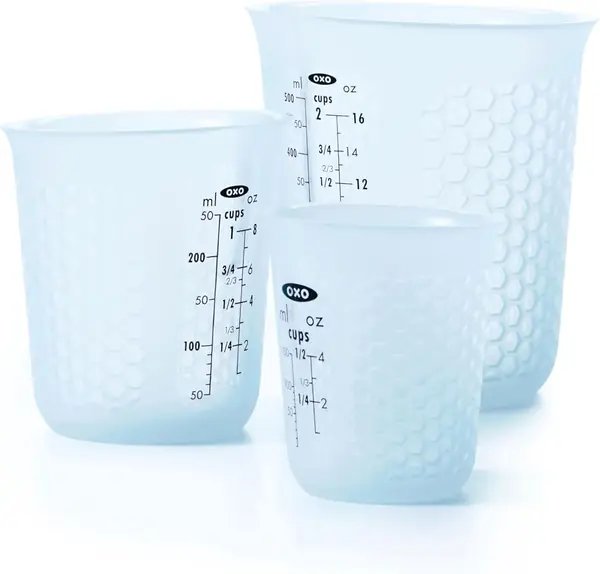
White silicone one-cup measuring cup with a honeycomb-patterned exterior and a flexible spout

Melting butter, chocolate

Bake Score 95/100
Material
Silicone
Capacity
1 cup (250 ml)
Cleaning
Dishwasher safe
Microwave
Yes
View on Amazon

Melting butter or chocolate in a glass cup means waiting for the glass to cool before you can touch it, then scraping the last of it out with a spatula. This cup is built for exactly that job: the silicone body goes in the microwave, the honeycomb pattern on the outside dissipates heat and keeps your hand comfortable, and the spout can be pinched shut and opened slowly to drizzle.

The flexible walls are the whole trick. Squeeze the body and the contents rise in a controlled stream you can aim into a narrow jar or a ramekin; press a spatula against the side and the silicone gives, so less stays behind. An immersion blender head fits inside it too, which makes it a small mixing vessel and not just a measuring cup.

The markings read clearly and have not lost contrast in the wash, and the whole thing goes in the dishwasher. It also weighs almost nothing, so it earns a spot in a crowded drawer instead of a shelf.

Between this and a glass 1-cup, the silicone is the one we reach for when heat is involved, and glass is the one for cold milk going into a recipe. Owning both is not excessive; they do different halves of the same job.

Worth Noting

  • One-cup capacity limits it to small jobs
Our Verdict

Worth it if you melt butter or chocolate in the microwave more than once a month; the squeeze turns a dribbly pour into a precise one.

Check Latest Price
5

Anchor Hocking 3-Piece Glass Measuring Cup Set

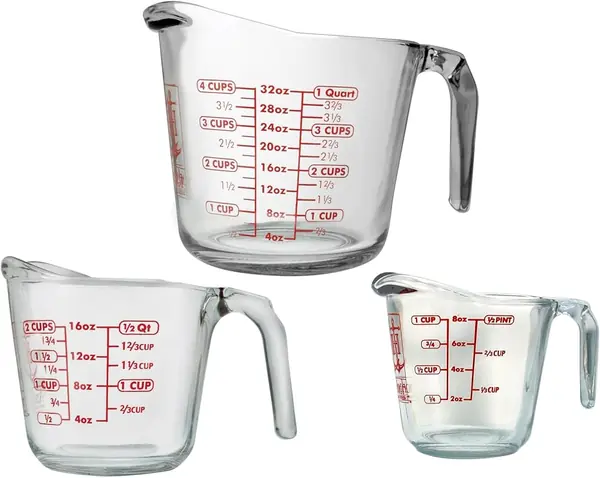
Three clear glass Anchor Hocking measuring cups in 1, 2, and 4 cup sizes with printed scales

Substantial glass set

Bake Score 94/100
Material
Glass
Markings
Imperial and metric
Heat Use
Microwave, freezer, dishwasher
Sizes
1, 2, and 4 cups
View on Amazon

These are the other three-piece glass set worth owning, and the difference is in the hand. Anchor Hocking's glass is thick and the cups are less conical than the Pyrex set, so they sit like small pitchers with a wide flat base and straighter sides.

The handle is the part we appreciate most. It is thick and open, easy to get a whole hand around, and that girth helps if grip strength is a concern. Markings are large and printed side by side in imperial and metric. Nest them with a finger's width of play, though: wedged together, the 2-cup can be a fight to pull out.

Where this set wins for us is stability. The wide base does not skate across the counter while you whisk one-handed, and the extra glass keeps the cup planted when the handle is doing the work. They go in the microwave, the freezer, and the dishwasher, and they are made in the United States.

Between this and Pyrex, it comes down to shape: Pyrex cups are more conical with a pronounced pour lip, while these sit straighter and steadier. For a kitchen that simply goes through cups, the difference is small; for hands that want more to hold, it is not.

Worth Noting

  • ⚠️ Care needed with sudden hot-to-cold shifts
Our Verdict

For cooks who want a substantial glass cup with a straighter side and a handle you can get a whole hand around, this three-piece set is our pick.

Check Latest Price
6

Amazon Basics 8-Cup Glass Measuring Cup

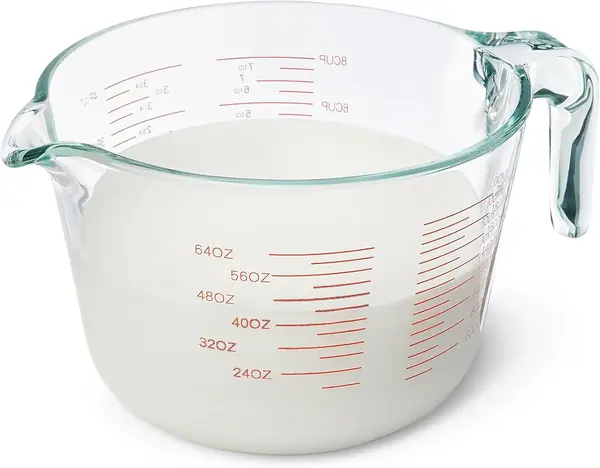
Large clear glass eight-cup Amazon Basics measuring cup with bold printed markings and a pour spout

Big-batch dough, stock

Bake Score 92/100
Material
Glass
Capacity
8 cups (2 quarts)
Heat Use
Microwave, freezer, preheated oven
Weight
3.42 lb
View on Amazon

Eight cups is two quarts, and that is a different job from everything else here: a whole batch of bread dough through bulk fermentation, a brine, a stock strained straight into the vessel. The bowl is wide enough to whisk in, the spout pours fast, and the scale runs up the side in bold print.

We treat this as a mixing bowl that happens to measure. It goes in the microwave, the freezer, and a preheated oven, so dough can proof in it and a lot of butter can melt in it at once. The wide mouth gives you room to stir, and the pour is quick enough for dividing stock among containers.

It earns its cabinet space only if you cook in volume. For a single cake or a pancake breakfast, the 4-cup Pyrex is the better reach. Where this one makes sense is bread: a full recipe of dough fits with room to double, and you can watch the rise through the side without lifting the vessel.

Worth Noting

  • Printed markings wear with repeated washing
  • Heavy to lift when full
Our Verdict

For bread bakers and big-batch cooks, this eight-cup glass vessel does the work of a mixing bowl and a measuring cup at once.

Check Latest Price
7

Norpro 4-Cup Plastic Measuring Cup Best for Messy Jobs, Backups

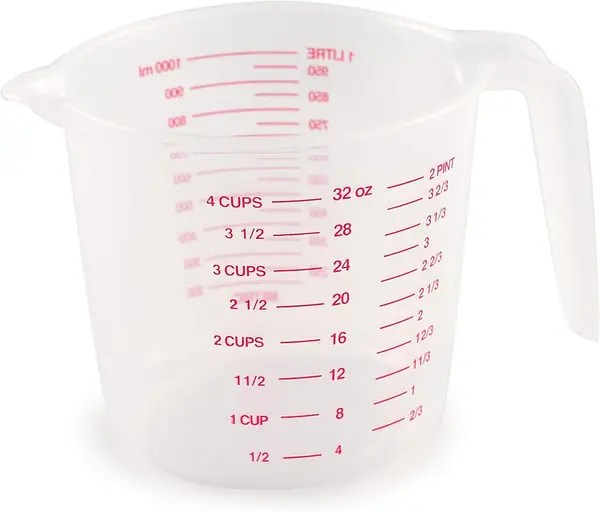
Clear plastic four-cup Norpro measuring cup with an oversized handle and printed measurement scale

Messy jobs, backups

Bake Score 91/100
Material
Food-grade plastic
Capacity
4 cups (32 oz / 1000 ml)
Cleaning
Top-rack dishwasher safe
Dimensions
4.5 x 5 x 7 inches
View on Amazon

This is the least expensive cup in this group, and it is the one we treat as equipment rather than heirloom: four cups of clear plastic, a wide mouth, a big handle, and nothing precious about it.

What it gets right is weight. At 2.4 ounces it is the lightest full-size cup we compared, which matters when you are carrying four cups of stock or batter across the kitchen. The handle is oversized enough for a whole hand, the base is broad and flat, and it is top-rack dishwasher safe.

The mouth is wide enough to get a spatula into and the spout is contoured for pouring, so it handles batter and marinade without drama. It comes as a single 4-cup cup, so plan on pairing it with something smaller rather than replacing a set with it.

Our take: buy it as the second or third cup in the drawer, the one that takes the jobs you do not want to do in glass. Clear plastic lets you see what is in it, it is light enough to hold one-handed at full capacity, and it is inexpensive enough that a scratch does not sting.

Worth Noting

  • Printed markings wear off with washing
Our Verdict

The lightest and least expensive full-size cup here, and a good second cup for the messy jobs.

Check Latest Price

How We Tested Liquid Measuring Cups (and What We Measured)

We started with the cups that have a genuine following in home kitchens, then filtered by capacity range — nothing smaller than 1 cup, nothing bigger than 8 — along with material, whether the markings were printed on the surface or fused into it, handle and spout design, and price per cup. That narrowed the field to 15: three sizes of glass sets, single glass cups, angled-read styles, a stainless cup, a flexible silicone one, and a clear plastic 4-cup.

Testing happened where these cups actually live, on the counter next to the mixing bowl. We filled each to the 1-cup line with water and weighed it on a digital scale to see which ones ran high or low, then repeated at the 2-cup and 4-cup lines. We poured into narrow-necked bottles and into a stand mixer bowl to watch for dribbles down the outside, and noted whether we could read the line standing up or had to crouch to counter height.

Durability got the roughest treatment. Every cup went through 30 dishwasher cycles, took an abrasive sponge straight to the markings, and got knocked over on the counter more than once — we recorded chips, cracks, and any line that faded past readability. We also weighed each cup empty and full, because a glass 8-cup of stock is genuinely heavy one-handed, and we priced sets against buying the same sizes individually to see where the value actually sits.

The lasting observation: the cups that scored best weren't the fanciest ones, they were the ones whose markings survived the dishwasher and whose handles stayed steady when full.

How to Choose a Liquid Measuring Cup

Start With How the Markings Are Made

A graduation can be printed on top of the glass or plastic, molded into the wall, or etched into metal. Printed ink is the most legible thing in the store and the least permanent thing in the sink, and a bolder print is not a stronger print. Molded and etched numbers cannot wash off because they are not sitting on the surface. If you want the scale to still be there in five years, that is the choice to make first.

Then look at where the marks sit. Side markings mean lifting the cup or crouching to counter level; an angled face, like the one on the OXO 4-cup, lets you read the level from above while the cup stays planted. If you measure four or five times in a single baking session, that is a real saving in motion.

Match the Material to the Heat You Use

Glass goes in the microwave, the freezer, and, when the maker says so, a preheated oven, and you can watch the level through the side. It is also breakable and heavy. Plastic is light and inexpensive and scratches into a haze that makes the markings harder to read. Silicone is for melting and squeezing rather than whisking. Steel is unbreakable and opaque, and it never goes in the microwave.

Choose by your most common job, not the rare one. If you melt butter or chocolate every week, a silicone or glass cup earns its space; if you cook next to a hot pan, steel. With any glass cup, let it come to room temperature before it meets hot liquid or a hot oven. Thermal shock is what breaks glass, not stirring.

Buy Sizes, Not a Size

One cup is for eggs, milk, and vanilla. Two cups covers most sauces and small batters. Four cups is the workhorse for cake and pancake batter, and eight cups is for dough, brine, and stock. Most kitchens do fine with a 1-cup and a 4-cup, and a nesting set usually costs less than buying those two on their own.

Weight is the hidden variable. A full 4-cup is a two-hand lift, and a full 8-cup is a set-it-down-and-pour proposition. If you bake double batches often, the big one spares you a mixing bowl; if you bake a single layer cake once a month, it is cabinet space you do not get back.

Check the Spout, the Handle, and the Base

A good spout delivers a thin stream at a moderate tilt, while a wide shallow lip dumps everything at once and sends it down the outside of the cup. A handle mounted high on the body balances a full cup better than one attached at the rim, and a wide flat base stays put while you whisk with the other hand.

Hold the cup before you commit, ideally with a wet hand, because that is when grip changes. Check the dishwasher rating too: top-rack-only plastic will warp on a bottom rack, and even dishwasher-safe glass keeps its printed numbers longer when you wash it by hand.

Frequently Asked Questions

Final Verdict

The Pyrex Essentials three-piece set is what we tell most people to buy: three sizes, tempered glass that goes from the microwave to a preheated oven, and markings you can read from across the counter. It covers more recipes per dollar than any single cup here.

If a dropped cup is a genuine risk in your kitchen, the Newness steel cup is the one we keep by the stove, with graduations that cannot wash away. If you want one cup instead of a set, the OXO angled cup reads from above and takes up less room.