The 7 Best Rechargeable Food Scales of 2026

The worst moment for a kitchen scale to quit is halfway through weighing flour, and that's exactly when mine did — screen blank, batter half-built, not a AA battery in the apartment. That's why I switched to a rechargeable one that tops up off the same USB-C cable as everything else on the counter. Charging is the easy part, though. What separates a good scale from an annoying one is whether the numbers hold steady while you dribble in yeast, whether the platform fits a mixing bowl you can still see around, and whether it survives a year of flour dust and spills.

Cooking, baking and portioning on 14 rechargeable scales showed a wider spread than you'd expect. One thing worth knowing before you shop: capacity is overrated. Nearly every model now claims 33 pounds, and unless you're weighing a turkey or a return package you'll never touch it — how a scale reads the first few grams of salt matters far more. Our seven run from dead-simple to app-connected, all judged on the same counter.

Our Top Picks

The Best Rechargeable Food Scales

1

KOIOS 33lb Food Scale Best Overall
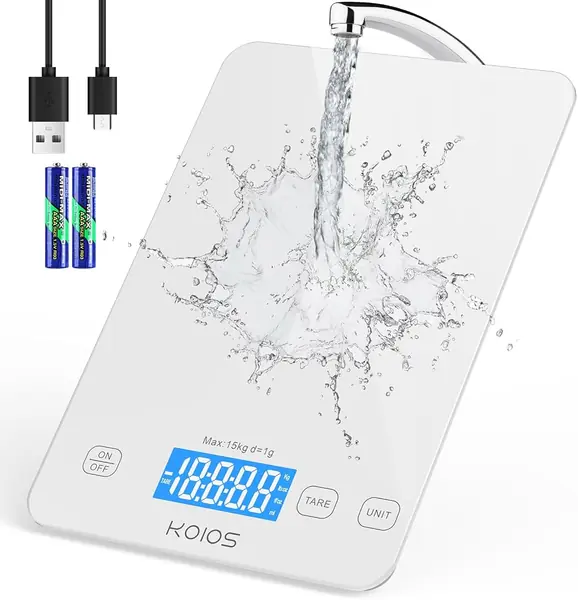
KOIOS white tempered-glass digital food scale with backlit LCD and USB-C charging

Everyday baking

Bake Score 94/100
Capacity
33 lb (15 kg)
Charging
USB-C plus 2 AAA batteries
Graduation
0.04 oz
Platform
9.0 x 6.3 in tempered glass
View on Amazon

The first thing we do with a new scale is drop a four-quart mixing bowl on it, and most of them fail that test: the bowl overhangs the platform, the rim covers the numbers, and you end up crouching to read a total. The KOIOS is the one where that stops being a problem. Its tempered-glass platform runs about nine by six inches, the backlit display is bright enough for a dim kitchen, and a full bowl of dough still leaves the readout in view.

Power is the other reason it leads. It charges over USB-C, and when the internal cell eventually stops holding a charge, two AAA batteries keep it running. That combination is rarer than it should be among these picks, several of which seal the battery inside and become drawer clutter the day the built-in cell gives out. We also found that a charge lasts long enough that topping it up never becomes part of the routine.

Five units cover what baking actually asks for: grams for flour and starter, pounds and ounces for a butcher's label, and milliliters for liquids, with separate settings for milk and water because a milliliter of each does not weigh the same. The glass wipes clean in a single pass. It is the least fussy scale in this group, which is most of why it is the one we keep coming back to.

Worth Noting

  • Unsteady readings below a few grams
  • No kilogram option among the five units
Our Verdict

Our pick for anyone who bakes by weight: the wide glass platform swallows a mixing bowl, USB-C charging has an AAA backstop, and the five-unit readout covers every recipe we tried.

Check Latest Price
2

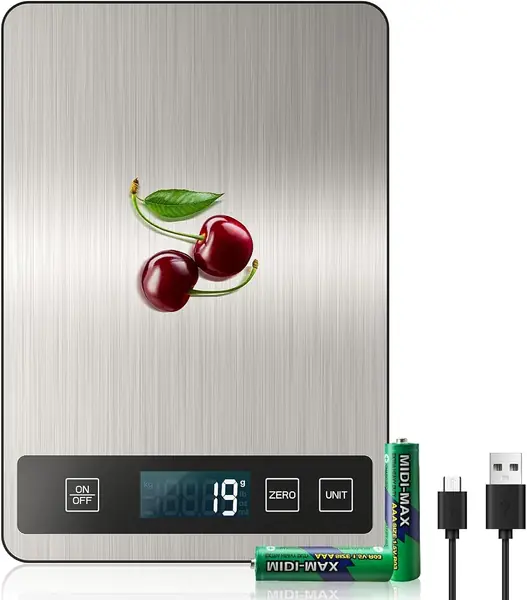
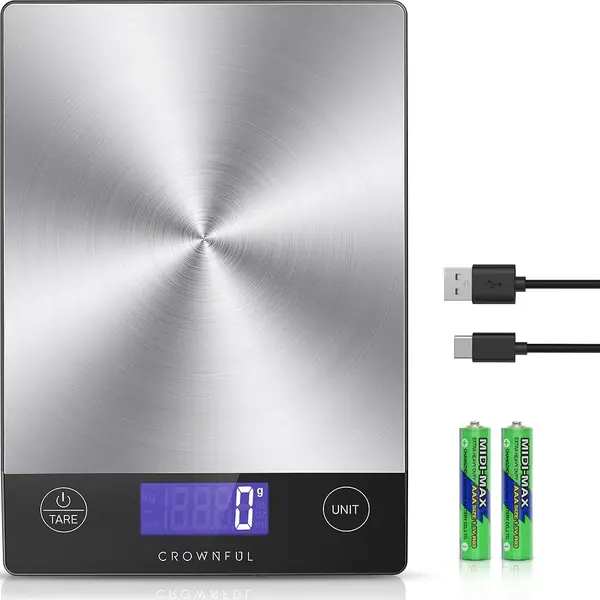
CROWNFUL 33lb Food Scale Best for Big-Batch Baking

CROWNFUL silver stainless-steel digital kitchen scale with slanted LCD display

Big-batch dough

Bake Score 93/100
Capacity
33 lb (15 kg)
Charging
USB-C or 2 AAA batteries
Graduation
0.04 oz
Units
6 units
View on Amazon

The slanted screen is why this one stays in the rotation. Most scales lay the numbers flat on the deck, so you lean over a bowl of dough to read them; CROWNFUL angles the LCD up toward your eyeline, which sounds like a small thing until you have done it both ways. The stainless panel is broad enough for a wide container, and 33 pounds of capacity covers a full stockpot or a double batch of bread.

At the low end of the price range here, we expected to make excuses for it and mostly do not. It charges over USB-C and takes two AAA batteries, so a flat cell is a five-second fix rather than a lost afternoon of baking. The real compromise is at the bottom of the measuring range: readings start at 3 grams, which puts yeast, salt, and single-gram adjustments out of reach. Keep a spoon measure nearby and it earns its place as a big-batch workhorse.

Worth Noting

  • Shorter charge life than the other picks here
Our Verdict

We like it for plates and stockpots: the angled screen stays readable behind a bowl, and the wide stainless panel takes big containers. Just do not expect fine gram work.

Check Latest Price
3

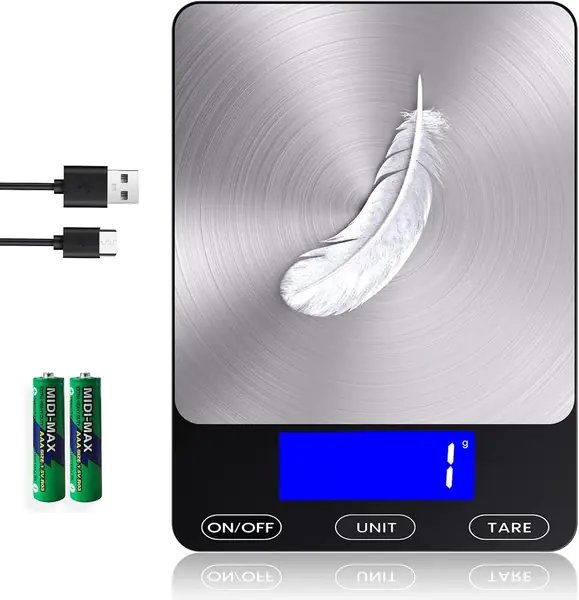
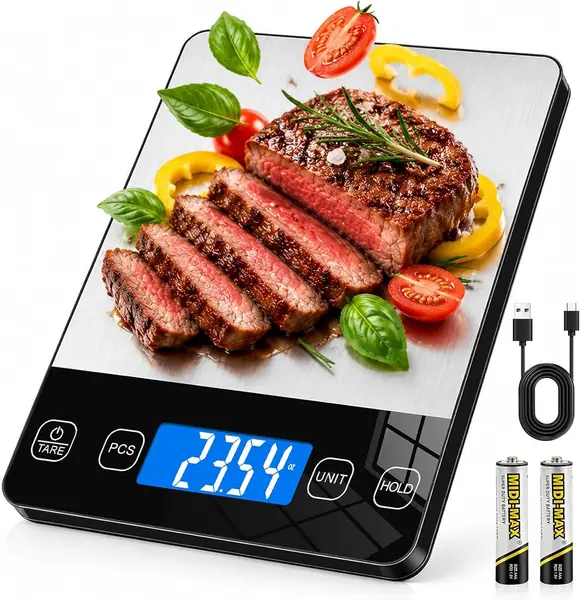
Letron 33lb Food Scale Most Versatile

Letron silver stainless-steel food scale with USB-C cable and AAA batteries

Mixed-unit recipes

Bake Score 92/100
Capacity
33 lb (15 kg)
Charging
USB-C with AAA backup
Units
7 units
Functions
Tare, hold, PCS counting
View on Amazon

Seven units is more than most kitchens need and exactly right for a kitchen with two recipe traditions: grams for a European baking book, pounds and ounces for an American one, plus fluid ounces and milliliters for liquids. Moving between them does not require the manual. That range, and the way the readings hold steady, is why this is the one we point to when someone weighs something different every day.

Hold is the feature we did not expect to use as often as we do: press it and the last weight stays on screen after you lift the bowl away, which solves the covered-display problem for wide containers. One-touch tare handles the bowl itself, and a counting mode tallies small identical items if you portion by piece as well as by weight.

It ships with a USB-C cable and two AAA batteries, so it works the day it arrives and keeps working after the internal cell starts to fade. For a scale with this many functions, the surprise is how little you have to think about them: hold and tare were the only two controls we touched in a week of baking.

Worth Noting

  • No water-resistance rating
Our Verdict

We point people here when they weigh something different every day: seven units, a hold button that keeps the last reading visible, and two ways to keep it powered.

Check Latest Price
4

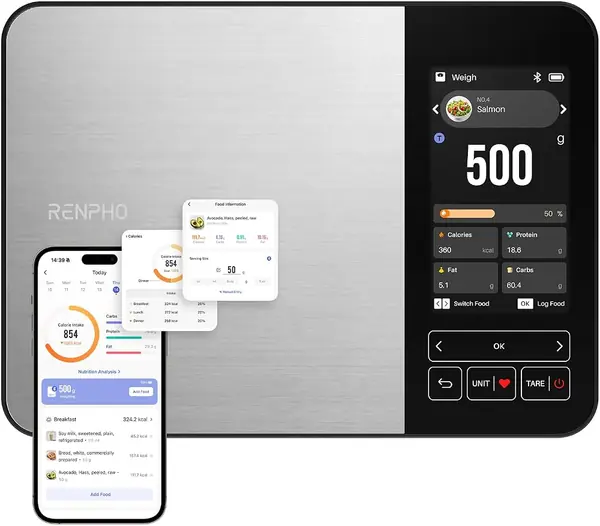
RENPHO Calibra+ Smart Food Scale Best for Macro Tracking

RENPHO Calibra+ stainless-steel smart food scale with 4.3-inch color TFT screen

Macro tracking

Bake Score 91/100
Capacity
5 kg (11 lb)
Graduation
0.04 oz
Display
4.3-inch color TFT
Nutrition
800,000+ USDA foods
View on Amazon

This is a scale that does the arithmetic. A 4.3-inch color screen shows calories, protein, fat, and carbohydrates for whatever is on the platform and updates as you add, so a handful of almonds becomes a number without a phone in your other hand. If you have ever weighed chicken, opened an app, and typed the weight in, that is the whole pitch.

The library behind it is the substance: a database of more than 800,000 foods in the app, with up to 100 presets stored on the scale itself so portioning works offline and syncs later. Three profiles mean a household can track separately instead of sharing one login, and 25 nutrition facts are logged per meal if you want that much detail.

Capacity is the trade. Five kilograms covers a portion of almonds, a bowl of batter, a chicken breast, but it stops well short of a full batch of dough, and on baking day you will be reaching for something else. That is a real limit for a kitchen that does both jobs, and it is the reason this one sits beside a general-purpose scale rather than replacing it.

What we keep coming back to is the screen. It is big, it is in color, and it shows weight and macros at the same time, which means no toggling with a dirty hand. Whether that is worth the premium over a plain scale depends entirely on whether you log your food; if you do not, you are paying for arithmetic you will never use.

Worth Noting

  • Tops out at 5 kg, too little for dough
  • App pairing and logging are the weak link
Our Verdict

We hand this to anyone counting calories or protein: it does the lookup while you portion, so long as your recipes stay under five kilograms.

Check Latest Price
5

GGQ 33lb Food Scale

GGQ black stainless-steel digital food scale with touch buttons and hanging hook

Budget backup

Bake Score 90/100
Capacity
33 lb (15 kg)
Charging
USB-C rechargeable
Graduation
0.04 oz
Platform
7.5 x 5.5 in stainless steel
View on Amazon

This is the least expensive way into a rechargeable scale here, and it handles the basics without drama: a black stainless deck wide enough for a dinner plate, touch controls, five units, and a USB-C port instead of a battery door you have to feed. At 250 grams it is light enough to hang from its loop or stand on its side in a drawer.

What you give up is consistency. Put the same bowl back twice and the reading can shift by a gram or two, which matters not at all when you are dividing a batch of mince and matters quite a lot in a genoise where every gram of flour is doing structural work. The 33-pound ceiling and five units cover everything else we asked of it, and it went weeks between charges, which is more than we can say for some of the scales here.

Worth Noting

  • Two-minute auto-off cuts long recipes short
Our Verdict

We treat it as the spare or the second scale: it swings a 33-pound batch, hangs out of the way, and costs less than anything else here.

Check Latest Price
6

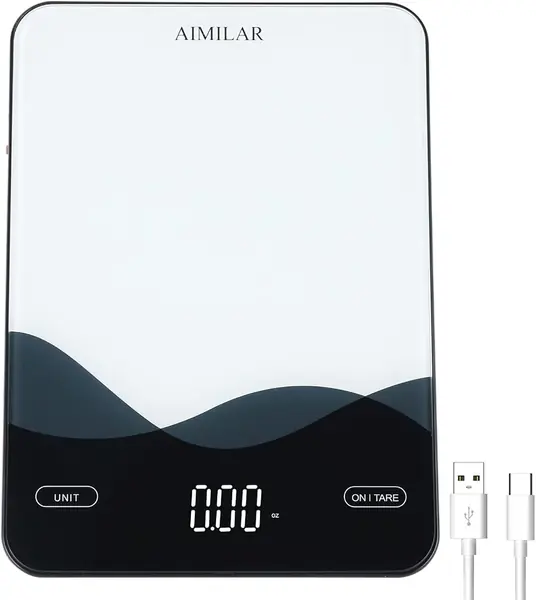
AIMILAR Glass Food Scale Best for Messy Countertops

AIMILAR tempered-glass USB-C food scale with flat touch LED display

Messy countertops

Bake Score 89/100
Capacity
22 lb (10 kg)
Charging
USB-C, 2.5-3 hr full charge
Graduation
1 g / 0.1 oz
Platform
Tempered glass touch panel
View on Amazon

Flour gets everywhere, and on a scale with raised buttons it gets into the seams. The AIMILAR's top is a single sheet of tempered glass with the controls printed beneath it, so there is nowhere for flour to lodge, and a wipe with a damp cloth finishes the job. Of the scales here, it feels most like a clean surface and least like an appliance.

It charges over USB-C, with a full top-up taking a couple of hours, and there is a physical switch on the side. That detail matters more than it sounds: with a flat touch panel there is no obvious off, and a real switch leaves no doubt about whether the thing is running. A 120-second auto-off takes over if you walk away mid-recipe.

Ten kilograms is plenty for home cooking, though it is two-thirds the capacity of the big stainless scales here. The unit list is the shortest in the group, grams, ounces, pounds and ounces, and milliliters, with no kilograms, and it will not register anything below about a tenth of an ounce, so a pinch of salt simply reads zero. For bread, batch cooking, and portioning, neither limit comes up.

Worth Noting

  • Can stop powering on within a few months
Our Verdict

We keep this one for messy baking days: a seamless glass top wipes clean in one pass, and the side switch means it is actually off in the drawer.

Check Latest Price
7

izeyu 33lb Food Scale Best for Sourdough and Starters

izeyu stainless-steel digital food scale with LCD display and six weight units

Sourdough and starters

Bake Score 88/100
Capacity
33 lb (15 kg)
Charging
USB rechargeable
Graduation
0.04 oz
Units
6 units
View on Amazon

It arrives smaller than the photos suggest. The deck is narrow enough that a dinner plate covers the display, and you will tilt the scale toward the light to read a total. Use a small bowl or a measuring cup and the problem disappears; use the plate you are about to eat from and it does not.

Where it earns its place is sourdough. Fifteen kilograms of capacity takes a full batch of dough, six units cover metric and imperial recipes, and tare lets you build a loaf in one bowl, zeroing between the flour, the water, and the starter. Nothing about that workflow needs more than it offers, and it slides into a drawer afterwards.

The rechargeable cell is what it sells hardest, and standby is rated at more than 120 days, so it can live in a cupboard and still have power when you want it. Between charges it is light, tidy, and untroubled by a full batch of dough, the sort of scale you tuck beside the stand mixer and stop thinking about.

Worth Noting

  • Readings drift a gram or two between weighings
Our Verdict

We keep this as a compact second scale: it handles a full batch of dough and six units, and its long standby means it is charged when you dig it out.

Check Latest Price

How We Tested the Best Rechargeable Kitchen Scales

We started with a shortlist of nearly 40 scales drawn from retailer best-seller lists and customer reviews, then narrowed it by charging method, platform material, unit range, and price — we wanted models a home cook could buy without wincing. That left 14, which we ran for four months in our own kitchens: coffee beans at 6 a.m., Sunday meal prep, holiday baking, portioning ground beef for the freezer, and weighing a return package on the way out the door.

Accuracy came first. We weighed certified 100-, 500-, and 1,000-gram reference weights on each scale, then repeated the same 200 grams of flour five times in a row to see whether the reading drifted. We sprinkled salt a gram at a time to check how quickly the display caught up, and stood a dinner plate on the platform to see whether it blocked the screen.

For battery life, we ran each scale from full to dead and logged the hours, watched how much charge it lost sitting in a drawer for a week, and timed a full recharge from empty. Ease of use meant unpacking without the manual, switching units with a wet thumb, and wiping up spilled milk and flour with a damp cloth. We also noted footprint on the counter and whether each one slid into the utensil drawer.

At the four-month mark we re-checked every scale against the reference weights, looked for scratches and moisture creeping under the buttons, and retired two whose touch panels had gone finicky. The app-connected models got a week of real meal logging to see whether entries synced or dropped, and for value we counted what came in the box — cable, batteries, and all.

How to Choose a Rechargeable Food Scale

Power: USB-C, AAA Backup, or Both

Nearly everything here charges over USB-C, which means one cable in the drawer instead of a wall adapter you will lose. The variable that matters is what happens as the internal cell ages. A scale that also takes AAA batteries keeps working on the day the built-in battery stops holding a charge; a sealed one becomes drawer clutter. We put real weight on dual power for that reason. Check the port type before ordering, and if the scale lives on the counter, plan a monthly top-up rather than leaving it plugged in around the clock.

Capacity and Resolution: Match Them to Your Recipes

One gram is the working resolution for bread, pastry, and portioning, and every scale here delivers it. Where they split is the ceiling. Ten or fifteen kilograms takes a stockpot or a full batch of dough, while a five-kilogram model is really a portioning tool that will make you reach for something else on baking day. Sub-gram quantities, the yeast and salt and spice end of a recipe, are outside all of them, so keep measuring spoons for the smallest amounts instead of paying for precision these load cells cannot give you.

The Platform, the Bowl, and the Readout

The most common daily annoyance is a mixing bowl that swallows the numbers. A platform around nine by six inches gives a wide bowl somewhere to sit, and an angled or front-facing display keeps the reading visible while you stand at the counter. If the scale has to go back in a drawer between uses, check the body dimensions too, because the shortlist runs from slim glass slabs to taller stainless units, and the one that will not fit is the one that never gets put away.

Tare, Hold, and Timers You Will Notice

Tare is non-negotiable: it is how you weigh flour into the bowl you are already using. Hold is rarer and worth seeking out if your containers block the screen, since it pins the last weight in view after you lift the bowl. Then there are the auto-off timers, which run from roughly two minutes on most of these. That is short enough to catch you mid-recipe. A quick press on the platform wakes the scale again without losing your tare, so build the habit before you start sifting.

Cleaning: Glass, Stainless, and Water

Tempered glass wipes clean and hides scratches; brushed stainless looks more serious but shows wear and can flex under a heavy bowl on a light body. Not one of these scales publishes a water-resistance rating, so treat the top as wipe-clean only: brush the flour off, then a damp cloth, and no rinsing under the tap. A flat panel with no raised buttons is the easiest to keep clean, which sounds like a small thing until you are baking weekly and scraping dough out of a seam.

Frequently Asked Questions

Final Verdict

We recommend the KOIOS 33-pound scale for most kitchens. It holds a real mixing bowl, charges over USB-C with AAA batteries as a backstop, and reads in enough units to follow any recipe you own, which is most of what decides whether a scale gets used or buried.

If you log macros, the RENPHO does the arithmetic for you at the cost of capacity. If you want the longest unit list and a hold button, take the Letron. Both are good buys; neither replaces the KOIOS as the one to start with.