The 8 Best Roasting Pans for Prime Rib of 2026

A standing rib roast is the most expensive thing most of us put in the oven all year, and the pan underneath it is usually an afterthought — until it buckles at 450 degrees, the drippings burn into a black ring, and the rack tips the roast into a corner. A good one fixes all three at once: even heat so the bottom crust browns as well as the top, a surface you can deglaze for gravy without scrubbing for an hour, and enough sturdiness that lifting ten pounds of beef out of a hot oven doesn't feel like a magic trick.

We roasted in 12 pans, from single-ply stainless to nonstick. Here's what nobody tells you: the rack matters as much as the pan — a V-shaped one holds a rib roast centered over the drippings, while a flat one lets it slide. Size is the other trap; most 16-inch pans fit a three-rib roast, and anything bigger is just extra surface to scrub. These are the pans we still reach for on a Tuesday, long after the roast is gone.

Our Top Picks

The Best Roasting Pans for Prime Rib

1

Cuisinart 16-Inch Stainless Roasting Pan Best Overall
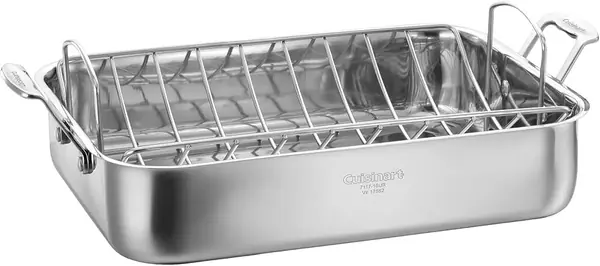
Cuisinart 16-inch stainless steel roasting pan with rack and riveted handles

Most buyers

Bake Score 97/100
Oven Safe
500 °F
Rack
Removable stainless
Cooktop
Induction compatible
Overall Size
20.7 x 12 x 4.9 in
View on Amazon

Sixteen inches of pan, 20.7 inches overall once the handles are counted, and sides close to five inches deep: that's the shape a standing rib roast wants. A four-bone roast settles in with an inch or two of air on every side, which is what lets the oven heat move and the exterior brown instead of steam, and the depth holds a full load of drippings without threatening the oven floor. The tapered rims pour cleanly, so the jus goes into a fat separator instead of down the outside of the pan.

We made this our default because it handles the entire prime rib sequence without asking for help. It's rated to 500°F, so a hot start and a short broiler pass are both fine, and the interior is bare stainless rather than a coating, which means the pan can go across a burner after the roast comes out, take a splash of wine, and give up its fond for the jus while the meat rests. The U-shaped rack cradles the roast instead of letting it wallow in the fat, and the open center leaves room for onions and a head of garlic underneath.

The handles are the detail that decides whether it fits. They project past the rim, and that overall length, not the 16-inch pan size on the box, is the number to check against your oven's interior with the door closed and the rack in place. Loaded with a four-bone roast it's a two-hand lift, so clear the landing spot before you open the door.

Cleanup is undramatic. The rack is the only fussy piece and it soaks free while you eat, and the stainless interior lets go of a crusted glaze after a short soak.

Worth Noting

  • Handles add almost five inches to overall length
  • Dishwasher use can dull the polished finish
Our Verdict

We think this is the pan most people should buy for a standing rib roast: room for four bones, 500°F of headroom, a U-rack, and a bare interior that makes the jus on the stovetop.

Check Latest Price
2

Viking 3-Ply Roasting Pan Best High-Heat Pick

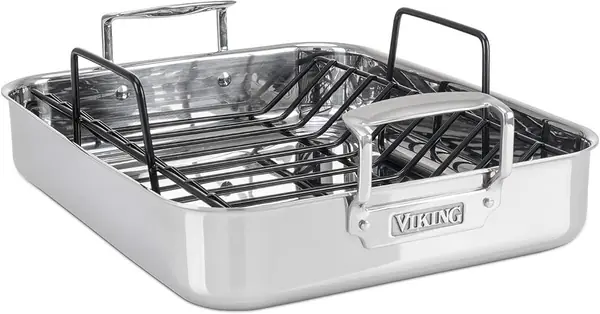
Viking three-ply stainless steel roasting pan with nonstick rack and inverted handles

High-heat searing

Bake Score 96/100
Oven Safe
600 °F
Size
16 x 13 in
Rack
Nonstick rack
Weight
11.4 lb
View on Amazon

Set this next to our top pick and the extra money buys two things: a 600°F oven rating, the highest in this group, and three-ply metal that carries heat all the way up the walls. For prime rib that means a 500°F blast, a low finish, and a final pass under the broiler are all inside the pan's comfort zone rather than at the edge of it.

The 16-by-13-inch footprint takes a seven-bone roast with room to spare and swallows a 25-pound bird, and the rack is coated so the roast releases instead of tearing when you lift it. The handles curve inward, a low profile that slides under a shelf but gives your mitts less to grab than a straight handle does.

It weighs 11.4 pounds empty. That's what the three-ply base costs you, and it's the number to sit with: pulling a rib roast out of a 500°F oven in this pan is an elbows-in, two-mitt job, and the counter needs to be clear before you start.

If you roast at high heat more than a few times a year, or you cook on induction and want the same pan to deglaze on the burner, this is the one that earns the outlay. For a single holiday roast at 325°F, the top pick does the same work for far less.

Worth Noting

  • 11.4 pounds empty, before the roast goes in
  • Inward-curved handles leave less room for mitts
Our Verdict

For searing hard and finishing under the broiler, we choose the Viking: 600°F of headroom, three-ply evenness, and the heft to hold a seven-bone roast steady.

Check Latest Price
3

Cuisinart Tri-Ply 16-Inch Roaster Best for Stovetop Jus

Cuisinart tri-ply stainless roasting pan with polished interior and stainless rack

Stovetop gravy

Bake Score 95/100
Oven Safe
500 °F
Capacity
9.1 liters
Construction
Tri-ply, induction ready
Overall Size
19.3 x 12.1 x 5.2 in
View on Amazon

Ten pounds of empty pan is the first thing you notice, and it's the reason the rest works. The three-ply construction runs from the cooking surface to the rim, so there's no thin band where the roast sits and no hot corner where the jus catches, and the base is rigid enough to bridge two burners without rocking while you reduce.

The pan measures 16 inches across with 9.1 liters of capacity and sides a little over five inches deep, which makes it shorter and deeper than our top pick and slightly more compact on the oven rack. A four-bone roast fits with room around it; a seven-bone one is a squeeze. The polished interior releases fond the second liquid hits it.

Where it separates from the rest of this list is the half hour after the roast comes out. Drippings go straight onto the cooktop, wine goes in, and the fond lifts into the sauce instead of into the sink. It's induction ready and oven safe to 500°F, and the riveted handles stay cool long enough to move the pan while it's still reducing.

Set it against the single-ply Cuisinart above and the difference is evenness and a heavier bottom rather than size, since the tri-ply pan actually holds less. The lighter pan is the easier everyday roaster, and this one is the gravy pan.

Worth Noting

  • Ten pounds empty, and heavier with a roast in it
Our Verdict

We reach for this one when the jus matters as much as the roast: tri-ply evenness, a polished interior that releases fond, and a base that sits across two burners.

Check Latest Price
4

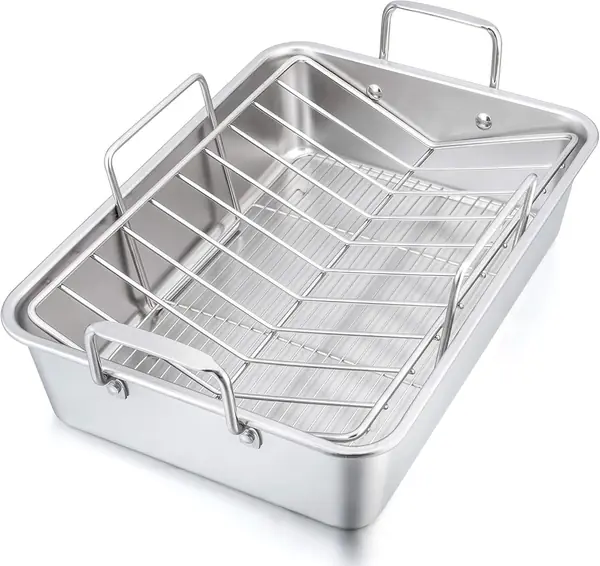
P&P CHEF 16-Inch Roasting Pan Best Value

P&P CHEF stainless steel roasting pan with V-shaped rack and flat baking rack

Bone-in or boneless

Bake Score 94/100
Oven Safe
500 °F
Size
15.25 x 11.5 x 5.5 in
Capacity
Up to 20 lb
Racks
V-shaped and flat
View on Amazon

It's the least expensive pan here that ships with two racks, and for prime rib that second rack is the whole argument. A bone-in roast goes into the V-shaped rack so the ribs sit down and the meat stands clear of the fat; a boneless or tied roast moves to the flat rack, where it lies level and browns on all sides instead of tipping into the drippings.

We think that pairing makes it the best value in the group. The pan is bare stainless, brushed outside and polished on the racks, rated to 500°F and dishwasher safe, so there's no coating to blister at sear temperature and nothing that needs a dedicated sponge. The riveted handles are wide enough for a mitt, and the racks lift out cleanly for carving.

Watch the footprint. At about 15.25 by 11.5 inches it takes a four-bone roast comfortably and most boneless ones, but a full seven-bone rack is the cut that won't go, and a large bird will hang over the rim.

The finish is where it shows its price. Brushed stainless picks up a dull, discolored cast after a few high-heat roasts and scrubbing doesn't bring the original look back. It has no effect on how the pan cooks, and for what this one costs, we don't mind.

Worth Noting

  • Brushed finish stains and discolors with high heat
  • About 15 by 11.5 inches, so a seven-bone roast won't fit
Our Verdict

Our value pick, and the only pan here with both a V-shaped and a flat rack — one purchase covers a bone-in roast and a boneless one.

Check Latest Price
5

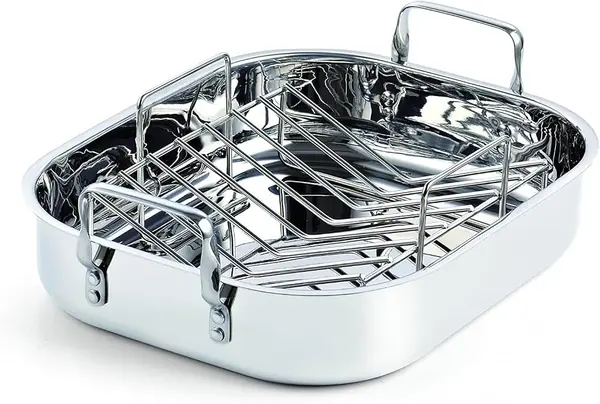
Cooks Standard 14 x 12 Roaster Best for Smaller Ovens

Cooks Standard stainless steel roaster with V-shaped rack and riveted handles

Smaller ovens

Bake Score 93/100
Oven Safe
500 °F
Rack
V-shaped stainless
Weight
6.5 lb
Interior Size
14 x 11 x 3 in
View on Amazon

This is the pan for a tight oven and a small household. Fifteen inches edge to edge slips in lengthwise where the bigger pans foul the door, and the interior — 14 by 11 inches, three inches deep — takes a three- or four-bone roast with the bones in and still leaves room for a few potatoes around it.

The V-rack is why it earns a place. A bone-in roast settles into the V with the ribs down and stays put while you baste, and the three-inch depth catches the drippings from a roast that size without running over the rim. Set the pan on the stove afterward and the flat bottom is stable enough to build the jus right there.

It's 6.5 pounds of heavy-gauge 18/10 steel, rated to 500°F, dishwasher safe, and flat-bottomed enough for gas, electric, or glass-ceramic. Induction is the exception — this one won't work on an induction cooktop, which rules it out in some kitchens before anything else matters.

One rack in the box, and it's a V, so a boneless roast needs tying to sit level rather than rolling to one side. That's a small tax on a pan that fits where the rest of this list doesn't.

Worth Noting

  • No flat rack, so a boneless roast needs tying
  • Not induction compatible
Our Verdict

For a tight oven or a three-bone roast, we point to this one: a heavy V-rack that holds a bone-in roast steady and a 15-inch footprint that clears the door.

Check Latest Price
6

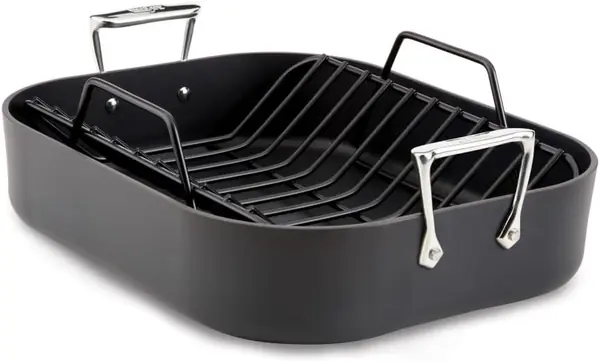
All-Clad HA1 Roaster Best Nonstick

All-Clad HA1 black hard-anodized nonstick roaster with matching nonstick rack

Nonstick ease

Bake Score 92/100
Oven Safe
500 °F
Size
13 x 16 in
Capacity
Up to 25 lb
Finish
Hard-anodized nonstick
View on Amazon

The first time we lifted a standing roast out of the oven on the rack instead of chasing it around the pan with a carving fork, the case for a nonstick pan of this size made itself. The rack does the lifting, the roast slides off onto the board, and the pan goes into the sink with warm water and a sponge rather than a scouring pad.

The pan is 13 by 16 inches of hard-anodized aluminum with a stainless base, rated to 500°F, induction ready, dishwasher safe, and listed to hold a 25-pound bird. Heat spreads across the base instead of concentrating over the burner, which is what keeps the end of the roast over the corner from running ahead of the middle.

What you give up is the fond. A coated surface doesn't build the browned crust of drippings that makes a pan jus worth the trouble, and a 500°F sear is the hardest life a nonstick coating can have. If your plan is low and slow with the jus built from stock, neither of those matters; if you want to deglaze, buy stainless.

Worth Noting

  • No browned fond, so no pan jus
  • Coated rack can chip where the wires bend
Our Verdict

For carving and cleanup with the least fuss, we like this nonstick pick: a rack that lifts the roast clear and a surface that rinses clean, with even heat across 13 by 16 inches.

Check Latest Price
7

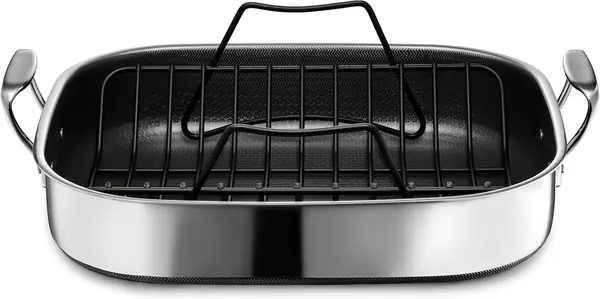
HexClad Hybrid Roasting Pan Best for Large Nonstick Roasts

HexClad hybrid roasting pan with hexagonal nonstick surface and stainless rack

Large nonstick roasts

Bake Score 91/100
Size
17 x 14.5 x 3.5 in
Capacity
5 quarts
Cooktop
Induction compatible
Construction
Tri-ply, hybrid surface
View on Amazon

At 17 by 14.5 inches this is the widest pan in the group, an inch and a half wider than the Circulon at the same length, and shorter overall than our top pick once the handles are counted. That's room for a seven-bone roast with onions scattered around it, and also the pan most likely to foul an oven wall or catch the door on the way in. Measure first.

The hybrid surface is what you're paying for: laser-etched hexagons of stainless set into a ceramic nonstick, so the roast sears on bare metal at the pattern and releases everywhere else. It takes metal utensils and the dishwasher, the tri-ply core spreads heat evenly, and it works on induction and on the stovetop when you're reducing the drippings.

One thing to settle before the first cook: the oven maximum for this pan is given as 450°F in one place and 900°F in another. A prime rib that starts hot needs the higher number to be real, so confirm it before you plan a 500°F roast.

Among the priciest pans here, it earns its place for a cook who wants one pan to sear, roast, and wipe clean, and who has the cupboard and the oven for a 17-inch footprint. For a traditional jus, we still prefer bare stainless.

Worth Noting

  • Oven maximum listed as both 450°F and 900°F
  • Among the priciest pans in this group
Our Verdict

It's the widest pan here and the only one that sears on stainless and releases like nonstick; we suggest confirming the oven rating before the first high-heat roast.

Check Latest Price
8

Circulon Total Bakeware Roaster Best for Crowd-Size Roasts

Circulon Total Bakeware gray nonstick roaster with U-shaped rack and wide handles

Crowd-size roasts

Bake Score 90/100
Oven Safe
450 °F
Size
17 x 13 x 3.8 in
Capacity
24 lb
Rack
U-shaped rack
View on Amazon

For a crowd, this is the most capacity in the group — 17 by 13 inches, rated to hold 24 pounds — and it costs about what the value picks do. A seven-bone rib roast goes in with a layer of onions and carrots around it, and there's still room to baste without sloshing anything over the side.

The nonstick surface is genuinely easy to live with: the roast releases, the drippings wipe out, and the wide steel handles give you something to hold with mitts on. A U-shaped rack keeps the meat off the bottom and out of the fat, which is the whole reason to use a rack in the first place.

The ceiling is 450°F, which is fine for a low-and-slow rib roast and wrong for the 500°F blast that builds a crust. It rules out the broiler too, though a nonstick pan has no business under one anyway. If your recipe starts hot, this is the wrong pan; if it starts at 325°F and stays there, nothing here holds more.

The coating is the part that wears out first — that's the nature of the material — so hand wash it, keep metal utensils away, and don't stack anything heavier than a cutting board on top. Treated that way, it's a lot of pan for a once- or twice-a-year crowd.

Worth Noting

  • 450°F ceiling rules out a 500°F blast or broiler
Our Verdict

We keep this one for crowd-size roasts on a budget: 24 pounds of capacity, a rack, and a nonstick surface that wipes clean, as long as your recipe stays at or below 450°F.

Check Latest Price

How We Tested Roasting Pans for Prime Rib

We started by narrowing the field to pans that could actually hold a three- or four-rib roast: nothing under 14 inches, nothing sold without a rack. From there we compared construction (single-ply versus tri-ply versus nonstick), oven-safe temperature ratings, rack shape, induction compatibility, and dishwasher claims, then bought 12 pans across the price range and cooked in each of them over eight months.

Every pan got a holiday prime rib, several Sunday chickens, a Thanksgiving turkey, and weeknight vegetables when we wanted to see how the corners browned. We weighed each one empty and again with a ten-pound roast in it, then lifted it out of a 450-degree oven holding dry towels and, on a later run, damp ones — a fair stand-in for how the handles feel when your hands are greasy. We also set each pan over a burner to deglaze the drippings into gravy, watching for hot spots, spinning, and that unsettling ping of a bottom that's warping.

Cleaning got its own pass. We let the drippings cool and set, soaked each pan for 20 minutes, and scrubbed with a non-abrasive pad, noting whether the crust lifted off in one piece or took real work. Pans that claimed to be dishwasher safe went through repeated cycles, and we checked for discoloration and wear on the nonstick. Finally, we nested them in a cabinet the way anyone with limited storage would, then checked the racks for sliding when tilted and the rims for dents after a few months of use.

How to Choose a Roasting Pan for Prime Rib

Size the Pan to the Roast and to the Oven

A standing rib roast is wide and shallow, so length matters more than the pounds-of-turkey number on the box. A four-bone roast runs about 9 or 10 inches long; a seven-bone roast runs closer to 14, and it wants an inch or two of air on every side so it browns instead of steaming. Measure the roast, add two inches in each direction, and shop that number.

Then measure the oven. The figure that counts is overall length with the handles, since a 16-inch pan can run past 20 inches handle to handle, and that is what has to clear the interior with the door shut and the rack in place. Depth earns its keep too: about three inches of side holds the drippings from a four-bone roast without sloshing onto the oven floor.

The Rack Decides Bone-In or Boneless

A rack lifts the roast out of the fat, lets heat move underneath, and gives you a way to get the meat from pan to board. For a bone-in roast, a V-shaped rack is the right shape: the ribs settle into the V, the roast stays upright, and it doesn't roll when you baste. A flat rack suits a boneless or tied roast, which will lean in a V.

A pan that ships with both racks is worth more than one with an extra inch of length. Rack height matters as well — an inch or two of clearance under the roast is plenty, and much more lifts the meat out of the oven's heat.

Bare Steel, Coatings, and Heat

Bare stainless is the better partner for prime rib. It takes a 500°F start and a broiler pass without complaint, and it lets you deglaze the drippings on the stovetop, which is the step that turns pan liquid into jus. Nonstick is easier to clean and gentler on a delicate crust, but most coatings stop at 450°F and a coated surface never builds the browned fond you want to scrape up.

Read the oven maximum and the cooktop compatibility separately. A 500°F rating gets you a hot roast; induction compatibility or a heavy flat base is what lets you reduce the jus in the same pan. The Viking's 600°F rating is the most headroom in this group, and the Circulon's 450°F ceiling is the tightest.

Weight, Handles, and Cleanup

An empty roaster in this group weighs between about 3 and 11 pounds, and a four-bone roast adds another seven or eight. Wide, riveted handles you can get a mitt around matter more than a mirror finish, and handles that sit above the rim keep your knuckles off hot steel. Check their span against your oven width, since handles that flare out cost clearance.

Cleaning is the last and least interesting decision. Bare stainless tolerates the dishwasher but keeps its looks with a hand wash and a warm soak; a coated pan rewards five minutes of soaking over five minutes of scrubbing, and a soft sponge over anything abrasive.

Frequently Asked Questions

Final Verdict

Prime rib is the roast that makes a pan prove itself, and the Cuisinart 16-inch stainless is the one we point most people to: room for four bones, a 500°F rating, a U-shaped rack, and a bare interior that goes from oven to burner so the drippings become jus.

Two situations change the answer. A tight oven or a three-bone roast belongs in the Cooks Standard, which fits where the big pans foul the door. And if you sear at high heat often and want the headroom to prove it, the Viking's 600°F rating and three-ply body are worth the extra weight.