The 7 Best Sugar Containers of 2026

There is no sadder baking moment than reaching for the brown sugar and finding a brick. Sugar seems simple until it isn't: moisture turns it into gravel, a loose lid invites ants, and a too-small opening means you're excavating with a teaspoon. A good sugar container fixes all three by keeping air out, making the scoop easy, and holding enough that you're not refilling every other week.

I've rearranged enough pantry shelves to know that the biggest container isn't automatically the best one. Across 14 sugar containers, the differences came down to lid closure, usable capacity, and whether the opening fit a measuring cup. A wide mouth matters more than a fancy shape; a lid you can seat with one hand matters more than a long feature list or a high price.

We filled them with granulated, brown, and powdered sugar, lived through humid weeks, and noted the annoyances: crooked lids, cramped openings, containers that waste shelf space.

Our Top Picks

The Best Sugar Containers

1

Rubbermaid Brilliance Pantry Set Best Overall
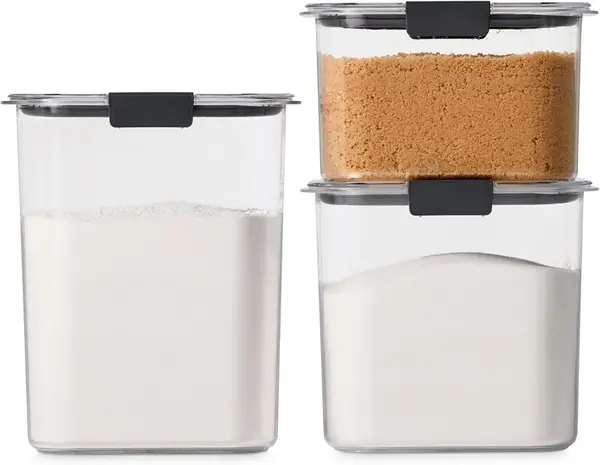
Rubbermaid Brilliance clear plastic pantry containers with latch lids and gaskets, three sizes

All-purpose baking

Bake Score 98/100
Footprint
11.5 x 8.25 x 11.31 in
Sizes Included
16, 12 and 7.8 cups
Total Capacity
35.8 cups
Material
BPA-free Tritan plastic
View on Amazon

The container that matters in this set is the middle one. A five-pound bag of granulated sugar is a little over eleven cups, and that container holds twelve, so the bag goes in whole with just enough headroom to get a measuring cup under the rim. The 16-cup container takes the flour, the 7.8-cup one handles powdered sugar or a box of brown sugar, and one purchase covers the baking shelf. That is why it leads this list.

The seal is the second reason. Four latches pull the lid down onto a gasket and close with an audible click, and of everything we handled, this is the seal we trust most — the airtight feedback on this set is stronger than on any other pick here. Sugar does not spoil, but it pulls moisture out of the air and hardens, and it takes on the smell of whatever sits beside it. A lid that actually seals is the product.

Tritan earns its keep too. It is clear from every angle, so you can see how low the sugar has gotten without lifting anything; it goes in the dishwasher; and it resists staining and holding odors, which matters once a container has spent a winter full of cinnamon sugar. It also shrugs off drops in a way the glass picks here cannot.

Set against the four-piece sets below, the price is steeper per set and gentler per container. The thing we cannot argue away is the footprint: three containers this size claim about a foot of cabinet shelf once stacked as designed. Measure that shelf before you order, because everything else about this set is the easy part.

Worth Noting

  • Costs more than the four-piece sets
  • Three containers claim about a foot of shelf
Our Verdict

The set we recommend first: three truly airtight sizes, the middle one sized for a five-pound bag of sugar, in plastic that shrugs off drops and the dishwasher.

Check Latest Price
2

ProKeeper Sugar Keeper Best for Sugar on the Counter

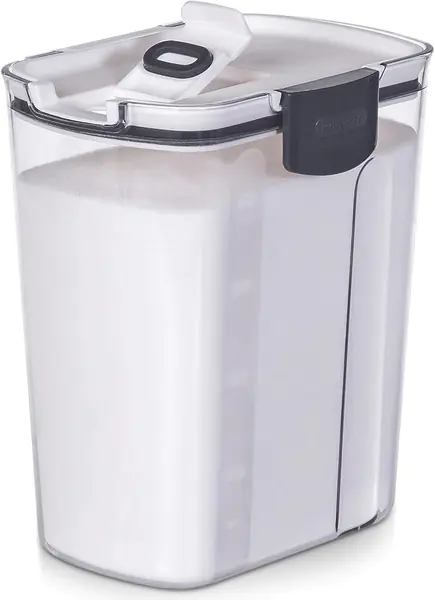
ProKeeper sugar container in white plastic with flip-to-pour spout and latch lid

Counter sugar

Bake Score 97/100
Footprint
7.7 x 6.7 x 6.7 in
Capacity
2.5 quarts
Closure
Latch lid with flip-to-pour spout
Holds
Up to 4 lb of sugar
View on Amazon

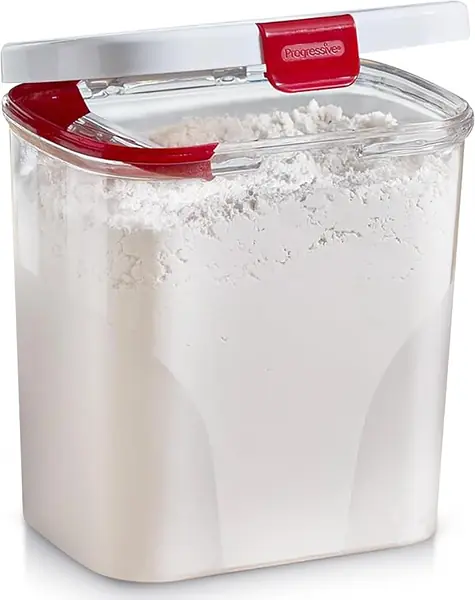
Pouring is the point of this one. Where most containers ask you to dig a cup into the sugar, the ProKeeper puts a hinged spout in the lid: flip it, tip, and the sugar lands in the measuring cup instead of on the counter. The body is contoured so the container sits comfortably in one hand while the other holds the cup — a small thing until you are filling a sugar bowl before your coffee.

It closes on a latch over a gasket, and that seal is why it suits the sugars that misbehave. Brown sugar and powdered sugar are the two that brick up and clump when air reaches them, and a four-pound bag poured in here stays loose. We rate this the most useful container in the group for daily sugar — the one that changes the routine rather than just holding the ingredient.

Capacity is the honest limit. Two and a half quarts is a four-pound bag filled to within an inch of the lid, which is what most supermarkets sell as a bag of sugar. If you buy the five-pound club bags, you will be finishing that extra pound out of the bag.

What you get in exchange is a container built around one motion. The Rubbermaid set holds more and seals just as well; it does not pour. That is the whole trade, and for a household that goes through sugar by the cup, the pour is the part you notice every day.

Worth Noting

  • Can crack if it takes a hard fall
Our Verdict

The best answer if sugar lives on your counter: a hinged spout pours straight into a cup and the latch seals tight enough to keep a four-pound bag loose.

Check Latest Price
3

ComSaf 78 oz Glass Jars Best Glass

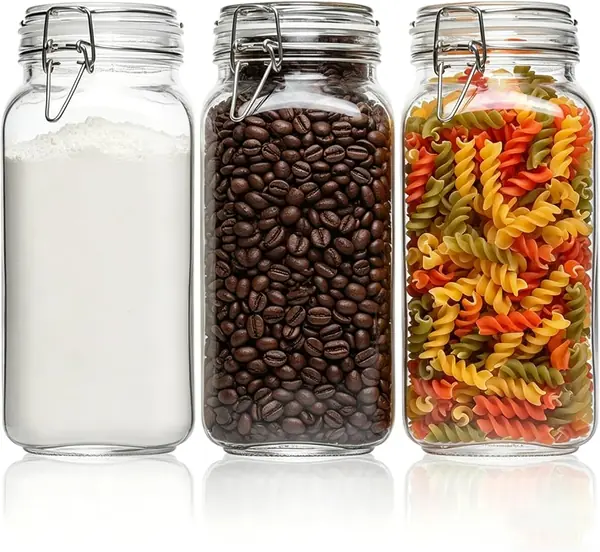
ComSaf clear square glass jars with wire clamp lids and silicone gaskets, set of three

Counter display

Bake Score 96/100
Footprint
4.5 x 4.5 x 10 in
Capacity
78 fl oz (2.3 L) each
Closure
Wire clamp with silicone gasket
Opening
Wide mouth fits a 1-cup scoop
View on Amazon

Most pantry canisters open to about three inches across, which is why a one-cup measure goes in at an angle and half the sugar ends up on the counter. These open wide: the scoop goes in flat, comes out level, and the excess drops back where it belongs. It is the sort of detail you notice once and then refuse to live without.

Each jar is 78 fluid ounces — about 2.3 liters, or a four-pound bag of sugar — and the square profile means three of them line up on a shelf without the wasted gaps round canisters leave. Four reusable labels come in the box, which helps when the contents are two white powders that look identical.

The lid is glass with a thick silicone gasket held down by a wire clamp, so nothing plastic sits against the sugar except the gasket itself. There is no plastic taste to pick up and nothing to stain, and the glass goes in the dishwasher.

Where these lose ground is at the edges. Thick glass is heavy, and a knock against a stone counter is unforgiving in a way plastic is not — one fumbled jar and you are sweeping. We recommend them for the counter, where the looks earn their place, rather than for a high shelf you reach up to blind.

Worth Noting

  • Thin wire clasp is the wear point
Our Verdict

Wide-mouth glass jars with a clamp lid: our pick if you want sugar you can watch disappear and a one-cup scoop that drops in flat.

Check Latest Price
4

PrepSolutions Flour Keeper Best for Measuring

PrepSolutions flour keeper, a clear rectangular plastic container with a flip-top lid

Cup measuring

Bake Score 95/100
Footprint
7.75 x 6.31 x 8.75 in
Capacity
3.8 quarts
Holds
Up to 5 lb
Feature
Built-in leveling lip
View on Amazon

A flat ledge molded into the rim is the best idea in this entire category. Fill a measuring cup, drag the back of a knife along the lip, and the excess falls back into the container instead of across the counter. It is the feature we did not expect to care about, and for a baker who measures sugar in cups — where a level cup is the difference between a cookie that holds its shape and one that spreads — it is the pick.

The container is 3.8 quarts and holds a full five-pound bag, and at 7.75 by 6.31 by 8.75 inches it slides under a shelf that a taller canister will not clear. The lid is a flip-top over a gasket, the plastic is BPA-free, and it goes in the dishwasher. It is sold one at a time, so a shelf of them is a series of purchases rather than a set.

One quirk: pour in a whole five-pound bag and the sugar sits high enough that you are leveling against the very top of the ledge, which works but leaves no margin. Scoop a cup or two into a jar first and the container behaves exactly the way it was designed to.

If you weigh your ingredients rather than scooping them, the leveler is decoration you are paying for, and the four-piece sets here hold more for less. If you bake the way most American recipes are written, this is the container that makes the least mess.

Worth Noting

  • Latch needs a firm pull to open
  • Plastic can crack if knocked
Our Verdict

One container, one job, done properly: a molded leveling lip sweeps a level cup and a whole five-pound bag fits inside a short footprint.

Check Latest Price
5

Storeganize 5.3L 4-Pack Best Value Set

Storeganize four clear square pantry containers with black clip lids and measuring scoops

Bulk on a budget

Bake Score 94/100
Footprint
7 x 7 x 12 in
Capacity
5.3 L each
Closure
Four-sided clip locks
In The Box
4 containers, 4 scoops, 8 labels
View on Amazon

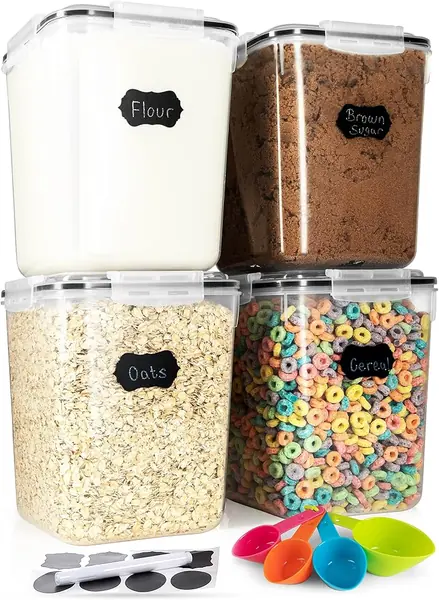
Four containers, four measuring scoops, eight labels, and a chalk marker land in the box. The scoops are the part we did not expect to use; one now lives in the sugar permanently, which is the difference between measuring a cup and hunting for the cup measure in a drawer.

Each container is 5.3 liters, roughly twenty-two cups or about ten pounds of sugar, and four of those for this money is the best value in the group. The seal is a silicone gasket pulled down by clips on four sides, and the plastic feels sturdier than the price suggests.

Two things to know before you order. The clips need a real snap — set the lid, press both sides until they catch, then run a thumb around the rim, because a container that looks closed and is not is worse than one that obviously is not. And these are twelve inches tall, roughly three inches taller than the Vtopmart set, which is enough to miss a shelf you were counting on.

If your cabinet is deep, none of that matters and you have four large airtight containers plus the scoops for the price of one good glass jar. If your shelves are tight, measure first and take the shorter set.

Worth Noting

  • 12 inches tall, so check shelf clearance
  • All four containers are the same large size
Our Verdict

Four 5.3-liter containers, four scoops, and labels for less than any other set here — the budget answer for a baking shelf that needs reorganizing.

Check Latest Price
6

Vtopmart 5.2L 4-Pack Best for Bulk Flour and Sugar

Vtopmart clear square food storage containers with black side-locking lids, set of four

Bulk flour and sugar

Bake Score 93/100
Footprint
7.5 x 7.5 x 9.1 in
Capacity
5.2 L / 175 oz each
Closure
Side-locking lids
In The Box
4 containers with labels
View on Amazon

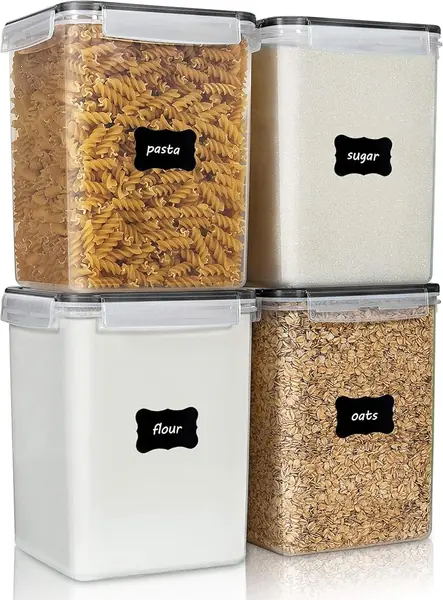
Five and a fifth liters is about twenty-two cups, or roughly ten pounds of granulated sugar, and that is the number that matters if you buy in bulk. A five-pound bag of flour goes in still inside its paper sack, which is a small mercy when the alternative is decanting into a cloud of dust.

You get four identical containers, square at 7.5 inches and 9.1 inches tall, so they stack and line up without the gaps round canisters leave. Labels and a chalk pen come in the box, and the clear sides let you see what is left from across the kitchen.

The lids are the rub. They are side-locking and need a firm press on both sides to seat; a container that looks shut and is not is exactly the failure you cannot afford with sugar, so press until it catches and run a thumb around the rim. Once it is down, it stays down.

It sits below the Storeganize set here for one reason: same idea, similar money, and the other one's clips feel better in the hand. What this one has going for it is the shorter body — three inches less — which is the difference between fitting on your shelf and living on top of the fridge.

Worth Noting

  • Side locks need a firm two-sided press
  • All four containers are the same size
Our Verdict

Roomy, stackable, and sealed once the lid is down: the set for anyone storing sugar and flour in serious quantity, provided you press those side locks firmly.

Check Latest Price
7

PRAKI 24-Piece Set

PRAKI clear plastic food storage containers in assorted sizes with clip lids and labels

Whole-pantry reset

Bake Score 92/100
Footprint
13 x 12 x 7 in
In The Box
40 labels and a marker
Sizes Included
0.8L/1.4L/2.0L/2.8L
Total Capacity
7 liters
View on Amazon

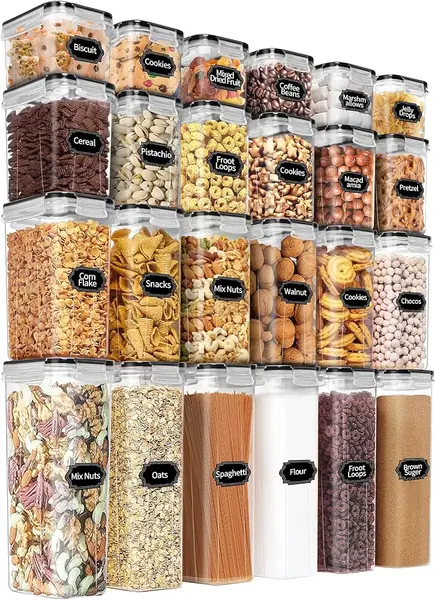
Twenty-four containers arrive nested inside one another, so the box looks like it holds a single size until you start pulling them apart. What is actually in there runs from 0.8 to 2.8 liters: a few big pieces for sugar and flour, a run of middle ones for brown sugar, cereal and pasta, and small ones for the odds and ends that clutter a shelf.

Forty labels and a marker come with it, and that matters more than it sounds. Powdered sugar, cornstarch and salt are indistinguishable in a clear container, and the marker is the only thing standing between you and a batch of cookies with salt in it.

The lids are the weak part. Each is a four-clip lid over a silicone strip, and latching is not always clean on the first try; a piece that catches on three sides and not the fourth is not sealed. For dry goods in a cabinet that is survivable. For the bag of sugar you open twice a day, a lid that catches every time is worth paying for, which is why the single-purpose containers above rank higher.

Where it earns its place is the reset. If a pantry has never been organized, this box does the whole job at once and leaves you labels to keep it that way — then you buy one good sugar container for the bag you open daily.

Worth Noting

  • Lids do not always catch on the first press
Our Verdict

A whole pantry of containers for the price of one good canister — as long as you know that only the largest pieces hold a serious amount of sugar.

Check Latest Price

How We Tested Sugar Containers

We started by pulling together the sugar containers that show up most often in reviews and on store shelves, then narrowed the list to models with a true airtight gasket, a practical opening, and capacities that match how people buy sugar—five-pound bags, not decorative scoops. We included single canisters and sets, square and round shapes, and clear and opaque styles, then bought 14 units to test over three months.

Testing happened in a working kitchen, not a lab. We filled each container with granulated, light brown, and powdered sugar, then used them for daily coffee, weekend baking, and a few larger holiday prep sessions. We left brown sugar in them for a week at a time and checked whether it stayed soft or hardened into chunks; we also turned sealed containers upside down over a sheet pan and looked for escaping grains. We opened and closed each lid with dry hands and wet hands, counted how many presses or turns it took, and noted whether the lid seated crooked or needed two hands. We measured how much sugar actually fit below the rim, whether a one-cup scoop could get in and out without a funnel, and how much shelf space the container ate for the amount it held.

For durability and value, we stacked full containers, slid them in and out of the pantry daily, and washed the ones that allowed it, checking gaskets, hinges, and seams for cracks or loosening. We also counted how many containers in a set were actually useful; a set with three tiny jars and one workhorse is not the same value as four containers that each earn their space. The ones that advanced kept sugar dry, opened cleanly, and still felt solid after three months of regular use.

How to Choose a Sugar Container

Match the container to the bag, not the shelf

Sugar runs about two and a quarter cups to the pound, so a four-pound bag is a little over nine cups, a five-pound bag about eleven and a quarter, and a ten-pound bag close to twenty-two and a half. Buy a cup or two of headroom beyond that, because a canister filled to the rim is one you cannot scoop from without a mess. A 12-cup container takes a five-pound bag with almost nothing to spare; a 5-liter container takes a ten-pound bag.

Treat every holds a 5-lb bag claim as describing sugar poured in, not a bag dropped in whole. If you want the bag to go in still in its paper sack, you need the larger size, which is where the 5-liter sets earn their place.

Judge the seal by its mechanism

An airtight claim on a box means nothing; a gasket means something. Look for a fat silicone ring seated in a channel in the lid, plus a latch or clamp that pulls the lid down evenly — four latches, four clips, or a wire bail. A glass lid sitting glass-on-glass is decorative rather than airtight, and a friction-fit lid holds for a month and then stops.

Decide whether you scoop or pour

Two designs cover the job and they suit different people. A wide mouth lets a one-cup measure go in flat, which is what you want if you bake by the cup. A pour spout is faster for filling a sugar bowl or a mixer and is the only thing that helps when the sugar is going into something narrow.

If you bake by weight, the wide mouth and a scoop you leave inside the canister matter more than a spout. If sugar goes into coffee and iced tea more often than into a mixing bowl, the pour wins.

Plan for where it will live

Counter containers are the ones you look at, so glass earns its keep there and plastic struggles to. In a cabinet, square canisters beat round ones because they use the corners, and height is the number that decides: the picks here run from 6.7 inches for a single sugar keeper to 12 inches for a 5.3-liter set, and those three inches are the difference between a shelf and the top of the fridge.

Weight matters too. A full glass jar is heavy to bring down one-handed from a high shelf, so keep the glass on the counter and the plastic up top.

Frequently Asked Questions

Final Verdict

Start with the Rubbermaid Brilliance set: three genuinely airtight sizes, one of which takes a five-pound bag of sugar with room to scoop, in plastic that survives the dishwasher and the occasional drop. If your sugar lives on the counter and gets poured far more often than scooped, the ProKeeper's spout is worth giving up the extra capacity for.

And if you buy sugar in ten-pound bags, skip both and go to the Storeganize four-pack, where capacity is the entire point and the price is the lowest of any set here.