The 8 Best Wooden Rolling Pins of 2026

A rolling pin looks like the one tool in the kitchen that can't go wrong — a cylinder of wood, no moving parts. Then you try to roll chilled pie dough with a pin that's too short and too light, and you spend ten minutes chasing a sticky disk around the counter. The right one does some of the pressing for you and clears the full width of your dough.

I bake in a small kitchen with exactly one drawer deep enough for a rolling pin, so length matters to me as much as anything. We rolled out 14 wooden pins — tapered handle-free dowels, classic handled models, and short pins built for small batches — through pie crust, cookie dough, pizza, fondant, and chapati. Two things worth knowing before you buy: tapered handle-free pins give you the most control because your palms sit right on the wood, and no wooden pin should ever go in the sink — scrape it, wipe it with a damp cloth, and dry it standing up.

Our eight weren't chosen for matching decor. They're the ones that rolled straight, wiped clean, and still felt solid months later, whether you're laminating pastry or knocking out cookies with kids.

Our Top Picks

The Best Wooden Rolling Pins

1

KARRYOUNG French Rolling Pin Best Overall
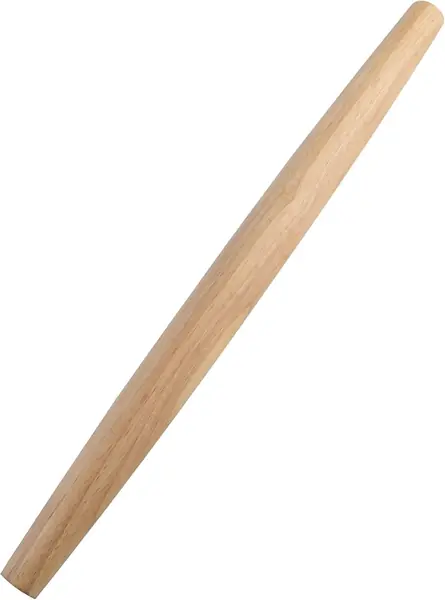
KARRYOUNG French rolling pin, one-piece rubberwood dowel with tapered ends

Everyday baking

Bake Score 98/100
Length
18 in
Barrel Diameter
1.57 in
Weight
8.4 oz
Style
French tapered, handle-free
View on Amazon

One piece of rubberwood, no handles, no bearings, nothing that can work loose: that simplicity is exactly why this is the pin we recommend first. With your palms on the barrel you feel the dough's thickness through your hands, and the tapered ends let you pivot into a round with a small shift of weight instead of a re-grip. On a pie crust it's the difference between steering and shoving.

The barrel is slim at 1.57 inches and the whole pin weighs 8.4 ounces, so it moves quickly over cookies and pizza and wipes down in a few passes. There's no seam or handle joint for flour to pack into. It runs 18 inches overall, long enough to cover a 12-inch round without sliding your hands.

What you get for the simplicity is a pin with nothing to break: no bearing to seize, no glue line to open up, which is the part that loosens first on a handled model. Rubberwood wants the usual courtesies — a wipe, a full dry, and a spot out of the sink — and it stays slick in return. It's the one we pull out for a weekday crust without thinking about it.

Worth Noting

  • Light 8.4-ounce body leaves stiff dough to your muscle
Our Verdict

We recommend it as the default wooden pin: direct control, easy cleanup, and a price that makes a second one painless.

Check Latest Price

2

Farberware Classic Wood Rolling Pin Best with Handles

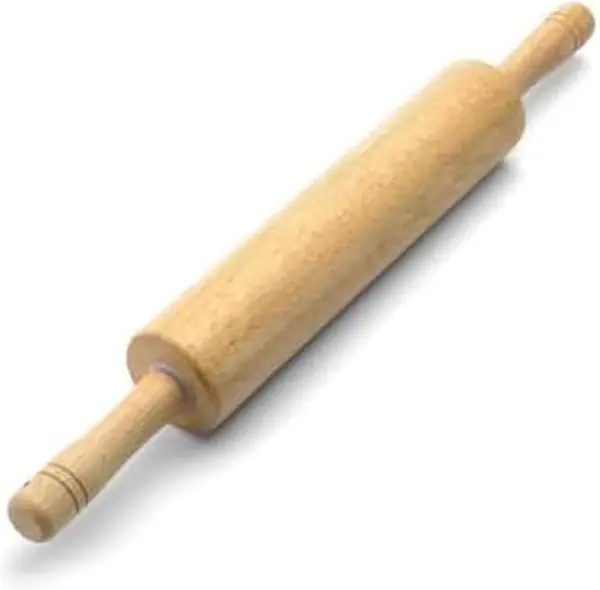
Farberware Classic wood rolling pin with two natural hardwood handles

Handles and leverage

Bake Score 97/100
Weight
1 lb
Style
Handled hardwood
Barrel Length
10 in
Overall Length
17.5 in
View on Amazon

The two chunky handles are the entire argument: they keep your knuckles clear of the counter, they keep your floured hands off the barrel, and they give you something to push against when cold dough fights back. This is also one of the least expensive pins here, which is a large part of why it turns up in so many kitchens.

We recommend it for stiff dough and for anyone who wants leverage more than feel. The trade sits in the measurements: the barrel runs only 10 inches between the handles, so a 17.5-inch pin offers far less contact area than an 18-inch French roller, and a wide sheet of pastry takes noticeably more passes.

A pound of hardwood plus two grips means the pin does a share of the work on butter-heavy dough, and Farberware backs it with a limited lifetime warranty — the only one in this group. It's a workhorse rather than a precision instrument, and it's priced like one.

Worth Noting

  • Handles can work loose with heavy use
Our Verdict

Buy it if you want handles and leverage for stiff dough; we think it's the best-value handled pin in this group.

Check Latest Price
3

J.K. Adams French Tapered Rolling Pin Best Splurge

J.K. Adams French tapered rolling pin in solid maple, 20.5 inches long

Large sheets

Bake Score 96/100
Length
20.5 in
Material
Maple
Barrel Diameter
1.5 in
Style
French tapered, handle-free
View on Amazon

Twenty and a half inches of solid Vermont maple is a lot of pin, and it changes how you work: a full sheet of pastry or a big round of dough gets covered in one pass, with room left at the edges.

The surface is the part we keep coming back to. It's sanded to a slight texture rather than a glassy polish, and that's deliberate — maple like this holds a dusting of flour instead of shedding it, so soft dough releases cleanly without a gluey buildup of extra flour. A bench scraper handles the rest.

At 10.4 ounces it feels substantial without tiring your wrists, and the taper is gentle enough to steer with very little practice. The size is the catch: 20.5 inches needs a deep drawer or a permanent spot on the counter, and a small kitchen will notice it every time.

So is it worth it? For anyone who bakes bread and pastry through the year, we think so. The length covers the big work, the maple holds its shape with ordinary care, and the surface is the best of the tapered pins here for soft dough. A cookie baker with a 14-inch drawer should look at the shorter pins instead.

Worth Noting

  • Most expensive pin in this group
Our Verdict

Our pick for big batches and long-term ownership: the maple, the length, and the surface justify the splurge if you bake often.

Check Latest Price
4

muso wood Beech French Rolling Pin Best Compact

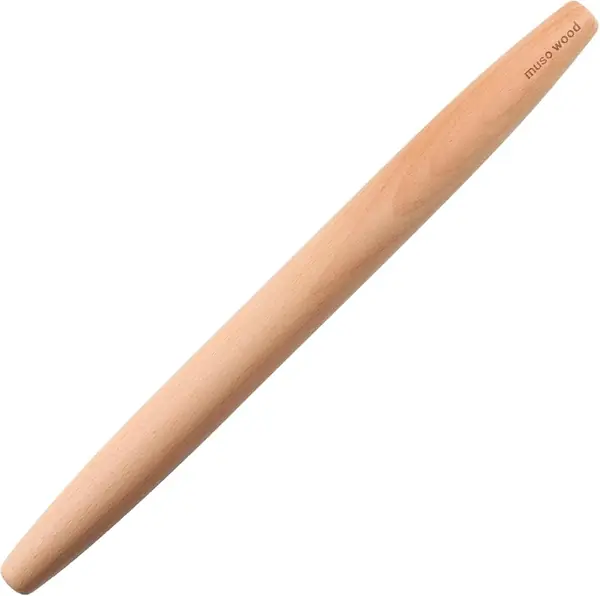
muso wood beech French rolling pin, slim tapered dowel in natural finish

Small kitchens

Bake Score 95/100
Length
15.75 in
Material
Beech
Barrel Diameter
1.37 in
Weight
8 oz
View on Amazon

This is the pin that lives in the drawer rather than on the hook. At 15.75 inches and 8 ounces it feels closer to a dowel than to the bulky pins most of us grew up with — beech, hand-sanded, tapered at both ends — and that's the appeal in a kitchen where the counter doubles as prep space.

We like it as a first pin. It's the least expensive one here, the size is easy to live with, and there's nothing to learn: dust it, roll, wipe it. Three rounds of hand-sanding show in a surface that's uniform from end to end, and it stores in the same drawer as your spatulas, which is more than the 20-inch pins here can say.

Worth Noting

  • Short barrel takes extra passes on wide sheets
Our Verdict

A short, smooth beech pin we recommend for tight drawers and small batches, as long as you are not rolling wide sheets.

Check Latest Price
5

QUELLANCE French Rolling Pin with Mat Best Set

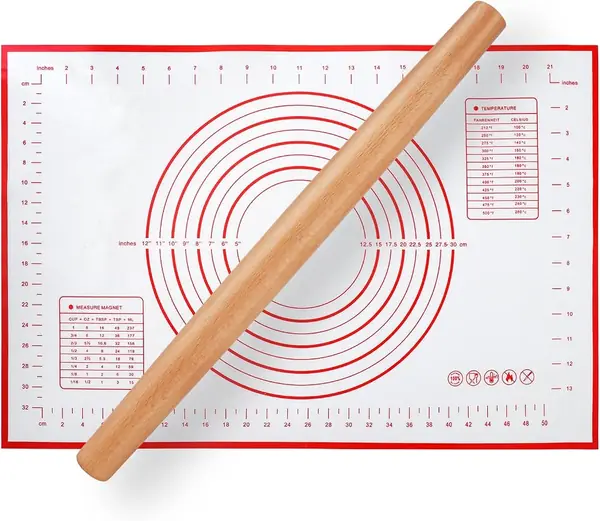
QUELLANCE beech French rolling pin with red silicone baking mat

Mat and pin

Bake Score 94/100
Length
17.7 in
Material
Beech
Weight
12.8 oz
Includes
Silicone mat, 23.6 x 15.7 in
View on Amazon

The mat is the reason to look at this set. It's a 23.6-by-15.7-inch silicone sheet printed with measurement circles, and on a clean, dry counter it grips well enough that dough stays put while you roll. Anyone who has chased a pie crust across a wooden board will get more out of that than the description suggests.

The pin is a 17.7-inch beech French roller and the heaviest tapered model here at 12.8 ounces. That weight does some of the rolling for you — a batch of cinnamon rolls or a wide sheet of pasta takes fewer passes than it does with a lighter pin.

As a package it suits someone setting up a kitchen, or baking on a counter nobody wants to scrub afterward. You spend a little more than a bare pin costs, but the mat is the piece we reach for even when we're rolling with a different pin.

Worth Noting

  • Heavier barrel is slower for small, delicate pastry
  • Mat adds storage bulk to the set
Our Verdict

We like this pair for messy counters and even rounds: the mat does real work, and the pin carries enough weight to help.

Check Latest Price
6

BIDFUL Rolling Pin with Thickness Rings Best for Even Thickness

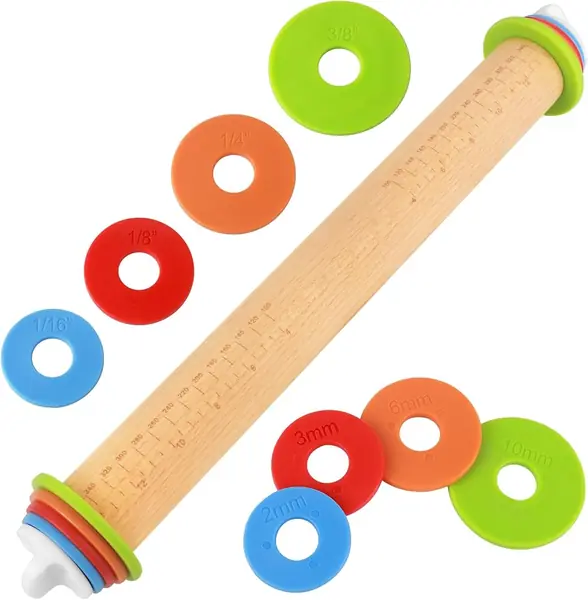
BIDFUL beech rolling pin with removable thickness rings at both ends

Even cookie thickness

Bake Score 93/100
Length
17.32 in
Material
Beech
Width
2.75 in
Thickness Rings
1/16, 1/8, 1/4, 3/8 in
View on Amazon

Four rings — 1/16, 1/8, 1/4, and 3/8 inch — twist onto the ends of this beech pin, and the barrel rides on them so the dough comes out at the same depth every time. For cut-out cookies that have to match, that's the whole argument: no eyeballing, no thick snowman next to a thin reindeer.

We reach for it whenever thickness matters more than feel — cookies, crackers, a sheet of pastry for a tart. Rolled bare, it behaves like any straight pin, though it never gives you the tapered pivot of a French roller. Where it earns its keep is repetition: batch after batch at the same depth, which is what decorated cookies demand.

Worth Noting

  • Only four depths, with a gap between 1/8 and 1/4 inch
Our Verdict

For cookies that have to match, we reach for this one: the rings deliver even thickness without any eyeballing.

Check Latest Price
7

AISOSO French Rolling Pin

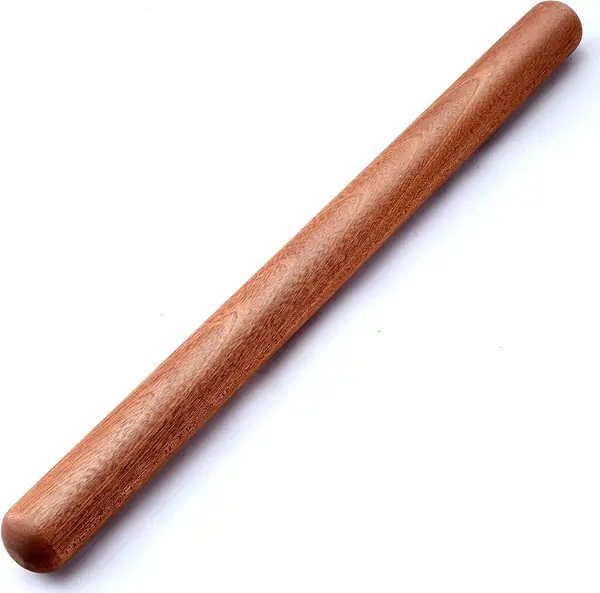
AISOSO French rolling pin, sanded brown wood dowel with tapered ends

Budget long pin

Bake Score 92/100
Length
17.7 in
Material
Wood
Barrel Diameter
1.38 in
Finish
Sanded, no paint or wax
View on Amazon

Bare wood is the pitch here: this pin is sanded and left unfinished — no paint, no wax — so what touches your dough is the wood itself. It arrives smooth, with tight grain and tapered ends, and the color runs darker than the listing photos suggest.

At 17.7 inches it covers a decent round in one pass, and the tight grain takes a dusting of flour evenly, so dough releases without much extra flour. The finish is honest rather than fancy, which is what you want at this price.

Unfinished wood is also the upkeep. With no factory oil or wax coat, the surface wants a rub of food-grade mineral oil when it starts looking dry, and it should be wiped and dried rather than washed. Skip that and the wood goes thirsty and grabs at soft dough.

As a budget first pin or a second one for long sheets, we think it makes sense: you get length, a smooth taper, and a darker finish for less than most of this group. The KARRYOUNG pin at the top of the list gives you a thicker barrel for about the same money.

Worth Noting

  • Slim 1.38-inch barrel covers less area per pass
Our Verdict

A good budget pin for long sheets: we rate the sanded surface, though the bare wood asks for occasional oiling.

Check Latest Price
8

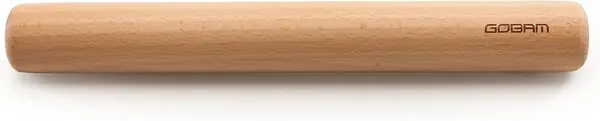
GOBAM Small Wood Rolling Pin Best for Tortillas, Small Batches

GOBAM small beech rolling pin with a burnished natural wood finish

Tortillas, small batches

Bake Score 91/100
Length
11 in
Material
Beech
Barrel Diameter
1.38 in
Finish
Burnished and oiled
View on Amazon

Eleven inches is short for a rolling pin, and that's the whole proposition: it drops into a drawer you already have, it's light enough to work one-handed, and it's sized for tortillas, dumplings, chapati, and small batches of cookie dough rather than a full sheet of pastry.

The beech barrel is burnished and finished with cooking oil, so it feels smooth in the hand and releases dough with a light dusting of flour. There's nothing to adjust — no rings, no handles, no hardware — and cleanup is a wipe and a dry.

We keep this one for people who cook flatbreads weekly or bake in a small apartment kitchen, and for those jobs it does as well as anything here. What it can't do is cover a 16-inch pizza or a sheet of puff pastry in one pass; you'll be repositioning constantly. If that's your baking, buy one of the 17- to 18-inch pins and keep this for tortillas.

Worth Noting

  • Finish can arrive drier or rougher than expected
Our Verdict

We keep this one for tortillas and small batches; it is too short for a full pastry sheet, and that is the whole trade.

Check Latest Price

How We Tested the Wooden Rolling Pins

We started by gathering every wooden pin we could find from major retailers and bakery-supply shops, then narrowed the field by wood species, length, handle style, and cost — setting aside anything with a painted finish that could chip, a seam where water could work its way in, or a hollow, too-light feel. Fourteen made the cut, from an 11-inch pin built for small batches to a 20-inch tapered dowel, and we used them for four months.

Every pin went through the same rotation: a Sunday pie crust made with cold, butter-heavy dough, weeknight pizza, a cookie marathon with kids, fondant for a birthday cake, and chapati. We noted how much extra flour we needed to stop dough from sticking, whether the pin tracked straight or wobbled under pressure, and how much muscle each one required. Handled pins got checked for whether the grips turned freely or seized up once flour worked into them.

Cleanup was observed step by step: we scraped off the dough, wiped each pin with a damp cloth, and looked for paste stuck in the joint between handle and barrel. At the four-month mark we inspected every pin for cracks, splinters, lifting finish, and looseness, and we weighed cost against how each one actually performed — a few inexpensive pins rolled as true as pricier ones. Size got its own note, since a pin that won't fit your drawer or clear your dough is a nuisance no matter how well it's made.

How to Choose a Wooden Rolling Pin

Start with your grip: tapered or handled

A French pin is a single tapered dough roller, and your palms sit directly on the barrel. You feel thickness through your hands and pivot by shifting your weight, and there's no joint for flour to pack into. A handled pin moves your hands to the ends, which buys leverage on stiff dough and keeps your knuckles off the counter — but the barrel is shorter than the overall length. Our handled pick measures 17.5 inches overall with only 10 inches between the grips. Choose tapered for pastry and pizza, handled for cold dough and tired hands.

Match the length to your counter and your drawer

A pin around 15 to 16 inches stores easily and handles a 9-inch pie crust without fuss. Seventeen and 18 inches covers a 12-inch pizza round or a standard cookie sheet in one pass, which is why most of our picks land there. A 20.5-inch pin is a different animal: lovely for long sheets, awkward in a shallow drawer. Measure the inside of the drawer, not the outside, and remember that a handled pin's usable length is its barrel, not the number in the title.

Decide who controls the thickness

Pastry depth is the one judgment a plain pin asks you to make, and a tapered barrel gives you more to read — the dough thins under your palms as you work outward. Ring-style pins take the guesswork out: the barrel rides on removable collars, and our adjustable pick offers four depths from 1/16 to 3/8 inch. Rings pay off for decorated cut-out cookies that must bake evenly. For pie crust, pizza, and bread, feel is more useful than a fixed depth.

Wood, finish, and the care that keeps it smooth

Beech, rubberwood, and maple all make sound pins; the difference is grain tightness and how the surface is finished. A lightly textured, sanded surface holds a dusting of flour, and that dusting is what actually keeps dough from sticking. A heavily sealed pin can feel slicker but has less grip on flour. Whatever you buy, plan on a rub of food-grade mineral oil when the wood starts looking dry — the habit, more than the price, is what keeps a pin rolling smoothly.

Frequently Asked Questions

Final Verdict

We tested all of these on pie dough, pizza, and cookies, and the KARRYOUNG French pin is the one we recommend to almost everyone: direct control under your palms, nothing to work loose, and a price at the low end of this group. If you want handles for cold, stiff dough, the Farberware Classic is the better fit. If you bake bread and pastry through the year and want one pin for the long haul, the J.K. Adams maple earns its premium.