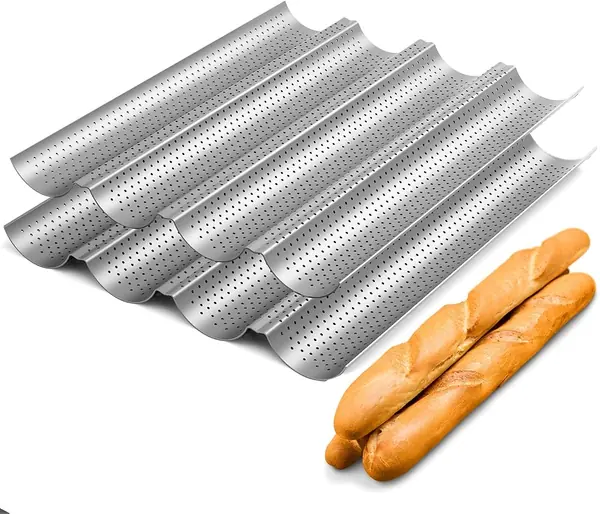
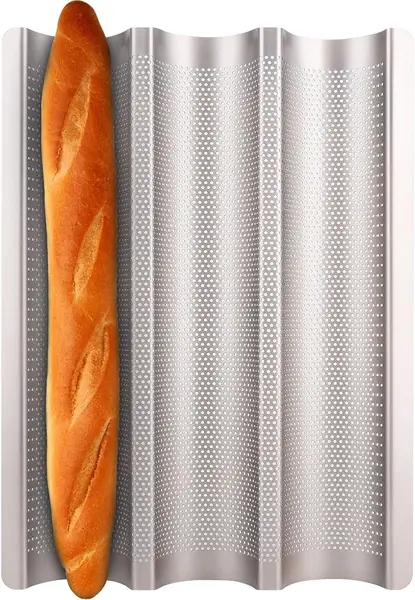
The 9 Best Baguette Pans for Baking of 2026

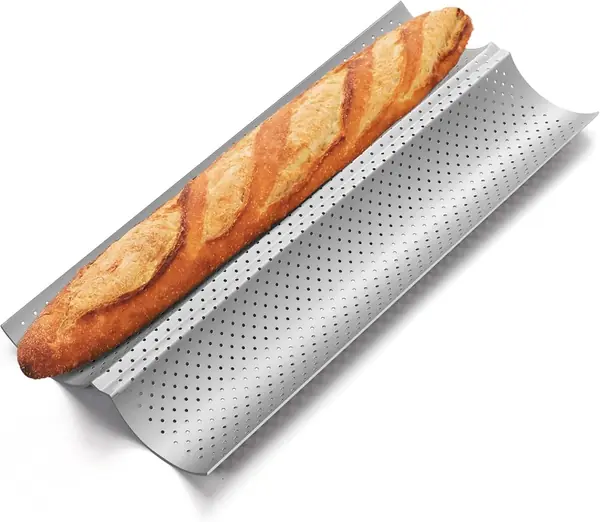
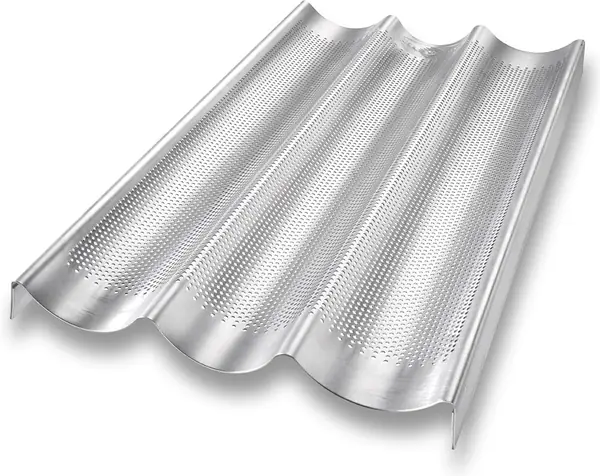
A baguette pan is a perforated cradle: the holes let hot oven air reach the underside of the dough, so the crust sets and browns instead of steaming pale against a flat sheet. That's the whole trick, and every pan here does it. What separates them is wave depth, how evenly the holes are spread, and whether the nonstick survives a dozen Sunday bakes. My long loaves came out golden on top and anemic underneath for years; one switch fixed it.

Between two-, three- and four-wave trays and a couple of two-packs, we baked with 14 baguette pans. Wave depth surprised me: shallow channels let dough slump into a flat oval. Sharp rims are more common than they should be, and a pan that's miserable to clean ends up in the cabinet no matter how good the crust.

Our nine span the footprints and loaf counts worth owning, whether you're baking two loaves on a Sunday or a tray of subs for a crowd.

Our Top Picks

The Best Baguette Pans for Baking

1

Chicago Metallic Commercial II French Bread Pan Best Overall
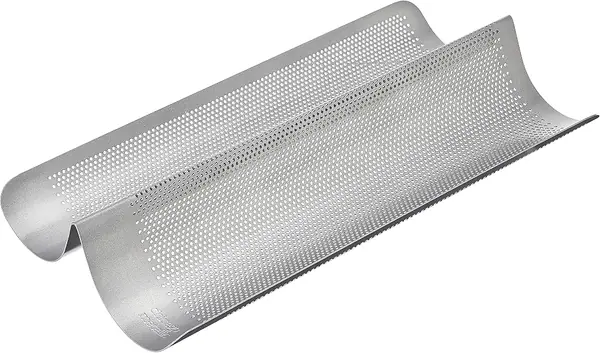
Chicago Metallic Commercial II perforated French bread pan in gray with two long loaf wells

Everyday two-loaf baking

Bake Score 96/100
Loaves
2
Pan Size
16.38 x 8 x 2.5 in
Oven-safe To
450°F
Care
Dishwasher safe
View on Amazon

The case for a perforated pan is simple: hot air has to reach the underside of the loaf. This one does it better than anything else in the group, because the holes run the full length of both wells and the heavy-gauge metal beneath them holds its heat instead of dumping it. We baked a pair of loaves in it and got a shell that crackled as it cooled, browned underneath where a solid pan leaves a pale stripe.

What keeps us coming back is how little the release takes. The dual-layer nonstick let both loaves slide out whole, and the pan wiped clean instead of soaking. That is the difference between a pan you reach for on a Sunday and one that lives in the drawer.

The wells are broader than a classic baguette trough, so loaves come out closer to a fat French loaf than a pencil-thin baton. For sandwiches, garlic bread, and anything you slice thick, that is a plus; if you are chasing a crackly, slim baguette with a sharp edge, the USA Pan is the better tool. It also claims a full rack at 16 inches across, so a second pan waits its turn.

A lifetime warranty, a dishwasher-safe rating, and a 450°F ceiling round it out. We hand-washed ours anyway, mostly out of habit, but it is nice not to have to.

Worth Noting

  • Bakes only two loaves per batch
Our Verdict

We recommend it as the pan to buy first: broad wells, a crackling crust, and a coating that lets loaves out whole.

Check Latest Price
2

KITESSENSU 4-Loaf Baguette Pan Best for Baking a Batch

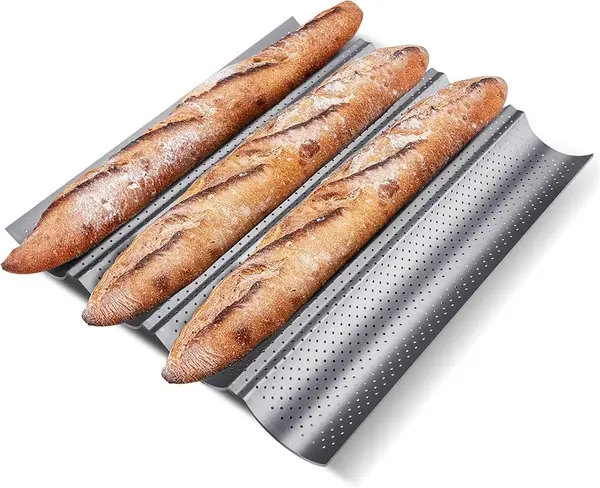
KITESSENSU nonstick carbon steel baguette pan in silver with four perforated loaf wells

Batch baking

Bake Score 95/100
Loaves
4
Pan Size
15 x 13 x 1 in
Oven-safe To
450°F
Care
Hand wash
View on Amazon

Four wells across a 15-by-13-inch tray is the most capacity you get from a single pan here. It goes into the oven once and comes out with a week's worth of bread, which is the whole argument if you bake on a schedule and freeze the surplus.

We have had good results with it. The perforations do their work on the bottom crust, the nonstick lets a shaped loaf out without a knife run around the edge, and the curved wells hold a soft dough steady through the final rise. It is also one of the easiest pans here to wash, which matters more than it sounds when you are baking every weekend.

The one thing to know is that the wells are shallow. A slack, over-proofed dough will sag through the holes and weld itself to the pan, and no coating saves you. Shape firmly, keep the dough on the stiff side of your recipe, and cut the final rise short if it looks loose.

Fifteen inches is a touch shorter than the longest baguettes here, so loaves come out slightly stubby, and the ten-year warranty assumes you hand wash it. Both are fair trades for the capacity.

Worth Noting

  • Hand wash only
  • Loaves top out at 15 inches
Our Verdict

We recommend it to anyone who bakes in batches: four wells, dependable release, and a ten-year warranty behind the coating.

Check Latest Price
3

USA Pan 3-Loaf Baguette Pan Best for Classic Thin Baguettes

USA Pan aluminum perforated baguette pan with three long nonstick wells and a rolled rim

Thin classic baguettes

Bake Score 94/100
Loaves
3
Pan Size
16 x 9.5 x 2 in
Oven-safe To
450°F
Well Width
3 in
View on Amazon

Three inches across and 16 inches long: these are the narrowest, longest wells in the group, and they make the shape most of us mean when we say baguette. We noticed it the moment a loaf came out, slim and even, with color on the sides as well as the top.

The aluminum body is the other half of the appeal. Aluminum moves heat fast, so the dough sets quickly and keeps the oven spring it built instead of spreading sideways. The nonstick silicone coating is made without PFAS, PTFE, PFOA, or BPA, which is the sort of detail worth paying attention to on a pan that spends an hour at a time in a hot oven.

It is hand wash only, and the nonstick is good rather than magic: a loaf that sat in its well while we mixed the next batch came out with a bit more grip, so a light brush of oil before loading is cheap insurance. Three loaves per bake is also the fewest of any multi-well pan on this page.

Worth Noting

  • Hand wash only
  • Three loaves per bake
Our Verdict

We point thin-baguette bakers here: long narrow wells, fast aluminum heat, and a coating free of fluorinated chemicals.

Check Latest Price
4

Hesanzol 3-Loaf Baguette Pans, 2-Pack Best Two-Pan Set

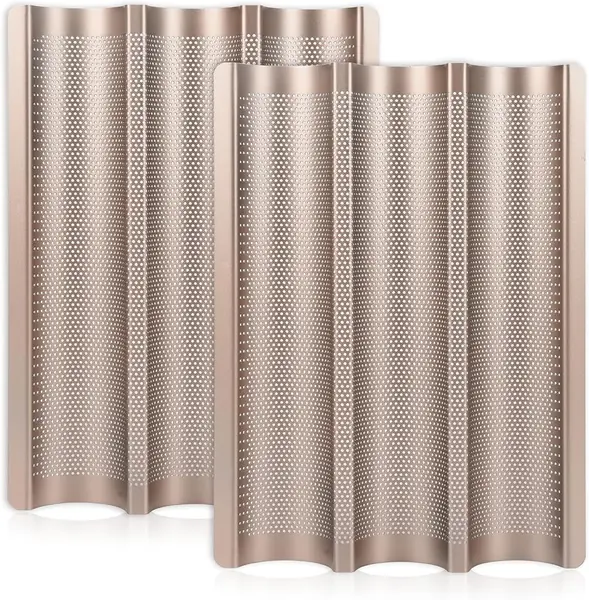
Hesanzol gold carbon steel baguette pans, two perforated trays with three wells each

Two-pan setups

Bake Score 93/100
Loaves
3 per pan, 2 pans
Pan Size
15 x 11 x 1 in
Care
Dishwasher safe
Material
0.8 mm carbon steel
View on Amazon

Two pans in one box changes a baking routine more than any single upgrade on this list. One pan holds the shaped dough through its final rise while the other is in the oven, so you are never standing at the counter waiting for a tray to cool.

We were struck by how solid they feel. The carbon steel is 0.8 mm with a strengthened, rolled edge, the kind of pan that does not flex when you pick it up loaded, and the gold finish looks better in person than a listing photo suggests. Six loaves of capacity across the pair, dishwasher safe, and a two-year warranty make this the set we suggest to anyone building up a small baking habit or a side business.

The coating is the soft spot. It does not have the longevity of the best finishes here, and it can wear at the wells after months of steady use. Treat these like a good skillet: no metal utensils, no scouring pad, and hand wash them even though the label allows otherwise.

Worth Noting

  • Coating can wear at the wells
Our Verdict

We suggest the pair for two-pan bakers: six loaves of capacity, steel that will not warp, and a finish that earns its place on the counter.

Check Latest Price
5

Yupjlia 2-Loaf Baguette Pan Best for Small Ovens

Yupjlia narrow silver baguette pan with two perforated wells for 15-inch loaves

Small ovens

Bake Score 92/100
Loaves
2
Pan Size
15 x 6.3 x 0.94 in
Oven-safe To
446°F
Care
Hand wash
View on Amazon

Six and a third inches wide is the number that matters. Most four-well pans here are 13 inches across and claim the whole rack; this one slides in beside a roasting pan, and it still bakes two full 15-inch loaves. We like it for small kitchens for exactly that reason.

The baking holds up, too. The perforated floor browns the bottoms evenly, the nonstick released both loaves without a nudge, and the wells are deep enough that a soft dough does not pancake out the sides the way it will on a flat sheet. It is the pan that made us stop treating a narrow oven as a reason to skip shaped loaves.

What you give up is capacity and a little refinement: two loaves per bake, hand wash only, and a gauge that is not as thick as the Hesanzol or CHEFMADE. None of that matters if the alternative is a wider pan that will not fit.

Worth Noting

  • Hand wash only
  • Two loaves per bake
Our Verdict

We reach for it when the oven is small: full-length loaves from a pan narrow enough to store in a crowded cabinet.

Check Latest Price
6

Eparé French Baguette Bread Pan Best for Very Hot Ovens

Eparé silver carbon steel baguette pan with three perforated wells and a cut rim

High-heat baking

Bake Score 91/100
Loaves
3
Pan Size
15 x 11 in
Oven-safe To
500°F
Care
Dishwasher safe
View on Amazon

A 500°F rating is the highest in this group, and it is not decoration. It means you can preheat hard, slide the pan into a properly hot oven, and not spend the bake wondering whether you are cooking the coating along with the bread.

We also appreciated how little the bread fought us. The perforated carbon steel browned the undersides evenly, three wells give a useful batch, and the pan goes in the dishwasher when you are done. For anyone chasing a blistered, dark crust at high heat, this is the one we point to.

The trade-off is heft. At 0.5 mm the steel is thinner than the sturdiest pans here, so it wants two hands and a straight lift when it is loaded, and it will flex a little when hot. Treat it gently; the extra heat headroom is worth the care.

Worth Noting

  • Thinner 0.5 mm steel than the sturdiest picks
Our Verdict

We point high-heat bakers here: the top temperature rating in the group, even browning, and a surface that releases without grease.

Check Latest Price
7

CHEFMADE 3-Wave Baguette Pan Best for Slim Batons

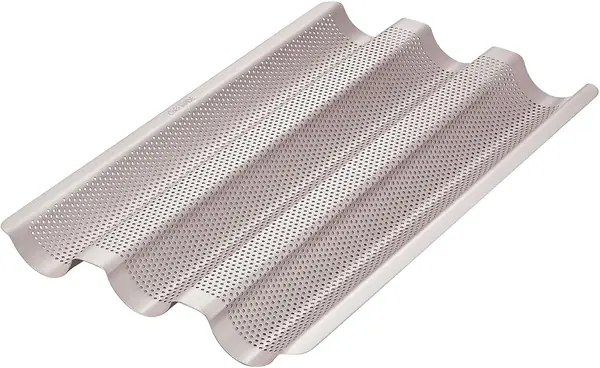
CHEFMADE champagne gold carbon steel baguette pan with three perforated wave channels

Slim batons

Bake Score 90/100
Loaves
3
Pan Size
15.2 x 9.6 x 0.98 in
Oven-safe To
428°F
Channel Width
2 in
View on Amazon

Two-inch channels take a side in the long argument over what a baguette pan should produce: a slim, crackly baton or a broader loaf with more crumb. The CHEFMADE goes slim, and it does that shape convincingly.

The build is the pleasant surprise. It is 0.8 mm carbon steel with a strengthened, rolled edge, so it feels heavier in the hand than most of this group, and the champagne-gold finish is handsome enough to leave on an open shelf. The silicone coating is made without PTFE or PFOA, three wells run the full 15 inches, and nothing stuck when we turned the loaves out.

Two limits are worth knowing. The rated ceiling is 428°F, the lowest here, so it is the wrong pan for a blasting-hot bake; and the narrow channel that makes slim baguettes makes a tight squeeze for a fat sourdough loaf or a hoagie roll. If your bread runs broad, the Chicago Metallic is the better fit.

Worth Noting

  • Lowest heat ceiling here at 428°F
  • Channels too narrow for fat loaves
Our Verdict

We recommend it for slim, classic batons: the heaviest-feeling steel in the group and a finish worth leaving on the counter.

Check Latest Price
8

Tiawudi 4-Loaf Baguette Pans, 2-Pack

Tiawudi silver baguette pans, two perforated carbon steel trays with four wells each

First baguette pan

Bake Score 89/100
Loaves
4 per pan, 2 pans
Pan Size
15 x 13 x 1 in
Oven-safe To
450°F
Gutter Width
2.8 in
View on Amazon

Two pans, four wells each: eight loaves' worth of hardware for about what a single pan costs elsewhere in this group. That arithmetic is the whole pitch, and it is a good one if you are new to shaped loaves and not ready to commit.

We got decent bread out of them. The 2.8-inch gutters handle sub rolls as easily as baguettes, the perforations brown the bottoms properly, and once we had brushed the wells with oil, nothing stuck. Loaves held their shape through the final rise, which is more than we expected from pans this light.

Light is the operative word. The steel is thin, the corners are sharp enough to mind, and the coating is the weak point: it can flake onto the underside of a loaf after enough bakes. Grease the wells every time, skip the dishwasher, and retire the pans when the surface starts to go. For occasional baking, that is a fair trade.

Worth Noting

  • Coating can flake onto bread
  • Thin steel with sharp corners
Our Verdict

We suggest it as a low-risk first buy: two pans, eight wells, and bread that comes out right as long as you grease them.

Check Latest Price
9

Fulimax 3-Slot Baguette Pan Best for Rolls and Baguettes

Fulimax gold three-slot baguette pan with perforated carbon steel wells

Rolls and baguettes

Bake Score 88/100
Loaves
3
Pan Size
15.15 x 11 x 2 in
Care
Hand wash
Gutter Width
2.77 in
View on Amazon

Three wells with 2.77-inch gutters, a gold finish, and a 15.15-by-11-inch footprint: the Fulimax is the plain, unshowy tray of the group, and plain trays bake bread perfectly well.

We noted the mid-width channels first, because they are the most useful thing about it: narrow enough to shape a baguette, wide enough that a sub roll does not come out square. The carbon steel is described as thicker than standard, the nonstick coating is BPA-free, and it is built like the rest of this class, with a perforated floor and a rolled rim.

What is left is fit. Three wells means three loaves, the gold shows scratches sooner than a plain silver pan will, and there is no dishwasher rating to fall back on. It is a sensible second pan, or a gift for someone who wants a good-looking tray without paying premium money.

Worth Noting

  • Hand wash only
Our Verdict

We suggest it as a solid mid-width three-well pan for bakers who want a good-looking tray and do not mind hand washing.

Check Latest Price

How We Tested Baguette Pans, Loaf by Loaf

We started with a wide sweep of perforated baguette pans, then narrowed by footprint, loaf count, and how much of the baking surface was genuinely ventilated — some trays punch holes down the center strip and leave the flanks solid. Listings with vague sizing or no care instructions got dropped. That left 14 pans, spanning single-loaf molds, three- and four-wave trays, and two-packs.

For three months those pans lived in our home kitchens, mostly on Sunday mornings but also on weeknights when someone wanted sub rolls for dinner. We baked the same high-hydration dough in two pans at once on the same rack, so we could compare how each browned the underside, whether the loaves held a round profile or spread into ovals, and whether the ends caught before the middles were done. We also checked that every pan sat flat on the rack and cleared the oven door on the way out.

Cleanup got its own pass: we washed each pan by hand after every bake, noting whether crumbs released from the perforations or had to be picked out hole by hole, then ran the dishwasher-safe ones through repeated cycles. We ran a fingertip along every rim and hole edge, and a few were sharp enough that we started keeping a towel between hand and pan. To judge durability, we baked each pan at least eight times and watched the coating around the holes for flaking and the wave channels for twisting, since a pan that warps will rock on the rack and bake crooked.

How to Choose a Baguette Pan

Start With Channel Width, Not Loaf Count

Channel width decides the shape more than any other figure on the box. Two-inch wells make a slim, crackly baton; three-inch wells make the sandwich loaf most of us picture; the broadest wells here turn out something closer to a fat French loaf. Measure the bread you actually want, and use the height of your favorite bakery baguette as a proxy.

We lean toward a wider channel because it is more forgiving and takes sub rolls and hoagies as well as baguettes. A narrow pan is only worth it if slim, sharp-edged batons are genuinely the goal.

Count Wells, Then Measure the Oven

Four wells across a 13-inch tray is a lot of bread and even more rack space: it claims the full width of a standard shelf, so a second pan will not fit beside it. Two-well pans around six inches wide slip in next to a roasting pan and store in a drawer.

Before you buy, measure the usable width of your rack and subtract an inch for the oven walls. A pan that only fits on the diagonal is a pan you stop using in February.

Perforations Only Help if the Dough Holds

The holes are what separate a baguette pan from a muffin tin: they let hot air at the underside so the crust sets instead of steaming. They also give a slack dough somewhere to go. Run your recipe wet or let the final rise run long and the loaf can sag into the perforations and weld itself to the pan, and no coating saves you.

Shape firmly, proof until the dough springs back slowly, and bake the first loaf with a slightly stiffer dough than usual while you learn the pan.

Gauge, Warp, and What Happens to the Coating

Thicker steel is the difference between a pan that lasts and one that pings as it heats. The sturdier pans here run about 0.8 mm; the thinner ones flex under a loaded loaf and can arrive out of true, so check the wells before the first bake.

Coatings age too. Silicone-based nonstick, including finishes made without PTFE and PFOA, releases cleanly but still wears at the wells after a few years. Hand wash any coated pan even when the label says dishwasher safe, because detergent and the heat cycle are what kill nonstick first.

Mind the Cut Edges

Perforated pans are stamped, and the rim is a cut edge. On several of these trays it is sharp enough to catch a finger, especially at the corners. Lift a loaded pan with a folded towel rather than bare hands, and grip it by the short sides where there is more metal between you and the edge.

Run a thumb along the rim of a new pan before the first bake so you know where the sharp spot is. It is the one thing about this category we want makers to fix.

Frequently Asked Questions

Final Verdict

If you bake baguettes more than a couple of times a month, the Chicago Metallic is the pan we recommend: broad wells, an evenly browned crust, and a nonstick layer that releases a loaf in one piece. For a thinner baton, the USA Pan's three-inch wells get you there.

Baking four at a time, or working in a small oven? The KITESSENSU and the Yupjlia solve those two problems better than anything else on this page.