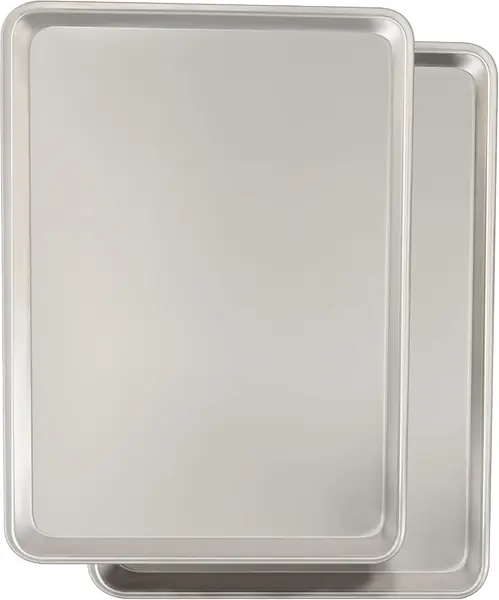
The 4 Best Baking Sheets of 2026

A baking sheet is the most-used pan in most kitchens and the one people think about least — until a cheap one buckles in a hot oven halfway through a batch of cookies. Warping is the failure everyone fears, but thin steel also browns unevenly and flexes under a heavy chicken. A good pan fixes all of it at once: it stays flat, heats evenly, and wipes clean without soaking.

We cooked on 14 of them, from bare aluminum half sheets to coated sets that came with their own cooling racks. Weight surprised me more than coating: heavy-gauge pans with no nonstick at all browned better than lighter coated trays. And "half sheet" is a looser term than you'd expect, so measure your oven rack and your cabinet before you commit.

Our four picks cover both camps — bare aluminum that will outlast most kitchens and coated pans that release cleanly, some with a rack in the box. All of them stayed flat through everything we threw at them.

Our Top Picks

The Best Baking Sheets

1

Nordic Ware Naturals Half Sheet 2-Pack Best Overall
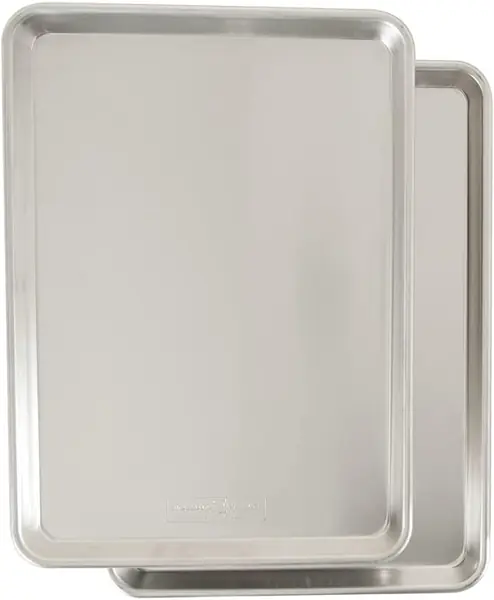
Nordic Ware Naturals aluminum half sheet pans, two-pack, natural finish with steel rims

Everyday oven baking

Bake Score 96/100
Material
Pure aluminum
Set Includes
2 half sheets
Outer Dimensions
17.9 x 12.9 x 1 inches
Baking Area
17.1 x 12.1 inches
View on Amazon

Half sheet is a size before it is a product: about 18 by 13 inches, which is what fits a standard home oven, takes a standard sheet of parchment, and lines up with the racks and silicone mats most kitchens already own. Nordic Ware's Naturals pan is that size, 17.9 by 12.9 inches outside and 17.1 by 12.1 inside, and it arrives two to a pack. That second pan is the detail that makes this our top pick rather than just a good single sheet.

Pure aluminum does the work. It moves heat quickly and evenly, so a tray of cookies browns edge to edge instead of in a ring around the middle, and there is no coating to bubble, chip, or peel into the dough. What we appreciate most on a pan this light is the encapsulated galvanized steel rim: it is easy to pull from a hot oven with one hand, and the steel band around the edge is what keeps the pan from buckling in a hot oven. Nothing here needs protecting from a spatula either, which is more than we can say for a coated pan.

What you give up is cosmetics. Bare aluminum darkens, mottles, and stains, so these will look well used within a month, and that is patina rather than rust, backed by a lifetime limited warranty. Sticky doughs and sugary glazes still want parchment or a light grease, because a bare surface does not release the way a coated one does. In daily use the second pan earns its keep more than we expected: one holds cookies on a rack while the other roasts at a completely different temperature.

Worth Noting

  • Bare aluminum darkens and stains with use
Our Verdict

We recommend this pair as the default for anyone who bakes and roasts weekly: even browning, no coating to peel, and two pans for the money of one coated set.

Check Latest Price
2

USA Pan Extra Large Sheet Pan with Rack Best for Roasting

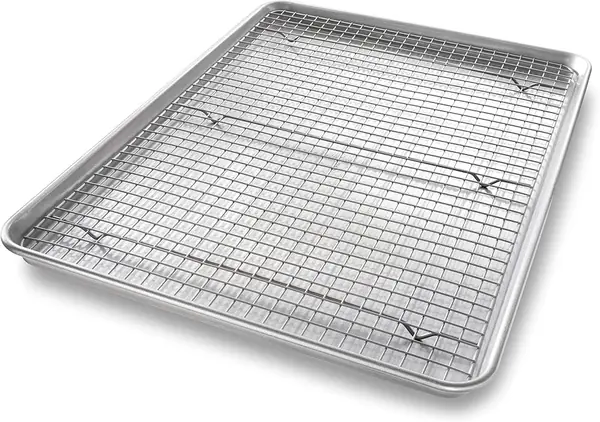
USA Pan extra large aluminized steel sheet pan with matching wire cooling rack

Large-batch roasting

Bake Score 95/100
Material
Aluminized steel
Outer Dimensions
20.75 x 14.75 x 1 inches
Coating
Nonstick, PTFE- and PFOA-free
Cooling Rack
19.75 x 13.62 x 0.5 inches
View on Amazon

The rack is the reason to buy this set. USA Pan pairs a 20.75-by-14.75-inch sheet pan with a bakeable cooling rack that drops inside it, and together they turn a baking sheet into a roasting rig: bacon crisps above the drippings, chicken wings render instead of stewing, and a rib roast can sit on the wire with room to spare. The rack has six raised feet, so it stays put instead of sliding across the pan floor.

The pan underneath is substantial, at 4.5 pounds, with a corrugated surface that lets air move under whatever you are cooking. That corrugation plus the nonstick coating, which is PTFE-, PFOA-, and BPA-free, means food releases cleanly and cleanup is a short soak, though we keep metal utensils away from the surface. This is the pan we reach for when dinner is the job and dessert is not.

Two things to measure against your kitchen. At 20.75 inches long it needs a genuinely large oven, so check the interior width and the door swing before ordering, because it will not clear a compact range. High heat is also where it is least consistent: it holds flat through most roasting, but it can buckle near the top of its range, so don't count on the same rigidity at 450°F that you get at 375°F. For a pan that lives under a chicken or a tray of bacon, that trade is easy to accept.

Worth Noting

  • Extra-large footprint needs a big oven
  • Can buckle near the top of its heat range
Our Verdict

If you roast more than you bake, the rack and the extra inches earn this pan's higher price: bacon, wings, and a big roast all cook better off the pan floor.

Check Latest Price
3

Rottay Baking Sheet with Rack Set Best for Small Ovens

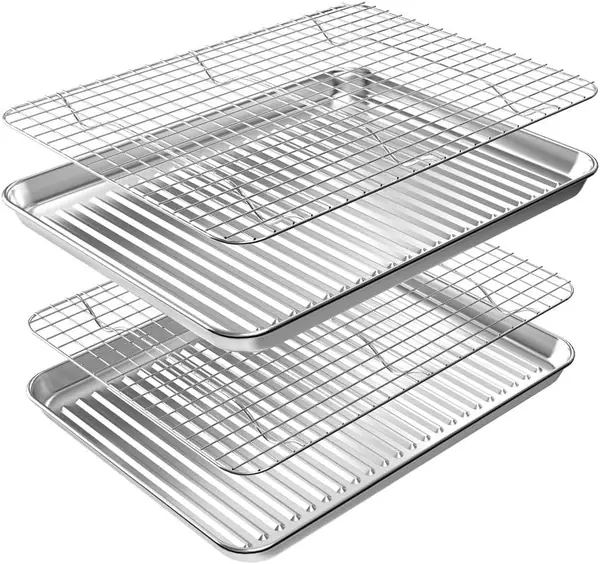
Rottay stainless steel baking sheet set with two pans and two wire racks

Toaster oven baking

Bake Score 94/100
Material
18/0 stainless steel
Set Includes
2 pans, 2 racks
Pan Dimensions
16 x 12 x 1 inches
Rack Dimensions
15.35 x 11 x 0.65 inches
View on Amazon

A 16-by-12-inch pan sounds like a compromise until you try to work an 18-inch sheet into a toaster oven, a convection oven, or a camper's galley. Rottay's set solves that: two pans at 16 by 12 by 1 inch, each with a fitted wire rack and a full rolled rim rather than a shallow lip. It also turns out to be a sensible pair for two people, where a full half sheet is more surface than a weeknight dinner needs.

Both pans are 18/0 stainless steel with no coating at all, which we like for something that gets scrubbed and banged against a sink. The corrugated bottom keeps food off most of the surface, and the racks, welded with dense parallel wires and six raised feet, double as cooling racks on the counter. Stainless does not release like nonstick, so a light film of oil or a sheet of parchment is not optional with sticky food; for vegetables and chicken it is the only prep you need.

Heat is the weak spot. These hold their shape at moderate temperatures, but they can bend around 400°F, so keep them off the hottest rack and let them cool before washing. The racks also want a scrub after anything fatty, since the wires catch grease and there is no shortcut around it. Neither issue is a dealbreaker at this size and this price; both are things to know going in.

Worth Noting

  • Pans can bend around 400°F
  • Racks need scrubbing after roasting
Our Verdict

A good fit for small ovens, camper galleys, and anyone who wants four uncoated pieces: two 16-inch pans and two racks that scrub clean and ask for no special care.

Check Latest Price
4

Umite Chef Aluminum Baking Sheet 2-Pack Best Budget

Umite Chef natural aluminum baking sheet pans, two-pack, with reinforced steel core rims

Budget everyday baking

Bake Score 92/100
Material
Bare aluminum, 18 gauge
Set Includes
2 pans
Pan Dimensions
18 x 13 inches
Oven Safe
Up to 500°F
View on Amazon

Two 18-gauge aluminum pans for less than the coated sets in this guide is the whole pitch, and it holds up. The aluminum is 0.8 mm thick, the rim is a reinforced encapsulated steel core rather than a simple rolled edge, and the pans are rated to 500°F. Nothing is coated, so there is no nonstick surface to scratch through, and the pans simply do the plain-metal job of taking heat and passing it along.

Size is where to slow down. The listing says 18 by 13 inches, though the flat baking area runs closer to 17 by 13, which is enough to matter if you are matching a half-sheet silicone mat, a lid, or a cooling rack. We still think the set is worth it, with one adjustment: cut parchment to size instead of buying fitted liners, and don't order it to match the half-sheet accessories you already own.

Care is the other consideration. Hand washing is recommended because the dishwasher oxidizes bare aluminum and leaves it dull gray, and a paste of baking soda and water handles baked-on residue without scouring. The darkening that comes with use is normal patina, not damage, and it appears quickly. If you want a pair of pans for roasting vegetables and sheet-pan dinners without worrying about the finish, this is the least expensive route to it.

Worth Noting

  • Hand wash recommended to prevent oxidation
  • No rack or mat included
Our Verdict

Two thick aluminum pans for the least money here, and a smart buy if you cut parchment to fit rather than counting on standard half-sheet accessories.

Check Latest Price

How We Tested the Best Baking Sheets

We started with about 40 sheet pans — bestsellers, restaurant supply workhorses, and the models readers ask about most — and narrowed that to 14 by comparing gauge, rim construction, coating, size, and whether a cooling rack came in the box. Price mattered, but a few cheap sets got dropped early because the centers flexed noticeably when we pressed a thumb into them.

Testing ran seven months in our own kitchens, across weeknight sheet-pan dinners at 425 degrees, Saturday batches of sugar cookies at 375, and the occasional broiler session. We weighed and measured every pan, since listed sizes run generous — a couple of the "18 by 13" pans came in closer to 17 inches, which changes how many dough balls fit in a row. Each pan also went into a 450-degree oven empty for 20 minutes so we could listen for the pop of a rim buckling, then checked it against a straight edge once it cooled. We watched how cookies browned from edge to center, whether vegetables at the corners cooked at the same rate as the ones in the middle, and how a pan handled a whole chicken without bowing when we lifted it out.

Cleanup got its own pass. We baked cheese until it caramelized, let it cool, and scrubbed with a sponge and dish soap to see what lifted easily and what left a stain; several pans also ran through repeated dishwasher cycles to check for dulling and spotting. For the sets with racks, we confirmed the rack sat level inside the rim, fit a full batch, and came out of a hot oven without rusting. Over seven months we tracked scratches, coating wear, and discoloration, and compared the per-pan cost of each set to see what the money actually buys.

How to Choose Baking Sheets

Metal First, Coating Second

Aluminum is the material to beat for even browning. It moves heat quickly and spreads it across the pan, which is why the bare aluminum pans here turn out a tray of cookies with fewer pale spots than thinner steel. Aluminized steel, like the USA Pan, is heavier, heats more slowly, and holds temperature well under a roast. Coatings are a separate decision from metal: nonstick makes release and cleanup easy and is the right call if you bake a lot of sticky, sugary things, but it has a working life, and chips or peeling end it.

Our position is simple. Buy bare aluminum or stainless for the pan you plan to keep, and add a coated pan or a silicone mat when release matters more than longevity. Bare metal stains and needs parchment for sticky dough; it also never fails the way a coating does.

Match the Pan to Your Oven, Then Your Recipe

A half sheet, about 18 by 13 inches, is the size most home ovens are built around, and unlike a rimless cookie sheet its 1-inch rim holds vegetables and pan juices. An extra-large pan around 20 inches long needs a big oven and a door that opens wide. If your oven is a toaster model, a convection unit, or the small range in an apartment, a 16-by-12 pan is the one that actually gets used.

The trap is the label. Half sheet gets applied to pans that are an inch short, so measure the flat baking area against the liner, lid, or rack you plan to use. And two pans side by side need roughly an inch of clearance so air can move between them.

Why Pans Warp, and What Stops It

Warping is thermal shock. A thin pan goes into a hot oven, one face expands faster than the other, and the sheet pops and buckles. Heavier gauge, a rolled or encapsulated rim, and a corrugated base all resist it, which is why the thickest pans here hold flat at 425°F while the thinner stainless set can bend near 400°F.

Technique matters as much as the pan. Let a hot sheet cool on the stovetop before it meets water, skip the sink-full-of-cold-water shortcut, and don't slide a chilled pan straight into a hot oven. If you routinely roast at the top of the range, expect even a good pan to flex now and then.

Racks, Mats, and What Comes in the Box

A wire rack turns a baking sheet into a roasting pan: food sits above the drippings, bacon crisps, and the rack doubles as a cooling rack when it comes out. It also gives you a second thing to scrub. Silicone mats do for bare aluminum what a coating does, easy release and quick cleanup, without altering the pan, and they are cheaper to replace than a pan is.

Our rule: buy the rack if you roast meat or vegetables more than once a week. Skip it and put the money into plain pans if your oven mostly sees cookies and sheet cakes.

Frequently Asked Questions

Final Verdict

The Nordic Ware Naturals half sheet two-pack is the pair we point most people to, because it handles the everyday job, cookies to sheet-pan dinners, with even heat, a rim that stays flat, and nothing to peel. Choose the USA Pan extra-large set with its rack if roasting is the main event and your oven has the room, or the Rottay set's 16-inch pans if it doesn't.

Whichever you pick, buy two pans before you buy one fancy one. Rotation is what keeps a batch moving, and it is the cheapest upgrade in the kitchen.