The 5 Best Bread Makers with Ceramic Pans of 2026

A bread maker either earns its counter space or becomes an expensive breadbox. I’ve had both kinds — the ones that knead reliably and the ones that wobble across the counter and leave a tough crust. The difference often comes down to the pan: ceramic releases a loaf cleanly without a PFAS coating and holds up after repeated cycles. The right machine turns a bag of flour into a week of breakfasts; the wrong one sends you back to the bakery.

We baked white, whole wheat and gluten-free loaves in 12 machines, mixed pizza dough in them and tried the jam settings. We paid attention to what you notice after living with a bread maker: whether the pan still releases cleanly after a dozen washes, whether the controls and manual assume prior knowledge, and whether the unit stays put during a heavy knead. Size matters too — an inch too tall and it won’t fit under your cabinets, and a smaller footprint means you’ll actually leave it out.

Our Top Picks

The Best Bread Makers with Ceramic Pans

1

KBS Pro 710W Bread Maker Best Overall
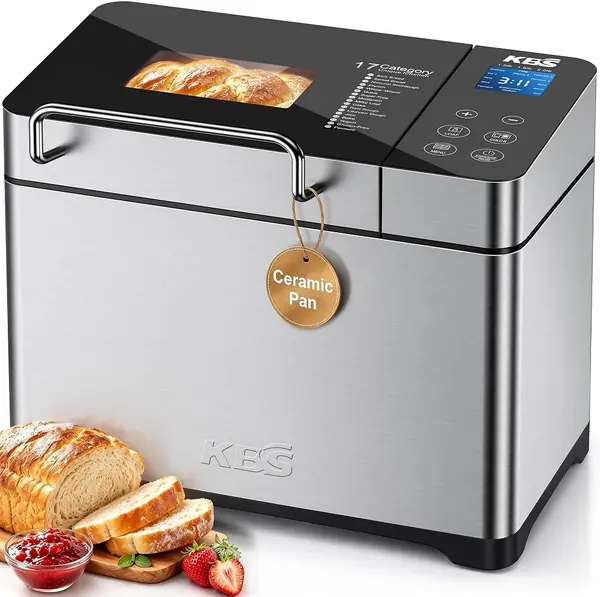
KBS Pro stainless steel bread maker with ceramic pan, glass touch panel, and nut dispenser

Family-size loaves

Bake Score 90/100
Pan
Ceramic pan and paddle
Capacity
2 lb
Programs
17
Power
710 watts
View on Amazon

Every machine on this list has a ceramic pan; the KBS is the one that coats the paddle to match, so the blade scraping through every loaf is ceramic too. Add a 710-watt motor, 17 programs, and a stainless dispenser that tips nuts and raisins in mid-knead, and you have the most complete machine in this group. We like the dispenser more than we expected to, because raisin bread stops being a recipe you have to stand next to.

Three loaf sizes and three crust settings cover everything from an everyday loaf to a full two-pounder, and the pan seats into a cradle in the base that keeps a stiff whole-wheat dough from sloshing around. It is the heaviest machine we recommend at 14.7 pounds, so give it a permanent spot rather than a cabinet shelf. Care is simple but not optional: never lever a stuck loaf out with a knife, because a ceramic lining chips exactly where it is pried.

The 15-hour delay and the hour of keep-warm are the settings we lean on most: load it before bed and a warm loaf is waiting at seven. The detail that sold us is smaller, a 15-minute power recovery, so a flicker in the kitchen does not scrap the loaf mid-rise.

Worth Noting

  • Instructions and recipe book are hard to follow
  • Paddle can be stubborn to remove from a baked loaf
Our Verdict

Our top pick for households that bake often: the strongest motor here, a ceramic paddle to match the pan, and the only automatic nut and raisin dispenser.

Check Latest Price
2

Elite Gourmet Ceralast Bread Maker Best Value

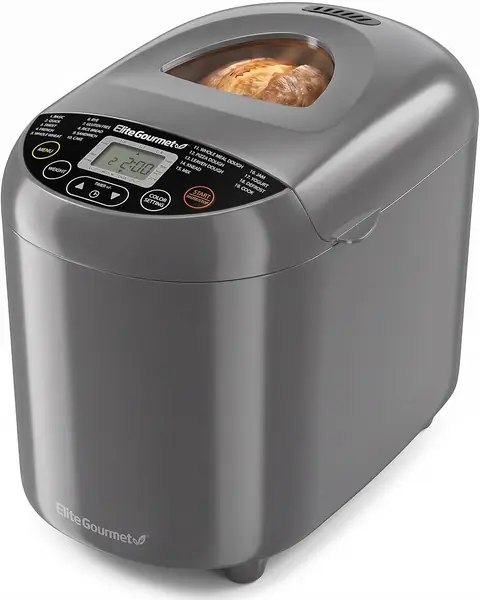
Elite Gourmet steel gray bread maker with PFAS-free Ceralast ceramic pan and kneading blade

Small households

Bake Score 89/100
Pan
PFAS-free ceramic coating
Capacity
1, 1.5, and 2 lb
Programs
19
Weight
8.8 lb
View on Amazon

Most machines here are built for a family that finishes a loaf in two days. This one is for the other household: it bakes 1-, 1.5-, and 2-pound loaves, but the small setting is where it earns its keep. A short loaf that is gone before it stales is the real argument for a bread machine when you cook for one or two.

At 8.8 pounds it is the lightest machine in this group by nearly six pounds, and we were surprised by how much that changes daily use: lifting it out of a cabinet with one hand is the difference between using it on a Tuesday and leaving it in the cupboard. Nineteen programs include jam and yogurt alongside the bread cycles, and the Ceralast pan and blade are PFAS-free ceramic, so cleanup is the same rinse-and-wipe the pricier machines get.

There is no dispenser to fill and no second paddle to keep track of. Pick a size, a crust color, and a program, and the machine takes it from there. For a first bread maker or a small kitchen that only ever needs one loaf at a time, that simplicity is worth more than the extras on the KBS. The 15-hour delay and the 60-minute keep-warm are here too, so an overnight loaf works the same way.

Worth Noting

  • Loaves come out smaller than the pan suggests
  • Lid feels flimsy for the money
Our Verdict

We point one- and two-person households to this one: it is the lightest machine here, the least expensive, and it bakes the small loaf you will actually finish.

Check Latest Price
3

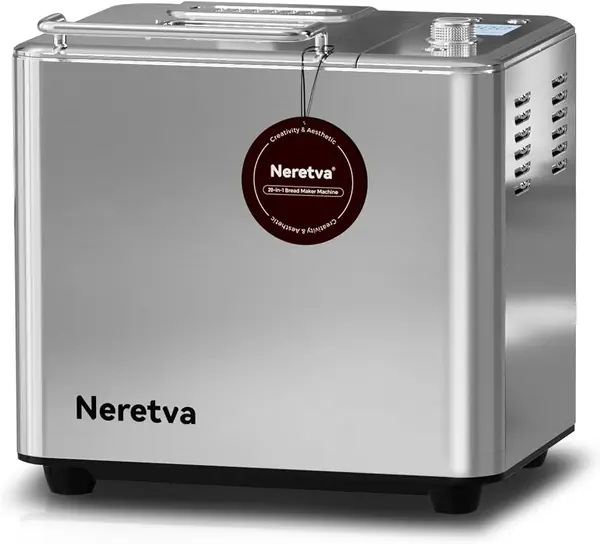
Neretva 20-in-1 2LB Bread Maker Best for Tight Counters

Neretva stainless steel bread maker with ceramic pan, dual heaters, and included measuring tools

Tight counters

Bake Score 88/100
Pan
Nonstick ceramic
Capacity
2 lb
Programs
20
Footprint
11"D x 7.91"W x 9.25"H
View on Amazon

Counter space decides this one. At 7.91 inches wide the Neretva is three to six inches narrower than every other machine here, which is the difference between fitting beside the sink and living in a closet. It is shorter too, so it tucks under an upper cabinet as long as you leave room for the lid to swing.

Two heaters, one under the pan and one above it, wrap the loaf in heat instead of baking it from the bottom up, and the top crust browns without any flipping. Twenty programs cover white, French, whole wheat, gluten-free, potato, and corn breads, and the 15-hour delay with an hour of keep-warm works the way it does on the KBS. Brushed stainless and rounded edges make it the best-looking machine in this group, for whatever that is worth in your kitchen.

What we appreciate most is the kit: two kneading paddles, a removal hook, and a heat-resistant mitt. The hook matters more than it sounds, because it frees a jammed paddle without a knife going anywhere near a ceramic pan, and the spare paddle means one lost blade does not retire the machine. That is a generous box for the smallest body here.

Worth Noting

  • Bakes a smaller loaf than a 2-lb pan implies
Our Verdict

We recommend it for a narrow strip of counter: the smallest footprint here, top-and-bottom heaters, and a full set of tools in the box.

Check Latest Price
4

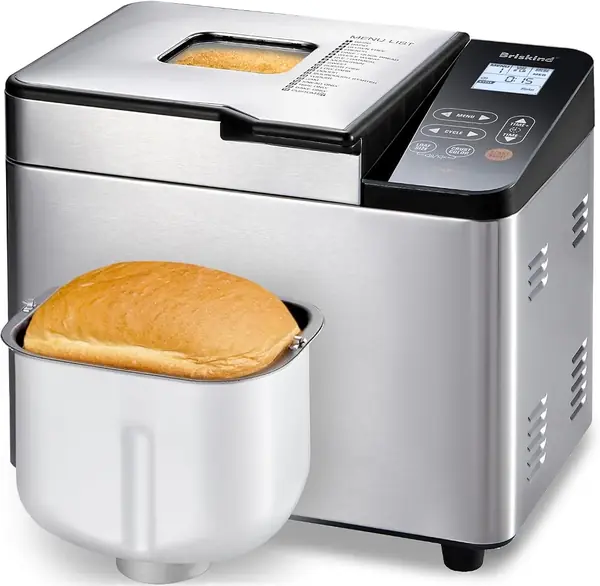
Briskind 19-in-1 Bread Maker Best for Sandwich Loaves

Briskind stainless steel bread maker with horizontal ceramic pan and black glass touch panel

Sandwich-style slices

Bake Score 85/100
Pan
Ceramic nonstick, horizontal
Capacity
2 lb
Programs
19
Power
600 watts
View on Amazon

The Briskind's pan lies flat instead of standing upright, so the loaf comes out long and low, closer to a loaf-pan loaf than the tall brick most machines turn out. We think that shape is the quiet reason to pick it: the slices land sandwich-sized without trimming, and the crust has more surface to brown. The glass touch panel is the other thing we noticed, with white-on-black lettering you can read from across the kitchen at six in the morning.

Nineteen programs, three loaf sizes, and three crust colors cover the usual ground, and the 15-hour delay with an hour of keep-warm matches the rest of the group. It runs at 600 watts in a stainless body with a grounding plug, overload protection, and overheat protection, and the knead is a hum rather than a growl. It is a newer name than KBS or Elite Gourmet, so you are buying on the design and a short record rather than a long one, which is why the loaf shape and the clear instructions are the reasons to choose it.

Worth Noting

  • Pan can be stiff to lift out of the well
Our Verdict

We choose it for the loaf shape: a horizontal pan bakes sandwich-ready slices, and the clear panel and quiet motor make it easy to live with.

Check Latest Price
5

VEVOR 19-in-1 Bread Maker Best for Simple Everyday Loaves

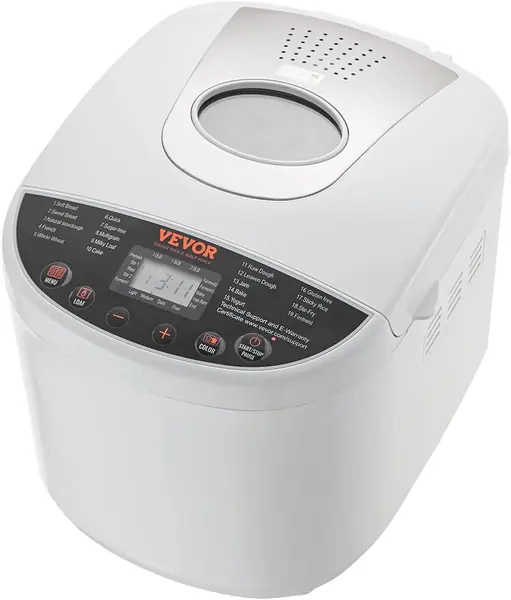
VEVOR white bread maker with food-grade ceramic inner pot and digital control panel

Simple everyday loaves

Bake Score 82/100
Pan
Food-grade ceramic
Capacity
1.98 lb
Programs
19
Power
650 watts
View on Amazon

Start with the manual: it is rough, the baking chart in it is off the mark, and following it closely is how you end up with a dense loaf and a bad mood. We stopped reading it after the first bake and got better bread for it. Weigh your ingredients, use a recipe you trust, and the machine does its job with 19 programs, three loaf sizes, three crust colors, and a food-grade ceramic pot that lets a loaf drop out in one piece.

For a price near the bottom of this group you get 650 watts, a 0.9 kg pan, and no automatic dispenser; instead a reminder beep tells you when to add nuts or cheese by hand, which is the next best thing. Nothing about the finish suggests luxury, and that is fine by us. For a baker who already has recipes that work, the trade is fair: less money, fewer features, the same ceramic release.

Worth Noting

  • Lid hinge feels flimsy
Our Verdict

We keep it on the list for the price: a food-grade ceramic pot and 19 programs for very little money, provided you bring your own recipes.

Check Latest Price

How We Tested Ceramic-Pan Bread Makers

We started by researching the ceramic-pan segment — filtering out machines with non-ceramic or unknown coatings, then narrowing by capacity (most were 2 pounds), preset variety, and price. We looked for models with gluten-free settings, delay timers, and keep-warm functions, since those are the features shoppers actually compare. We also weighed which features felt worth paying for and which were filler. From there, we bought 12 machines at retail and brought them into our kitchens.

For eight months, we baked at least three loaves a week in each machine — white sandwich bread on weekdays, whole wheat and gluten-free on weekends, plus dough for pizza and jam cycles when the model offered them. We measured counter footprint and height, then checked clearance under standard upper cabinets. To test stability, we set each machine on a granite counter and watched whether it shifted during the knead cycle. We also noted how clearly the manual explained first-time use, and whether the display and buttons made sense without it.

After every bake, we washed the ceramic pan by hand and inspected it for scratches or sticking. We ran each machine through at least 20 cycles to see if the nonstick surface degraded or the motor strained. Bread quality was judged on rise, crust color, and how evenly the loaf baked — a pale top or a dense center counted against a model. We also tracked reliability: did the timer actually start when programmed, and did the keep-warm function dry out the loaf? The machines that scored best were the ones that stayed consistent from the first loaf to the twentieth.

How to Choose a Bread Maker with a Ceramic Pan

What Ceramic Means on a Bread Pan

In this category, ceramic almost always means a ceramic coating sprayed over an aluminum pan rather than a solid ceramic vessel. That coating is what releases the loaf cleanly, and it is also the part that wears, chipping at the rim or around the paddle shaft if a loaf is pried out with a knife. Makers have moved toward PFAS-free formulations, with Elite Gourmet's Ceralast coating the clearest example here; the claim is worth having, though it tells you nothing about how thick or tough the coating is.

Judge the pan by feel and by whether the maker sells replacements, then protect it: no metal utensils, no knife near the rim, and use the paddle hook that comes in the box.

Match the Loaf to Your Household

A 2-pound pan is a maximum, not a promise. Most bread machines here offer 1-, 1.5-, and 2-pound settings, and the small one is what gets used in a one- or two-person kitchen: a loaf eaten in three days beats a bigger one that goes stale. If you feed four or freeze half, buy for the full 2 pounds and accept the counter space that comes with it.

Pan orientation matters as much as capacity. A horizontal pan, like the one on the Briskind, bakes a long, low loaf with sandwich-shaped slices. Vertical pans turn out tall, square slices that toast neatly but need trimming for a sandwich. Neither is better, but you will live with the shape every time you cut into a loaf.

Programs, Delay Timers, and Keep-Warm

The cycles that earn their space are basic white, whole wheat, gluten-free, and dough. Jam, yogurt, and cake settings are pleasant extras, not reasons to choose one machine over another. What you use daily is the delay timer and the keep-warm: a 15-hour delay means a loaf finishes before your alarm, and an hour of keep-warm means it is still warm when you get to it.

The trap is reading the program count as a quality signal. A 20-program machine with a thin pan and a booklet you cannot follow is worse than a 19-program machine you understand on the first loaf. Count the cycles you will actually press and treat the rest as marketing.

Where It Will Live

Measure twice: the strip of counter you have in mind and the cabinet it goes into. Stated weights here run from 8.4 to 14.7 pounds, which is the difference between one-handed storage and a permanent parking spot. Leave clearance above for the lid to swing and behind the machine for the vents.

Then think about the knead, which is the loudest part of any cycle and the point where a machine can creep. A silicone mat or a grippy shelf liner keeps it where you put it, and it should never sit at the edge of the counter. If noise matters in your kitchen, it is the motor you will hear, not the bake.

Frequently Asked Questions

Final Verdict

Buy the KBS Pro if you bake often and want one machine to do the whole job: the strongest motor here, a ceramic paddle to match the pan, and a dispenser that handles the raisins for you. It is the one we recommend first.

If a loaf lasts your household a week, the Elite Gourmet saves money and nearly six pounds and bakes the smaller loaf you will actually finish. If your counter is a narrow strip, the Neretva fits where the others do not.