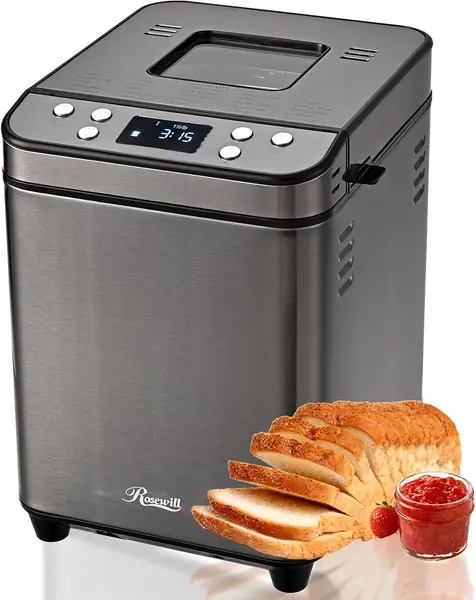
The 8 Best Bread Makers of 2026

A bread machine is one of the few kitchen appliances that either earns its counter space or quietly becomes a very expensive breadbox. I've watched both happen. What separates the keepers isn't a 20-program menu — it's whether the loaf is worth slicing and eating plain, and whether you can start one half-asleep on a Sunday morning.

Nine machines baked white sandwich loaves, whole wheat, gluten-free and enough dough for pizza night in our kitchen, and the pattern held: the ones that earn their keep are simple to run, easy to clean, and consistent loaf after loaf. Two things nobody tells first-time buyers — the paddle leaves a hole in the bottom of every loaf, and the first bake is always a learning loaf.

The features you'll actually notice are quieter than the marketing: a delay timer so bread is warm at 7 a.m., a dispenser that drops nuts in at the right moment, dual heaters for an even crust, and a motor quiet enough to run overnight in a small kitchen.

Our Top Picks

The Best Bread Makers

1

KitchenArm 29-in-1 Bread Machine Best Overall
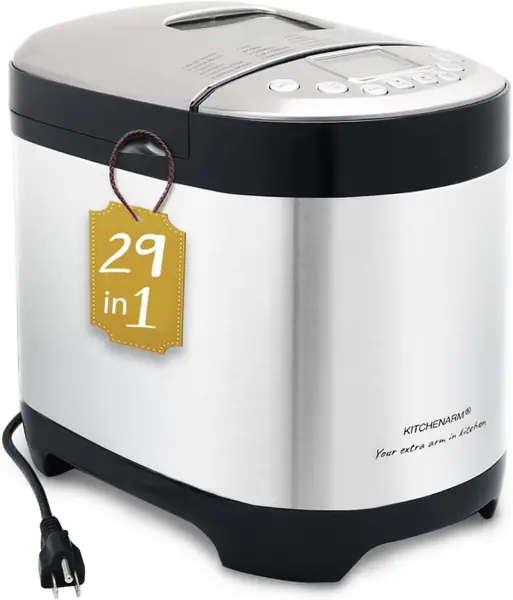
Stainless steel KitchenArm 29-in-1 bread machine with vertical nonstick pan and digital control panel

First bread machine

Bake Score 93/100
Programs
29
Footprint
8.9 × 14.2 in
Warranty
2 years
Loaf Sizes
1, 1.5, 2 lb
View on Amazon

The KitchenArm remembers what you did last time. Set a menu, a loaf size and a crust shade once and the machine holds them for the next bake, so a repeat loaf is three button presses instead of a scroll through 29 programs. You can also build up to four menus of your own, stage by stage through knead, rise and bake — the kind of feature that looks like filler on a spec sheet and turns out to be the reason you stop opening the manual.

It's our top pick because it gets the everyday job right at a price most households can justify. The 550-watt motor takes a 2-pound whole wheat loaf without straining, the three sizes mean one person isn't committed to bread they can't finish, and the recipe book is one of the clearer ones here — which matters more than it sounds, because the first bake decides whether the machine stays on the counter. Add a two-year warranty and a program list that covers gluten-free, sourdough starter and dough, and there isn't a job in this category it can't handle.

The loaf bakes upright in a vertical pan, so slices come out tall and narrow: perfect for toast, less so if you want sandwich-length bread for lunches. A high-rising white loaf can also crown into the viewing window, which does nothing to the bake but does end the show early. Neither is a dealbreaker, and the pan's nonstick releases cleanly enough to rinse and wipe.

Worth Noting

  • Pan and paddle are hand-wash only
  • Vertical pan gives tall, narrow slices
Our Verdict

We recommend the KitchenArm to most households: it bakes all three loaf sizes well, saves your settings, and asks less money than most of this field.

Check Latest Price
2

Zojirushi Virtuoso Plus Best Bread Quality

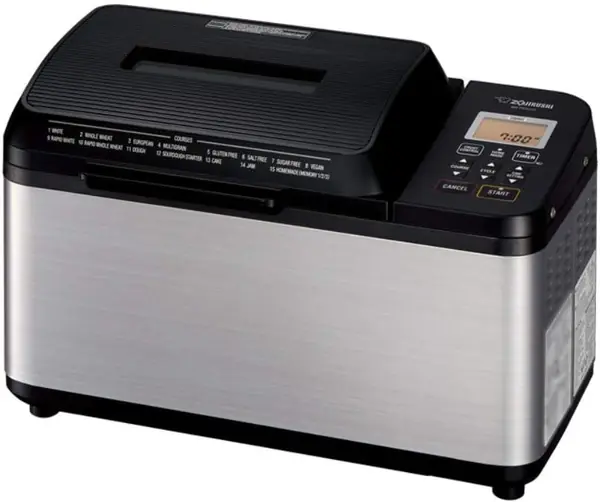
Black and stainless Zojirushi Virtuoso Plus breadmaker with two kneading blades and glass lid

Loaf quality first

Bake Score 92/100
Capacity
2 lb
Footprint
18 × 10.5 in
Delay Timer
13 hours
Kneading Blades
2
View on Amazon

Two kneading blades, one at each end of the pan, are why the Virtuoso Plus bakes the best-textured loaf in this group. They work the dough more evenly than a single center paddle, and a second heating element in the lid browns the top, so the bread comes out shaped like a bakery loaf rather than a tall cylinder. If the crumb and crust are what you notice, this is the machine to buy.

It's also built like an appliance rather than a gadget: a heavy pan, a lid that closes with a solid click, and a rapid course that puts a loaf on the counter in about two and a half hours when you've forgotten to plan. The 13-hour timer covers overnight bread, and the multigrain, sugar-free and vegan courses are real settings rather than menu filler.

The trade-off is real estate. At 24 pounds with an 18-inch width, it wants a permanent corner of the counter and enough clearance above it to open the lid and lift out a hot pan; stowing it between bakes is a two-hand job. For a household that bakes twice a week, that's a fair trade. For a first machine, it isn't.

Worth Noting

  • Heavy 24-pound body, 18 inches wide
  • Costs the most of any machine here
Our Verdict

Buy this one if the loaf itself is the point — no machine here bakes a better-textured, better-browned 2-pound bread.

Check Latest Price
3

Zojirushi Home Bakery Mini Best for Small Households

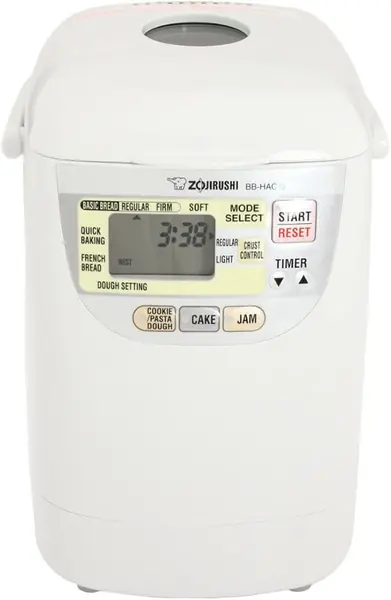
White Zojirushi Home Bakery Mini bread maker with carrying handle and viewing window

Small households

Bake Score 91/100
Programs
9
Capacity
1 lb
Footprint
8.5 × 11.25 in
Delay Timer
13 hours
View on Amazon

One-pound loaves are the entire point of the Home Bakery Mini, and they solve a specific problem: the two-person household that can't finish two pounds of bread before it stales. Zojirushi built the pan around a pound of dough rather than shrinking a bigger machine, so a small batch fills it and rises properly instead of spreading into a flat disc, which is what happens when you bake a small loaf in a wide pan.

What we appreciate most is how little there is to get wrong. Nine programs, a 13-hour timer, a viewing window and a quick-bake cycle that finishes in under two hours, with no crust menus to agonize over and a pan that rinses clean. At 8.5 inches wide with a carrying handle, it moves between counter and closet without a plan. The one adjustment is arithmetic: most recipes are written for 2-pound machines, so you'll be halving quantities — weigh them rather than eyeballing the division.

Worth Noting

  • One-year warranty is the shortest here
  • Most published recipes are written for 2-pound pans
Our Verdict

For one or two people, a properly risen 1-pound loaf in a compact body is worth the premium this little Zojirushi asks.

Check Latest Price
4

KBS Pro Bread Maker Best for Loaded Breads

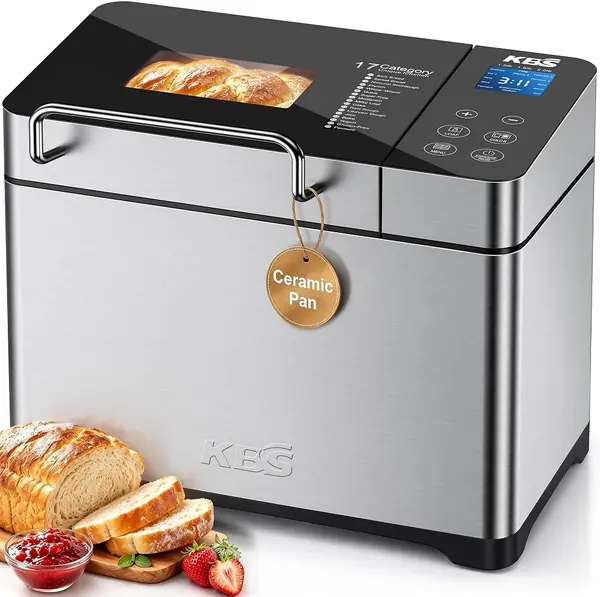
Brushed stainless KBS Pro bread maker with ceramic pan, glass touch panel and nut dispenser

Loaded breads

Bake Score 90/100
Programs
17 plus custom
Dispenser
Automatic nut dispenser
Loaf Sizes
3 loaf sizes, 3 crust shades
Pan
Ceramic
View on Amazon

The KBS Pro costs more than our top pick and adds two things that one can't do. The first is the automatic dispenser: fill the chute in the lid with nuts, seeds or raisins and it drops them in at the second knead, so they end up spread through the loaf instead of clumped at one end. The second is the ceramic pan, a pale coating rather than the usual dark nonstick, which releases a loaf with a shake.

Power is the other argument for it. A 710-watt motor turns a shaped kneading blade that develops dough quickly, and a full 2-pound whole wheat loaf doesn't leave it laboring. The 15-hour delay, one-hour keep-warm and 15-minute power-recovery setting make it forgiving of a household schedule, and the brushed stainless body with its glass touch panel is the best-looking machine in this group.

Two things get in the way. The paddle is stubborn to remove — the hook helps, but there's a moment of real effort after every bake, and the coating is what suffers if you lose patience and reach for a knife. The manual is the weakest here as well: the English reads like a translation and the recipe measurements don't line up with the cups in the box, so weigh your flour and treat the booklet as a starting point.

Loaded breads are where it earns its place. If raisin bread, seeded rye and multigrain are the loaves you actually bake, the dispenser justifies the step up in price from our top pick, and the ceramic pan is a genuine upgrade for release and cleanup. If you bake plain white sandwich bread week in and week out, you're paying for a chute you'll never fill.

Worth Noting

  • Paddle is hard to remove after baking
  • Manual and recipe measurements are unclear
Our Verdict

Worth the step up from our top pick if you bake seeded, fruity or multigrain loaves and want the machine to add them for you.

Check Latest Price
5

Neretva 20-in-1 Bread Maker Best for Tight Counters

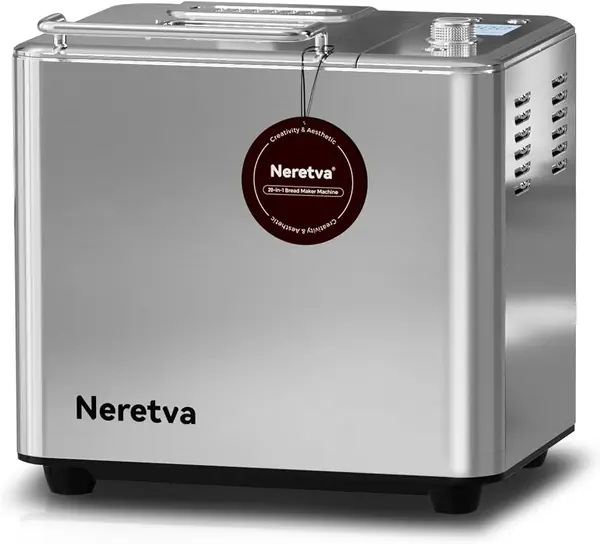
Silver Neretva 20-in-1 bread maker with stainless body, ceramic pan and dual heaters

Tight counters

Bake Score 89/100
Programs
20
Capacity
2 lb
Footprint
7.91 × 11 in
Delay Timer
15 hours
View on Amazon

At 7.91 inches wide and a little over 9 inches tall, the Neretva is the smallest machine here, and that is the whole reason to look at it. It slides under a low cabinet and leaves the rest of the counter to the cutting board — which, in an apartment kitchen, is the difference between a bread maker you use and one that lives in a closet.

It gives up less than the footprint suggests. There are 20 programs including gluten-free and cake, heating elements top and bottom, a ceramic-coated pan, a 15-hour delay, an hour of keep-warm, and a paddle hook and oven mitt in the box. The stainless body looks better than the price implies, and the loaves came out evenly browned with a thin, crisp crust.

One habit to build: with a stiff dough the machine can creep across the counter, so give it a nonslip mat and keep it back from the edge. Otherwise it behaves itself, running quietly enough for an open kitchen and cycling through a 2-pound loaf without complaint.

For a small kitchen this is the pick: a full-size loaf from a machine that fits where the others don't. Pair it with your own scale and a recipe book you trust — the printed one and the included cups are the weakest part of the package — and it bakes as well as machines that claim far more counter.

Worth Noting

  • Can creep on the counter with stiff dough
  • Recipe book and measuring cups are hard to read
Our Verdict

Our choice when the counter is the constraint: it fits where others won't and still bakes a full 2-pound loaf.

Check Latest Price
6

Cuisinart CBK-210 Best for Crust Lovers

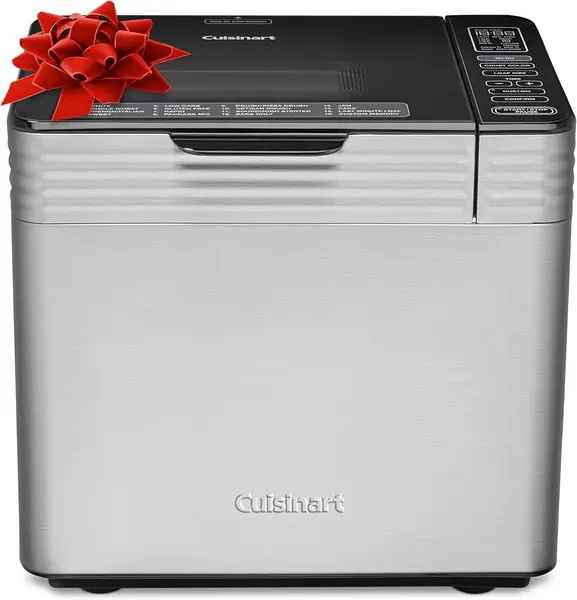
Stainless and black Cuisinart CBK-210 bread maker with glass-top viewing window and mix-in dispenser

Crust lovers

Bake Score 88/100
Programs
16
Capacity
2 lb
Warranty
3 years
Dispenser
3/4 cup
View on Amazon

A convection fan in a bread maker is unusual, and in the CBK-210 it earns its place: it moves air through the baking chamber so the crust browns evenly instead of only on the element side, and the three shade settings make a visible difference. If the crust is the part of the loaf you care about, start here.

The rest of the package is thoughtful. A three-quarter-cup dispenser drops raisins or seeds in at the second knead, there are 16 programs including sourdough starter and a low-carb setting, the paddle comes out before the final rise with the included hook, and the 13-hour delay and three-year warranty are both better than most of this group's.

So why isn't it higher? The manual's recipes are the weak link, and reliability is patchier than the top picks'. The warranty is the cushion there: three years is the longest here, which is the right answer for a machine with something to prove. Buy it for the crust and the dispenser, and buy it somewhere that takes returns without an argument.

Worth Noting

  • Dispenser holds only three-quarters of a cup
  • Manual recipes are inconsistent
Our Verdict

Choose it for the convection crust and the automatic dispenser, and weigh the thinner reliability record before you commit.

Check Latest Price
7

OSIPOTO 17-in-1 Bread Maker Best for Quiet Kitchens

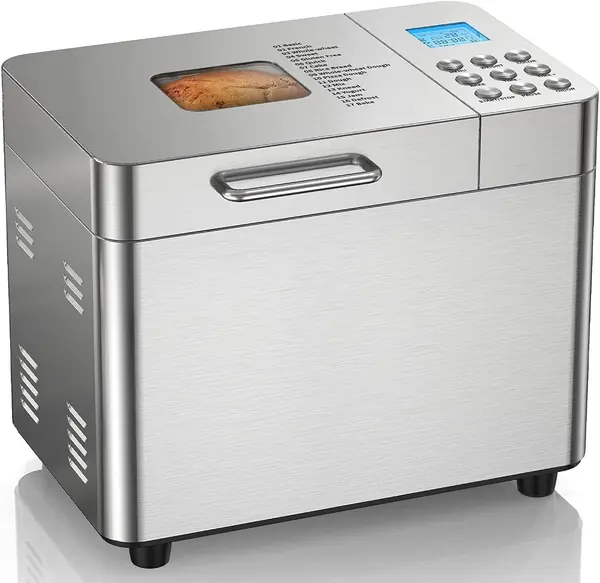
Silver OSIPOTO 17-in-1 bread maker with stainless body and LCD control panel

Quiet kitchens

Bake Score 87/100
Programs
17
Capacity
2 lb
Footprint
11.42 × 13.78 in
Delay Timer
15 hours
View on Amazon

The first thing we noticed about the OSIPOTO is how little noise it makes: the knead is a low hum rather than the counter-rattling thump of a bigger machine, which matters if your kitchen is also your living room or you set the delay for the small hours. The nonstick pan is the other pleasure — the loaf drops out with a shake and the pan wipes clean, no soak required.

It's a plain machine underneath: 17 programs, a 2-pound capacity, a 15-hour delay and a keep-warm, with no automatic dispenser and no custom programming. For most bakers that's an honest trade, since the extras are the ones most people touch twice a year. What you get instead is a control panel you understand in a minute and bread that comes out evenly browned with a soft crumb.

What we can't tell you yet is how it ages — durability is the open question with this one, and that is the reason it sits below the picks above. Everything else about it is quietly competent, and at this price competence is the point. If you want a machine that disappears into the background of your kitchen and just bakes the weekly loaf, this is a sensible buy.

Worth Noting

  • No automatic fruit and nut dispenser
  • Durability is the open question
Our Verdict

A quiet, easy-to-clean machine that bakes honest everyday loaves and doesn't ask much of you.

Check Latest Price
8

Rosewill 25-in-1 Bread Maker Best for Budget Families

Gray Rosewill 25-in-1 bread maker with metal body and nonstick bread pan

Budget families

Bake Score 82/100
Programs
25
Capacity
2 lb
Footprint
8.3 × 13.1 in
Warranty
1 year
View on Amazon

The Rosewill is the least expensive machine here, and it doesn't act like it: 700 watts with heating elements top and bottom, 25 programs, three crust shades, a 15-hour delay and an hour of keep-warm. For a first machine, a second one for a vacation house, or a gift for someone who isn't sure they'll use it, that's a lot of function for the money.

What you don't get is polish. It's loud enough during kneading that you'll find another room, and the manual reads like a translation, with ingredients listed in ounces and a recipe book built for a different set of cups and spoons. It's also a 2025 model with less history behind it than the Zojirushis, so the one-year warranty is doing real work. Weigh your ingredients, expect to write corrections in the margins, and it will bake a decent 2-pound loaf.

Worth Noting

  • Runs loud during kneading
  • Manual and recipes are hard to follow
Our Verdict

A sensible first machine for someone testing whether they'll actually bake — loud, plainly documented, and inexpensive enough to find out.

Check Latest Price

How We Tested the Best Bread Makers

We started with the best-selling and best-reviewed machines at major retailers and filtered by loaf size, pan coating, program count, and price so the lineup covered compact one-pound models as well as two-pound stainless steel machines. That left nine, and we ran them for seven months in home kitchens — a cramped apartment counter, a family kitchen where a loaf lasts a day, and an office break room where nobody reads a manual twice.

Every machine's first bake was a plain white loaf made by someone who had only skimmed the instructions, which showed us fast whether the manual was clear and how many button presses stood between you and bread. From there we worked through whole wheat, gluten-free, and dough cycles, loaded the mix-in dispensers with raisins and walnuts to see whether they landed in the crumb or got crushed, and set overnight delay-timer bakes to check that bread was still warm at 7 a.m.

We sliced each loaf an hour after baking and looked at how evenly the crust browned on top versus the sides, how big a hole the paddle left, and whether the interior was tender or gummy — then ate a lot of toast. Pans were washed only after cooling, so we could see which coatings released without a soak. Noise got measured with a decibel app at arm's length, because a machine that kneads at 5 a.m. in a small kitchen is a real consideration.

For reliability and value, one machine in the lineup ran four times a week for the full seven months while we checked the pan coating and paddle for scratches and wear, and we weighed what each price bought in loaf sizes, build, and programs. Footprint was measured on the counter too, since compact size matters more to most people than a longer program list.

How to Choose a Bread Maker

Start With the Loaf You'll Finish

Loaf size is the first decision, and it's about waste more than ambition. A 2-pound loaf is roughly a week of toast for two people; a 1-pound loaf is two or three days. Pay attention to how the size is reached, too. A machine offering 1, 1.5 and 2 pounds bakes the smaller batch in the same wide pan, which gives a shorter, flatter loaf, while a bread machine built around a single pound — the Zojirushi Home Bakery Mini is the one here — has a pan proportioned to that amount of dough, so it rises into a proper shape.

If two people eat toast most mornings, a 2-pound machine with a 1.5-pound setting is the flexible answer. If you bake for one, or you like a fresh loaf every other day, buy the smaller machine and halve the recipes by weight.

Measure the Counter, Not the Box

Width decides whether a bread maker lives on the counter or in a closet: the machines here run from 7.91 inches (the Neretva) to 18 inches (the Zojirushi Virtuoso Plus). Leave clearance above the lid as well, because you need room to open it and lift out a hot pan, and that is where a machine that technically fits under a cabinet still fails. Weight matters if you plan to move it: the Virtuoso Plus is 24 pounds, the Neretva 8.4.

One trap worth naming: a corner that fits the footprint may not fit the lid swing. Set the machine in place with a full pan and a closed lid before the first bake, not after it.

Three Programs You'll Use, Twenty You Won't

Every machine here has a basic cycle and crust control. Beyond that, the presets that earn their buttons are gluten-free if anyone in the house avoids wheat, whole wheat, and a plain dough cycle for pizza and rolls. Sourdough starter, jam, cake and yogurt are pleasant extras most people touch once. A 29-program list is not automatically better than a nine-program one.

What pays off daily is how the machine remembers. The KitchenArm holds your last menu, loaf size and crust shade between bakes and lets you save four menus of your own, so a weekly rye doesn't mean re-navigating the panel. If you bake loaded breads, an automatic dispenser like the KBS Pro's is worth more than any five extra presets.

Pan Shape, Coating and What Wears Out

Pans come in two shapes, and they change the slice. A vertical pan bakes a tall loaf that gives small, square-ish slices — good for toast, awkward for sandwiches. A horizontal pan bakes a loaf shaped like the ones from a bakery. Neither is better; decide which one you'll eat. A convection fan, as on the Cuisinart CBK-210, is the one feature that genuinely evens out browning.

Then plan for wear. The paddle, the coating and the motor are what end a bread maker's life, and warranties here run from one to three years. Hand-wash the pan, use the hook rather than a knife to free the paddle, and buy from a seller with an easy return in case you get a bad unit.

Frequently Asked Questions

Final Verdict

The KitchenArm 29-in-1 is the bread maker we point most people to. It bakes 1-, 1.5- and 2-pound loaves reliably, remembers the settings for your usual loaf, and costs less than most of the machines it beats.

Spend more only for a reason: the Zojirushi Virtuoso Plus makes the best loaf here if the crumb is what you're chasing, and the Home Bakery Mini is the right size if you're baking for one or two. Match the loaf to the household first; the rest is detail.