Best Kitchen Appliances for Baking
If you add one appliance for baking, make it a stand mixer. It creams butter and sugar, whips egg whites and kneads bread dough while your hands are free, and it opens up recipes that are hard by hand. For occasional bakers, a hand mixer covers most of the same jobs in a drawer.
After that, which appliances are worth the space depends on what you bake. Here's what each one does and who it's for.
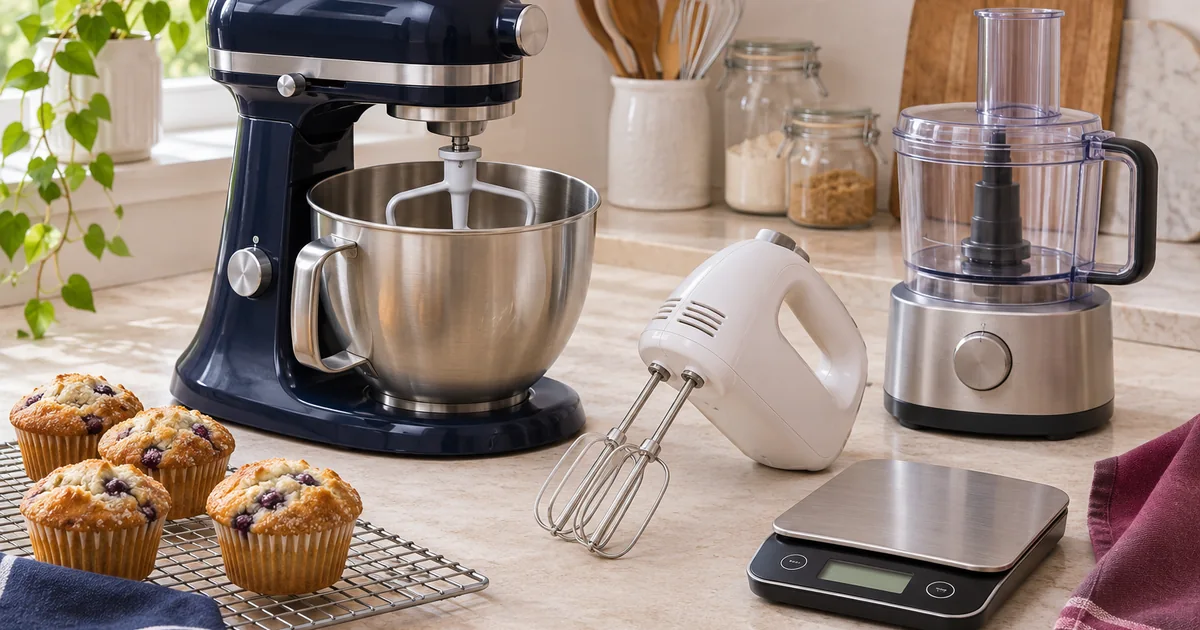
Appliances at a glance
| Appliance | What it does best | Who it's for |
|---|---|---|
| Stand mixer | Creaming, whipping, kneading, big batches | Anyone who bakes weekly |
| Hand mixer | Creaming, whipping cream and eggs | Occasional bakers, small kitchens |
| Food processor | Pie crust, scones, shortbread, quick kneading, chopping nuts | Pie and pastry bakers |
| Bread machine | Mixes, kneads, rises and bakes bread hands-off | Busy households wanting daily bread |
| Bread proofer | Steady warm temperature for rising dough | Sourdough and yeast bakers in cool kitchens |
| Countertop convection oven | A second, faster oven for small batches | Small households, holiday bakers |
| Digital scale | Accurate measuring | Every baker |
| Double boiler or melting pot | Gentle melting of chocolate | Candy and chocolate work |
Stand mixer
A stand mixer's power lets it cream butter until it's truly light, whip meringue to stiff peaks and knead stiff dough for 10 minutes without you holding anything. The KitchenAid Artisan 5-quart is the default for most home bakers; bowl-lift models of 5.5 to 7 quarts are better for frequent bread baking. See the best size KitchenAid mixer and our stand mixers section.
Worth it if you bake at least a few times a month, make bread or big batches, or find creaming by hand tiring.
Hand mixer
A good hand mixer whips cream, beats egg whites, mixes cake batter and creams butter for cookies. It stores in a drawer and costs far less than a stand mixer. It isn't made for kneading stiff bread dough or for long whipping jobs. Look for a slow start speed, so flour doesn't fly, and strong wire beaters. Compare them in our hand mixers section.
Worth it if you bake occasionally, are short on space, or want a second mixer for small jobs.
Food processor
Pulsing cold butter into flour is the fastest way to make flaky pie crust, biscuits, scones and shortbread, and the processor's speed keeps the butter cold. A processor also grinds nuts and graham crackers for crusts, and kneads a small batch of bread or pizza dough in about a minute with the dough blade. An 11- to 14-cup model handles most baking jobs.
Worth it if you make pies, tarts or scones often, or want quick dough without a stand mixer.
Bread machine
A bread machine mixes, kneads, proofs and bakes in one pan on a timer, so you can wake up to a fresh loaf. Many also make pizza dough, jam and gluten-free bread. Loaves are often tall with a hole from the paddle; horizontal-pan models such as Zojirushi's make a more traditional loaf shape. Many bakers use the machine just for the dough cycle and bake the loaf in the oven. Compare models in our bread machines section.
Worth it if you want regular sandwich bread with almost no effort.
Bread proofer
Yeast and sourdough rise best at about 75 to 80°F. In a cool kitchen, rise times stretch out and become unpredictable. A proofer, such as the Brød & Taylor Folding Proofer, holds dough at the temperature you set. It's also handy for keeping a sourdough starter active, softening butter and making yogurt.
Worth it if you bake yeast bread or sourdough regularly, especially in winter.
Countertop convection oven
A large countertop convection oven preheats in minutes, uses less energy than a full oven for small batches, and gives you a second oven for holidays. Many fit a quarter sheet pan or a 9 x 13 inch pan. They're a good choice for apartments, RVs and households of one or two. See the types of ovens for baking and our baking appliances section.
Worth it if your main oven is small, unreliable, or always busy at the holidays.
Small appliances for specific bakes
- Waffle makers for Belgian and classic waffles.
- Donut makers for small cake donuts without frying.
- Pizzelle and krumkake irons for thin, patterned holiday cookies.
- Cake pop makers for bite-size cakes without rolling.
- Chocolate tempering machines for glossy chocolate work.
These are fun but single-purpose; buy them for a bake you make often.
Which appliances to buy first
- A digital scale. Not exciting, but the cheapest upgrade to consistent results.
- A hand mixer or a stand mixer, depending on how often you bake.
- A food processor if you love pies and pastry, or a bread machine if you want hands-off bread.
- A proofer once you're baking bread regularly.
- A countertop oven if your kitchen or oven is small.
Frequently Asked Questions
An oven you can trust, checked with an oven thermometer. After that, a mixer: a stand mixer if you bake often, a hand mixer if you bake occasionally.
Not necessarily. Many bakers keep both, using the hand mixer for small jobs like whipping a cup of cream, but either one can handle most recipes.
Yes, if you want fresh sandwich bread with little effort, or a reliable dough cycle for pizza and rolls. If you enjoy shaping and baking artisan loaves, a Dutch oven and a proofer are better buys.
For pie crust, scones and some doughs, yes. It can't whip cream or egg whites to volume or cream butter as light as a mixer does.