Best Gifts for Sourdough Bakers
The best gifts for sourdough bakers help with the steps they repeat every bake: feeding the starter, folding and proofing the dough, scoring and baking the loaf. Easy, welcome picks include a sharp bread lame, a well-made banneton, and a 0.1-gram scale for salt and starter. For a big gift, the Challenger Bread Pan or a Brød & Taylor Folding Proofer stands out.
Here are the best ideas, organized by the part of the process they help with.
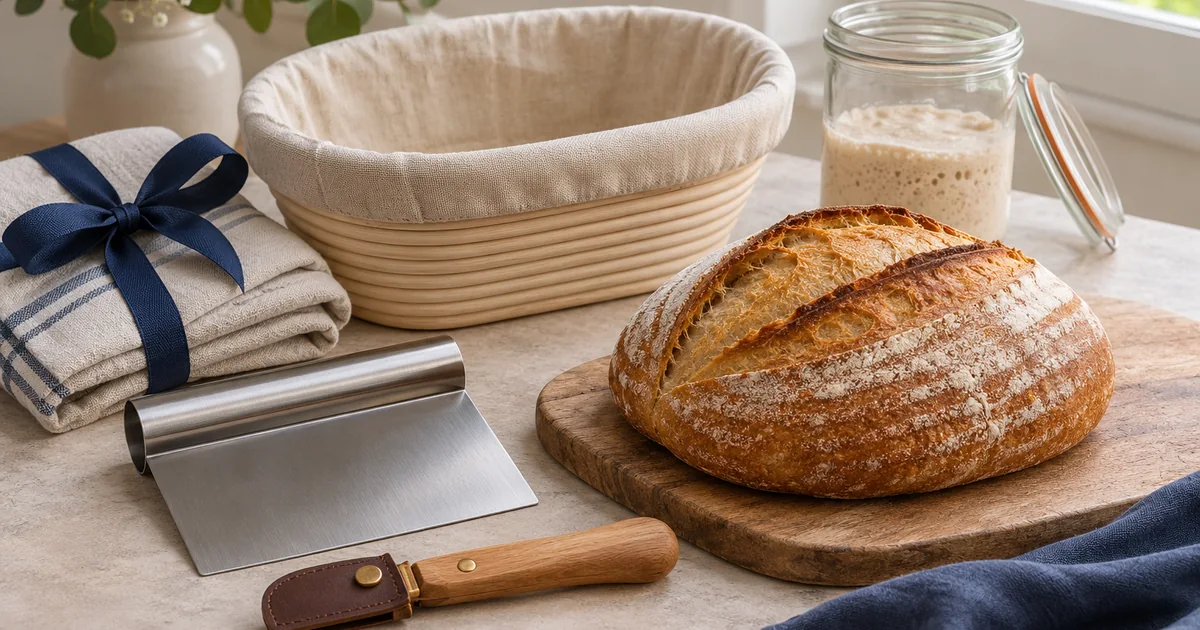
For the starter
- A wide-mouth starter jar. A straight-sided glass jar with a loose lid makes the starter easy to stir, scrape and watch rise. Weck jars are a classic; jars marketed for sourdough often come with a band to mark the starting level.
- A starter warmer. In a cold kitchen, starters get sluggish. Small heated mats or enclosures, such as the Sourhouse Goldie, keep a starter at a steady warm temperature so it peaks on time.
- A small flexible spatula. A narrow jar spatula scrapes the sides of the starter jar clean, which keeps mold away.
For mixing and folding
- A digital scale with 0.1-gram accuracy. Sourdough recipes are written in grams, and salt and small amounts of starter need precision. A compact jewelry-style scale alongside their main scale is a thoughtful extra.
- A Danish dough whisk. It mixes stiff flour and water without balling up.
- A clear dough tub. A straight-sided container with volume markings, such as a 4- or 6-quart Cambro food container, shows exactly how much the dough has risen during bulk fermentation.
- A bench scraper set. A metal scraper for dividing and shaping and a flexible plastic one for scraping dough out of the tub.
For shaping and proofing
- Bannetons. Rattan proofing baskets in round and oval shapes, with linen liners. A baker who only has one size usually wants the other. See our bread and sourdough tools section for options.
- A bread proofer. The Brød & Taylor Folding Proofer keeps dough at a set temperature, so fermentation runs on schedule year-round. It folds flat and doubles as a slow cooker.
- A linen couche. Heavy, floured linen that supports baguettes and batards as they proof.
For scoring and baking
- A bread lame. A handle that holds a razor blade for scoring. Wire Monkey's lames are favorites among home bakers, and a pack of spare blades is a welcome add-on.
- The Challenger Bread Pan. A heavy cast iron base with a tall lid, designed for bread. The low base makes loading a proofed loaf much easier and safer than a deep Dutch oven, and it fits both boules and batards.
- A Dutch oven or combo cooker. If they don't have one yet, a 5 to 6 quart pot or a Lodge Cast Iron Combo Cooker is the classic sourdough vessel. See the best size Dutch oven for bread.
- A pizza steel or baking stone. Useful for baguettes, pizza and anything too long for a pot. See pizza stone materials.
For slicing and storing
- A serrated bread knife. A long blade, 10 inches or more, cuts through a crackly crust without crushing the crumb. A bow knife is a fun extra for big loaves.
- A bread slicing guide. Helps cut even sandwich slices.
- Linen bread bags or a bread box. Keep the crust crisp longer than plastic does.
Books for sourdough bakers
- Flour Water Salt Yeast by Ken Forkish. Clear, schedule-based recipes and a great second book after a first few loaves.
- Tartine Bread by Chad Robertson. The book that started many people's sourdough habit, focused on open, crusty country loaves.
- The Perfect Loaf by Maurizio Leo. Detailed, precise and full of variations, for bakers who want to go deeper.
How to choose
- Beginner (a few months in): a lame, a bench scraper, a banneton and a dough tub.
- Regular baker: a proofer, the Challenger Bread Pan, or a second banneton shape.
- Experienced baker: a grain mill such as a Mockmill for fresh flour, specialty flours, or a linen couche for baguettes.
Avoid "complete sourdough kits" for someone already baking. They mostly duplicate tools the baker already has. Kits make sense only for a total beginner.
Frequently Asked Questions
A bread lame, a bench scraper, a round banneton, a digital scale if they don't have one, and Flour Water Salt Yeast. These cover the steps they're learning.
For people who bake bread every week, yes. It's heavy and expensive, but loading and unloading loaves is far easier than with a tall Dutch oven, and it fits batards.
For a standard loaf with about 500 grams of flour, a 9-inch round or a 10-inch oval banneton is the most useful size.
Yes. A jar of active starter from your own kitchen, or a dried starter from King Arthur Baking or Cultures for Health, is a good gift for someone who wants to begin.