The 6 Best Popover Pans of 2026

The whole trick to a popover is steam. You pour a thin, eggy batter into a ripping-hot pan, the liquid hits the fat and flashes to vapor, and that vapor shoves the batter up into a hollow, lopsided shell. So the pan has to survive high heat without warping, hold it evenly, and let go of the popover without tearing the sides.

I've had plenty of batches rise and then slump into pancakes, and the pan is usually the first suspect. We baked in 12 popover pans — standard six-cup models and individual molds — looking for the ones that climb. We cared about cup size, how the nonstick held up, and how much scrubbing the corners demanded.

Here's what first-time buyers miss: the cups need to be deep and slightly tapered, so the batter climbs a wall instead of spreading flat. Dark finishes also brown faster than light ones, which can leave you with a set bottom and a pale top. There's a pick below for however many popovers your table can eat.

Our Top Picks

The Best Popover Pans

1

Epica Bellemain Popover Pan Best Overall
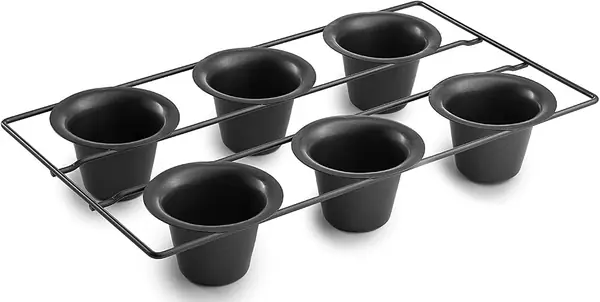
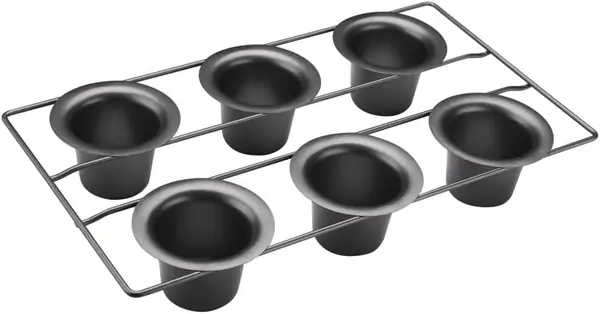
Epica Bellemain nonstick popover pan with six deep charcoal cups in a steel frame

Everyday popover baking

Bake Score 95/100
Material
Carbon steel
Oven Safe To
450 °F
Cleaning
Dishwasher safe
Cup Size
2.25" deep x 3" diameter
View on Amazon

The wells in the Epica are 3 inches across and 2.25 inches deep, with sides that drop straight down instead of flaring. That shape is the whole trick with popovers: the batter needs a wall to climb as steam drives it upward, and a sloped muffin cup gives it nothing to hold. In our bakes the popovers came out tall with a crisp, browned shell and the hollow custardy middle, and they released with a light coat of cooking spray.

Six cups is the right count for a home oven. One pan fills a rack, and a second pan handles a holiday dozen without crowding. The carbon steel heats evenly, the charcoal finish browns the outsides well, and the 450 °F rating covers the hot start most recipes call for — worth noting, because several pans here top out lower.

It is dishwasher safe, though the nonstick is the part that ages on any pan and the dishwasher is usually what speeds that up. Ours gets a warm soapy soak and a soft sponge, which takes about as long as loading it would. Nothing about the pan is fussy: no seasoning, no dedicated utensils, no special storage.

What we keep coming back to is how little thought it requires. Two of these will do a dozen popovers for a holiday dinner, one in the oven and one loaded and waiting, and the pan has never been the reason a batch went wrong.

Our Verdict

The pan we point most bakers to: straight-sided wells that send popovers up, a 450 °F rating, and coating that releases with a light spray.

Check Latest Price
2

Nordic Ware Grand Popover Pan Best Heavy-Duty

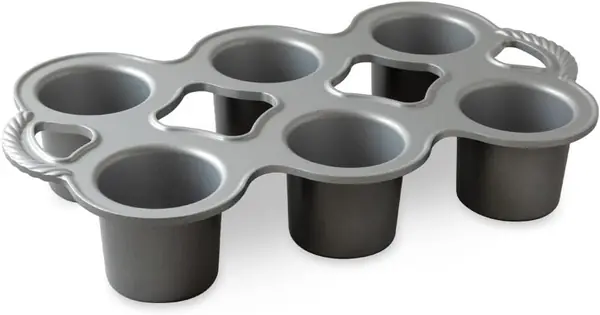
Nordic Ware Grand popover pan in graphite cast aluminum with six deep round cups

Long-term daily use

Bake Score 94/100
Material
Cast aluminum
Oven Safe To
400 °F
Cleaning
Hand wash
Made In
USA
View on Amazon

The number that gives us pause on the Nordic Ware is 400 — as in 400 °F, the pan's stated ceiling, while plenty of popover recipes start at 425 or 450 to drive the initial rise. Stay under it and this is the best-built pan in this group: heavy cast aluminum, made in the USA, with a 10-year warranty behind it.

Cast aluminum is why. The metal is thick and dense, so the wells hold their heat through the bake and the browning lands evenly across all six cups. At 16 ounces it is also the lightest of the full-size pans here, which we appreciate when pulling a hot pan out with one mitt and looking for somewhere to set it down.

Convenience is where it asks for more. Nordic Ware specifies hand washing with mild detergent and warns that the dishwasher shortens the coating's life, so this is a wash-dry-put-away pan rather than one that goes in the rack. The nonstick itself has been reliable for us; popovers drop out with a thin film of butter.

What the premium buys is metal that should still be flat and evenly heating a decade from now. That is a fair trade for a pan you will hand wash anyway — just check your recipe's starting temperature before you commit.

Worth Noting

  • Rated to 400 °F, under many popover recipes
  • Hand wash only to protect the coating
Our Verdict

For recipes that top out at 400 °F, this cast-aluminum pan delivers the most even browning here and the longest-lived build.

Check Latest Price
3

Chicago Metallic 6 Cup Popover Pan Best Budget

Chicago Metallic six-cup popover pan in black nonstick aluminized steel with separated wells

Tight budgets

Bake Score 93/100
Material
Aluminized steel
Oven Safe To
450 °F
Cup Size
2.75 x 2.25 inches
Warranty
25 years
View on Amazon

The Chicago Metallic is the least expensive full-size pan in this group, and nothing about the way it bakes feels like a shortcut. The aluminized steel is heavy enough to hold heat, the wells measure 2.75 by 2.25 inches, and the cups stand apart from each other so hot air moves between them instead of letting six popovers merge into one sheet.

We think it is the best value here. Popovers rose properly, released cleanly, and browned without scorching — unremarkable competence, which is exactly what you want from a pan you pull out a few times a year. The 25-year warranty is longer than the coverage on pans that cost twice as much.

The one thing to know is the washing. It is rated dishwasher safe, but Chicago Metallic recommends hand washing to extend the coating's life, and on a pan this inexpensive that is a fair trade. Give it a soak rather than a scrub and the finish stays slick.

Worth Noting

  • Cup rims can feel sharp while washing
Our Verdict

Our budget pick: heavy enough for an even bake, spaced for a proper rise, and backed by a 25-year warranty.

Check Latest Price
4

Cuisinart 6-Cup Popover Pan Best Warranty

Cuisinart six-cup popover pan in dark nonstick steel with tapered cups and a wide frame

Dishwasher users

Bake Score 92/100
Material
Alloy steel
Oven Safe To
450 °F
Warranty
Limited lifetime
Cup Design
Tapered
View on Amazon

The Cuisinart and our top pick do the same two things: six deep wells and a trip through the dishwasher. It costs a little less and carries a limited lifetime warranty, which is the honest reason it has a place here instead of being folded into the Epica's entry.

Its wells are tapered rather than straight, which Cuisinart sells as better air circulation. They still give a good rise — ours came out tall and evenly browned — but the sides lean in slightly, so the shape reads a bit more muffin than the popovers from the Epica. Heavy-gauge steel does the rest, and the nonstick covers the outside of the frame as well as the cups, which keeps it from staining.

What we noticed most is the handling. At 1.5 pounds it is easy to take out of a hot oven with one mitt and turn around, and the frame is rigid enough that a full pan of batter does not flex when you move it. Tapered cups also make it the more graceful oversized-muffin pan of the group if you bake both.

The warranty is the reason to pick it over the Epica. Nonstick bakeware is a wear item, and limited lifetime coverage on a pan in the middle of this price range is a real hedge against the day the coating gives out.

Worth Noting

  • Tapered wells give a slightly less vertical rise
Our Verdict

A light, dishwasher-safe pan with tapered wells and a limited lifetime warranty — our pick when coating coverage matters more than maximum rise.

Check Latest Price
5

Fox Run Non-Stick Popover Pan Best for Crisp-Sided Popovers

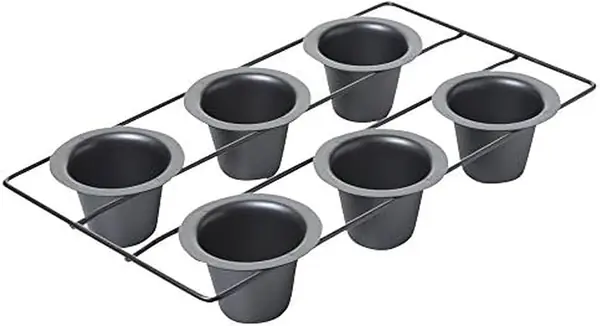
Fox Run six-cup nonstick popover pan in gray carbon steel with steep wells and an open wire frame

Crisp-sided popovers

Bake Score 91/100
Material
Carbon steel
Oven Safe To
446 °F
Cleaning
Dishwasher safe, top rack
Pan Size
9" x 15" x 2"
View on Amazon

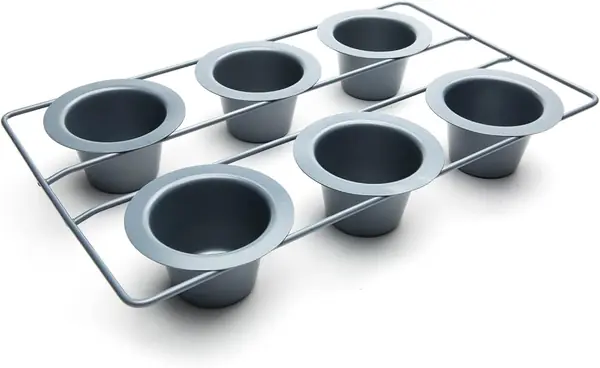
Fox Run's design is the most distinctive of the six-cup pans: steep wells set in an open wire frame that lets heat reach the cups from underneath and between them rather than through a solid sheet of metal. That is the right idea for popovers, and the 446 °F rating clears the hot start most recipes want.

It bakes a crisp-sided popover, with the browned shell and airy middle we look for, and the wells are deep enough that a full pour stays put. At 1.8 pounds it is the heaviest of the six-cup pans here — no problem in the oven, noticeable when you are carrying it across the kitchen with mitts on.

The coating is the part that needs attention. It is rated for the dishwasher's top rack, but hand washing with a soft sponge is the way to make it last, and metal utensils are out. Ours is holding up; the finish is simply the piece of this pan with the shortest life ahead of it, which is true of every nonstick pan here.

Our Verdict

The most distinctive design of the six-cup pans, with an open wire frame and steep wells that produce crisp-sided popovers.

Check Latest Price
6

Proshopping Popover Molds Best for Small Batches

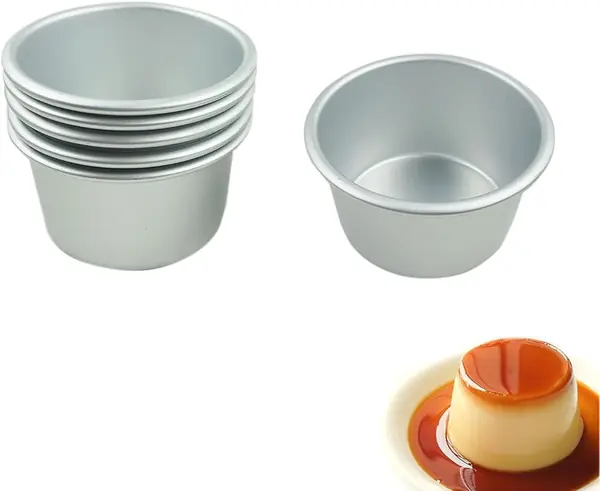
Six individual silver aluminum popover molds with flared rims and deep round cups

Small batches

Bake Score 90/100
Material
Aluminum
Cleaning
Hand wash only
Coating
Hard-anodized, not nonstick
Mold Size
3.4" x 2"
View on Amazon

Sometimes four popovers is dinner and six is a leftover problem. These are six individual molds rather than a joined pan — 3.4 inches across and 2 inches deep — so you fill the number you need and leave the rest in the drawer.

The surface is the catch. Proshopping calls it hard-anodized aluminum and states plainly that it is not a nonstick coating; greased properly it releases cleanly, and skipped it will grab. They are hand wash only, with a soft sponge and no dishwasher, and the flared rims give you somewhere to grip when you lift a hot mold out.

We like the flexibility more than we expected. A set of molds is the answer for a two-person household, for Yorkshire puddings portioned one per plate, or for an oven too small to take a 15-inch pan flat. What you give up is the frame: there is no handle and no rigid rack, so you are moving six hot cups onto a sheet pan instead of pulling out one pan.

Worth Noting

  • Not a nonstick coating, so each mold needs greasing
  • Hand wash only; no dishwasher
Our Verdict

The right buy for two-person households and small ovens, where a full-size pan is more pan than the meal needs.

Check Latest Price

How We Chose and Tested Popover Pans

We started by gathering every popover pan we could find and narrowing by the things that actually change a bake: cup depth and taper, pan gauge and finish, whether the cups sit connected in one frame or as separate individual molds, and how the whole thing fits on a single oven rack. That left 12 pans, which we baked in for six months — Sunday breakfasts, a couple of holiday roast-beef dinners with Yorkshire pudding batter in the same cups, and plenty of weeknight experiments.

Every pan went into a 425°F oven empty to preheat with a knob of butter or a spoonful of beef drippings, then got the same batter in the same volume per cup and the same 20 minutes without the door opening. We measured the rise with a ruler against the rim and watched whether the shells stayed up or sank as they cooled. Turning them out onto a rack told us about release: did they drop free, or did we have to coax them loose with a knife?

Cleaning and durability got equal attention. We let each pan cool with stuck batter on it, then soaked and scrubbed to see what lifted easily and which corners held on. Over six months, every pan ran through dozens of heat cycles and several dishwasher loads, and we checked rims and handles for flaking coating, warped frames, and cups that wobbled loose — the failure points that show up long after the first pretty batch.

How to Choose a Popover Pan

Start With the Shape of the Well

Popovers rise on steam, and steam takes the easiest path out. In a shallow, sloped muffin cup the batter spreads sideways and sets as a muffin; in a deep well with near-vertical walls, the steam has nowhere to go but up and the batter climbs with it. Look for wells at least 2 inches deep with sides that drop straight down or taper only slightly — the Epica's are 2.25 inches deep with vertical walls. A dark finish browns the crust faster, which is worth knowing if your oven already runs hot.

Count the Cups and Measure the Rack

Nearly every dedicated pan holds six, which suits a standard rack and a family dinner. What actually differs is footprint: the six-cup pans here run 14 to 15.75 inches long and about 9 inches deep, so check your oven rack and your cabinet shelf before ordering — length is the number that surprises people. If you usually bake three or four, individual molds let you heat only what you need. A dedicated Yorkshire pudding pan is the same object under a different name, so buy on dimensions rather than the label.

Match the Heat Rating to Your Recipe

Popover recipes usually start hot, in the 425 to 450 °F range, to trigger the initial rise, then drop for the finish. That makes the pan's maximum temperature a real specification rather than a formality: our picks are rated from 400 to 450 °F, and the Nordic Ware's 400 °F ceiling is the reason it isn't the default recommendation despite the best build here. Read your usual recipe before you buy, and if it opens at 450, choose a pan rated for it rather than dialing the oven back.

Coating, Release, and Washing

Nonstick is what makes a popover pan pleasant instead of punishing, and it is also the part that ages. Every pan here wants a thin film of butter or oil before the batter goes in, and none of them want metal utensils or abrasive scrubbers. Dishwasher ratings differ: the Epica and the Cuisinart handle the rack, while Nordic Ware and the Proshopping molds ask for hand washing. When a maker rates a pan dishwasher safe and then recommends hand washing anyway, that is about coating life, not safety.

Frequently Asked Questions

Final Verdict

The Epica Bellemain is the popover pan we point most bakers to. Straight-sided wells are shaped for the job, the 450 °F rating covers a hot-start recipe, it goes in the dishwasher, and it sits in the middle of this group's price range.

Choose the Nordic Ware Grand if you want cast aluminum and bake at 400 °F or below, or the Chicago Metallic if popovers are a few-times-a-year project and you want to spend as little as possible.