The 6 Best Pullman Loaf Pans of 2026

The whole trick of a pullman loaf pan is the lid. Slide it on before the pan goes into the oven and the bread has nowhere to rise but into the corners, so you get slices that stack flat and actually fit the toaster. That same lid traps steam, which is where these pans start to separate: a good one releases the loaf in one piece, a bad one leaves half the crust welded into the corners.

I've run the same enriched sandwich dough through 14 of these. Two things I'd tell a first-time buyer. Corrugated walls, the ridged kind you'll see on a lot of them, cut surface contact so the crust browns evenly and lets go of the pan. Steel gauge matters just as much, because a thin pan twists the first time you push the oven to 450°F for sourdough, and once it warps, the lid never seats flat again.

Capacity is the other fork in the road: a 1-pound pan turns out petite square slices, while the 2.2-pound sizes are built for a full sandwich loaf. All six earned their spot on crust release, even browning and whether the lid still sealed tight after months of Sunday baking.

Our Top Picks

The Best Pullman Loaf Pans

1

USA Pan Pullman Loaf Pan, Large (Set of 2) Best Overall
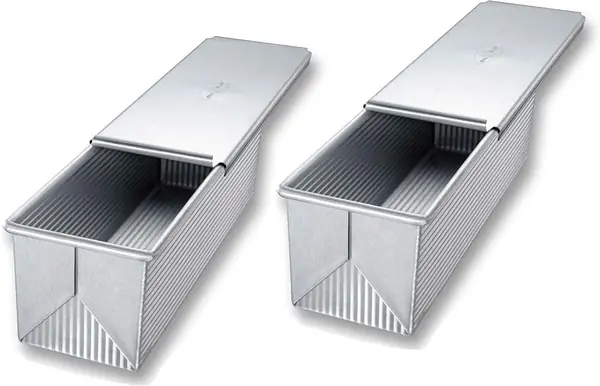
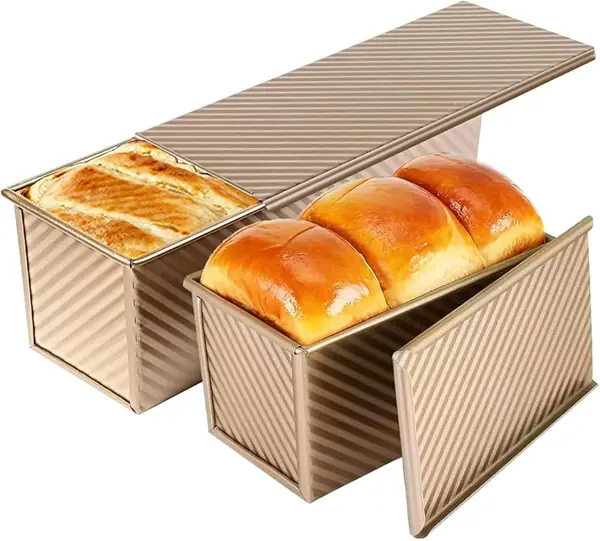
USA Pan aluminized steel Pullman loaf pans with covers, set of two

Weekly sandwich loaves

Bake Score 94/100
Material
Aluminized steel
Max Temperature
450°F
Care
Hand wash
Interior Size
13 x 4 x 4 in
View on Amazon

Two pans, a cover for each, and the highest price in this group — that's the USA Pan set in a sentence, and it's still the first one we name when someone asks what to buy. The baking surface is 13 by 4 by 4 inches of aluminized steel, the material we trust most for a long loaf: it heats evenly from end to end and skips the seasoning routine carbon steel wants.

Release is what settled it. With nothing more than a swipe of butter, a plain white sandwich loaf dropped out with its corners intact, and the crust came out an even gold from the first slice to the last. The covers seat squarely and stay where you put them. The trade is slice size: 4 inches across is narrower than a standard 9-by-5 pan, so sandwiches come out a little more compact — the slices fit a toaster without trimming, which is the part we ended up appreciating.

Care is where we're honest with you. These are hand wash only, and the coating is the part to protect. A pan can arrive dented, and pans stacked loose in a drawer chip at the rims; wash them, dry them completely, and put a towel between them in storage.

The second pan earns its keep more than we expected. One loaf cools while the next proofs, and on a baking Saturday both go in at once — which is the argument for the set over a single pan.

Worth Noting

  • Hand wash only; nothing dishwasher safe
Our Verdict

We recommend this set to anyone baking sandwich bread most weeks: two even-browning, clean-releasing 13-inch pans, with hand washing the one chore they add.

Check Latest Price
2

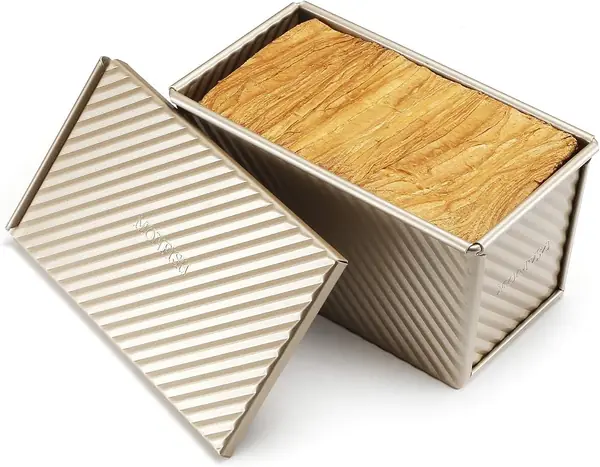
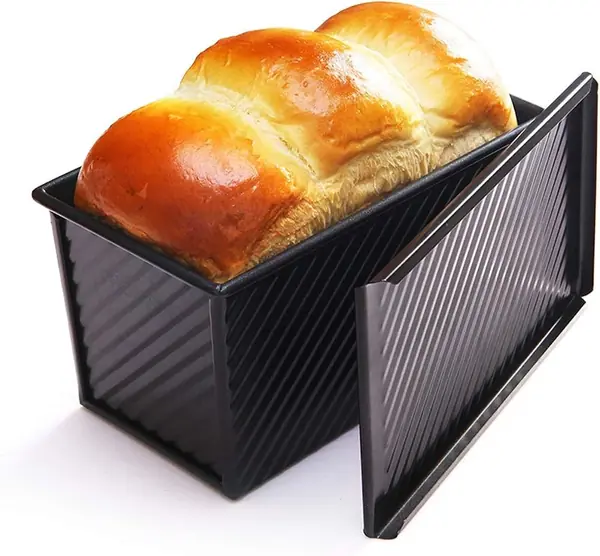
CHEFMADE Pullman Loaf Pan, 1 lb Best for Small Households

CHEFMADE black carbon steel Pullman loaf pan with slide-on lid

Small households

Bake Score 93/100
Material
Carbon steel
Max Temperature
428°F
Care
Hand wash
Interior Size
7.5 x 4 x 4.4 in
View on Amazon

Small is the point, so start there: the interior runs about 7 1/2 by 4 by 4 1/2 inches and bakes a one-pound loaf, which is a week of sandwiches for two people and not much more. We kept reaching for it anyway, because the CHEFMADE is the most consistent small pan in this group — the lid slides on with no wiggle, the crumb bakes evenly, and the black coating has come through repeated hand washing without the flaking we've seen on other pans here.

Carbon steel is why it browns the way it does. At 0.5 mm it's thinner than the aluminized pans on this list, so it comes up to heat fast and gives a sandwich loaf a deep, even crust in less time than we expected — closer to what a Dutch oven produces than to the pale loaf a thin pan turns out. The 428°F ceiling covers milk bread and pain de mie comfortably and rules out anything hotter.

Two things to accept. It's hand wash, and the maker asks for a dry in a warm oven so water doesn't sit in the corners — a minute of extra work. And if you routinely bake two loaves at once, this isn't the pan; one is all you get.

Worth Noting

  • Hand wash and oven-dry after every bake
  • Capped at 428°F
Our Verdict

For a two-person household that wants one tidy square loaf a week, this is the pan we hand over: a snug lid, fast browning, and a footprint that doesn't take over the counter.

Check Latest Price
3

Barlket Pullman Loaf Pan Set, 2 Pack Best Two-Size Set

Barlket gold aluminized steel Pullman pans in two sizes with lids

Two loaf sizes

Bake Score 92/100
Material
Aluminized steel
Dough Capacity
2.2 lb and 1 lb
Max Temperature
446°F
Pan Sizes
13 x 5 in and 8 x 4 in
View on Amazon

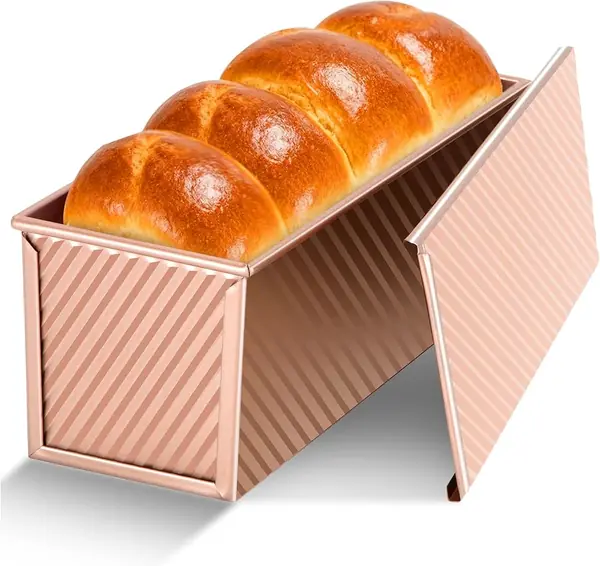
Two pans, two sizes: a 13-by-5 that takes 2.2 pounds of dough and an 8-by-4 that takes a pound. That pairing is the reason to look at this set at all — you can bake the family sandwich loaf and a small one in the same session, or use the little pan to test a recipe before committing the whole batch.

The pans are aluminized steel with a gold finish and corrugated walls, rated to 446°F, and they bake the way that material should: even color top and bottom, no warping in a hot oven. The 13-inch pan turns out the long square slices that stack neatly in a lunch box. Three scraper tools come in the box, which sounds like filler until you're dividing dough on the counter.

What holds this at runner-up is history, not performance. It's a newer design with less behind it than the USA Pan, and the gold finish is the part we watch on any pan of this color — so no metal utensils, no dishwasher, and dry it before it goes away. As a two-pan setup for someone who bakes both sizes, we haven't found a better arrangement in this group.

Worth Noting

  • Gold finish needs gentle handling and no dishwasher
Our Verdict

Buy this set if you want a full 13-inch Pullman loaf and a small one without shopping twice; the big pan alone earns its place.

Check Latest Price
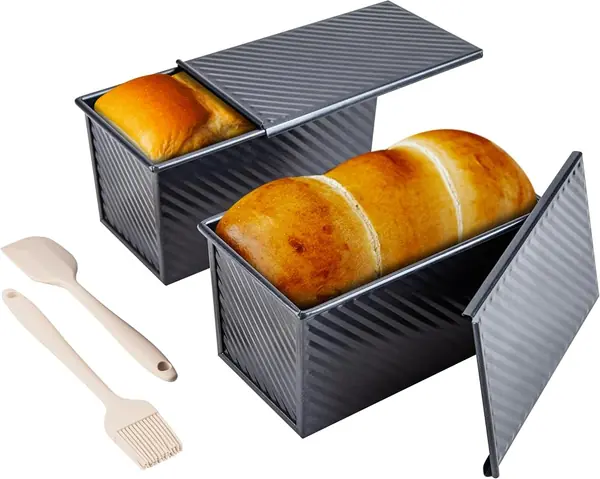
4

CARTMAN Pullman Loaf Pan Set, 2 Pack Best Budget Set

CARTMAN black carbon steel Pullman loaf pans with lids and tools, two pack

First bread pans

Bake Score 91/100
Material
Carbon steel
Dough Capacity
1 lb per pan
Includes
Spatula and pastry brush
Pan Size
8.4 x 4.7 x 4.1 in
View on Amazon

Two 8.4-inch pans, lids for both, a silicone spatula and a pastry brush — this is the set we point a first-time bread baker toward, because it costs about what one pan from the names above does and covers the whole job. Each pan takes a pound of dough, which makes a compact loaf, taller than it is wide, with the square corners that make sandwiches easy to stack.

In use they're straightforward: greased, filled, lid on, and the bread comes out with a shake. Baking was even across the small loaves we made, and the size turned out to be the useful part — a one-pound loaf is what two people finish before it stales. The lid is the basic slide-on kind; it shapes the top but doesn't lock, so carry the pan by its body.

The caveats come with the price. It's hand wash only, the corners want a real dry or they spot, and we keep metal tools away from the coating. For someone baking a loaf a week on a starter budget, none of that is a dealbreaker.

Worth Noting

  • Hand wash only; corners need a full dry
  • One-pound loaves only
Our Verdict

The set we suggest for a first Pullman: two greased-and-go pans with lids, plus tools, for less than most single pans here.

Check Latest Price
5

Monfish Pullman Loaf Pan, 1 lb Best for Two-Person Households

Monfish gold aluminized steel Pullman loaf pan with slide-on cover

Two-person households

Bake Score 90/100
Material
Aluminized steel
Dough Capacity
1 lb
Care
Dishwasher safe
Exterior Size
8.5 x 4.75 x 4.375 in
View on Amazon

Vent holes in the bottom of this pan are the detail you notice on the first bake: they let heat and air move under the loaf, which is why the base browns as well as the top — and they mean a loose, wet dough can seep through onto the oven floor. Firm sandwich dough and milk bread are fine. A high-hydration sourdough wants a sheet pan underneath.

Seepage aside, this is the pan we reach for when we're baking for two. At 8 1/2 inches outside and a pound of dough inside it makes a small, tall loaf, about a week of sandwiches, and the gold coating has released everything we've put in it, including a sticky discard-sourdough dough that usually needs parchment. The lid is the weak point: it slides on and slides right back off, so treat it as a cover that shapes the top rather than a handle.

Durability is the open question. Aluminized steel is the right material and the pan is listed as dishwasher safe, but the finish on this one ages faster with hard washing — hand wash it, dry it fully, and it holds up. At this price, it's still the small pan we recommend most often.

Worth Noting

  • Lid sits loosely and slides off
Our Verdict

The small Pullman we recommend for a two-person household: even browning and clean release, provided you keep wet dough off that vented base.

Check Latest Price
6

Gicyiit Pullman Loaf Pan, 13 x 4 Best for Large Family Loaves

Gicyiit rose gold carbon steel Pullman loaf pan with lid, 13 inch

Large family loaves

Bake Score 87/100
Material
Carbon steel
Dough Capacity
2.2 lb
Max Temperature
420°F
Exterior Size
12.59 x 4.72 x 4.64 in
View on Amazon

2.2 pounds of dough in a 12-inch interior makes this a genuine family loaf — longer and taller than the one-pound pans that fill out most of this list, and the cheapest route to that size here. Slices come out long and square, the shape that makes a packed sandwich look like it came from a bakery, and one bake covers lunches for most of a week.

Carbon steel at this gauge heats fast and browns deeply, and the pan is rated to 420°F, the lowest ceiling in this group — fine for sandwich bread, not the pan for a hot bake. It's sold as nonstick and it mostly is, but we grease it anyway; a buttered pan is the difference between a clean release and picking crumbs out of the corners.

The finish is where these pans age first. The rose-gold coating is prettier than it is tough, and it's the part to protect: hand wash, dry it thoroughly, no metal utensils. Even so, for a large household that wants the long loaf without paying a premium, this is the pan we point to — a workhorse, not an heirloom.

Worth Noting

  • Finish wears before the pan does
  • 420°F ceiling limits hotter bakes
Our Verdict

For a big family loaf on a small budget, this is the one: a full 2.2 pounds of dough and deep browning, as long as you grease it and go easy on the finish.

Check Latest Price

How We Tested the Best Pullman Loaf Pans

We started with a working list of roughly forty pans sold as singles and as two-piece sets, then cut anything whose lid didn't seat flush and filtered the rest by steel type, dough capacity, and price. That left 14 pans, which we baked with for five months in home kitchens rather than a test lab, because a pullman pan only shows its flaws once it's been through a dozen real bakes.

Every pan got the same enriched sandwich dough, baked on a Sunday and eaten as toast through the week, plus at least one high-heat sourdough round. We greased half of each batch and left the other half bare to see where the crust grabbed, slid the lid on and checked whether it sat flush or rocked, and watched for steam escaping around the rim where it shouldn't.

When the timer went off, we turned each loaf out onto a rack and counted how much stayed behind in the corners. Pans went through hand-washing after every bake, and a few went into the dishwasher to see what the coating did. We stacked them in a drawer the way you actually store them and pressed on the rims to check for flex, then re-seated each lid weeks later to catch the warping that shows up only after repeated oven cycles.

The pans that survived all of that with an intact finish and a lid that still clicked down flat are the ones that made the list.

How to Choose a Pullman Loaf Pan

Match the Pan to the Loaf You Actually Eat

Pullman pans, often sold as pain de mie pans, are sized by dough capacity rather than by the finished loaf, and that number is what to shop by. A one-pound pan has an interior around 7 to 7 1/2 inches long and bakes a compact loaf for two; a 2.2-pound pan runs 12 to 13 inches and gives the long square slices that stack in a lunch box.

The trap is buying the big pan and baking a one-pound recipe in it. An underfilled pan gives a short, dense loaf that never reaches the lid, and an overfilled one spills over the rim and bakes onto the outside. Scale the recipe to the pan, not the reverse. If you bake both sizes, a two-pan set usually costs less than buying them separately.

The Lid Does the Work

The cover is what turns a loaf pan into a Pullman: it sits on the rising dough and forces a flat top, so slices are square from corner to corner. What separates a good lid from an irritating one is how it seats. A cover that rocks or slides freely shifts when you move the pan, and you end up with a slanted loaf.

Look for a lid that settles flush with no play. Most slide on without locking, which is fine as long as you lift the pan by its body. Many bakers also wait until the dough has risen to just below the rim before sliding the cover on, which gives a better rise than lidding it from the start.

Finish and Rust Matter More Than Anything Else on the Label

The most common way a Pullman pan dies is at the surface: coating flaking into the crumb, or rust creeping out of a seam after a few weeks of washing. No listing tells you how a coating will hold up, so treat the care instructions as the warranty. Hand wash in warm water, dry it completely, corners and seams included, and skip the dishwasher even when the pan is labeled dishwasher safe.

Metal utensils and pans stacked loose in a drawer do the same damage faster. The pans with the best long-term record here are the ones whose owners dry them properly and store them with something between.

Vent Holes and Temperature Ratings

Many Pullman pans have small holes in the bottom, which improve air circulation and give the base a better crust. They also leak: a high-hydration sourdough or a loose gluten-free batter can seep through onto the oven floor, so set the pan on a sheet pan for wet doughs.

Check the oven-safe rating too. The pans here top out between 420°F and 450°F, which covers sandwich bread and milk bread comfortably and rules out very hot bakes. The lowest-rated pan in this group is not the one to push.

Frequently Asked Questions

Final Verdict

The USA Pan set is the recommendation we stand behind: two 13-inch aluminized steel pans, an even bake from end to end, and bread that drops out with a swipe of butter. Buy it if you bake sandwich bread most weeks and want to buy once.

If your household eats one small loaf at a time, the CHEFMADE does the same job in a smaller footprint with a lid that seats better than anything else here. Outfitting a first kitchen? The CARTMAN pair, tools included, costs less than most single pans on this page.