The 6 Best Small Stand Mixers of 2026

The day I stopped hauling my full-size mixer out of the bottom cabinet was the day small stand mixers won me over. Creaming butter for one batch of cookies or whipping a half-pint of cream shouldn't feel like a project, and a 3- to 4.5-quart mixer handles a single recipe without eating the counter.

I've baked with these for years, and 12 of them went through real batches in our kitchen — some convert into hand mixers, others are tilt-head machines that share attachments with their bigger siblings. Something first-time buyers get wrong: the wattage on the box is peak power, not a promise the motor won't stall in stiff dough.

Size and durability are what separate a good one from a frustrating one — how much counter it claims, how it feels when you lift it to a shelf, and whether the finish is still something you want to look at after a season of cookie dough. All six were judged on the same handful of recipes, so you can compare them honestly.

Our Top Picks

The Best Small Stand Mixers

1

KitchenAid Artisan Mini 3.5-Qt Best Overall
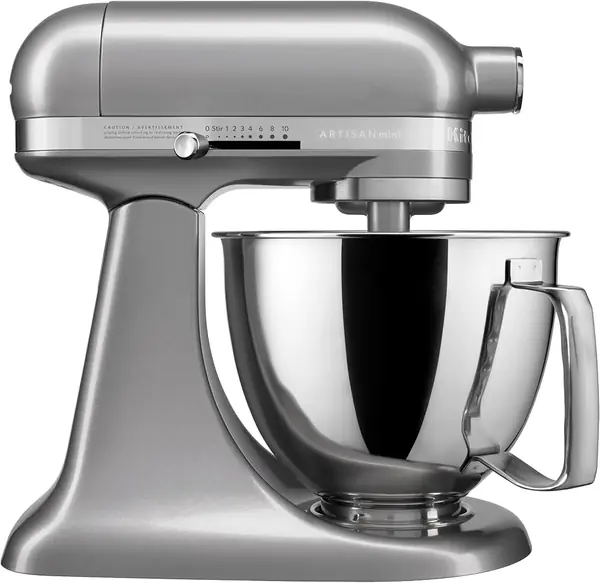
KitchenAid Artisan Mini stand mixer in contour silver with stainless steel bowl

Everyday small batches

Bake Score 96/100
Capacity
3.5 quarts
Speeds
10
Weight
14.3 lb
Dimensions
12.3"D x 7.8"W x 12.3"H
View on Amazon

At 7.8 inches wide and 12.3 inches deep, the Artisan Mini occupies less counter than any other dedicated stand mixer here, and it still mixes like the full-size KitchenAid it is modeled on. That is the trade most compact mixers get wrong, shrinking the bowl and the motor along with the body. This one keeps the ten speeds, the tilt head, and the metal build, and drops the weight to 14.3 pounds. It is the machine that stayed out on our counter instead of going back in the closet.

The 3.5-quart bowl is rated for five dozen cookies in a single batch, and the tilt head lifts clean of it, so adding nuts or scraping the sides does not turn into a spatula-versus-beater argument. KitchenAid also ships this model with a Flex Edge beater that wipes the bowl as it turns. The less expensive Classic in this guide comes with a plain flat beater, a small difference you notice every time you scrape.

Where it earns its keep is repetition: a cake Saturday, pancakes Sunday, frosting midweek, without ever being hauled out of a cabinet. For a household of two to four baking at that pace, the bowl is sized right, the head clears a standard upper cabinet, and the whole thing wipes down in a minute.

Worth Noting

  • Priciest mixer in this guide
  • 3.5-quart bowl rules out double batches
Our Verdict

We think it's the best small stand mixer for most people: full-size mixing behavior, a 7.8-inch footprint, and a tilt head that gets out of your way.

Check Latest Price
2

bella 3.5-Qt Hand & Stand Mixer Best for Tiny Kitchens

bella 2-in-1 hand and stand mixer in oatmilk with stainless bowl and lid

Tiny kitchens

Bake Score 92/100
Capacity
3.5 quarts
Speeds
6
Weight
4.6 lb
Motor
200 watts
View on Amazon

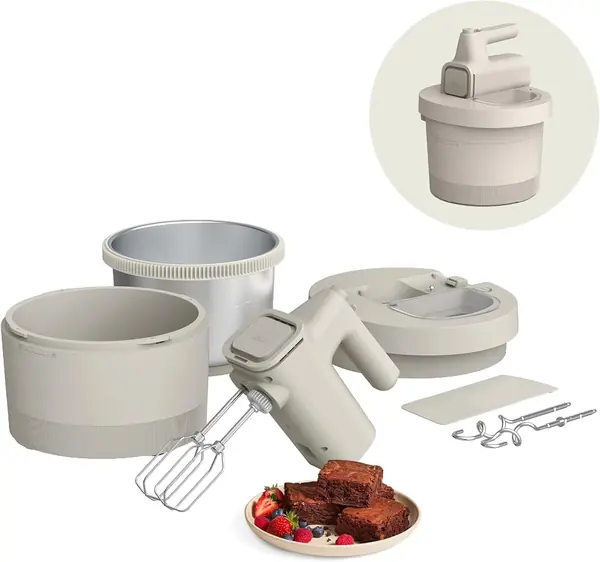
The bella is a hand mixer first. Drop it into the ring on top of its own 3.5-quart bowl, though, and the bowl's gear teeth turn it while the beaters spin, so pancake batter mixes itself while you grease the pan. Lift the head off and you are holding a hand mixer again, for a pot of frosting or the bowl you already have dirty.

What we appreciate most is how completely it packs away. At 4.6 pounds it is the lightest machine here, and the bowl, beaters, and hooks nest inside it, so it disappears onto a cabinet shelf instead of claiming counter space. The cover doubles as a splatter guard with a clear window, which is the detail that won us over: you can watch a batter come together without stopping the motor or wearing the flour.

It is not a bread machine. With 200 watts and six speeds it is the least powerful pick in this guide, and a stiff dough will let you know, so keep it to cakes, muffins, whipped cream, and pancake duty where it is plenty. The beaters are the lightest-gauge of the group too, so knock the batter off gently rather than rapping them on the rim.

Worth Noting

  • 200-watt motor limits it to light batters
  • Beaters feel thin next to the rest
Our Verdict

Our pick when the mixer has to disappear between bakes: it converts to a hand mixer and stores inside its own bowl.

Check Latest Price
3

Hamilton Beach Classic Stand and Hand Mixer Best Budget Two-In-One

Hamilton Beach Classic 2-in-1 hand and stand mixer with 4-quart stainless bowl

Hand and stand

Bake Score 91/100
Capacity
4 quarts
Speeds
6 with QuickBurst
Motor
290 watts peak
Attachments
Beaters, dough hooks, whisk
View on Amazon

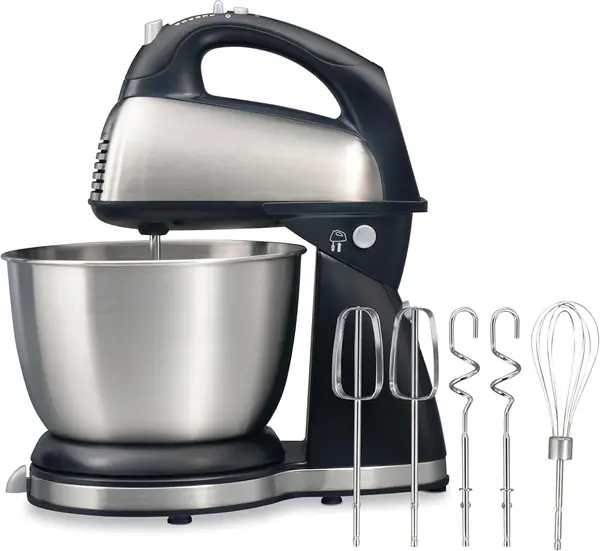
The cheapest route here to a four-quart bowl is also the only machine that pulls double duty: lift the head off its base and the Hamilton Beach keeps mixing in your hand. That is why it stays in this guide even though it is the least automatic mixer we recommend. Nothing else here covers both jobs for the money.

The bowl is a full quart larger than the bella's, and the 290-watt motor with six speeds and a QuickBurst button covers everything from whipped cream to cookie dough. What it does not do is mix hands-free. A lever on the base shifts the bowl side to side into the beaters, so you stand there steering, which is a small chore with frosting and a sensible rhythm with stiff dough you want to watch anyway.

Five attachments come in the box: two beaters, two dough hooks, and a whisk. The head weighs 6.7 pounds, light enough to lift off one-handed, and the bowl rest keeps drips off the counter between additions. Set aside real counter depth, though. At 8.2 inches by 13.25 inches it wants a corner rather than a sliver.

Worth Noting

  • You shift the bowl side to side by hand
Our Verdict

We recommend it to anyone who wants both a hand and a stand mixer on one small budget, as long as you don't mind steering the bowl.

Check Latest Price
4

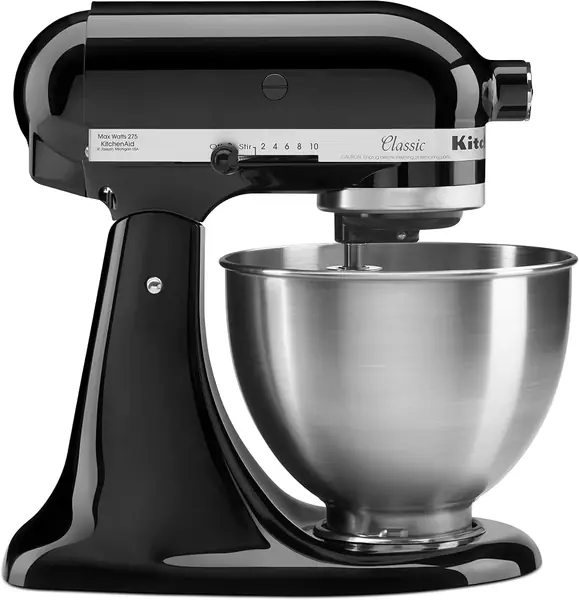
KitchenAid Classic Series 4.5-Qt Best for Big Batches

KitchenAid Classic Series tilt-head stand mixer in onyx black with 4.5-quart bowl

Bigger batches

Bake Score 90/100
Capacity
4.5 quarts
Speeds
10
Weight
22 lb
Dimensions
14.1"D x 8.7"W x 13.9"H
View on Amazon

Twenty-two pounds and 14.1 inches from the wall out: the Classic is the heaviest, deepest machine in this guide, and it is not one you will lift down from a shelf every Sunday. Give it a permanent corner, though, and the 8.7-inch width means it barely crowds the counter it sits on.

What you get for that footprint is capacity. The 4.5-quart bowl is rated for eight dozen cookies in a batch and takes a five-cup batch of bread flour without strain. The ten speeds run from a true stir to a fast whip, the tilt head opens the bowl for scraping, and the front hub accepts KitchenAid's pasta roller, grinder, and spiralizer, all sold separately and all reasons this machine outlives the cake phase.

We have come to think of it as the sensible splurge: more capacity than the Artisan Mini for less money, with the same metal build and the same tilt head. What it asks in return is bench space and a little care. Gear wear is the long-term trouble spot on this model, so keep stiff dough on the low speeds and let the motor work rather than forcing a heavy mix at speed six.

Worth Noting

  • 22 pounds and 14.1 inches deep
  • One-year warranty is short for the money
Our Verdict

We like it best for volume bakers: 4.5 quarts, ten speeds, and an 8.7-inch width, provided 22 pounds can stay put.

Check Latest Price
5

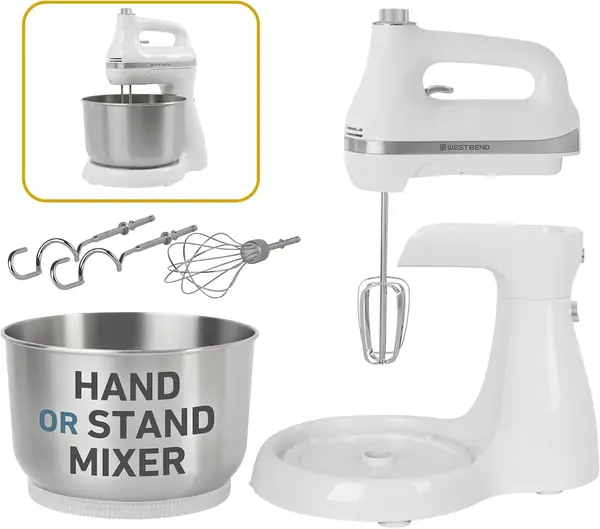
West Bend Two Sweet 2-in-1 Best for Large 2-In-1 Batches

West Bend Two Sweet 2-in-1 hand and stand mixer in white with 4.4-quart bowl

Large 2-in-1 batches

Bake Score 88/100
Capacity
4.4 quarts
Speeds
11 with Turbo
Weight
5 lb
Bowl Motion
Base-driven rotation
View on Amazon

A 4.4-quart bowl in a machine that weighs five pounds is the pitch, and it is a fair one. This is the largest bowl among the two-in-ones here and the lightest way to get past four quarts. The bowl sits on a base that turns it for you, so mixing is hands-off in a way the Hamilton Beach's side lever is not.

What we like best is how much control that light body buys: eleven speeds plus a turbo burst, a tilt head that lifts clear for scraping, and a whisk, two beaters, and left and right dough hooks that all go in the dishwasher. One quirk to know is the gear ring under the bowl, which traps water if you wash it by hand, so run that piece through the dishwasher and it never comes up.

Where it trails the KitchenAids is build. The body is plastic and the fit is a step below the metal machines, which is the honest reason it sits in also-consider rather than in the top tier. For cake, frosting, and a single batch of bread it does the job, and it stores in less cabinet space than anything else here with a bowl this size.

Worth Noting

  • Plastic body feels a step below the KitchenAids
Our Verdict

We see it as the big-bowl option: 4.4 quarts in a five-pound machine, with a plastic build as the trade.

Check Latest Price
6

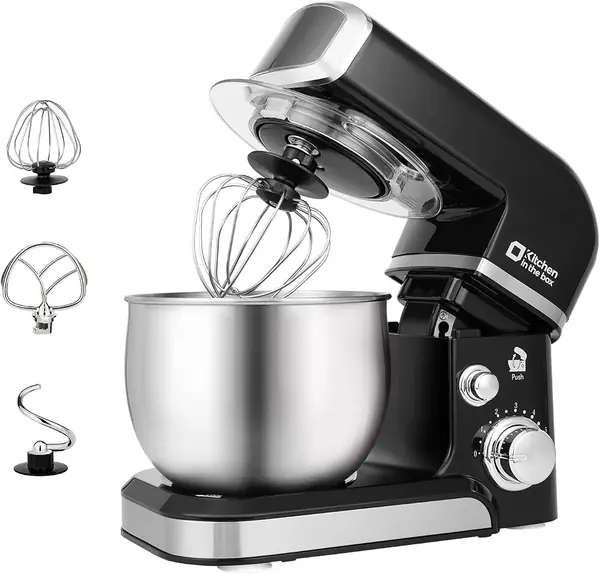
Kitchen in the box 3.2-Qt Stand Mixer Best for Narrow Counters

Kitchen in the box 3.2-quart stand mixer in black with stainless bowl and whisk

Narrow counters

Bake Score 87/100
Capacity
3.2 quarts
Weight
7 lb
Motor
300 watts
Dimensions
12.9"D x 7"W x 10.2"H
View on Amazon

The first thing we noticed with a stiff cookie dough was the whisk riding high: the bottom of the 3.2-quart bowl stayed unmixed until we unlocked the bowl and lifted it into the beaters. It is a two-second fix and it becomes habit after the first batch, but it tells you what kind of machine this is.

What it does well is fit. At 7 inches wide it is the narrowest mixer here, narrow enough for a counter that has no room for anything else, and the four suction feet keep it planted while it works. The 300-watt motor is as strong as anything in this group on paper, six speeds cover the basics, and the bowl, beater, hook, and whisk all go in the dishwasher. Cakes, pancakes, and meringue come together without drama.

So the case for it is narrow, like the machine: a first apartment, a dorm kitchen, or a counter where nothing else fits. Judged that way it is a perfectly good mixer that does what a stand mixer is supposed to do for less than most of this group. It just is not the one to buy if you plan to bake through the holidays.

Worth Noting

  • Durability is the weakest in this group
  • 3.2-quart bowl rules out double batches
Our Verdict

We rate it for narrow counters and light jobs, not for holiday baking or a decade of weekly dough.

Check Latest Price

How We Picked and Tested These Mixers

We started by rounding up every compact mixer we could find in the 3- to 4.5-quart range — tilt-head machines, two-in-ones that convert to a hand mixer, and a few lightweights built for small kitchens — then compared specs and reviews to get down to 12. Capacity claims were the first thing we checked against reality: a bowl listed at 3.5 quarts still has to cream one stick of butter without the beater missing the edges.

Every mixer went through the same four jobs on a home kitchen counter: creaming cold butter and sugar for one batch of cookies, whipping a half-pint of cream, mixing a single cake layer, and kneading a half-batch of bread dough on the hook. We started each one at its lowest speed with a cup of flour in the bowl to see whether it threw a cloud or eased in.

Along the way we noted how the bowl locked and released, how far the head tilted, and how much of the bowl the beater actually reached — whether we had to stop and scrape every minute. Dough batches showed which motors ran warm and which machines walked across the counter. We weighed and measured every mixer before lifting it into a cabinet, since that's where small mixers usually live, and wiped the finishes after each session to see which held fingerprints.

Functionality and value came down to small things: a slow first speed that kept powdered sugar in the bowl, controls we could read with doughy hands, and whether the whisk, dough hook, and beater came in the box or cost extra. At the end we compared motor warmth, head wobble, and how each machine felt on the eighth batch versus the first.

How to Choose a Small Stand Mixer

Match the Bowl to the Batch You Actually Make

Bowls in this category run from about 3.2 to 4.5 quarts, and that spread is a batch, not a bite. KitchenAid rates its 3.5-quart bowl at five dozen cookies with the flat beater and its 4.5-quart at eight dozen. A single cake, a dozen muffins, or one loaf of bread fits the smaller bowl with room to fold; a doubled cookie recipe for a school bake sale does not.

If you double regularly, buy the bigger bowl and accept the bigger body. A too-small bowl is the one compromise you will curse every time you bake, because there is no workaround short of splitting the recipe into two rounds.

Measure Depth and Headroom, Not Just Width

Width is the number every listing leads with, and it matters least. What you need is depth, plus clearance above the head, because a tilt-head mixer rises as it opens. Measure from the wall to the front edge of your counter and from the counter to the underside of the upper cabinets before you decide where the machine lives.

Then think about lifting. A 22-pound mixer belongs on the counter permanently, while a five- or seven-pound one can live in a cabinet and come out when you need it. The KitchenAid Classic is only 8.7 inches wide but 14.1 inches deep; the bella is 4.6 pounds and disappears onto a shelf.

Decide Whether a Two-in-One Really Gives You Two Mixers

A hand mixer that docks into a bowl earns its place in a small kitchen, but these machines do not all work alike. Some spin the bowl on a powered base, so mixing is hands-off. Others hold the bowl still and give you a lever to shift it into the beaters, which means you stand there steering.

The bigger difference is torque. A hand-mixer motor turning a bowl will cream butter and fold batter, but it will not knead stiff bread dough the way a dedicated stand mixer will. If bread is on your list, buy a stand mixer.

Read Watts and Speeds as a Pair

Power here runs from 200 to 300 watts, and the number on its own tells you little, since bowl size and gearing matter as much as the motor. What you can compare is speed count and how slow the slowest setting is. Six speeds handle batters; ten give you finer control at the low end, which is where you want to be when flour goes in.

A genuinely slow first speed keeps the flour cloud inside the bowl instead of on your cabinets. We rank the two KitchenAids where we do partly because their low end is controllable rather than merely slow-ish.

Frequently Asked Questions

Final Verdict

Most small kitchens are best served by the KitchenAid Artisan Mini. It mixes like the full-size machine it is modeled on, needs less than eight inches of width, and the tilt head makes scraping and adding easy in a way no fixed-head compact can match. The money is the hurdle, not the performance.

If you bake often enough to double recipes, the KitchenAid Classic gives you a 4.5-quart bowl and ten speeds for less, provided 22 pounds can live on the counter. And if the mixer has to vanish into a cabinet between bakes, the bella packs into its own bowl and handles the light jobs well.