The 5 Best Commercial Stand Mixers of 2026

The night my old stand mixer started smelling like hot wiring midway through a stiff rye dough, I learned the difference between a machine that mixes and one that works. A commercial mixer buys that morning back: heavier motor, sturdier drive, a bowl that doesn't flinch at five pounds of flour.

We worked seven of them through weeknight loaves, a marathon Saturday of cake orders and a shift on a friend's pizzeria prep counter. Wattage gets the marketing, but what decides whether you love a machine is duller stuff: whether it walks toward the counter's edge when the dough tightens, whether you can hear yourself think on speed two, and how much counter it swallows when it's parked.

Two things get buried in the fine print: a safety guard that's genuinely quick to take off and refit, since a fiddly one ends up left off, and how the bowl lifts into place, because that's the motion you repeat every batch. Bake for a living and the heft is the point; bake for fun and you can size down.

Our Top Picks

The Best Commercial Stand Mixers

1

ZACME 8.4-Quart Commercial Stand Mixer Best Overall
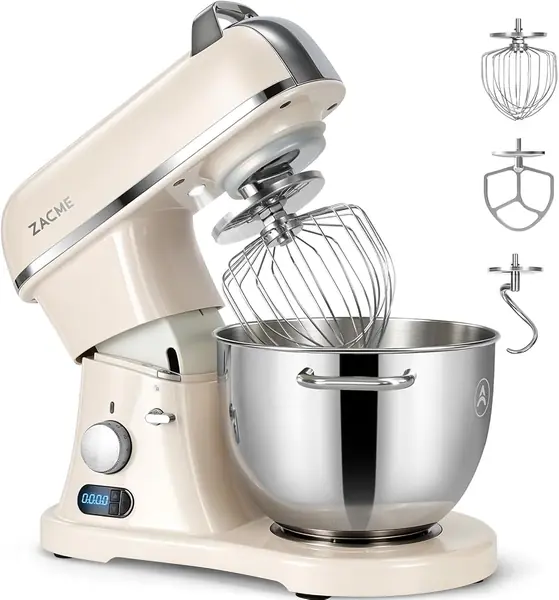
Cream ZACME 8.4-quart commercial stand mixer with stainless steel bowl and three attachments

Small bakery batches

Bake Score 92/100
Motor
800 watts
Bowl Capacity
8.4 quarts
Max Dough Per Batch
3 kg/6.6 lbs/105.8 oz
Certification
NSF/ANSI 8-2023
View on Amazon

The number that decides this one for us is 6.6 pounds. That's the dough ZACME rates its 8.4-quart bowl for — more than the 15-quart VEVOR in this guide manages — and it comes from a machine that weighs 33 pounds and sits on a counter. If you're running sourdough, bagels, or four dozen cookies at a time, that pairing of batch size and a body one person can lift is the whole argument.

The bowl light is the detail we didn't expect to care about. It comes on while the mixer runs, and in a bowl this deep there's real shadow down at the beater; seeing the bottom of the bowl without stopping the machine changes how confident you feel adding the last of the flour. The countdown timer and pause button work the same way — set eight minutes, step away, and the mixer stops itself.

Underneath, it's an 800-watt gear-driven unit with 11 speeds on a knob and a digital panel, and ZACME lists it as meeting NSF/ANSI 8-2023. Noise surprised us most: 48 dBA on the slowest gear and 68 on the fastest, which means a phone call at the bench is possible while it kneads. Suction feet hold it down, and this one doesn't walk.

The trade-off is muscle. A 1100-watt floor model out-kneads it on stiff, low-hydration dough, and 6.6 pounds is a ceiling rather than a pace you keep up twice an hour. What buys that back is everything around the mixing — a timer that stops the machine for you, a light in the bowl, and 33 pounds you can move alone when the kitchen gets rearranged.

Worth Noting

  • 800 watts trails the floor models here
Our Verdict

For a small bakery or a bread business run from a home kitchen, this is the mixer we tell people to buy: 6.6 pounds of dough, quiet operation, an NSF claim, and a body one person can lift.

Check Latest Price
2

KitchenAid KSM8990CU Commercial Mixer Best for Small Kitchens

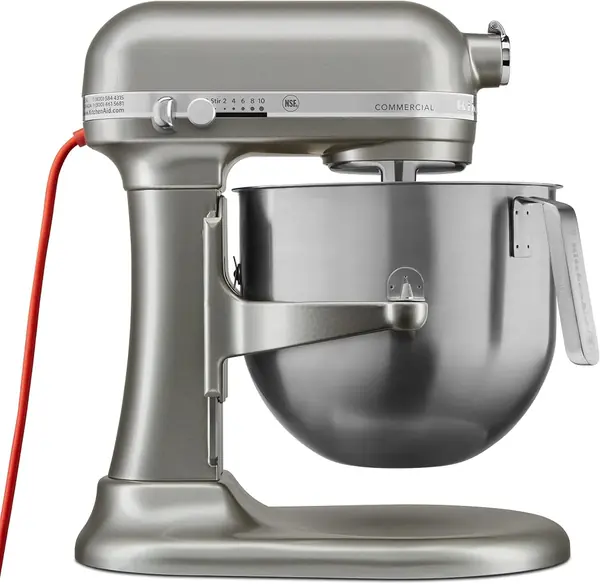
Contour silver KitchenAid KSM8990CU commercial stand mixer with bowl-lift lever and stainless bowl

Countertop teaching kitchens

Bake Score 87/100
Motor
500 watts
Bowl Capacity
8 quarts
Speeds
10
Certification
NSF certified
View on Amazon

At 25 pounds, the KSM8990CU is the lightest mixer here by a distance — the ZACME is 33, and the floor models run past 100. In a teaching kitchen or a café where the mixer shares a counter with prep work, that's the difference between a machine you can put away and one that owns its corner.

Its 500-watt DC motor is the smallest figure on this page, and that would matter more if wattage told the whole story. The DC design is built to run long kneads with less heat build-up, and 10 speeds with a bowl-lift lever give you finer control over a stiff dough than the three-speed floor mixers do. We also like the speed-control protection, which keeps the mixer from starting when someone wipes the housing down. The 8-quart bowl comes with a flat beater, a spiral dough hook, and an 11-wire elliptical whip.

Staying power is the caveat, and it's the reason this isn't our top pick. Early failures are a real possibility with the KSM8990CU in a way they aren't with the ZACME, and at this price you're underwriting that risk. Two years of replacement limited commercial warranty is what makes it a reasonable bet for a school or a test kitchen that wants NSF certification and a company to call.

Worth Noting

  • Premium price for the smallest motor here
Our Verdict

Choose it when counter space is short and a two-year commercial warranty matters more than dough capacity; it's the lightest certified mixer here, and the price is the trade you make.

Check Latest Price
3

VEVOR 15-Quart Commercial Mixer Best for Batters and Fillings

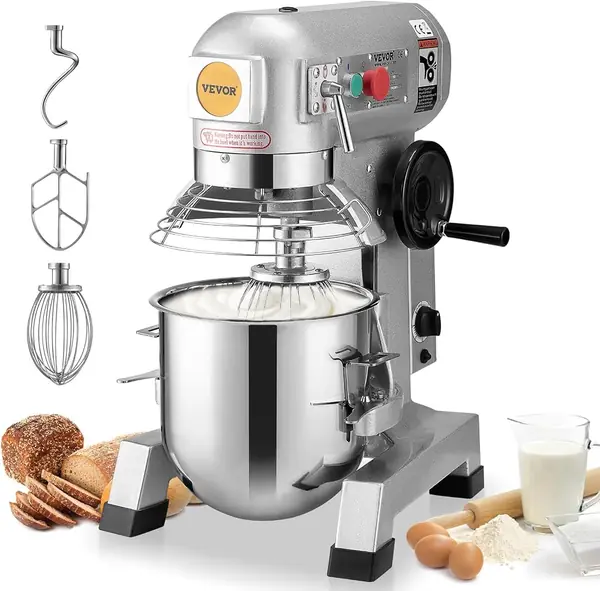
Silver VEVOR 15-quart commercial food mixer with stainless steel bowl and three mixing attachments

Cakes and fillings

Bake Score 84/100
Motor
550 watts
Bowl Capacity
15 quarts
Max Dough Per Batch
1.5 kg / 3.3 lbs
Weight
105.8 lb
View on Amazon

Fifteen quarts of bowl and 3.3 pounds of dough are the two numbers to hold together, because they pull in opposite directions. The bowl is nearly twice the ZACME's; the dough rating is half. Read as a pair they describe the machine accurately: cream, frosting, fillings, and batter in volume, with bread as the side job.

That's a machine worth having if cakes are the business. Three speeds cover what a bowl this size does, the push-button controls are simple enough to hand to anyone on staff, and the timer knob runs to 30 minutes and stops the mixer at the end of it — the feature we appreciate most on a long whip, since nobody has to stand there watching. The 550-watt gear drive has enough behind it for a full bowl of buttercream.

The catch is where it lives and how it gets there: 105.8 pounds and 26.6 inches tall, so it stands on a dedicated table rather than a shelf, and it takes two people to land it the first time. Plan the spot before delivery. If bread is what you sell, the ZACME kneads twice the dough for less money — that's the whole decision.

Worth Noting

  • Rated for only 3.3 pounds of dough
  • 105.8 pounds; needs two people and a stand
Our Verdict

We recommend it for frostings, fillings, and big batter batches rather than heavy dough; the 15-quart bowl holds volume no countertop mixer here can match.

Check Latest Price
4

VEVOR 30-Quart Commercial Mixer Best for High-Volume Dough

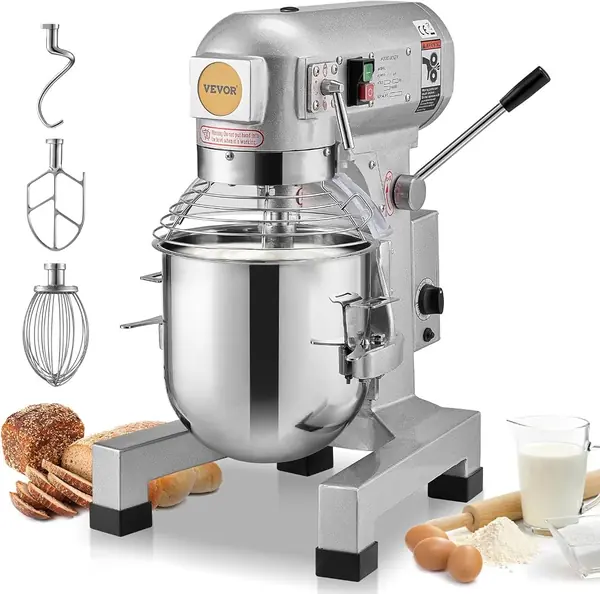
Sparkling silver VEVOR 30-quart floor-standing commercial mixer with lever lift and stainless bowl

High-volume bread dough

Bake Score 83/100
Motor
1100 watts
Bowl Capacity
30 quarts
Max Dough Per Batch
3.5 kg / 7.7 lbs
Weight
149.9 lb
View on Amazon

The lever raises and lowers the bowl instead of cranking a wheel, and across a morning of batches that's the difference between a machine you tolerate and one you don't mind running. The stainless shield across the bowl is the other half of it: flour stays in, hands stay out.

Behind the shield it's 1100 watts through a gear drive, three speeds stepped for dough, fillings, and cream, and a 30-minute timer that shuts the machine down at the end of the set time. At 7.7 pounds of dough per batch it's the biggest capacity here, and at 149.9 pounds and 33.7 inches tall the mass does a lot of the work — a stiff dough barely moves the head. That was the first thing we noticed, before anything about the controls.

What it asks in return is floor space and commitment. Nearly 150 pounds means the spot you pick is the spot it stays, and a 30-quart bowl wants a real batch; a single loaf leaves the hook spinning above the flour. If your week swings between two loaves and two hundred, this is the second machine, not the only one.

Worth Noting

  • Nearly 150 pounds; the spot is permanent
  • Bulk batches only in a 30-quart bowl
Our Verdict

A production mixer for a shop that kneads more than seven pounds of dough at a time and has the floor space, the help to move it, and a permanent spot for it.

Check Latest Price
5

Towallmark 15-Quart Commercial Mixer Best for Schools and Bakeries

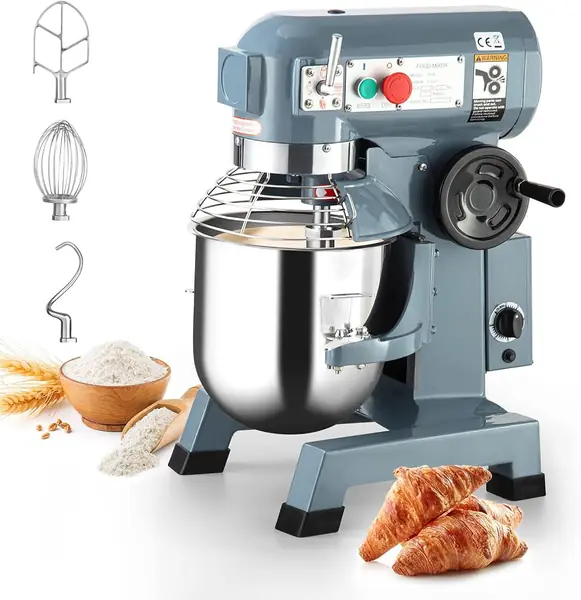
Blue Towallmark 15-quart commercial stand mixer with stainless steel bowl and safety guard

Schools and bakeries

Bake Score 82/100
Motor
600 watts
Bowl Capacity
15 quarts
Speeds
3
Safety Guard
Stainless steel
View on Amazon

Towallmark requires the stainless guard to be closed whenever the machine runs, and that rule is easier to keep when the guard is sitting right there on a 15-quart bowl. For a school, a church kitchen, or a bakery where the person at the bench changes every shift, that's a feature rather than a fuss.

Behind it is a 600-watt, three-speed machine — 130, 233, and 415 rpm — with food-grade 304 stainless in the bowl and all three attachments. Start and stop are separate buttons, and non-slip feet take some of the shake out of a stiff mix. It's the only mixer in this guide with a guard over the bowl, and for a setting where the operator changes, that's the reason to pick it.

Two practical things to settle first. Dough hooks are the part that wears on a mixer this size, and a replacement isn't always easy to find, so confirm a source before you commit. And at some of the three speeds, flour and cocoa still escape past the guard and settle into crevices around the head. Neither is disqualifying; both are easier to live with in a shop that wipes down between batches.

Worth Noting

  • Replacement dough hooks are hard to find
  • Flour escapes past the guard at some speeds
Our Verdict

A solid 15-quart choice for schools and shift kitchens that want a guard over the bowl, as long as you can source a spare dough hook when one goes.

Check Latest Price

How We Tested Commercial Stand Mixers

To build the shortlist, I went through specs and review data on more than 30 mixers, then filtered hard: bowl capacity measured against actual counter footprint, drive and gearbox construction, whether the dough hook, whisk, and flat beater came in the box or cost extra, and price per quart of bowl. That left seven machines, from compact 8-quart countertop models to a 30-quart lever-lift mixer that takes two people to move.

Each one then lived in my kitchen for eight months. The standing test was a stiff bagel dough — five pounds of flour at the lowest speed — where I watched whether the machine crept across the counter, whether the head flexed under load, and how evenly the hook reached the bottom and sides of the bowl. Around that we ran four-batch bread mornings, a week of buttercreams and meringues to see how the whisk behaved at top speed, and two days each on a friend's pizzeria prep counter, mixing dough back to back with the built-in timer running.

Noise got a decibel meter held at arm's length on speed two and on high. We weighed every machine on a bathroom scale, then lifted it onto a shelf to see how bad the schlepp really is, and I timed how long each safety guard took to remove and refit and counted how many hands the bowl lift needed.

By month six the interesting differences were reliability ones: which machines still ran as smoothly as they did in week one, which developed a rattle, and which speed ranges were actually usable. We set each machine's price against its bowl capacity and what shipped in the box to judge value, then kept baking.

How to Choose a Commercial Stand Mixer

Start With the Dough Rating, Not the Bowl Size

A 15-quart bowl holds more than an 8.4-quart one, but that says nothing about how much bread the machine can knead. ZACME rates its 8.4-quart bowl for 3 kg of dough; VEVOR rates its 15-quart bowl for 1.5 kg. The smaller bowl is the stronger bread machine, and the bigger one is built for volume of batter, cream, and fillings.

Work backward from the heaviest single batch you mix in a week, then find the published dough figure. If the maker only lists quarts, treat that as a bowl measurement and nothing more.

Settle Countertop or Floor Before You Measure Anything

Height and weight decide this faster than any feature. The countertop machines here run 25 to 33 pounds and about 16 inches tall; the floor models run 26.6 to 33.7 inches and 105.8 to 149.9 pounds. A 100-plus-pound mixer is not a countertop appliance, whatever shelf the listing files it under — it needs a stand that carries the weight and two people to land it there.

Measure with the head raised and the bowl lifted, not with the machine closed, and pick the spot before delivery day.

Weigh Watts, Speeds, and the Timer Together

Wattage is the number everyone compares and the least useful alone: a 500-watt DC motor built for long kneads can outlast a cheap 1100-watt one. What we look at instead is the combination — gear-driven transmission, how many speeds you get, and whether the machine can stop itself.

Three speeds is normal for a floor mixer and enough for production, as long as the fixed ratios cover dough, fillings, and cream. A timer that shuts the mixer off after a set interval is worth more than an extra speed if you're the person who walks away mid-knead.

Treat Commercial as a Claim Until You See the Certification

Commercial shows up in nearly every title on this page. The certificate is what tells you an inspector will recognize the machine: NSF/ANSI 8 is the standard mixers are evaluated against, and both countertop machines here carry it.

Then read the warranty language. Two-year replacement coverage on a commercial mixer is a different promise than a home-kitchen warranty, and it's the part you lean on if the unit quits in month three.

Cleaning and Noise Are the Daily Costs

Noise figures here run from 48 dBA on the quietest countertop model to about 70 dBA on the floor machines — the difference between taking a call at the bench and stepping out of the room. Cleaning is the quieter differentiator: stainless attachments that go in the dishwasher and a light inside the bowl save a couple of minutes every batch, while a guard you have to undo each time adds them back.

Neither shows up in a specification comparison, and both decide whether you still like the machine in month six.

Frequently Asked Questions

Final Verdict

The ZACME 8.4-Quart is what we point most buyers toward: 6.6 pounds of dough per batch, an NSF/ANSI 8-2023 claim, a timer that stops the machine on its own, and 33 pounds that one person can lift.

Move up to the VEVOR 30-Quart only when a single batch passes seven pounds of dough and the mixer has a permanent spot with two people to install it. If a two-year commercial warranty and a 25-pound body matter more than dough capacity, the KitchenAid covers that trade.