The 7 Best Stand Mixers for Bread Dough of 2026

Bread dough is the hardest thing most of us ever ask a stand mixer to do — a stiff, heavy mass that fights the hook for ten minutes straight. It's also where a weak mixer exposes itself: the bowl creeps across the counter, the head starts to shudder, and the motor begins to smell warm.

I've run 11 mixers through loaves, bagels and pizza dough in my own kitchen. The lesson that surprised me most: wattage and speed count tell you less about bread performance than bowl design does, and price tells you even less.

A tilt-head machine is easier to load and scrape down; a bowl-lift gives a big dough more room and wobbles less at the end of a long knead. None of that matters if the mixer is too tall for your cabinets, too loud to run before 7 a.m., or slow to clean. Our seven are the ones I'd trust with a Saturday sourdough.

Our Top Picks

The Best Stand Mixers for Bread Dough

1

KitchenAid 5.5-Qt Bowl-Lift Best Overall
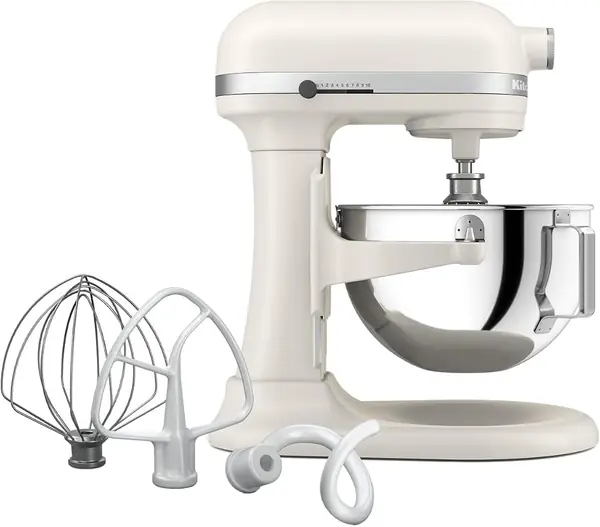
KitchenAid 5.5-quart bowl-lift stand mixer in porcelain white with stainless steel bowl

Everyday bread baking

Bake Score 94/100
Motor
500 watts
Bowl Capacity
5.5 quarts
Speeds
11
Dough Per Batch
Over 7 lbs
View on Amazon

On a bowl-lift mixer the head never moves. The bowl twists down into a three-point lock, and the beater comes to the dough instead of the dough chasing a tilting head. That single difference is why this KitchenAid, rather than one of the tilt-heads here, is the machine we point bread bakers to first: stiff dough pushes back hard, and a locked bowl gives it nothing to push against.

The 500-watt motor drives through the bowl, and KitchenAid rates the machine for more than 7 pounds of bread dough in a batch, or 11 dozen cookies with the flat beater. That headroom shows up exactly where bread needs it: heavier doughs and double batches run without the mixer walking across the counter or the housing turning warm. Eleven speeds include a half setting for folding, which is more useful than it sounds when raisins or nuts go into a stiff dough at the end. We think this is the best balance of kneading muscle, footprint, and price in the group, and the one whose specs and behavior both point at bread first.

What you give up is loading convenience. You lift the bowl into the cradle and lock it every time you scrape down or add flour, and there is no tilting the head back for a clear view. At 16.5 inches tall it also needs clearance under the upper cabinets, so measure before you decide it lives on the counter. Neither is a dealbreaker for bread, where you are stopping to scrape anyway. The coated dough hook, flat beater, and six-wire whip come in the box, and the 10-plus optional attachments fit this hub.

Worth Noting

  • Bowl must be lifted and locked each time
Our Verdict

We recommend this one to anyone whose shopping list starts with bread: 500 watts through a locked bowl, more than 7 pounds of dough per batch, and a size that still fits a normal kitchen.

Check Latest Price
2

ZACME 8.4QT Commercial Best for Large Batches

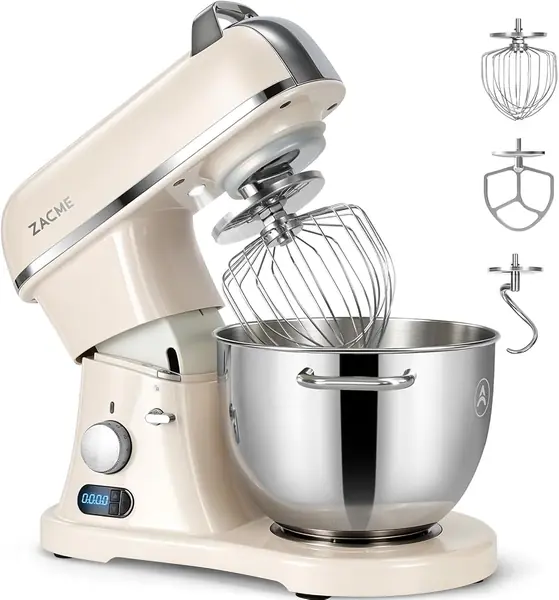
ZACME 8.4-quart commercial stand mixer in cream with stainless steel bowl and dough hook

Large batches

Bake Score 93/100
Motor
800 watts
Bowl Capacity
8.4 quarts
Max Dough
3 kg (6.6 lbs)
Noise, Slow Speed
48 dB
View on Amazon

Where the KitchenAid above is sized for a home kitchen, this ZACME is built like the mixer at the back of a small bakery. The bowl holds 8.4 quarts, the stated dough maximum is 3 kg (about 6.6 pounds), and the body weighs 33 pounds and sits 18 inches deep on the counter. You notice all of that the moment you slide it into place.

The extras are what make it pleasant rather than merely big. An LCD runs a countdown timer, so a ten-minute knead does not need a separate clock, and a light inside the bowl lets you watch the dough come together without stooping. It is rated at 48 dB on its slowest speed, quiet enough to knead through a phone call, and the suction feet keep it planted once the dough stiffens. The accessories are stainless and dishwasher safe, and the two-year limited warranty is the longest coverage of any mixer here.

Who it suits comes down to batch size. For one loaf on a Tuesday, most of this capacity is wasted and the weight is simply a nuisance. For three or four loaves at a time, or a small bread business, the combination of 800 watts, a 3 kg dough rating, and a timer you can set and walk away from is the most useful thing on this page. That is the trade: it wins on throughput and loses on floor space.

Worth Noting

  • 33 pounds, so give it a permanent spot
  • Needs 18 inches of counter depth
Our Verdict

Our pick for anyone mixing four loaves at a time: 3 kg of dough capacity, 800 watts, and a timer that lets a long knead take care of itself.

Check Latest Price
3

Bosch Universal Plus Best for Whole-Grain Dough

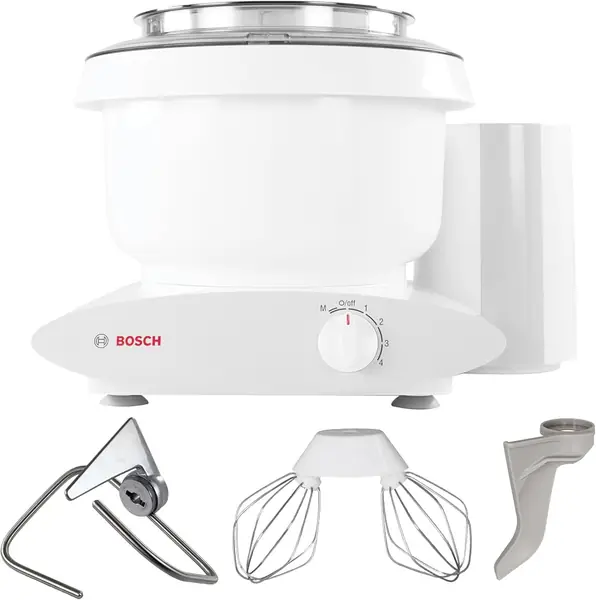
Bosch Universal Plus stand mixer with white plastic 6.5-quart bowl, lid, and dough hook

Whole-grain dough

Bake Score 92/100
Motor
500 watts
Bowl Capacity
6.5 quarts
Speeds
4
Max Dough
15 lbs (14 loaves)
View on Amazon

Nothing else here drives from below. The motor sits in the base, the 6.5-quart bowl drops down over the drive shaft, and the top stays wide open, so you add flour through a lid and splash ring instead of tilting a head back. It is the layout that made this machine a fixture among whole-grain bakers, and it makes a different kind of sense once you are working with rye or fresh-milled wheat.

Capacity is the headline: Bosch rates it for 15 pounds of whole-grain dough, up to 14 loaves, which is more than double what most of this group will take. The belt-driven transmission keeps torque up as the dough stiffens, and it does not skate across the counter at that load. What we liked most is the open top. Adding the last of the flour or a soaker is a two-second job instead of an interruption, and the dough hook extender bundled here reaches further down the bowl for a heavy dough that wants to climb.

One part deserves a warning. The whip drive supplied with the wire whips is plastic, and it is the piece most likely to crack; the metal version is an inexpensive upgrade to order alongside the mixer. The bowl itself is BPA-free plastic rather than stainless, light and dishwasher safe but not what you buy if you want metal. If you bake whole wheat in quantity, this is the machine in the group designed around that job.

Worth Noting

  • Plastic bowl rather than stainless
  • Highest price in this group
Our Verdict

We chose this for whole-grain bakers: 15 pounds of dough per batch, a belt drive that holds torque, and an open top that makes adding flour easy.

Check Latest Price
4

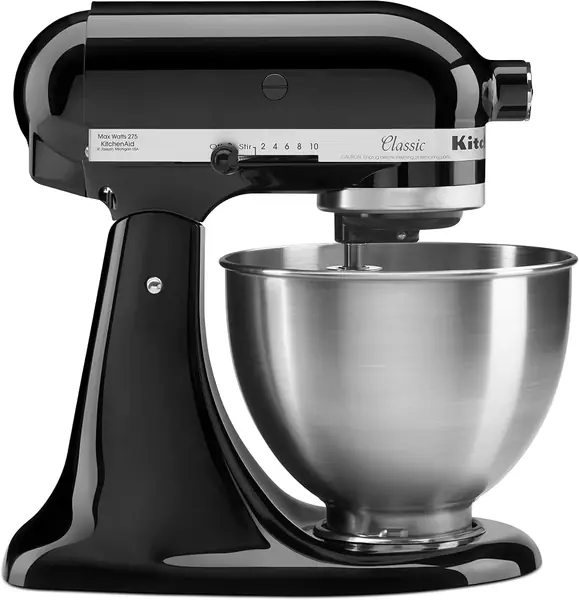
KitchenAid Classic 4.5 Qt Best for Small Counters

KitchenAid Classic 4.5-quart tilt-head stand mixer in onyx black with stainless steel bowl

Small kitchens

Bake Score 91/100
Motor
275 watts
Bowl Capacity
4.5 quarts
Speeds
10
Width
8.7 inches
View on Amazon

Eight and seven-tenths inches of width is the number that earns this KitchenAid its place. Every other mixer here wants a foot of counter or more, and this one slots into the gap beside a coffee maker and stays there. In a small kitchen where the mixer lives out in the open or not at all, we think that is worth more than a bigger bowl you have to haul out of a cabinet.

It will knead bread, within limits. The 4.5-quart bowl and 275-watt motor are the smallest pairing in this group, and the workable batch is a single loaf, around five cups of flour, before the machine starts to labor. The tilt-head gives a clear view for scraping, the ten speeds run from a stir to a whip, and the coated dough hook, flat beater, and six-wire whip are all included. We kept coming back to it for small batches and for anything that wants the bowl in front of you rather than under a locked cradle.

The caveat is longevity. The gearbox is the part to watch on this model, and a year of heavy dough work asks more of it than it is built to give; keep big batches for a bowl-lift and this one holds up the way it should. Coverage is a one-year limited warranty. Treat it as the one-loaf specialist in a small kitchen and it does exactly what you bought it for.

Worth Noting

  • 275 watts is the least power here
  • 4.5-quart bowl limits you to small batches
Our Verdict

We keep recommending this one to bakers with a narrow counter and a single-loaf habit; just know that 275 watts and 4.5 quarts set the ceiling.

Check Latest Price
5

Martha Stewart 5.3QT Best Budget

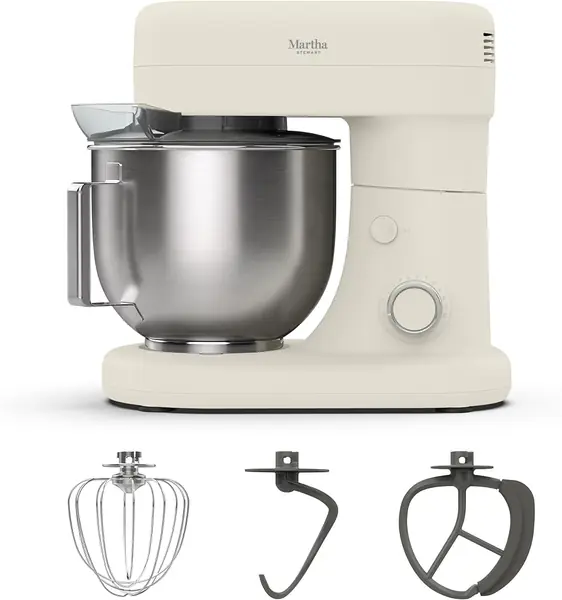
Martha Stewart 5.3-quart tilt-head stand mixer in linen cream with stainless bowl and splash shield

Tight budgets

Bake Score 87/100
Motor
660 watts
Bowl Capacity
5.3 quarts
Speeds
12
Weight
9 lb
View on Amazon

A 5.3-quart mixer with a 660-watt motor and a splash shield does not usually sit near the bottom of the price range. This Martha Stewart model does, and it stretches a beginner's budget further than we expected going in.

The build is light at nine pounds, which is why it is easy to lift out of a cabinet and back in again, and also why it shifts on the counter once a stiff dough starts fighting the hook. The removable splash shield with its pour chute is the most genuinely useful extra at this price: flour goes in without a cloud, and the silicone-edged beater scrapes the bowl as it turns. Twelve speeds is more control than the motor needs, but the low end is gentle enough to bring a dough together without throwing it up the sides. For sourdough and single loaves it does the job.

The light frame is the thing to weigh. One loaf at a time, it is fine and surprisingly quiet about it; a full bowl of stiff dough is where it gives ground, with the body rocking and the motor getting loud. If you bake a loaf or two a week and want to spend as little as possible, this is the machine we point to. If you knead stiff dough four times a week, spend more.

Worth Noting

  • Shifts on the counter with stiff dough
Our Verdict

Our budget pick: 660 watts, a splash shield that earns its place, and a nine-pound body you can put back in the cabinet after one loaf.

Check Latest Price
6

Kitchen in the box 8.5 QT Best for Budget Big Batches

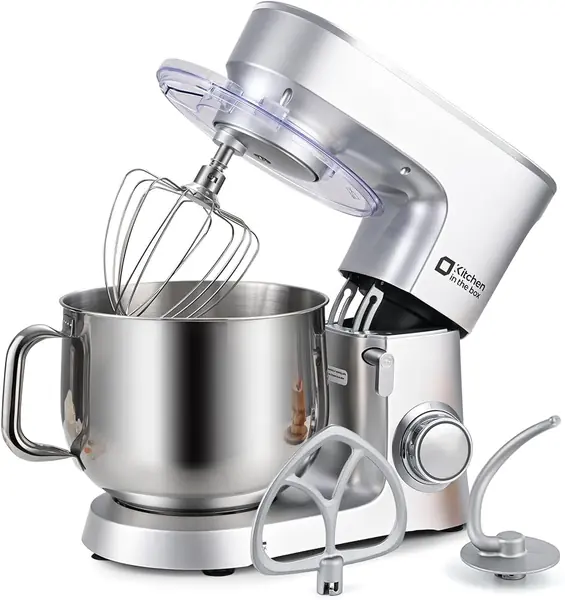
Kitchen in the box 8.5-quart tilt-head stand mixer in silver with stainless bowl and splash guard

Budget big batches

Bake Score 86/100
Motor
900 watts
Bowl Capacity
8.5 quarts
Speeds
10
Included
Dough hook, flat beater, whisk, splash guard
View on Amazon

Nine hundred watts and 8.5 quarts for about what the budget tilt-heads cost. On paper this is the most machine per dollar in the group. The real question is whether the numbers hold once the dough gets stiff, and for the most part they do.

The bowl is the attraction: 8.5 quarts of stainless with a handle, enough for a double batch without a second round. The frame is squarer and heavier than the tilt-heads at this price, and the suction feet keep it from travelling while the hook works. The splash guard, dough hook, flat beater, and whisk all come in the box, so there is nothing extra to buy before your first loaf.

Practicalities: it is 16.6 inches wide, the widest machine here, and the suction cups grip hard enough that sliding it across the counter for storage is a chore. Pick a spot and leave it there. The bowl and attachments are dishwasher safe, which matters more on a machine this size than on a four-quart one.

What we cannot vouch for is the long haul. This is the newest design in the group, with the least history behind it, and on a machine you plan to knead with for a decade that is a real consideration rather than a technicality. As a first big-batch mixer it earns its price: two or three loaves at a time, a motor that does not bog down, and a bowl you can lift with one hand when it is full.

Worth Noting

  • 16.6 inches wide on the counter
  • Suction feet make it hard to move
Our Verdict

We think this is the most mixer for the money here: 900 watts, an 8.5-quart bowl, and a double batch without strain.

Check Latest Price
7

bella STIR 5.3Qt Best for First-Time Bakers

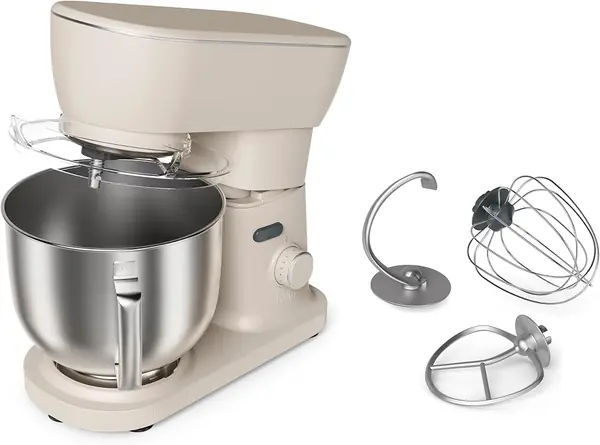
bella STIR 5.3-quart tilt-head stand mixer in oatmilk with stainless steel bowl and dough hook

First-time bakers

Bake Score 85/100
Motor
500 watts
Bowl Capacity
5.3 quarts
Speeds
12
Included
Dough hook, paddle, balloon whisk
View on Amazon

If you are buying your first stand mixer because you have started baking bread once a week, this is the machine that keeps the experiment cheap. Five hundred watts, twelve speeds, a 5.3-quart stainless bowl with a handle, and a dough hook in the box, at the lowest price of any mixer here. It covers the basics without asking you to commit a KitchenAid budget before you know whether the habit will stick.

The soft-touch speed control is a nicer detail than the price suggests. You can ease the dial up instead of jumping straight into a fast speed and throwing flour out of the bowl, which is exactly the mistake new bread bakers make. Planetary mixing sends the hook around the bowl rather than spinning it in place, and the bowl handle helps when it is full of a wet dough. At 16 inches wide it still wants real counter, but it is light enough to move between counter and cabinet.

What we cannot tell you is how it holds up. This is the least proven machine here over years of stiff dough, and 500 watts spread across a 5.3-quart bowl is modest once you push past a single loaf. If your baking is already a weekly two-loaf affair, step up to a bowl-lift. If you are still finding out, this is a sensible, low-risk place to start.

Worth Noting

  • 500 watts is modest for stiff dough
  • Wide 16-inch footprint
Our Verdict

We point first-time bread bakers here: a 5.3-quart bowl, a dough hook, and a gentle speed control for the least money in this group.

Check Latest Price

How We Tested Stand Mixers for Bread Dough

To build the shortlist, I started with the specs that matter for dough rather than for frosting: bowl capacity, motor wattage, tilt-head versus bowl-lift, and whether the dough hook felt substantial enough to handle a stiff mix. I filtered out anything without a dough hook or with a bowl under 4.5 quarts, then grouped the survivors by price band so the final 11 covered the range a shopper actually weighs — compact tilt-heads, a couple of bowl-lifts, and one 8.5-quart machine built for heavy dough and volume baking.

Testing ran for nine months, mostly on weekends. Every mixer made the same 70-percent-hydration country loaf, a stiffer bagel dough, and at least one enriched dough, and I timed how long each took to reach a clean windowpane.

I marked each mixer's starting spot on the counter with tape before kneading, to see whether the feet gripped or the machine walked. Noise got measured at arm's length with a decibel app during the longest knead. Ease of use got the same treatment: I loaded and scraped each bowl, swapped hook for whisk one-handed, checked whether the head cleared my upper cabinets, and noted how much counter each one ate.

Over the months I tracked the slower things, too — head wobble that showed up after a few dozen loaves, a change in motor pitch, warmth in the base after a long knead, and how much flour paste collected in the seams. For value, I recorded what came in the box: a splash guard, a bowl handle, a second bowl. My partner, who does the weeknight baking, kept a running note on which machine they reached for without thinking.

How to Choose a Stand Mixer for Bread Dough

Start with your batch size, not the bowl size

The bowl tells you how much batter fits. The maker's stated dough maximum tells you what the mechanism will survive, and the two are not the same number. The 4.5-quart KitchenAid Classic is a one-loaf machine, roughly five cups of flour. Move up to 5.5 or 6.5 quarts and you are in two-to-three-loaf territory, with the KitchenAid bowl-lift rated above 7 pounds and the Bosch at 15. The 8.4-quart ZACME is rated for 3 kg.

The trap is a big bowl bolted to a small motor. A full bowl of stiff dough is the hardest work a mixer ever does, so match the batch you actually mix, not the largest one you imagine mixing.

Tilt-head or bowl-lift

A tilt-head lifts the motor back so you can reach into the bowl. A bowl-lift locks the bowl into a cradle and lowers the head onto it. Tilt-heads are quicker to scrape and easier to watch. Bowl-lifts hold a stiff dough more steadily because the bowl is pinned at three points, and they tend to carry bigger motors.

The trade is overhead clearance and two-handed loading: most bowl-lifts here stand 16 inches or more, so measure the gap under your upper cabinets before you decide it lives on the counter.

Torque delivery beats the wattage number

A 275-watt machine geared to knead one loaf will outlast a 900-watt machine that shakes itself apart, because power only helps if it reaches the hook. Belt-driven designs like the Bosch hold torque as the dough stiffens. Direct-drive bowl-lift designs do the same by locking the bowl so the energy goes into the dough instead of the frame.

Read the stated dough maximum, then look at the frame. High wattage in a light plastic body mostly buys noise and movement.

Stability and where it will live

Stiff dough turns a mixer into something that wants to travel. Suction feet, a heavy base, and a locked bowl all help, and a nine-pound tilt-head will still shift under a full batch. These machines run from 8.7 to 16.6 inches wide and up to 18 inches deep.

If the mixer has to go back into a cabinet between bakes, weight matters as much as capacity. If it stays out, give it the depth it needs and check the height against your cabinets.

Parts, spares, and what is in the box

Every mixer here ships with a dough hook, and that is the only attachment bread needs. Look past the attachment count to the small parts: thin wire whips, plastic whip drives, and the coupling where the hook meets the drive are what break first, on any brand.

Before you buy, confirm the maker sells the hook and the whip separately. A machine you cannot buy a replacement hook for stops being a bread mixer the day the first one bends.

Frequently Asked Questions

Final Verdict

We recommend the KitchenAid 5.5-quart bowl-lift to most bread bakers. More than 7 pounds of dough behind a bowl locked at three points means stiff dough never gets the upper hand, and 5.5 quarts still fits a normal kitchen.

If your batches run to four loaves at a time, the ZACME's 8.4-quart bowl and 3 kg rating earn its footprint. And if you are not yet sure bread baking will stick, the bella keeps the experiment cheap.