Best Types of Rolling Pins
The best type of rolling pin for most bakers is a tapered French rolling pin: a single piece of hardwood, thick in the middle and narrowing toward the ends. It's light, it lets you feel how thick the dough is, and the taper lets you pivot it to roll a perfect circle of pie crust. The J.K. Adams French rolling pin, made of maple, is a long-standing favorite.
Different doughs favor different pins, though. Here's what each type does well.
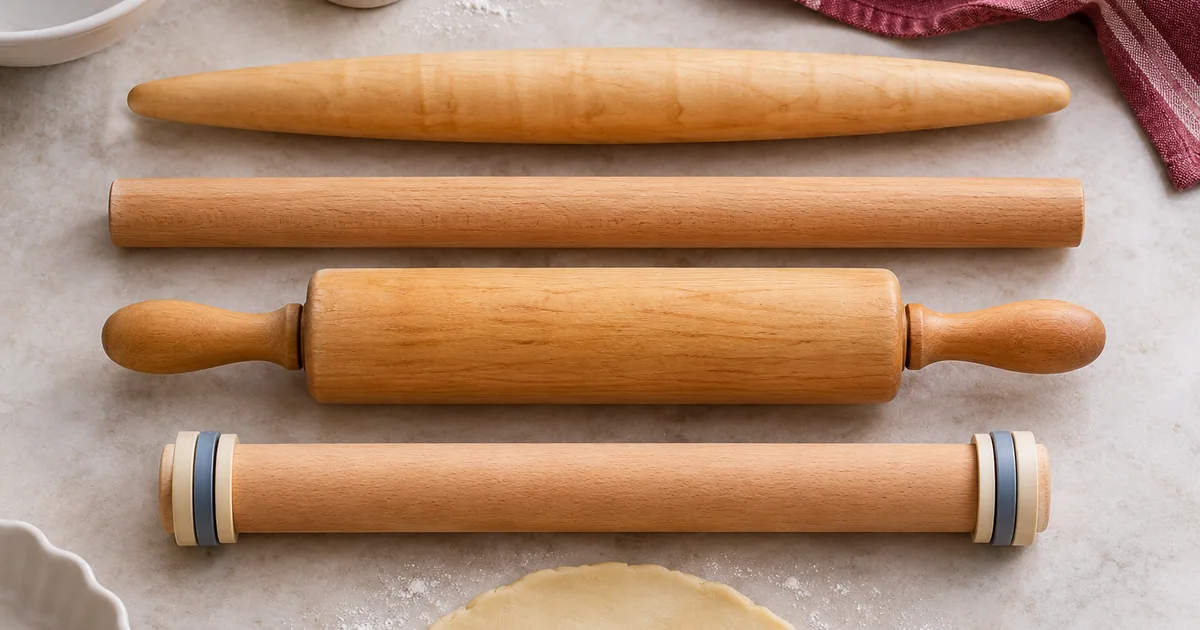
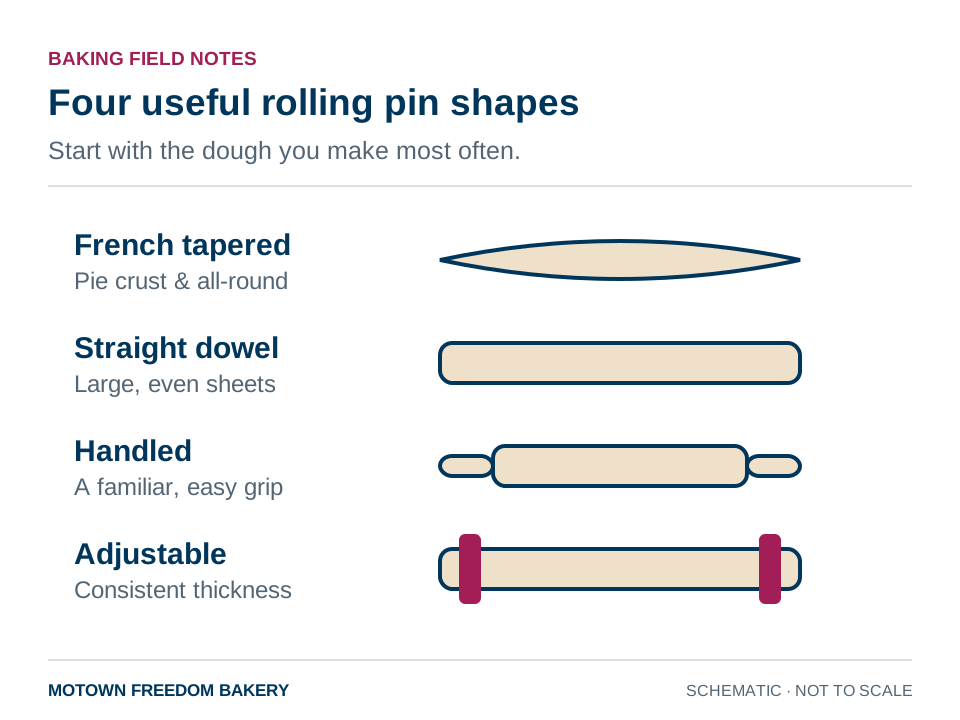
Types of rolling pins at a glance
| Type | What it looks like | Strengths | Best for |
|---|---|---|---|
| French tapered | Handle-free, thicker in the middle | Easy to turn, great feel, light | Pie crust, tart dough, cookies, all-round |
| Straight (dowel or baker's) | Even cylinder, no handles | Rolls to even thickness, big surface | Cookie dough, laminated pastry, large sheets |
| Handled (American) | Barrel on a rod with handles | Easy grip, less wrist strain | Beginners, everyday rolling |
| Adjustable | Pin with removable thickness rings | Exact, even thickness | Cut-out cookies, fondant, pasta |
| Marble | Heavy stone barrel, usually with handles | Stays cool, weight does the work | Butter-rich pastry, puff and shortbread |
| Embossed | Carved pattern on the barrel | Prints designs into dough | Decorative cookies, springerle |
| Small and specialty | Short pins, Chinese and tortilla pins | Control on small rounds | Dumpling wrappers, tortillas, pizza |
| Fondant pin | Smooth plastic or silicone, often long | Non-stick, no grain marks | Fondant, sugar paste, marzipan |
French rolling pins
French pins come in two shapes: tapered, which narrows toward both ends, and straight, which is a long cylinder with no handles. Both are usually solid maple or beech.
Tapered pins are the easiest to steer. Push on one end and the pin turns, so you can keep a circle of pie dough round as you roll. You also feel the dough directly through your palms, which tells you where it's thicker.
The trade-off: because the middle is thicker than the ends, tapered pins take a little practice to roll a large sheet to an even thickness.
Straight dowel pins
A straight pin, sometimes called a baker's pin, is the same diameter from end to end, typically 18 to 20 inches long. The flat, even barrel rolls large sheets to a uniform thickness, which is why pastry chefs use it for laminated doughs such as croissant and puff pastry, and why it's good for big batches of cookie dough.
Handled pins
The familiar American pin has a barrel that spins around a central rod, with a handle at each end. Because your hands push the handles rather than the barrel, it's the easiest type for beginners and for people with weak wrists or arthritis. You give up some feel for the dough, and the bearings in cheaper pins can loosen or squeak over time.
Adjustable pins with thickness rings
These pins slide rings of different thickness onto each end, so the barrel can only roll the dough down to that height, say ⅛ or ¼ inch. The Joseph Joseph Adjustable Rolling Pin is a common example. They take the guesswork out of cut-out cookies, where every cookie needs the same thickness to bake evenly, and they're handy for fondant and pasta.
You can get the same result with any straight pin by rolling between two wooden guide strips.
Marble and other materials
Material affects weight, temperature and how much dough sticks.
- Hardwood (maple, beech): the classic. Holds a light coat of flour that stops sticking. Hand wash, dry, and oil occasionally.
- Marble: heavy and cold. The weight does much of the rolling, and the cool surface helps keep butter in pastry from melting. Chill it before use for best results. It's heavy to store and can chip if dropped.
- Stainless steel: cool, smooth, easy to clean, and some can be chilled. Less grippy, so flour your dough well.
- Silicone or nonstick-coated: dough doesn't stick, but they can feel springy and give less feel.
- Plastic: mainly for fondant; no grain to leave marks.
Which rolling pin for which job
- Pie crust: French tapered pin.
- Cut-out sugar cookies: adjustable pin, or a straight pin with guide strips.
- Croissants and puff pastry: straight dowel pin, chilled marble or steel.
- Pizza dough: a small straight pin or none; many pizza makers stretch by hand.
- Tortillas and dumpling wrappers: a small, thin pin about 10 to 12 inches long.
- Fondant: a smooth plastic or silicone fondant pin.
- Decorative cookies: an embossed pin after the dough is rolled flat.
If you buy just one, buy a French tapered pin. Add an adjustable pin if you bake cut-out cookies often. Compare pins in our pastry tools section.
Frequently Asked Questions
Most pastry chefs use handle-free French pins, either tapered or straight. They give more control and feel, and they're easy to clean.
For butter-rich pastry, they help, because they stay cool and their weight does the work. For everyday rolling, many bakers find them heavy and prefer wood.
Lightly flour both the pin and the counter, roll from the center outward, and lift and turn the dough often. For very sticky dough, roll it between two sheets of parchment.
About 18 to 20 inches for a French or straight pin, which covers a 12-inch pie crust with room for your hands. Shorter pins of 10 to 12 inches suit small rounds.