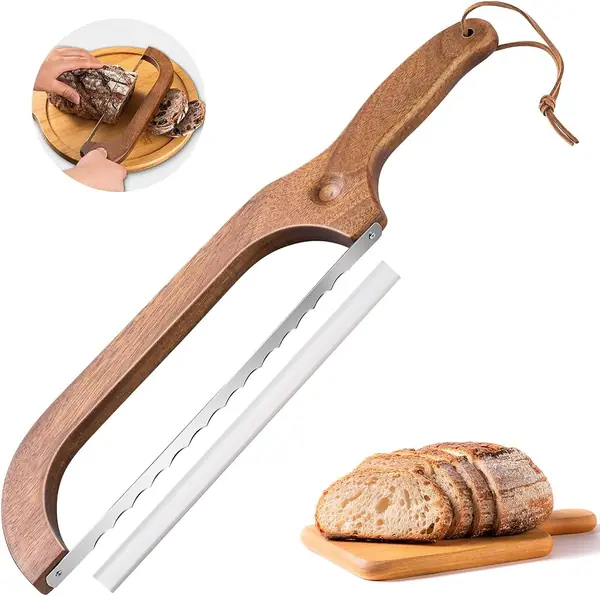
The 8 Best Bread Bow Knives of 2026

A crackly sourdough boule is where ordinary knives fall apart. A chef's knife skates across the crust, and by the time you've sawed your way through, the crumb is crushed and the slices come out wedge-shaped. A bow knife fixes that with one simple piece of engineering: a serrated blade strung under tension inside a wooden arch, so the loaf lies flat against the fence and drops away in even slices. The catch is that these saws are handed — most are built for right-handed cutting, so if you slice with your left, check which side the fence sits on before you buy.

We sliced loaf after loaf with 12 of them, from 14.5-inch saws up to full 16-inch bows in alder, cherry, acacia, and beech, and the differences showed up fast. Sharpness out of the box varied more than the price tags suggested, and the bows that felt best on the first loaf weren't always the ones that still felt solid after fifty. Whether the loaf is a crusty boule, a bagel or a baguette, these are the knives we kept reaching for.

Our Top Picks

The Best Bread Bow Knives

1

RAPSAKEMOH Bread Bow Knife Best Overall
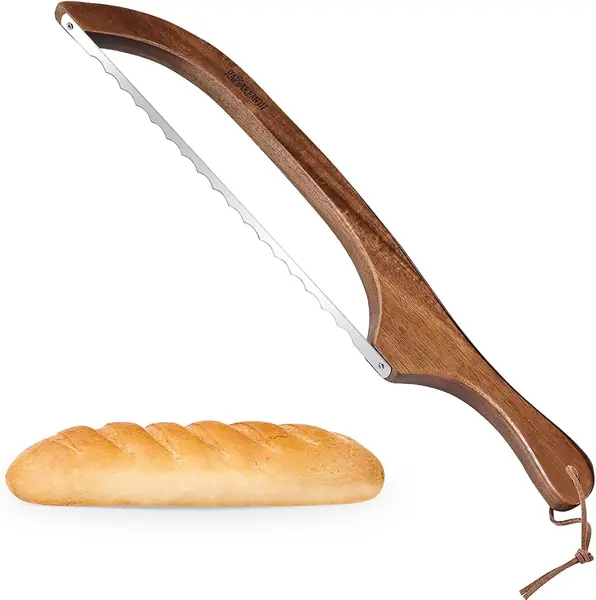
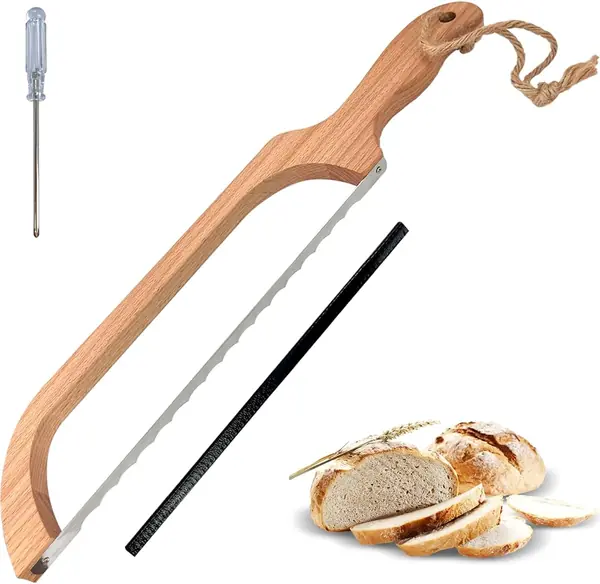
RAPSAKEMOH bow bread knife with acacia wood frame and stainless serrated blade

Everyday sourdough boules

Bake Score 94/100
Overall Length
15.6 inches
Blade Length
10.6 inches
Handle Wood
Acacia
Included
Blade cover, screwdriver, 2 spare screws
View on Amazon

Handedness is the first thing we check on a bow knife, because a frame cambered for a right-handed pull fights a left-handed one. This is the knife in the group that solves it with a screwdriver: loosen the two screws at the ends of the acacia frame, flip the stainless blade, and it cuts the other way. A 10.6-inch blade in a 15.6-inch frame, plus a cover, screwdriver, and two spare screws in the box, is why it is the one we recommend first.

Length is the quiet advantage. Ten and a half inches of serrated edge clears a tall boule in one pull rather than a down-and-back saw, and the bow keeps the blade level with the board, so slice thickness comes from where you set the loaf instead of how steady your wrist is. Working through a week of sourdough with it, we noticed the frame doing most of the steering.

The hardware is serviceable, which matters more than it sounds. The blade is held by two screws and the maker ships spares, so a stripped or lost screw does not retire the knife. The cover is the other small thing we appreciate: it makes the whole thing safe to keep in a drawer with the blade still mounted.

What you give up is polish. The acacia is plain next to the lacquered frames here, and there is no second blade in the box. If either matters more than the savings, the Out of the Woods and Uprichya picks cover you. If your loaves are mostly sandwich bread, the compact Pranski does the same work in less drawer space.

Worth Noting

  • Blade screws need occasional re-tightening
Our Verdict

Our pick for most bakers: it flips for either hand, runs a full-size blade, and ships with the cover and spare screws that keep it working.

Check Latest Price
2

Uprichya Sourdough Bow Knife Best With a Spare Blade

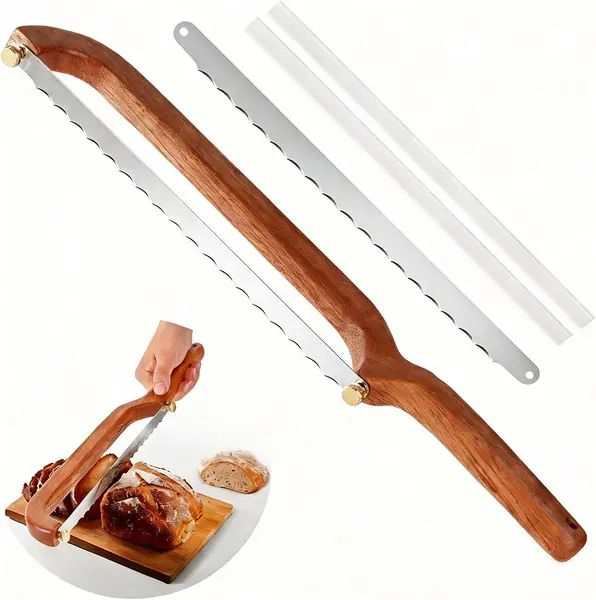
Uprichya sapele wood bow bread knife with extra blade and two guards

Right-handed frequent bakers

Bake Score 93/100
Overall Length
15.71 inches
Blade Length
10.6 inches
Handle Wood
Sapele
Included
Extra blade, 2 blade guards
View on Amazon

The blade is the reason to pay attention here. It is thicker and wider than the stamped edges on the budget frames, with serrations that stand proud of the cutting edge, and that is what lets it bite through a sourdough bottom crust instead of skating across it. Add a second blade in the box and this becomes the pick for anyone who bakes often and prefers to swap rather than shop.

The frame is sapele, 15.71 inches overall with a 10.6-inch blade, and the screws are embedded at both ends so changing blades does not chew up the wood. That is a small piece of design that turns the spare into a real second life for the knife rather than a part in a drawer. Two guards mean one can stay on the blade while the other lives in the drawer.

In use the bow lifts your hand clear of the counter, so most slices finish in one pull, and the heavier blade tracks straight through a hard crust. It runs a touch heavier than the acacia frames, which you notice on a whole loaf and not much otherwise. The spare is the part we keep coming back to: serrated edges do dull, and a knife you can re-blade is a knife you keep.

Worth Noting

  • Right-handed configuration only
Our Verdict

Buy it if you are right-handed and plan to bake for years: the extra blade and wood-protecting screws make it the longest-lived arrangement here.

Check Latest Price
3

Out of the Woods Bow Bread Slicer Best Premium

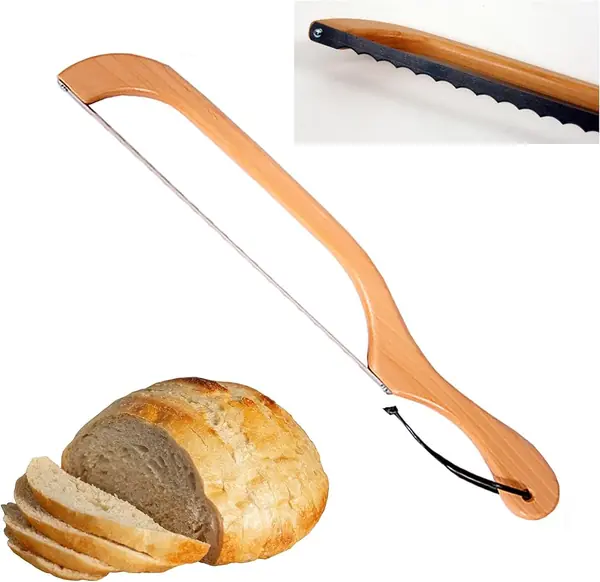
Out of the Woods red alder bow bread slicer with stainless serrated blade, made in USA

Wide boules, gifts

Bake Score 92/100
Overall Length
16 inches
Blade Length
11 inches
Handle Wood
Red alder
Handedness
Right- or left-handed
View on Amazon

Eleven inches of serrated blade — the longest in this group — is the first thing to like, and it sits in red alder grown and worked in the United States. The handle is a half inch thick, rounded and sanded smooth, and sealed in clear lacquer rather than left bare.

That extra reach is why we rank it first for wide boules: fewer re-positionings, one clean pull, and a fat handle that is the most comfortable grip in this set for large hands or a sore wrist. A left-handed build is available as well, which only one other design here can answer.

Care is the price of the finish: warm soapy water, then dry it immediately, because soaking dulls the lacquer and lifts the grain. Nothing else is fussy, and the fine serrations handle bagels and angel food cake as readily as sourdough. This is the one you leave out on the counter between bakes.

Worth Noting

  • Premium price for a single knife
Our Verdict

The premium choice, and worth it if you want the longest blade here, an American hardwood frame, and a knife handsome enough to leave out.

Check Latest Price
4

TYOARO Wooden Bow Bread Knife Best for Thin Slices

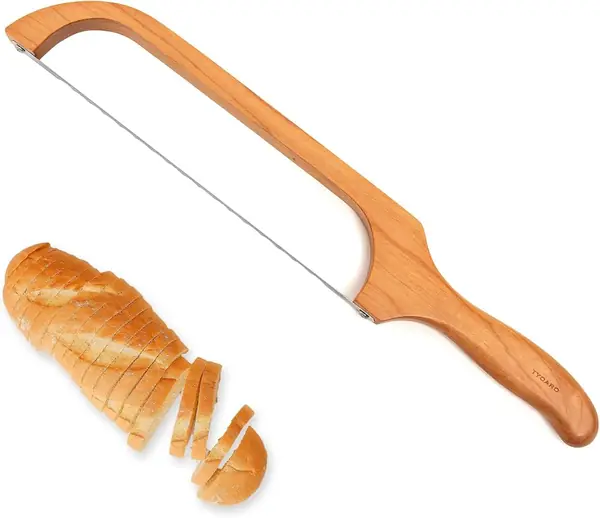
TYOARO cherry wood bow bread knife with serrated stainless blade

Thin sandwich slices

Bake Score 91/100
Overall Length
16.25 inches
Handle Wood
Cherry
Cutting Length
9 inches
Max Slice Thickness
1 7/8 inches
View on Amazon

Bow knives set slice thickness by how far you slide the loaf, and TYOARO is the one that puts a number on it: straight slices up to 1 7/8 inches thick, cut with a 9-inch cutting length inside a 16 1/4-inch cherry frame.

Thin is where it shines. The deep scalloped serrations need only a light saw, and the narrow blade tracks straight, so a pan loaf gives you even, toast-sized slices instead of wedges. For anyone who bakes sandwich bread and wants control over thickness, this is our pick in the group.

One thing to know: on a taller loaf the blade can stop short of the bottom crust, so you lift the loaf and finish the last bit from underneath. Mildly annoying the first time, automatic after that. Otherwise the cherry handle stays comfortable through a whole loaf, and the fine edge leaves very little crumb on the board.

Worth Noting

  • Right-handed grip only
Our Verdict

Our pick for sandwich loaves: deep scallops and a narrow blade give you even, thin slices, as long as you finish the bottom crust with a lift.

Check Latest Price
5

Woodever 2-Pack Bow Bread Knives Best Two-Pack

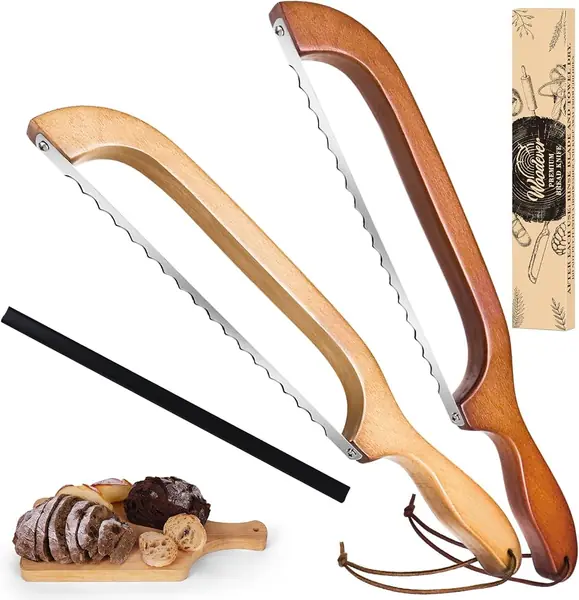
Woodever two-pack of wooden bow bread knives with stainless serrated blades

Two kitchens

Bake Score 90/100
Overall Length
16.5 inches
Blade Length
10.6 inches
Set
Two knives
Max Slice Length
9 inches
View on Amazon

Two complete bow knives in one box, each with a 10.6-inch blade in a frame that handles up to 9 inches of loaf, and both arrive assembled. The maker's own advice is to check the screws if a blade wobbles — a quarter turn with a screwdriver settles it.

The appeal is practical rather than precious, and we like that in a tool handled with flour on your hands. One knife for the kitchen and one for the cabin, the camper, or the friend who keeps asking how you get your slices so even. On a wide loaf the handle design puts your hand near the edge of the counter, so clear some space before you start.

Buy the set for two kitchens or for gifting. It is the practical answer to wanting a bow knife in more than one place, and the pair runs about the same money as one midrange knife here, which is the whole argument.

Worth Noting

  • Blade can snap at the screw point
Our Verdict

Worth it if you want two bow knives — one at home, one away — and can accept a thin blade that needs an occasional look.

Check Latest Price
6

HOTTOR Acacia Bow Bread Knife Best Budget

HOTTOR acacia wood bow bread knife with 420 stainless serrated blade

Budget first knife

Bake Score 89/100
Overall Length
16.3 inches
Blade Length
10.8 inches
Handle Wood
Acacia
Handedness
Ambidextrous
View on Amazon

Acacia instead of pine or bamboo is the pitch here, and it is a fair one: a denser bow flexes less in the hand, and screws hold their grip longer in hardwood. You get a full 10.8-inch blade in a 16.3-inch frame, cut from 420 stainless — the same steel most of this group uses.

It converts for left-handed use, ships with a safety guard, and includes a screwdriver, which the maker clearly expects you to use on the blade screws from time to time. The wide serrations take a crust without tearing the crumb underneath, so a still-warm loaf does not shred on the way through.

When price decides the purchase, this is the knife we point to. You give up the extras — no spare blade, no spare screws, a simpler finish than the sapele and cherry frames — but not size, not the left-handed flip, and not the sharpness. It is the sensible first bow knife for a new sourdough habit.

Worth Noting

  • Wood frame can crack with hard use
  • Hand wash only
Our Verdict

The budget pick: an acacia frame, a full-size blade, and a left-handed flip for less than most of this group.

Check Latest Price
7

ROYOROYI Beech Bow Bread Knife Best for Budget Wide Loaves

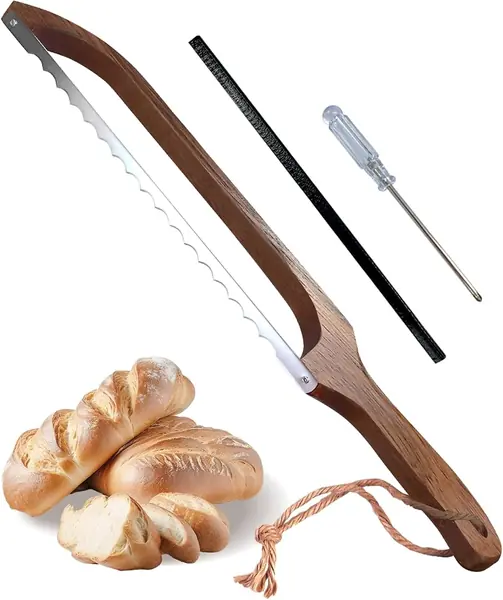
ROYOROYI beech wood bow bread knife with 420 stainless serrated blade

Budget wide loaves

Bake Score 88/100
Overall Length
16.1 inches
Blade Length
10.8 inches
Handle Wood
Beech
Blade Steel
420 stainless steel
View on Amazon

A 10.8-inch blade in a 16.1-inch beech frame, for less than the midrange picks here — that is the trade this knife offers, and on a loaf a week it holds up its end.

We found little to complain about in the cut. The 420 stainless serrations go through a sourdough crust cleanly, the long frame gives you real reach on a wide boule, and the slices come out even and thin enough for sandwiches. Nothing about the geometry asks you to fight it.

The blade is thin, and that is the thing to watch: against a dense crust it can bend rather than bite, which throws the slice off line before the frame can correct it. It rewards a light, steady saw rather than pressure — ease off and let the serrations work.

Buy it as a first full-size bow knife if you bake a loaf a week and slice gently; the savings are real and the reach is genuine. If your bread is tight-crumbed rye, or you lean on a blade when you cut, put the money toward the Uprichya instead.

Worth Noting

  • Beech frame can split over time
Our Verdict

A lot of frame and blade for the money, and a good first full-size bow knife for anyone who slices with a light hand.

Check Latest Price
8

Pranski Compact Bow Bread Knife Best for Pan Loaves, Bagels

Pranski compact wooden bow bread knife with stainless serrated blade

Pan loaves, bagels

Bake Score 87/100
Overall Length
14.5 inches
Blade Length
9.5 inches
Handedness
Ambidextrous
Blade Material
Stainless steel
View on Amazon

At 14.5 inches overall with a 9.5-inch blade, this is the compact one — short enough to live in a crowded drawer, and short enough that a wide round boule will not fit between the blade and the top of the bow.

Within that limit we found it a capable little knife. The blade is sharp, it converts for left-handed use with the two screws, and it makes short work of sandwich loaves, bagels, and soft breads. It is also the least expensive knife in this group, which makes it an easy second knife for a rental kitchen or a camper.

Round artisan loaves are where it runs out of room: the bow does not open wide enough to sit over a big boule, so you end up tipping the loaf and sawing at an angle — workable, never pleasant, and not what you want on a loaf you spent two days building.

Buy it for pan loaves, bagels, and small households. If sourdough boules are the main event in your kitchen, spend a little more and start at 10.6 inches of blade.

Our Verdict

A good small-batch knife for sandwich loaves and bagels, though a wide sourdough boule will not fit inside its bow.

Check Latest Price

How We Chose and Tested Bread Bow Knives

We built the shortlist by combing retailer listings for bow-style bread saws, then filtering on the things that actually change the experience: blade material and serration, overall length, wood type, and whether the fence is positioned for right- or left-handed cutting. Anything with a plastic arch, a pin that looked likely to work loose, or a length we couldn't picture fitting a standard loaf got dropped. That left 12 knives, all bought at retail so no maker knew we were coming.

Testing happened in home kitchens over four months, mostly on weekends when the week's loaves come out of the oven, with a few weeknights of bagels and a holiday run of dinner rolls thrown in. Every knife worked through fresh sourdough, dense whole-grain loaves, bagels, and baguettes, and both right- and left-handed testers took a turn with each one so we could feel where the fence fought the cut.

Cutting performance came down to the first inch. We noted whether the blade bit into the crust on contact or skated, whether it drifted toward one side of the fence as we pushed, and whether a full loaf's worth of slices stacked flat or fanned out into wedges. Sharpness we judged by pressure, not by feel alone — how hard we had to work through a bottom crust, and whether the blade started dragging by loaf thirty.

Durability testing was mostly maintenance: we checked fence screws and blade tension after every session, wiped each wooden arch with a damp cloth weekly, and watched for cracks, raised grain, or a blade that began to sing loose. Size got its own pass, running every bow across both a wide boule and a skinny baguette to see whether the longer models felt steady or clumsy on a small board. We graded grip comfort over a whole loaf rather than a single slice, and gave value the last word — a couple of the least expensive knives out-cut bows that cost twice as much, and we said so.

How to Choose a Bread Bow Knife

Size the Frame to Your Loaves

Bow knives are sold by frame length, but the blade is what does the work. The full-size picks here run 10.6 to 11 inches of serrated edge inside frames of roughly 16 inches, enough to clear a tall round boule in one pull. Compact frames pair a 9.5-inch blade with a 14.5-inch overall length and are happiest on sandwich loaves and bagels.

The bow opening matters just as much. The loaf sits between the blade and the top of the frame, so a wide boule can simply not fit — a detail worth checking against the diameter of your usual bake before you order. If sourdough boules are your main loaf, start at 10.6 inches of blade and do not go shorter.

Check the Hand Before Anything Else

A bow knife's handle is cambered, and that camber is usually cut for a right-handed pull. Three fixes exist in this group: a dedicated left-handed build, a blade that flips between two screws, and nothing at all — which is the case on more than one otherwise good knife.

If you are left-handed, confirm the flip or the left-handed version in the listing before you buy. The rest of the specification list will not tell you, and no amount of blade length makes up for a frame that pulls the wrong way.

The Blade Has to Stay Taut

Most of these are a bread saw at heart: a thin blade stretched between the ends of a wooden bow and held by two screws. A blade that flexes under a hard crust wanders off line, and a knife with no way to tension it is a return rather than a repair.

Look for protruding serrations, screws seated in metal or hardwood, and spare screws in the box. Then give the screws a quarter turn whenever the blade starts to feel loose; that is the whole maintenance routine, and it is what keeps slices straight.

Wood, Finish, and What Comes in the Box

Acacia, sapele, cherry, beech, alder — the species matter less than the finish. Bare wood wants hand washing and immediate drying, while a lacquered frame resists stains but dulls if it soaks. Either way, never leave a wooden bow standing in water.

Weigh the extras too. A blade guard keeps a long blade safe in a drawer, a spare blade postpones replacement, and a screwdriver in the box tells you the maker expects the knife to be maintained rather than discarded. Those small inclusions separate a tool you keep from one you reorder.

Frequently Asked Questions

Final Verdict

If you bake sourdough and want one knife that works in either hand, the RAPSAKEMOH is our pick: a 10.6-inch blade in a full-size frame, a cover, and the screwdriver and spare screws to keep it going. Right-handed and want a second blade waiting? Take the Uprichya.

Baking pan loaves in a small kitchen? The compact Pranski handles those, as long as you are not asking it to clear a wide boule.