The 8 Best Bread Cloches of 2026

You can feed a starter for three weeks, shape a loaf that looks like a magazine cover, and still pull something flat and pale out of the oven. The variable most bakers miss is steam. A bread cloche traps the moisture escaping from the dough in a small, hot chamber, keeping the crust soft long enough for the loaf to spring before it browns.

I baked sourdough in a preheated cast iron pot for years before trying anything else, and the vessel turned out to matter as much as the flour. We baked in 12 of them, from round enameled Dutch ovens to oval loaf pans with cloche lids.

Here's what first-time buyers tend to learn after one loaf: an oval pan suits batards and sandwich loaves better than a round one, and an oversized pot leaves your dough spread thin across the bottom. Several of the cloches we tested came bundled with a proofing basket, silicone sling, or oven mitts, which changes the value math. Pay attention to how each handles a hot lid, too — that's where pretty separates from useful.

Our Top Picks

The Best Bread Cloches

1

Flavehc Cast Iron Bread Oven Best Overall
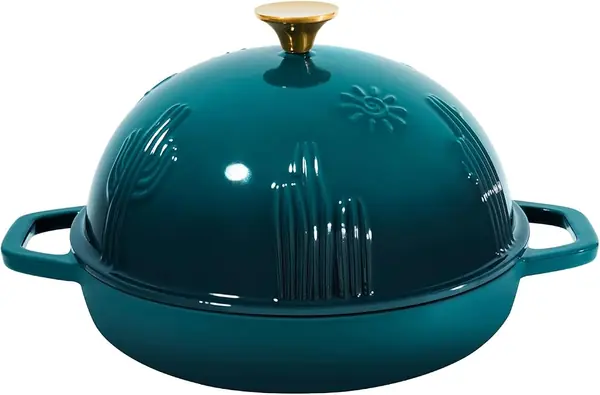
Flavehc dark cyan enameled cast iron bread oven with domed lid

Round sourdough boules

Bake Score 95/100
Capacity
5 quarts
Oven-Safe Temperature
500 °F
Interior
Matte black enamel
Diameter
9.8 inches
View on Amazon

A cloche comes down to two measurements: how low the base sits and how much room the dome leaves above the dough. The Flavehc gets both right. Its floor is 9.8 inches across and shallow enough that a proofed boule settles onto it without a drop, and the dome covers the loaf with room to spring. That shape is the first thing we check, and it's the reason this is our top pick. Five quarts of enameled cast iron, a 500 °F rating, and a matte black interior round out the spec sheet.

The baking is what keeps it in rotation. With the dome off for the second half, more of the loaf's sides sit exposed than in a deep Dutch oven, so the crust browns evenly instead of leaving a pale band around the middle. We also came to appreciate the dark interior: scorched flour and stray crust bits barely show, so the pot still looks new after a winter of Saturday bakes.

Cleanup is warm water and a nylon brush, and keeping metal utensils and scouring pads away from the coating is the whole maintenance routine. Enamel chips eventually — it's the failure mode on every coated pot here — so open the box over the counter, look at the rim, and buy from a seller with an easy return.

It's also the best-looking pot in this group, with a dark cyan exterior that reads more modern kitchen than farmhouse bakeware, and it earns a spot on the open shelf rather than the back of a cabinet.

Worth Noting

  • Base runs small for very large boules
Our Verdict

We send most bakers here first: the shallow base loads cleanly, the dome holds steam, and the crust browns evenly instead of scorching.

Check Latest Price
2

Nuovva Enameled Dutch Oven Best for Large Loaves

Nuovva enameled cast iron Dutch oven with matching lid, 6.4 quarts

Large boules

Bake Score 94/100
Capacity
6.4 quarts
Material
Enameled cast iron
Lid
Cast iron
Care
Hand wash only
View on Amazon

When the Flavehc's 9.8-inch floor sounds tight, this is the pot to look at instead. Nuovva lists 6.4 quarts, the largest round bread oven in this group, and the extra width shows where it counts: a big boule spreads out instead of climbing the walls, and the dome still clears the crown.

We think it's the best big pot for the money here — it lands within a few dollars of the 5-quart ovens while giving you another quart and a half of floor. Enameled cast iron inside and out, a cast-iron lid, and heat retention that carries through a long spring. Nothing comes in the box but the pot and the lid, so plan on a sling or a sheet of parchment.

The enamel is the part to watch. Chipped rims happen on this pot, and preheating a coated pan empty at high heat is the quickest way to stress the coating — load it cold, or have the dough shaped and ready before the pot goes in. Hand wash only, don't stack anything heavy inside between bakes, and set it on a trivet rather than a cold counter when it comes out.

Worth Noting

  • Enamel can chip at the rim
  • Hand wash only, no dishwasher
Our Verdict

Buy this one if your boules run big — we think it's the best big pot for the money here, and the extra floor shows in the shape of the loaf.

Check Latest Price
3

AHJ 6-Quart Bread Oven Set Best Starter Kit

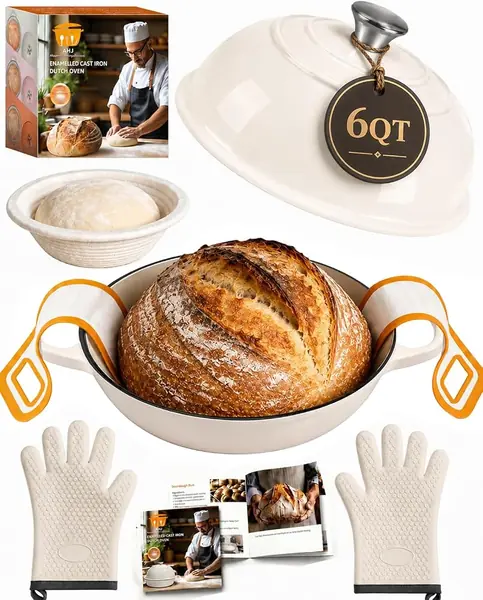
AHJ enameled cast iron bread oven with proofing basket, sling and mitts

First-time bakers

Bake Score 93/100
Capacity
6 quarts
Oven-Safe Temperature
500 °F
Included
Proofing basket, sling, mitts
Width
10.5 inches
View on Amazon

A first sourdough bake usually goes wrong on logistics, not on the dough: no proofing basket, no sling, no plan for handling 500 degrees of cast iron. AHJ's set closes that gap in one box — a 6-quart enameled bread oven, a proofing basket with a liner, a silicone sling, heat-resistant mitts, and an instruction manual.

At 6 inches tall overall, it's a shallow-based oven rather than a deep Dutch oven, and that's the difference between lowering dough onto the floor and dropping it in from a height. The 10.5-inch base takes a standard boule, the lid traps steam, and the whole thing is rated to 500 °F and listed as safe on gas, electric, and induction cooktops.

What we appreciate is that the pieces are matched to each other. The basket is sized for the pot, the sling spans the base, and the mitts are cut for the handles — nothing in the kit is the flimsy extra that usually ends up in a drawer. For a first-time baker that's the entire value: one order, one bake, no missing piece.

It's around 13 pounds, so plan on two hands and a cleared counter. Care is standard cast iron: hand wash, no dishwasher, no metal utensils.

Worth Noting

  • Enamel has peeled on some pots after early bakes
  • Around 13 pounds, so a two-handed lift
Our Verdict

Our pick for a first sourdough setup: the pot, basket, sling, and mitts arrive sized to work together, so nothing stalls the first bake.

Check Latest Price
4

COWORM Cast Iron Loaf Pan Best Budget

COWORM black pre-seasoned cast iron oval loaf pan with lid

Small oval loaves

Bake Score 92/100
Capacity
3.6 quarts
Oven-Safe Temperature
500 °F
Finish
Pre-seasoned cast iron
Shape
Oval
View on Amazon

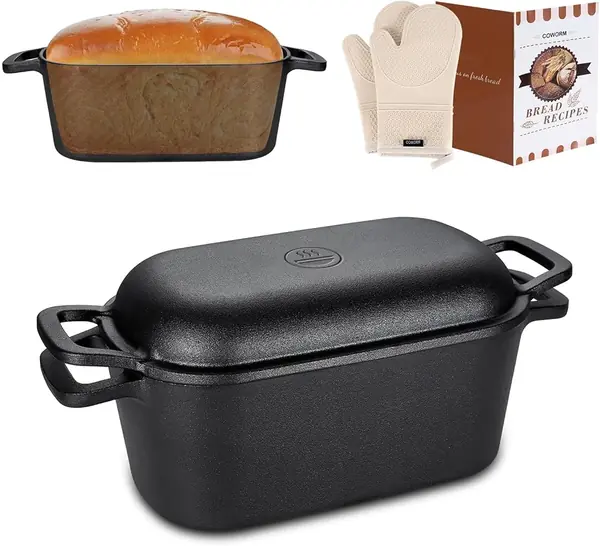
No enamel, no chips. The COWORM pan is bare, pre-seasoned cast iron, which means the surface your bread bakes on can't flake off after a year of high-heat Saturdays. It's also the least expensive bread oven here. If you want a covered loaf pan you never have to baby, this is the one we point you to.

It's a 3.6-quart oval, sized for one bâtard or sandwich loaf rather than a big round boule, with a lid heavy enough to hold steam and loop handles at both ends. Loaves come out crisp and deeply browned, and the pan moves to the stovetop afterward for a chicken or a small leg of lamb, so it earns its cabinet space between bakes.

The trade is upkeep. Bare iron wants drying on the stove and a thin wipe of oil before it goes away, and it will darken over time — that's the seasoning building, not the pan failing. Scrub it with a brush and hot water, skip the soap when you can, and re-season when the surface starts looking dull.

Worth Noting

  • Needs drying and re-oiling after every wash
  • Too small for large round boules
Our Verdict

We like it for anyone tired of babying enamel — bare cast iron can't chip, and it's the least expensive way into covered bread baking.

Check Latest Price
5

VORRINGARD Bread Oven Best for Long Loaves

VORRINGARD red enameled cast iron bread oven with lid

Long bâtards

Bake Score 91/100
Capacity
5 quarts
Oven-Safe Temperature
500 °F
Dimensions
14.2 x 5.4 inches
Cooktop Compatibility
Gas, electric, ceramic, induction
View on Amazon

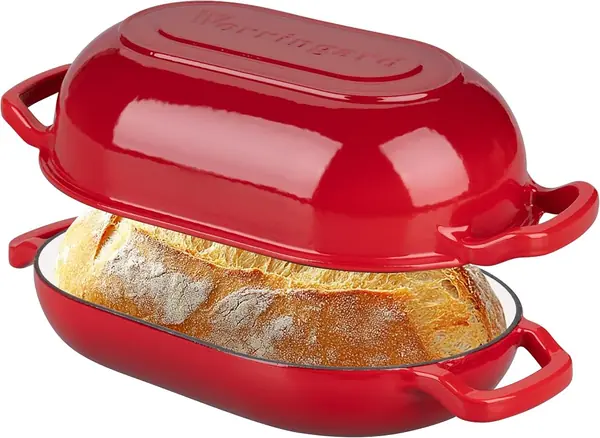
Fourteen inches across and five and a half inches tall — the VORRINGARD is the widest, shallowest pot in this roundup, and that profile is the whole argument for it. A long bâtard spreads out on the floor instead of curling up the sides of a round pot, and the low walls make it easy to slide a sling under the loaf and lift it clear.

We name it for anyone whose loaves are longer than they are tall. Five quarts, a 500 °F rating, loop handles, and a maker that spells out gas, electric, ceramic, and induction compatibility — worth noting, since not every enameled pot here confirms induction. Even browning across a long loaf is what it does best, with no scorched ends.

Look at the rim when the box arrives. A chip at the edge is the thing to check for, and a chip on the cooking surface is a return rather than a touch-up. It's also a 12½-pound pot, so give it a shelf at waist height and save your shoulders. Hand wash only; the enamel doesn't want a dishwasher or steel wool.

Worth Noting

  • Enamel can chip, including on arrival
  • Heavy at around 12½ pounds
Our Verdict

This is the one we name for bâtards and oblong loaves: wide, shallow, and steady on heat, with induction spelled out in the specs.

Check Latest Price
6

EDGING CASTING Dutch Oven Best for Oven-To-Table Baking

EDGING CASTING pistachio green enameled Dutch oven with domed lid

Oven-to-table baking

Bake Score 90/100
Oven-Safe Temperature
500 °F
Interior
White enamel
Dimensions
13.2 x 7.3 inches
Exterior
Pistachio enamel
View on Amazon

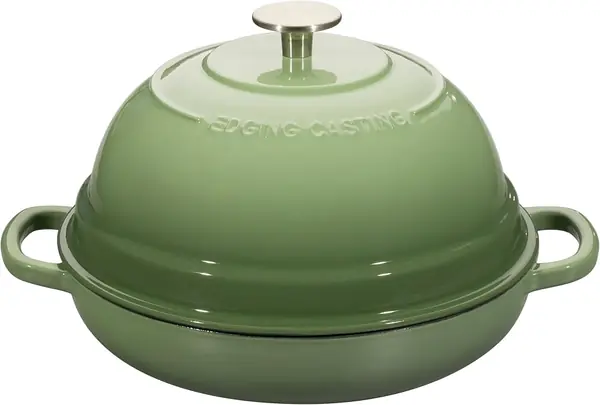
Pistachio green outside, white enamel inside, a domed lid with a stainless knob — the EDGING CASTING pot is the one people notice sitting on the counter. It's 13.2 inches across and 7.3 inches tall, so the dome leaves genuine headroom for a big oven spring.

It also bakes like a much plainer pot: even heat, a bottom crust that browns golden instead of scorching before the middle sets, and a 500 °F rating that covers any sourdough schedule. The white interior is the tell — you can see exactly how clean it is, which is satisfying right up until the first baked-on drip.

We recommend it to bakers who want a big dome and a pot worth leaving out, and who care more about the look of the loaf than about how the finish ages. On durability this one has the weakest record in the group: chips after a handful of uses come up more here than with the others.

The white interior stains, and a paste of baking soda lifts most of it — cosmetic, not structural. Buy from a seller with a straightforward return and the color stays a pleasure rather than a worry.

Worth Noting

  • Finish chips sooner than the others here
  • Around 13½ pounds before the dough
Our Verdict

We recommend it to bakers who want a big dome and a pot worth leaving out, as long as they accept the finish as the weak point.

Check Latest Price
7

Nuovva Double Loaf Pan Best for Two Small Loaves

Nuovva orange enameled cast iron double loaf pan with lid

Two small loaves

Bake Score 89/100
Capacity
4 quarts
Oven-Safe Temperature
500 °F
Finish
Enameled cast iron
Wells
Two round
View on Amazon

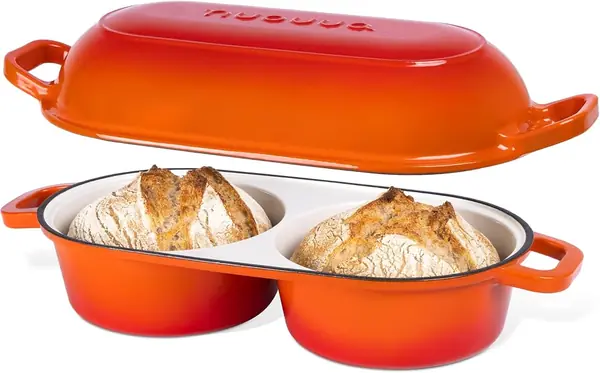
Two round wells under one lid. The Nuovva double loaf pan bakes a pair of small boules at once, and that alone makes it the odd one out here. If you make bread bowls for soup, bake for a household that wants smaller loaves, or sell at a market, no single-well pot in this group keeps up.

Each well takes roughly a pound of dough — a personal-size loaf, not a country boule. The lid spans both wells and traps steam over each, and the enamel releases loaves without parchment, which matters more than it sounds when you're juggling two hot wells and one pair of hands.

The baking side isn't in question. Heat moves evenly, both loaves brown at the same rate, and the pan cleans up with a short soak and a wipe.

Where we hesitate is value: it's the most expensive pot here by a wide margin, and it bakes less bread per pan than a 6-quart round. For two small loaves at once, though, nothing else in this group does the job — and if that's the job you have, it's worth the money.

Worth Noting

  • Most expensive pot here, with only 4 quarts total
  • Heavy to lift when both wells are full
Our Verdict

For two small loaves at once, we haven't found anything in this group that competes — just know you're paying the most for the least bread.

Check Latest Price
8

Umite Chef Bread Oven

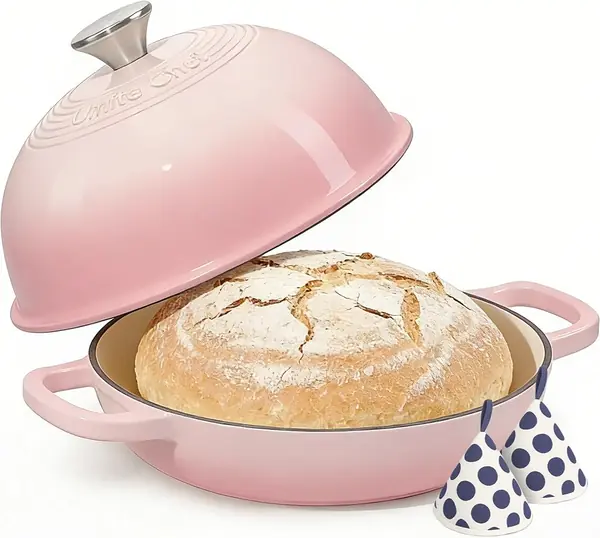
Umite Chef pink enameled cast iron bread oven with domed lid

Budget full-size pot

Bake Score 88/100
Capacity
6 quarts
Oven-Safe Temperature
500 °F
Included
Cotton potholders
Material
Enameled cast iron
View on Amazon

The Umite Chef is the least expensive six-quart bread oven in this roundup, and nothing about the enamel or the dome gives that away. Six quarts, a domed lid, a 500 °F rating, and a pair of cotton potholders in the box.

The potholders are the sleeper here: sized for the lid and the side handles, so you aren't folding a bar towel while the oven door hangs open. The lid seats well enough to hold steam through the spring, and the interior enamel wipes clean after a short soak.

It bakes evenly and browns the bottom without scorching, which is the whole job. Care is what you'd expect from coated cast iron: hand wash, no metal utensils, no dishwasher, and no preheating it empty.

Our reservation is size. Six quarts sounds generous, but the floor is tighter than the capacity suggests, and wide boules can bake up more oval than round. If your dough runs large, the Nuovva's extra floor is worth the small step up in price; for a standard weekly boule, this is the least expensive way into a full-size enameled oven.

Worth Noting

  • Enamel has chipped on some pots
  • Floor is tighter than six quarts suggests
Our Verdict

It's the cheapest six-quart pot here, and it bakes evenly enough that we don't miss the pricier ones.

Check Latest Price

How We Tested Bread Cloches (and What We Baked)

We started with more than 30 cloches and bread-baking Dutch ovens, then narrowed the field by shape, capacity, and material — enameled against bare cast iron, round against oval — plus each maker's oven-safe rating and what came in the box. That left 12, spread across a wide price range.

For eight months, every vessel got the same treatment in my kitchen: the same starter, flour, and hydration, and at least three bakes apiece, one after a 45-minute preheat and one in a hurry at 30. I measured the tallest point of each loaf to compare oven spring, noted whether a bottom scorched before a top browned, and checked how the lid handle felt through an oven mitt and whether the lid seated without wobbling. I also weighed every pot empty and measured its footprint against a standard oven rack, since a round that reads as reasonable online can crowd out a second loaf.

Durability took the whole eight months: repeated preheat cycles, tomato-heavy braises for anything sold as multi-purpose cookware, and hand-washing per each maker's instructions, with close looks at the rim where enamel chips first. Each one came to the table with bread in it, so I could judge how the finish read in real light and how the color held up after months of scrubbing. I finished by tallying what was actually in the box — a proofing basket, silicone sling, or mitts versus nothing but the pot — against what each one cost.

How to Choose a Bread Cloche

Cloche Shape vs. Deep Dutch Oven

A true cloche sets a shallow base on the rack and lowers a dome over it. That shape changes how you load: the dough goes onto a low, wide floor instead of being dropped into a deep pot, which is where burnt forearms and deflated loaves come from. The Flavehc and the AHJ both load this way, and it's the main reason we favor a cloche for weekly baking.

A Dutch-oven-style pot still turns out excellent bread, and it makes more sense if you want one vessel that also does stews and braises. Just accept the drop-in loading and the deeper reach when you pull the loaf out.

Match the Floor, Not Just the Quarts

Base diameter tells you more than capacity does. A 9.8-inch floor bakes a standard boule; push past that and the loaf climbs the sides and bakes up oval instead of round. The 6.4-quart Nuovva gives oversized dough somewhere to go, while the COWORM's 3.6-quart oval suits long loaves rather than round ones.

The trap is the footprint. A 14-inch pan covers most of a rack and needs a wide shelf, so measure the rack and the cabinet before you fall for a big one.

Enamel or Bare Cast Iron

Enamel wipes clean and needs no seasoning, which is why nearly every bread oven here is coated. The coating is also the part that fails, so look hard at the rim and the lid edge when the box arrives. Bare cast iron, like the COWORM, can't chip, but it wants drying and a thin coat of oil after every wash.

With either finish, skip metal utensils and scouring pads, and don't preheat a coated pot empty at high heat — put it in cold or have the dough ready to go.

Handles, Weight, and the Lift

A six-quart cast-iron pot with its lid runs 12 to 14 pounds, and you move it in and out of a hot oven twice per bake. Look for loop handles on both sides, a knob you can grab with a mitt, and a lid you can set down somewhere safe without hunting for a clear burner.

If the lift is the part that worries you, a smaller pan such as the 3.6-quart COWORM is easier to manage with one hand and a mitt, and it stores on a shelf instead of a lower cabinet.

Frequently Asked Questions

Final Verdict

The Flavehc is our pick for most kitchens: the shallow base loads cleanly, the dome holds steam, and the crust browns evenly instead of scorching. Buy it unless your dough runs big — then the 6.4-quart Nuovva gives you extra floor for about the same money.

If chipping enamel isn't something you want to think about, the COWORM's bare cast iron is the least expensive way into covered bread baking, and it gets better with every season rather than more fragile.