The 8 Best Bread Ovens for Sourdough of 2026

Good bread is mostly steam. A Dutch oven seals moisture under a heavy lid for the first half of the bake, keeping the crust from setting before the loaf finishes springing — which is why the pot matters as much as the starter. Enameled or bare cast iron, round or oblong, a lid that flips into a skillet: those choices change how evenly heat wraps the dough, how cleanly the loaf releases, and whether the pot is rust-free in two years.

Country loaves and wet sourdough went into 12 different pots before we settled on these. Weight is what nobody warns you about — a loaded 5-quart pot is awkward to lower into a 450°F oven and worse to pull back out — so handle design and lid fit mattered as much as any spec. Bare cast iron and bread baking are also a tense pairing: those hot, dry bakes cook off seasoning, so a pre-seasoned pot needs a swipe of oil now and then.

Color and finish count for more than I expected, since these pots live on the stove rather than in a cabinet.

Our Top Picks

The Best Bread Ovens for Sourdough

1

Lodge Double Dutch Oven Best Overall
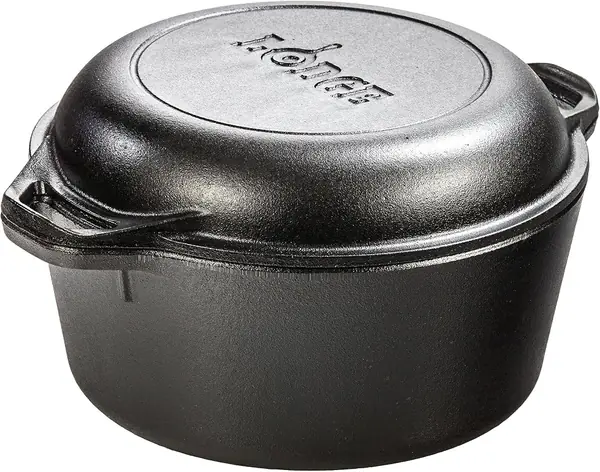
Lodge Double Dutch Oven in black cast iron with a skillet lid

Sourdough boules

Bake Score 97/100
Capacity
5 quarts
Material
Pre-seasoned cast iron
Oven-safe Temp
599°F
Weight
13.1 lb
View on Amazon

The lid of the Lodge Double Dutch is the reason it earns the top spot: it doubles as a skillet, and the whole thing can be inverted so the shallow lid becomes the base for a boule. That 2-in-1 design is more than a gimmick. The 5-quart pot is pre-seasoned cast iron, oven-safe to 599°F, and fitted with loop handles on both pieces.

We reach for it first for sourdough because bare cast iron takes the high heat without the enamel-chip anxiety that comes with enameled pots. The lid seals closely enough to trap steam, and the heat retention gives a loaf a fast, dark crust. The skillet lid has no handle, which makes it awkward for stovetop frying, but for bread that low, wide lid is useful: it gives you a place to slide the dough in and a second pan for searing afterward.

At 13.1 pounds, it is a two-hand lift when loaded, and the bare iron needs to be dried on the stove after washing or it will spot. Those are the costs of the design. The payoff is a pot that bakes a standard boule, sears a roast, and does not ask you to baby a coating. We also like that the lid gives you a second pan without another cabinet slot.

Worth Noting

  • Lid skillet has no handle
  • Heavy at 13.1 pounds
Our Verdict

If you want one pot that bakes a crackling boule and then sears the next night's dinner, the Lodge Double Dutch is the one we reach for.

Check Latest Price
2

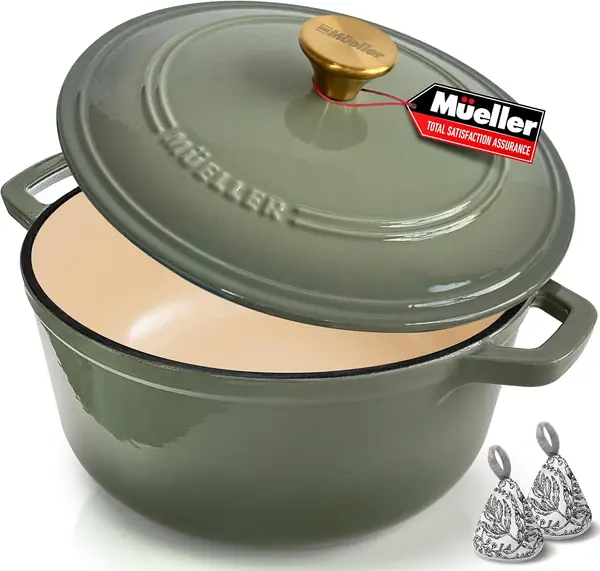
Mueller Home 6-Quart Dutch Oven Best Enameled for Larger Loaves

Mueller Home thyme-green enameled cast iron Dutch oven with stainless knob

Larger loaves

Bake Score 96/100
Capacity
6 quarts
Material
Enameled cast iron
Oven-safe Temp
500°F
Weight
12.5 lb
View on Amazon

A 6-quart pot gives a large boule room to spread without pressing against the sides, and that is the first reason we point to the Mueller Home. It is enameled cast iron, oven-safe to 500°F, and fitted with wide handles and a stainless-steel knob. At 12.5 pounds, it is lighter than a couple of the bare-iron pots here, though it is still a two-hand lift when full.

The enamel interior wipes clean after a bake, and the self-basting lid does its best work on braises rather than bread. For sourdough, the tight fit and heavy lid are what matter: they hold steam through the first half of the bake and then release it when you uncover the pot. The wide handles give oven mitts something to grab, which is not true of every pot this size.

We like it best as the enameled choice for larger loaves and family cooking. It is the one we leave on the table when the pot is also the serving dish, and the 6-quart capacity is forgiving if you bake a lot of high-hydration dough. The trade-off is weight and a finish that can chip if you treat it roughly; keep metal utensils out and do not stack it carelessly. If you mostly bake one small boule, a 5-quart pot is easier to handle.

Worth Noting

  • Heavy at 12.5 pounds
Our Verdict

The Mueller Home is our enameled pick for larger loaves and family cooking, with a 6-quart body that gives a big boule room and a finish that wipes clean.

Check Latest Price
3

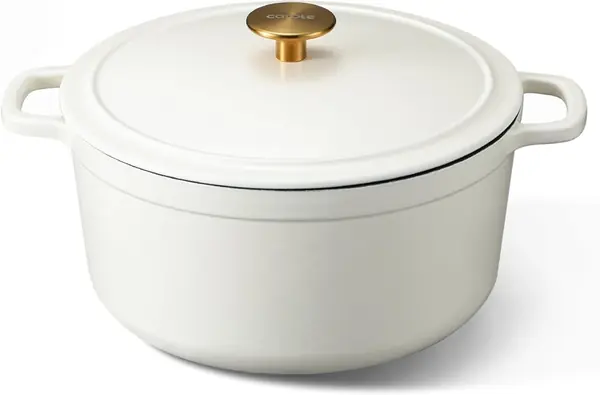
Carote 5-Quart Dutch Oven Best Budget Enameled

Carote cream-white enameled cast iron Dutch oven with gold lid knob

Budget enameled

Bake Score 95/100
Capacity
5 quarts
Material
Enameled cast iron
Oven-safe Temp
500°F
Weight
13.2 lb
View on Amazon

The Carote is the budget enameled pot we point to first, and we think it is the best value in this group for a standard 5-quart boule. It is oven-safe to 500°F, has a self-basting dome lid, and comes in a cream-white finish with a gold knob that looks more expensive than the pot. The trade-off is the pale exterior: it shows stains from high-heat baking, so wipe it down after each bake rather than waiting.

The enamel interior releases bread cleanly, and the wide dual handles are easy to grab with mitts. At 13.2 pounds, it is heavy enough that you will want two hands, and the coating can chip if you bang the rim or use metal utensils. We like it for a first enameled bread oven or a second pot for holiday baking. If you bake at 500°F often, the 500°F rating matters; if you want a larger loaf, the 6-quart Mueller is the better fit.

Worth Noting

  • Pale exterior shows stains
  • Heavy at 13.2 pounds
Our Verdict

The Carote is the budget enameled pot we recommend first for a standard 5-quart boule, as long as you can live with a pale finish that shows stains.

Check Latest Price
4

Crustlove Bread Oven Set Best Starter Set

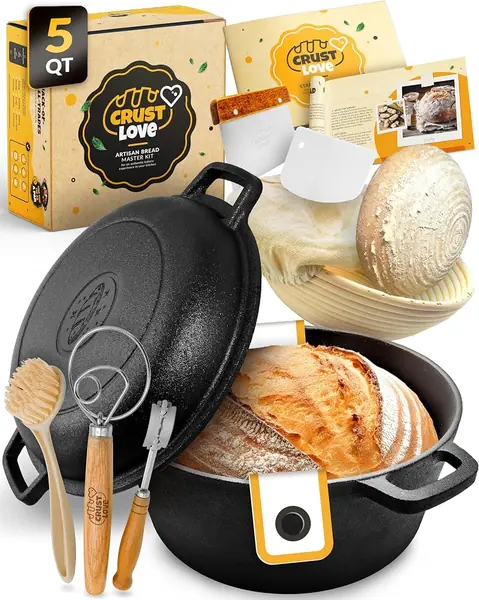
Crustlove black pre-seasoned cast iron bread oven set with tools

Beginner bread bakers

Bake Score 94/100
Capacity
5 quarts
Material
Pre-seasoned cast iron
Oven-safe Temp
500°F
Included Tools
Banneton, sling, lame, whisk, scrapers, brush, booklet
View on Amazon

The Crustlove set is the one we hand to someone starting from zero, and we think it is the best starter kit here because the box includes the pieces you would otherwise buy separately: a banneton, a bread sling, a scoring lame, a dough whisk, scrapers, a brush, and a booklet. The pot itself is a 5-quart pre-seasoned cast-iron bread oven, oven-safe to 500°F.

The pot bakes a crusty loaf with the same heat retention as the other bare-iron picks, and the included sling makes lowering the dough easier than using a wad of parchment. The lid has no knob, though, so lifting it off a hot pot is awkward; use a thick mitt and grab the rim carefully. The dough whisk is the flimsiest piece in the kit and the first thing we expect to replace.

The booklet is a helpful starting point, not a deep sourdough course, and the banneton is a better reason to buy the set than the recipe guide. If you already own a banneton, lame, and sling, buy the pot alone and skip the extras. If you are outfitting a first kitchen, this saves you a separate shopping list.

Worth Noting

  • Lid has no handle
  • Dough whisk feels flimsy
Our Verdict

The Crustlove set is the best starter kit here because it pairs a solid 5-quart bread oven with the banneton, sling, lame, and whisk a new baker would otherwise buy separately.

Check Latest Price
5

Nuovva Double Loaf Pan Best for Two Small Loaves

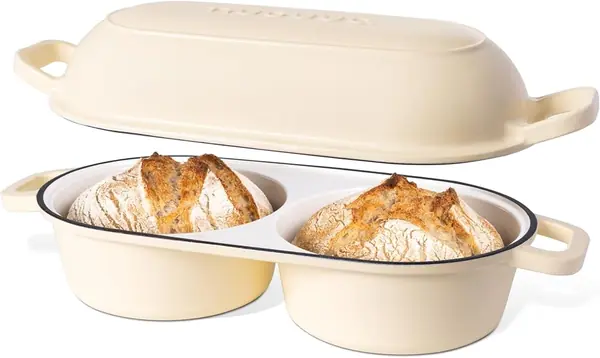
Nuovva cream enameled cast iron double loaf pan with lid

Two small loaves

Bake Score 93/100
Capacity
6.4 quarts
Material
Enameled cast iron
Oven-safe Temp
500°F
Loaf Wells
Two 16.5 cm rounds
View on Amazon

The Nuovva is not a standard boule pot. It is a double loaf pan with two round wells, each about 6.5 inches across, set under one lid. That makes it a different tool: it is for mini boules, bread bowls, and personal loaves, not a full-size sourdough round. The pan is 6.4 quarts total, enameled cast iron, and oven-safe to 500°F.

We like it for small-batch baking and for testing two flours side by side in one bake. The two wells heat evenly, the lid traps steam across both, and the loaves release cleanly from the enamel. It is the one we reach for when we want two small loaves from one batch, not when we want one big centerpiece loaf.

At 14.8 pounds, it is heavy, and the small wells mean you cannot stretch the recipe into a standard boule. The enamel can chip if you knock the rim, so treat it like any enameled pot. The compact footprint is a real advantage: it takes less cabinet space than a wide round Dutch oven.

The single lid covers both wells, so you uncover two loaves in one move; that is handy, but it also means you cannot rotate one loaf without exposing the other. For gift loaves, that is a fair trade.

Worth Noting

  • Wells fit only small loaves
  • Heavy at 14.8 pounds
Our Verdict

The Nuovva is the pick when you want two small loaves from one bake, not when you want one large centerpiece boule.

Check Latest Price
6

Vorringard 5-Quart Bread Oven Best for Long Loaves

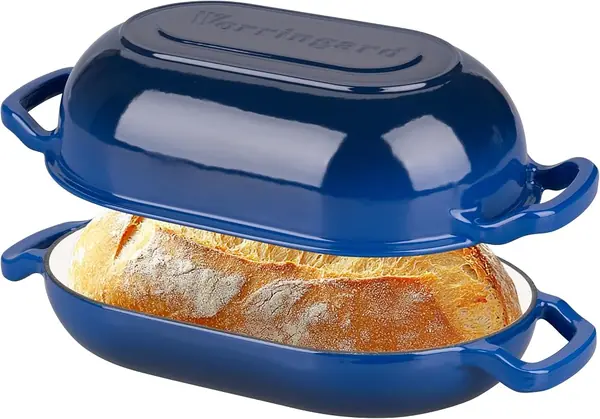
Vorringard blue enameled cast iron bread oven with loop handles

Long loaves

Bake Score 92/100
Capacity
5 quarts
Material
Enameled cast iron
Oven-safe Temp
500°F
Dimensions
14.2 x 5.4 inches
View on Amazon

The Vorringard is a wide, low 5-quart pot: 14.2 inches across and 5.4 inches high, with a blue enamel finish and loop handles. That shape is the reason to consider it. A long batard can stretch out without climbing the sides, and the shallow depth keeps the lid close to the loaf for steam.

The cast iron heats evenly, the lid seats well, and the enamel interior wipes clean after a bake. At 12.9 pounds, it is heavy but not the heaviest pot here, and the loop handles are easy to grab with mitts. The blue finish looks good enough to bring to the table, which is more than we can say for every pot in this group.

The wide footprint takes more cabinet space than a 5-quart round pot, and the enamel is the weak point: chips on the rim can expose the cast iron underneath. Keep metal utensils out and do not stack anything heavy on it. If you bake mostly tall, compact boules, a deeper pot is a better fit.

We like it best for long loaves, wide boules, and bakers who want a pot that can double as a roasting pan. It is the one here that makes a batard look intentional rather than squeezed. For a standard round boule, the Lodge Double Dutch is more versatile, but the Vorringard earns its place when the loaf is long.

Worth Noting

  • Enamel can chip
  • Wide footprint takes space
Our Verdict

The Vorringard is the best shape here for long loaves, with a wide, low body that lets a batard stretch out instead of climbing the sides.

Check Latest Price
7

Overmont 5.5-Quart Dutch Oven

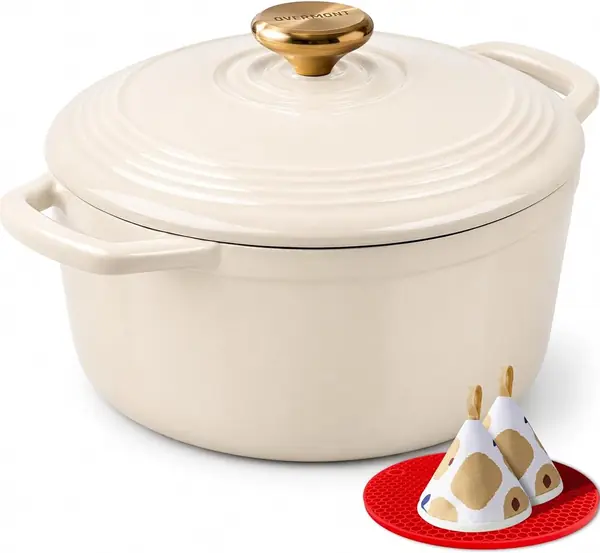
Overmont warm-white enameled cast iron Dutch oven with lid

Budget starter pot

Bake Score 91/100
Capacity
5.5 quarts
Material
Enameled cast iron
Oven-safe Temp
400°F
Included Extras
Cookbook, silicone mat, two potholders
View on Amazon

The 400°F oven limit is the first thing we check on the Overmont, because a lot of sourdough recipes start at 450°F or higher. If your method stays at or below 400°F, the pot is a useful 5.5-quart enameled Dutch oven with a self-basting lid, a cookbook, a silicone mat, and two potholders. If you like a blistering-hot preheat, this is not the pot for that.

The enamel interior is easy to wipe clean, and the warm white finish looks good on the table. The lid's condensation bumps are more about braising than bread, but the heavy lid still traps steam for the first part of the bake. The included potholders are actually useful, which is not always true of bundled extras.

We think it is a good budget choice for lower-heat baking and everyday cooking, not our first pick for high-heat sourdough. The interior enamel can chip, so keep metal utensils out and avoid stacking the pot. If your recipe tops out at 400°F, it is a useful package; if you routinely bake at 500°F, choose a pot rated for it.

Worth Noting

  • Oven-safe only to 400°F
  • Interior enamel can chip
Our Verdict

The Overmont is a good budget enameled pot for lower-heat baking and everyday cooking, but its 400°F limit keeps it out of the top tier for hot sourdough bakes.

Check Latest Price
8

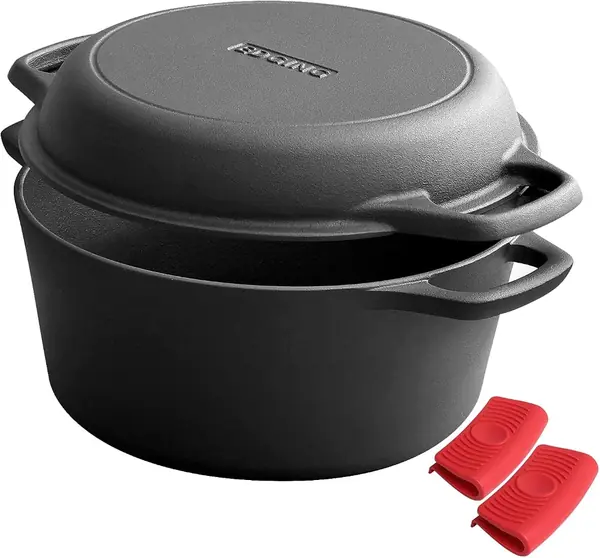
Edging Casting 5-Quart Dutch Oven

Edging Casting black pre-seasoned cast iron Dutch oven with skillet lid

Budget bare iron

Bake Score 90/100
Capacity
5 quarts
Material
Pre-seasoned cast iron
Oven-safe Temp
500°F
Design
Pot with skillet lid
View on Amazon

The Edging Casting is the least expensive bare cast-iron pick here, and the 2-in-1 design gives you a pot and a skillet lid. It is pre-seasoned, oven-safe to 500°F, and fitted with loop handles on both pieces. The surface is rougher than a smooth enameled pot, so bread can stick if you skimp on flour.

It bakes a crusty loaf well, and the skillet lid is handy for searing or frying after the bread comes out. The seasoning is thin out of the box, so give it one extra round of seasoning before the first bake. The rough surface mellows with use, but it asks for more oil than a slick enameled interior.

Rust is the main risk. Dry it on the stove after washing and rub on a thin coat of oil before it goes away. That is the bare-iron bargain: more care, less money. The rough surface and bare iron mean more upkeep, not less.

We rank it as a budget also-consider, not the top pick, because the Lodge Double Dutch is more consistent for a little more. For a cheap second pot, a camp bread oven, or someone who wants to learn bare cast iron, it earns a look. The rough interior is the main thing to accept.

Worth Noting

  • Rough interior can stick
  • Seasoning needs regular upkeep
Our Verdict

The Edging Casting is the least expensive bare cast-iron pick here, a decent budget bread oven if you accept a rough surface and more careful drying.

Check Latest Price

How We Tested 12 Bread Ovens Over Eight Months

Our shortlist started as a spreadsheet. We read through listings for both enameled and bare cast iron pots in the 5- to 5.5-quart range — big enough for a standard boule, small enough to lift with two hands — and crossed off anything without a stated oven-safety limit, anything with handles too small for an oven mitt, and anything that couldn't also braise a chuck roast. That left 12 pots, which we baked in for eight months.

Every pot got the same country loaf and the same wet sourdough, baked on weekend mornings and again on weeknights after work, when nobody was hovering and the timer was the only thing paying attention. We watched where the bottom of the loaf scorched, whether the crust set before the dough finished springing, and how cleanly the bread released — some loaves slid right out, others needed a spatula and left a ring of burnt flour behind.

Practically, we weighed each pot empty and again with a full batch of dough, then carried it to the oven one-handed to see how the handles felt under real weight. After every bake we washed and scrubbed, noting whether crust lifted off the enamel or had to be soaked. To check rust resistance we left the bare cast iron pots damp on the counter overnight, twice, then looked for orange spots and re-oiled as needed. We also compared what came in the box — a lid that flipped into a skillet, a banneton, a small recipe booklet — since the extras are part of what you're paying for, and we baked from the included recipes where there were any.

Eight months in, we tracked the things that show up late: chipped enamel rims, dulled finishes, and whether the pots we'd left sitting on the stove still looked like something we'd want to display.

How to Choose a Bread Oven

Size and shape

A 5- to 6-quart round pot is the default for a standard boule. It gives the dough room to rise without spreading so wide that the loaf bakes flat. A wide, shallow pot such as the Vorringard is better for a long batard, while a double-well pan like the Nuovva is for small loaves, not a full-size round.

Check the interior diameter, not just the quart capacity. A pot that is too narrow will press the loaf against the sides; one that is much too wide can let a small boule flatten out. If you bake mostly one loaf at a time, a single 5- to 6-quart pot is the most useful shape.

Material and finish

Bare cast iron takes high heat, develops a natural nonstick surface, and will not chip the way enamel can. It also needs to be dried thoroughly after washing and re-oiled now and then. Enameled cast iron is easier to clean and better for acidic braises, but the coating can chip if you knock it or use metal utensils.

We prioritize bare iron for high-heat sourdough and enamel for low-maintenance cooking. The Lodge Double Dutch is the bare-iron default in this group; the Mueller Home is the easier-clean enameled choice for larger loaves. Neither material is automatically better; the question is how much care you want to trade for convenience.

Heat, lid, and steam

Look for an oven-safe rating of at least 450°F, and 500°F if you like a hot preheat. A lid that seals closely traps the steam that gives bread its rise and shine; a domed lid gives the loaf more headroom. Self-basting bumps are useful for braises, but they are not the main reason a bread oven works.

The trap is assuming every enameled pot is high-heat safe. The Overmont tops out at 400°F, which is fine for some recipes but not for a 500°F bake. Check the knob and handles too: a lid without a handle, as on the Crustlove, is awkward to lift when hot.

Weight, handles, and the tools in the box

Most 5- to 6-quart cast-iron pots weigh 12 to 15 pounds. Wide handles and a secure lid knob matter more than a few ounces, because you will be lifting a hot pot with mitts. If the handles are small or slippery, the pot will feel heavier than it is.

A kit with a banneton, sling, and lame can save a beginner a separate shopping list, but check the quality of the extras. The Crustlove set is useful because the banneton and sling are the pieces you will actually use; its dough whisk is the weak link. If you already own those tools, buy the pot alone.

Frequently Asked Questions

Final Verdict

For most sourdough bakers, the Lodge Double Dutch is the sweet spot: bare cast iron that takes high heat, a lid that doubles as a skillet, and no enamel to baby. If you want easier cleanup and a larger 6-quart pot, the Mueller Home is the better fit; if you are outfitting a first bread kit, the Crustlove set saves you the separate shopping.

The choice really comes down to how you bake. One standard boule and a desire for low maintenance points to enamel; high heat, long-term durability, and a second pan point to bare iron. Pick the shape that fits your usual loaf, then choose the finish you are willing to care for.