The 8 Best Non Toxic Dutch Ovens for Sourdough Bread of 2026

The phrase "non toxic" on a Dutch oven label can mean almost anything, which is the problem. Some pots are bare cast iron that needs seasoning and holds onto last night's chili; others are iron coated in enamel, essentially glass fused to the metal, which won't react with your starter. Bread baking is the one job where a pot sits empty at 475 degrees and then holds a wet dough — whatever is on that surface ends up in your crust.

We baked through 12 of them, from bare cast iron to enameled pots in every color. Differences showed up fast: how evenly the base browned a loaf, whether the lid held steam for oven spring, how the surface cleaned up. Weight is its own consideration — a 6-quart enameled pot can run 13 pounds empty, and you feel it when lowering a slack dough into a hot oven.

The ones that stayed on my counter had a coating that didn't chip, handles I could grab with confidence, and enough range to braise short ribs the day after baking.

Our Top Picks

The Best Non Toxic Dutch Ovens for Sourdough Bread

1

Mueller DuraCast Dutch Oven Best Overall
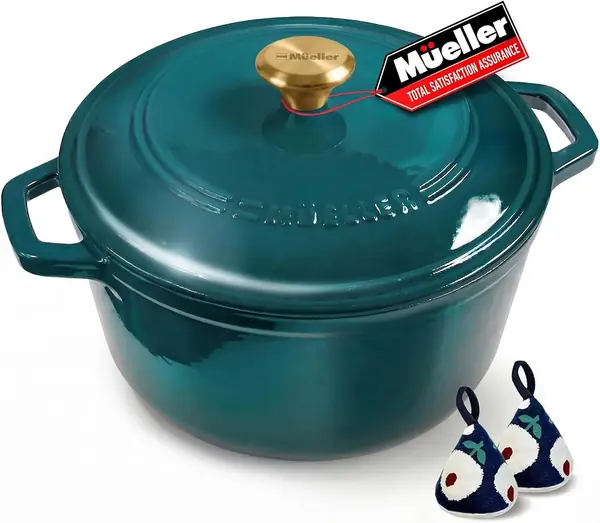
Emerald enameled cast iron Dutch oven with lid and dual handles from Mueller

Everyday sourdough baking

Bake Score 98/100
Capacity
6 quarts
Oven-Safe Max
500 °F
Weight
12.5 lb
Cooking Surface
Porcelain enamel, no seasoning
View on Amazon

The inside of the Mueller's lid is covered in raised bumps, and that is the reason this pot sits at the top of our list. Steam rises off the loaf, condenses on those bumps, and drips back onto the bread instead of running down the sides, which is exactly what you want in the first stretch of the bake while the crust is still soft enough to let the dough spring. Pair that lid with thick cast iron and a 500 °F rating and you have the two things a bread oven actually needs. Most pots give you one or the other.

At 12.5 pounds empty it is also one of the lighter enameled pots here, and that matters more than the spec suggests when you are pulling a hot, loaded pot off a rack at 475 °F. The dual handles leave room for a mitt, and the lid lifts off cleanly rather than sticking and requiring a pry. Because the cooking surface is enamel rather than bare iron, there is no seasoning step between the box and your first bake: warm water, a sponge, done.

Enamel is the part that wears on any pot like this, and this one sits near the top of the group on coating durability. It is also rated for induction, which several pots here are not, so it earns a place in a kitchen with a glass-top range as well as one with gas. What we like most is that none of this comes with a ritual attached.

Worth Noting

  • Exposed iron rim can spot with rust if left damp
  • Hand wash only, not dishwasher safe
Our Verdict

We recommend this one for most sourdough bakers: the noded lid keeps steam on the loaf, and the enamel takes 500 °F without a seasoning routine.

Check Latest Price
2

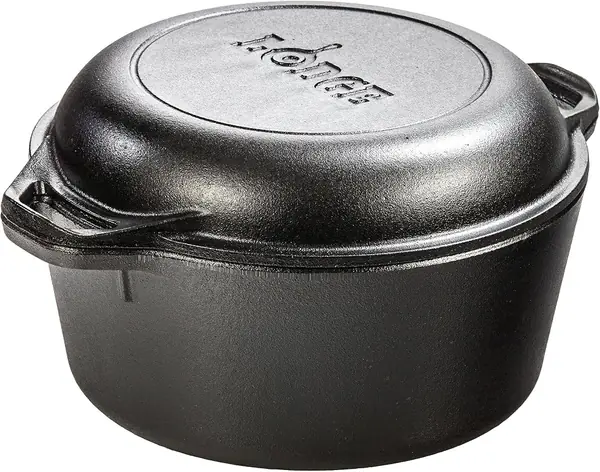
Lodge Cast Iron Double Dutch Oven Best Bare Cast Iron

Black pre-seasoned cast iron double Dutch oven with skillet lid and loop handles

Coating-free baking

Bake Score 97/100
Capacity
4.75 liters
Diameter
11.15 inches
Weight
13.1 lb
Lid
Cast iron, doubles as a skillet
View on Amazon

There is no enamel anywhere on this pot, and for the right shopper that is the entire pitch. Lodge seasons it with vegetable oil and stops there: no synthetic coating, no PFAS, no nonstick layer to think about at 450 °F. If the non-toxic half of this search is what brought you here, this is the shortest ingredient list in the group.

The better trick is in the lid. It is a two-handled skillet, which means the whole thing runs inverted: set the shallow skillet on the rack as your base, slide the boule onto it, and cap it with the deep pot. You get lower walls to load over and a lid with two real grips, and the pot is rated to 315 °C, hotter than any enameled one here. The seasoning shrugs off that kind of heat in a way a coating never quite does, and the skillet half earns its keep for searing and cornbread the rest of the week.

The trade-offs are honest ones. The skillet lid has no handle of its own, so lifting it off a hot pot takes both mitts and a little nerve, and 13.1 pounds of iron is a two-hand lift before the dough even goes in.

Where it beats the enameled pots beyond bread: the two halves nest for storage, so a pot that bakes your Sunday loaf is also the pan you sear Monday's chops in without taking up a second shelf.

Worth Noting

  • Seasoning needs drying and re-oiling after every wash
Our Verdict

We keep this one for anyone who wants nothing but iron in the oven — the lid doubles as a skillet, and it outranks every enameled pot here on heat.

Check Latest Price
3

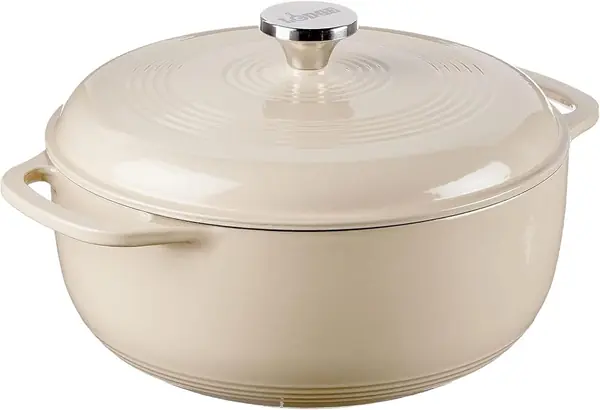
Lodge Essential Enamel Dutch Oven Best Big Enameled Pot

Sandalwood enameled cast iron Dutch oven with lid and dual handles from Lodge

Big loaves and braises

Bake Score 96/100
Capacity
6 quarts
Oven-Safe Max
500 °F
Diameter
13.25 inches
Weight
14.9 lb
View on Amazon

Fourteen-point-nine pounds of cast iron is what buys the steady heat in this pot. It is the heaviest round enameled Dutch oven here, and that mass is the reason a cold loaf set into a preheated pot does not drag the oven temperature down with it, so the bake stays even from the first minute.

What the weight gets you is a 6-quart round, 13.25 inches across, wide enough for a generous boule and long enough for a bâtard set on the diagonal. The enamel is rated to 500 °F, the handles are broad, and the pot goes from a stovetop sear to the oven to the table without any fuss. As everyday cookware it is the most familiar thing on this page.

As a bread pot it is good rather than great. That wide floor gives a boule room to spread before it climbs, so you get a broader, slightly flatter loaf than the 9.5-inch Carote turns out, and the pot is heavy enough that loading it one-handed is not an option. Where it wins is everything after the bake: chili, braises, a whole chicken.

Buy it as the one big enameled pot in a kitchen that cooks everything, and it will earn its place from October through March. If sourdough is the main event, the DuraCast does the same job on a sturdier coating.

Worth Noting

  • Enamel chips at the rim and lid edge
Our Verdict

We like this for the baker who wants one big, familiar enameled pot that bakes a wide boule and then goes straight into stew duty.

Check Latest Price
4

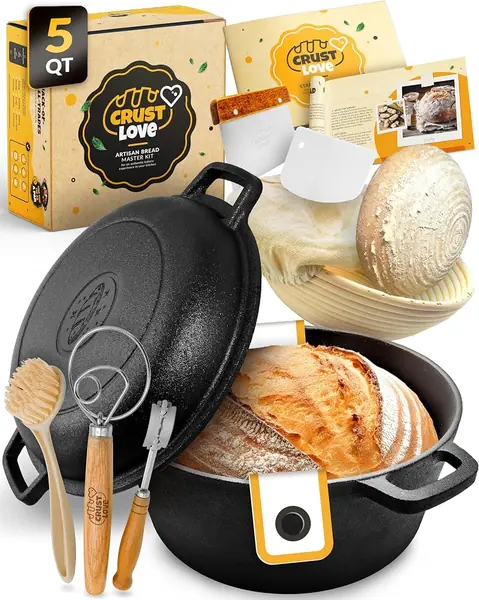
CRUSTLOVE Sourdough Dutch Oven Kit Best Starter Kit

Black cast iron Dutch oven with lid beside a banneton, lame, and dough whisk

First-time bakers

Bake Score 95/100
Capacity
5 quarts
Oven-Safe Max
500 °F
Diameter
10 inches
Included
Pot, banneton, bread sling, lame, whisk, scraper, brush, booklet
View on Amazon

The pot is only half of what arrives. Along with the 5-quart pre-seasoned cast iron Dutch oven you get a 10-inch banneton, a silicone bread sling, a scoring lame, a dough whisk, metal and plastic scrapers, a brush, and a starter booklet, which is the shopping list a new sourdough baker usually assembles one panic purchase at a time.

We like it for the two pieces people forget. The banneton holds the shaped dough overnight so it keeps its shape going into the pot, and the sling lets you lower a wet, wobbly boule into a screaming-hot oven without rearranging your knuckles. Having both in the box means you can bake the week it arrives rather than the week the last order shows up.

The pot holds up its end: bare iron, pre-seasoned, rated to 500 °F, 10 inches across, which is small enough that one boule fills it and climbs instead of spreading. It browns a crust hard and dark, and cleanup is a scrub and a dry on the stove.

As a gift for someone who has been talking about sourdough for a year, it is the most complete thing here, and the booklet gives them a first schedule to follow instead of a forum thread to decode.

Worth Noting

  • Lid has no knob, so hot lifts take both mitts
  • Dough whisk is the flimsiest piece in the kit
Our Verdict

We give this kit to first-time sourdough bakers: pot, banneton, sling, and lame arrive together, and the cast iron bakes a crisp, dark crust.

Check Latest Price
5

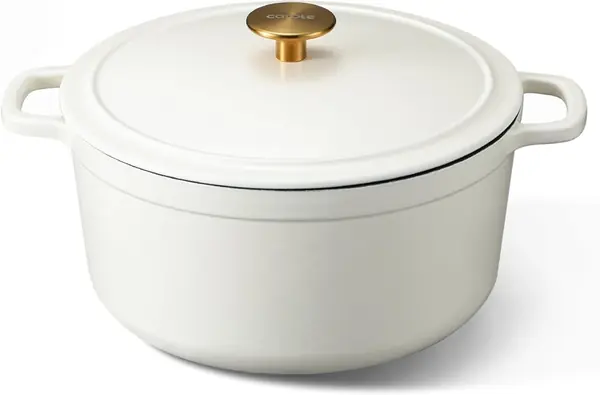
Carote Enameled Dutch Oven Best for Single Loaves

Cream white enameled cast iron Dutch oven with gold lid knob and dual handles

Single-boule bakes

Bake Score 94/100
Capacity
5 quarts
Oven-Safe Max
500 °F
Diameter
9.5 inches
View on Amazon

Five quarts with a 9.5-inch cooking floor is the shape we look for when one boule is the whole point. The dough meets the walls early and climbs instead of spreading, and the pot is small enough to move with one mitt and one hand on the counter. That was the first thing we noticed about the Carote, and it is most of why it is here.

It is also the best-looking pot in the group. The cream enamel and the gold lid knob read far more expensive than the pot is, and the interior is light enough that you can see how dark the crust is getting the moment you lift the lid. That sounds like a small thing until you have baked in a black-interior pot and guessed wrong twice.

Budget enamel is usually where corners show, and this one holds its own: rated to 500 °F, even heat, no seasoning step, and a coating that has held up better than most of the inexpensive pots here. It is also light enough that a full pot is not a wrestling match.

The size is the limit as well as the appeal, and for a household that bakes one boule a week that is not a compromise. It is the point.

Worth Noting

  • Exterior enamel picks up stains that do not wipe off
  • Too small for a wide bâtard
Our Verdict

We reach for this one when we are baking a single boule and do not want to haul out a larger pot — small, pretty, and easy to handle.

Check Latest Price
6

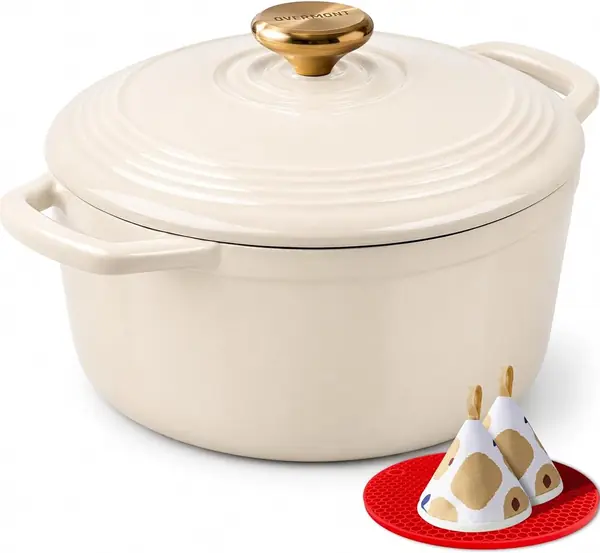
Overmont Enameled Dutch Oven Best for Braises and Stews

Enameled cast iron Dutch oven with a metal lid knob and wide dual handles

Braises and stews

Bake Score 93/100
Capacity
5.5 quarts
Oven-Safe Max
400 °F
Diameter
13.2 inches
Included
Cookbook, silicone mat, two potholders
View on Amazon

Bread baked at 400 °F comes out flatter and paler than bread baked at 475 °F. That is the practical consequence of this pot's temperature ceiling, and it is the first thing to weigh: a sourdough routine preheats hot to get oven spring before the crust sets, and the Overmont cannot go there.

Plenty of the rest is thoughtful. The lid knob is metal rather than plastic, so the knob is not quietly capping the rating on its own. It ships with a cookbook, a silicone mat, and two cotton potholders. The 5.5-quart body is a useful middle size, the warm white enamel looks good on a table, and it moves from stovetop to oven without complaint.

We rate it as a braiser that happens to bake bread. For stews, beans, and a Saturday pot roast it is pleasant to use and easy to clean, with a glossy interior that wipes out. For the kind of steamy bake that gives you an ear and a blistered crust, it is the wrong tool.

If your bread routine tops out in a moderate oven, or you want one pot to braise in all winter and bake in occasionally, this is a good-looking, well-equipped choice. If you want the hot bake, buy a pot rated to 500 °F and let this one handle Sunday dinner.

Worth Noting

  • Interior enamel chips over time
Our Verdict

We rate this for braises and cool bakes; its 400 °F ceiling rules out the hot start most sourdough routines want.

Check Latest Price
7

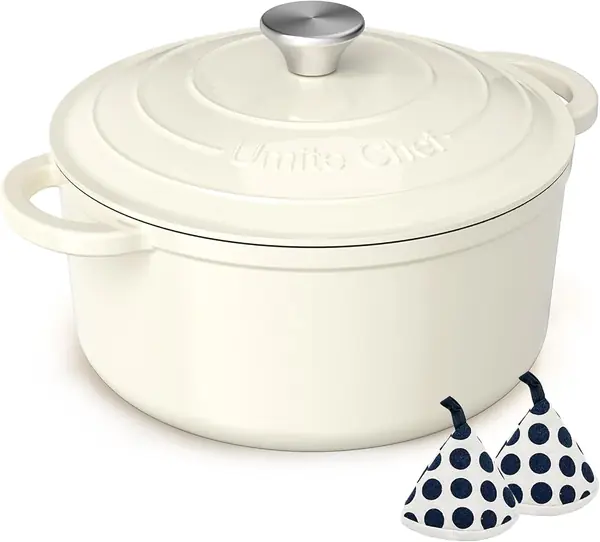
Umite Chef Enameled Dutch Oven

Cream white enameled cast iron Dutch oven with stainless handles and lid

First enameled pot

Bake Score 92/100
Capacity
5 quarts
Oven-Safe Max
500 °F
Included
Cotton oven mitts
Width
12.6 inches
View on Amazon

Same five quarts, same cream-white enamel, much the same job as the Carote, so the differences are in the details. Umite Chef fits wide stainless handles that are easy to grab with mitts and throws in a pair of thick cotton oven mitts, which is a small thing until the first time you pull a hot pot out and realize your only mitt is damp.

The body is enameled cast iron rated to 500 °F, with a lid that seats cleanly and a light interior that shows how the crust is coming along. It goes from stovetop to oven to table, and cleanup is warm water and a sponge.

Coating quality is where the money went. The interior enamel on this one can chip after a handful of uses, and the lid edge is the other spot to watch. Keep metal utensils out of it, skip the empty preheat over a hot burner, and it will last longer than the price suggests.

We think it is a fair first enameled pot. It bakes a loaf, it makes soup, and when the coating eventually goes you will know exactly what you want next time. What it is not is a pot to hand down, and at this end of the group that is the trade you are making.

Worth Noting

  • Interior enamel can chip after a few uses
Our Verdict

We think this suits a first enameled pot on a tight budget, provided you accept that the coating is where the money was saved.

Check Latest Price
8

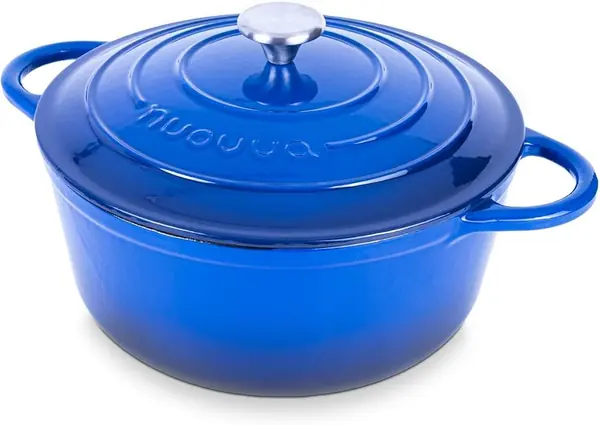
Nuovva Enameled Dutch Oven Best for Family-Size Batches

Dark blue round enameled cast iron Dutch oven with lid and double handles

Family-size batches

Bake Score 91/100
Capacity
6.4 quarts
Oven-Safe Max
500 °F
Diameter
11 inches
View on Amazon

At 6.4 quarts and 11 inches across, this is the largest pot in the group, and that cuts both ways. A big boule has room, but a wide floor also lets dough spread before it climbs, so you get a broader loaf than a 9.5-inch pot turns out.

The dark blue enamel is the nicest finish here: deep, even, and good enough to carry to the table instead of decanting into a serving dish. The double handles are robust, it is rated to 500 °F, and it cooks evenly enough for a roast or a loaf.

It is heavy at over fourteen pounds empty, and you feel every bit of that with a chicken inside. The double handles help; nothing else does.

We like it as the family pot it is. Heat it gradually with something in it rather than empty over a flame, keep metal tools out, and it will handle years of Sunday dinners with a loaf on the side. Just do not expect the extra capacity to improve your bread, because a boule bakes the same in five quarts.

Worth Noting

  • Over 14 pounds, and awkward when full
  • Enamel chips, and can crack under stovetop heat
Our Verdict

We see this as the big-batch pot: 6.4 quarts of deep blue enamel that swallows a family stew and still centers a boule.

Check Latest Price

How We Tested Non Toxic Dutch Ovens for Sourdough

We started with more than 30 listings and cut hard. Anything that didn't state what its cooking surface was made of, or that couldn't back up oven safety at 450 degrees or higher, came off the list, as did pots smaller than 5 quarts or larger than 6.5 — a boule plus a lid needs the room, and anything bigger gets too heavy to lift safely. That left 12 pots, a mix of bare cast iron and enameled iron, which we bought ourselves and tested for eight months.

Every Saturday morning I preheated each pot at 475 degrees for 45 minutes, then baked a boule in it. I noted whether the base browned evenly or scorched in a ring, how much the loaf rose once the lid went on, and whether steam escaped around the rim. Empty, then loaded with a proofed dough, each pot went on a kitchen scale; I lifted every one bare-handed and with a towel to see where the handles actually sit. Between bakes, the same pots went on the stove for braises, stews, and a pot of beans.

Cleaning told us the most about the enameled ones. After each bake I scrubbed with a baking soda paste and checked for staining, crazing, and chips at the rim and lid; the bare cast iron got scraped, wiped, and re-oiled. A few arrived with a booklet or a pair of potholders, so we cooked from those instructions and judged whether they were actually usable. By the last month we knew which pots still looked new and which had dulled.

How to Choose a Dutch Oven for Sourdough

Pick the finish before the features

Bare seasoned cast iron is iron and oil, nothing else. Porcelain enamel is a glass-like coating fused over the same iron. Both are non-toxic in the sense this search means, since neither needs a PFAS or PTFE nonstick layer, so the real choice is upkeep. Bare iron asks for a drying-and-oiling routine after every wash; enamel asks you to keep metal utensils out and avoid thermal shock.

If you want the shortest ingredient list, the Lodge Double Dutch is the pick here. If you want no seasoning ritual at all, go enameled, as on the Mueller.

Match the oven rating to your bake

A sourdough bake usually starts hot, somewhere between 450 and 500 °F, to drive oven spring, then finishes cooler. A pot rated to only 400 °F can still bake bread, but you give up the hot start that produces the ear and the blistered crust, and that is a limitation you will feel in every loaf rather than once.

Check the rating for the pot and not just the knob, since a plastic knob can cap an otherwise 500 °F vessel. Metal knobs are worth looking for, and they are one of the reasons the Overmont's ceiling is a specification rather than a guess.

Size the pot to the loaf, not the guest list

Five quarts with a 9.5- to 10-inch floor is the sweet spot for one boule: the dough meets the walls early and climbs instead of spreading. Step up to 6 quarts and you gain room for a wide loaf or a bâtard laid on the diagonal, and you gain weight you will feel on every hot lift.

An oval is the better shape for long bâtards and the worse one for a round boule. Buy for the loaf you bake most, not the one you bake at the holidays.

Plan for the hot lift

This is the step that catches people. You are moving a 12- to 15-pound pot at 450 °F or more, with a loaf inside, twice per bake: once to load, once to uncover. Wide dual handles and a lid knob you can actually grip with a mitt matter more here than anything else on the spec sheet.

A lid with no handle, like the skillet lid on a double Dutch oven, still works, but your hands are busier. Decide before you buy whether you can move the thing safely in your own kitchen.

Budget for what the pot doesn't include

A first sourdough setup also needs a banneton, a scoring lame, a dough sling, and a scraper, which together can rival the cost of the pot. A kit that bundles them, like the CRUSTLOVE set, is the fastest route to baking the week it arrives, though the tools in a bundle are usually the budget part.

Then plan on hand washing everything and, for bare iron, a minute of oiling after every bake.

Frequently Asked Questions

Final Verdict

For most sourdough bakers, the Mueller DuraCast is the pot to buy: the noded lid keeps steam on the loaf, the enamel needs no seasoning, and it takes a 500 °F bake without complaint.

If you want nothing but iron and oil in your oven, take the Lodge Double Dutch Oven and accept the upkeep. If you are starting from zero, the CRUSTLOVE kit puts a pot, banneton, sling, and lame in one order.