The 7 Best Bread Slicers for Bread Machine Bread of 2026

A loaf out of the bread machine is a beautiful thing until you try to slice it. It's square, it's soft, the crust fights back, and by the fourth slice the knife has wandered and you're cutting wedges. I've mangled more heels than I care to count. A slicer's only real job is to hold the loaf still and keep the blade honest, so every slice comes out the same thickness — the difference between a sandwich that stacks flat and one that collapses.

I've run 11 slicers through every loaf my machine could turn out, from foldable guides that stow in a drawer to hand-crank cradles on wood bases. Two things surprised me: bread machine loaves are taller and softer than bakery sourdough, so guide height matters more than most product pages admit, and a slicer that creeps across the counter is worse than a bare knife — the suction cups do as much work as the blade. There are picks here for tight drawers, thick-cut toast and bagels.

Our Top Picks

The Best Bread Slicers for Bread Machine Bread

1

Brvclon Manual Bread Slicer Best Overall
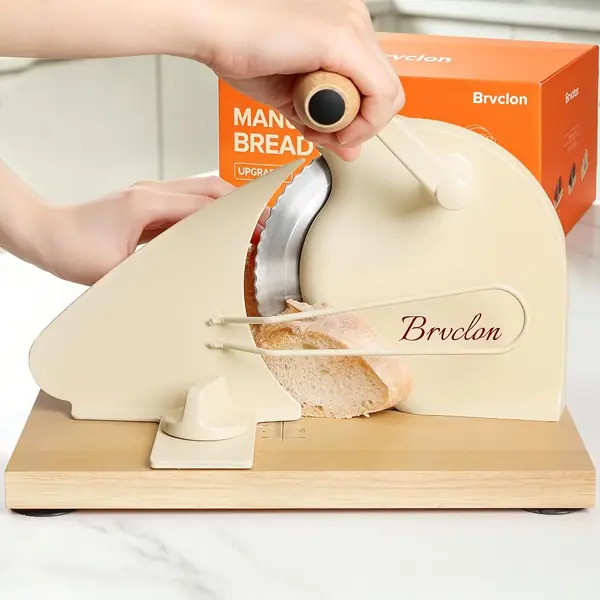
Brvclon manual bread slicer with cream wood base, hand crank, and stainless blade

Everyday machine loaves

Bake Score 89/100
Slice Thickness
0 to 0.9 inches
Blade
6.69-inch stainless steel, replaceable
Footprint
13.8 x 11.3 x 7.5 inches
Counter Grip
Suction cups
View on Amazon

A dial that runs from zero to nine-tenths of an inch is why this one sits at the top of our list. Bread-machine loaves are the awkward case for any slicer: soft enough to compress under a blade, square enough that a wandering guide shows in every slice. With the Brvclon we set a genuine sandwich slice, cranked through a two-pound loaf, then opened the dial up for French toast without reaching for anything else. The scale line is easy to read and the blade tracks it. One caution: pressure on the knob while the blade is moving can nudge the setting, so keep your hand on the crank rather than the dial.

Where most folding guides ask you to hold the loaf with one hand and saw with the other, this one stays where you put it. The suction cups grab a smooth counter hard enough that moving it takes a thumbnail under the edge; on butcher block and other textured surfaces the grip drops off, as it does with every suction base here. That gap matters more for bread-machine bread than for sourdough, because the loaf is light and the crust is thin — a base that creeps turns a straight slice into a wedge.

The blade is 6.69 inches of serrated stainless and comes out for sharpening or replacement, the small detail that decides whether a slicer earns a permanent spot or ends up at the back of a drawer. Full-size loaves and smaller ones both sit comfortably between the walls, and whole-wheat sandwich bread, the test we care about most with machine loaves, goes through without tearing at the bottom crust.

What you give up is drawer space. This is a countertop appliance in all but name, hand wash only, with wood that should never soak. Bake weekly and you will leave it out; slice a loaf a month and one of the folding guides below will store flat and do most of the same job.

Worth Noting

  • Hand wash only; the wood cannot soak
Our Verdict

We think this is the one to buy if you slice a bread-machine loaf every week: the dial runs from paper-thin to thick toast and the base does not creep.

Check Latest Price
2

vanerepok Manual Bread Slicer Best for Dense Loaves

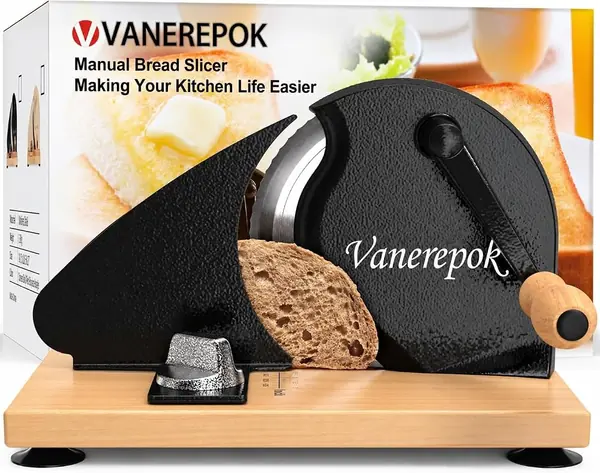
vanerepok manual bread slicer with black aluminum frame, wood base, and hand crank

Dense, tight-crumb bread

Bake Score 88/100
Slice Thickness
Up to 0.9 inches
Blade
6.6-inch serrated stainless steel
Body
Aluminum alloy and solid wood
Weight
5 lb
View on Amazon

If your machine runs two or three times a week, a slicer stops being a gadget and becomes part of the routine, and that is the case this one is built for. The body is aluminum alloy on a solid wood base, five pounds of it, and the weight earns its keep: it sits still while you crank instead of walking toward the edge of the counter.

On a tight-crumb loaf it goes through with almost no pressure on the handle, which is the entire argument for a crank machine over sawing by hand. Sharpness is where this one separates from the rest of the set — 6.6 inches of serrated stainless that arrives genuinely sharp — and the suction cups hold on granite and butcher block alike. Density is its friend: the tighter the crumb, the better the cut reads.

The trade-off that matters is longevity. The metal frame feels solid, but the handle can snap and the wooden board can crack down the middle inside a year, so keep the wood dry and do not lean on the crank. For a weekly baker it is still a fair deal, because the cut is what you are paying for.

Worth Noting

  • Slice can catch on the crank
  • Hand wash only
Our Verdict

The sharpest-feeling crank here on tight-crumb bread, and the pick for anyone whose machine runs two or three times a week.

Check Latest Price
3

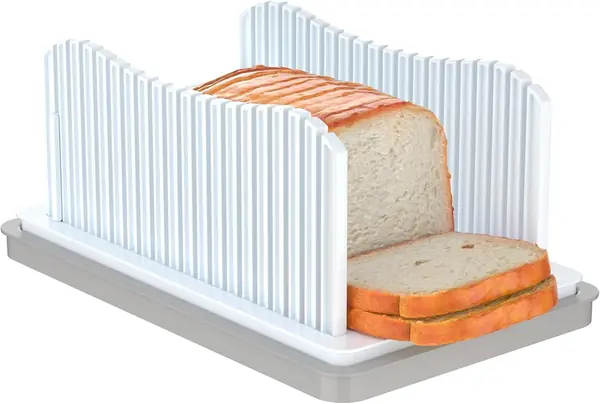
Kiss Core Bread Slicer Best Budget

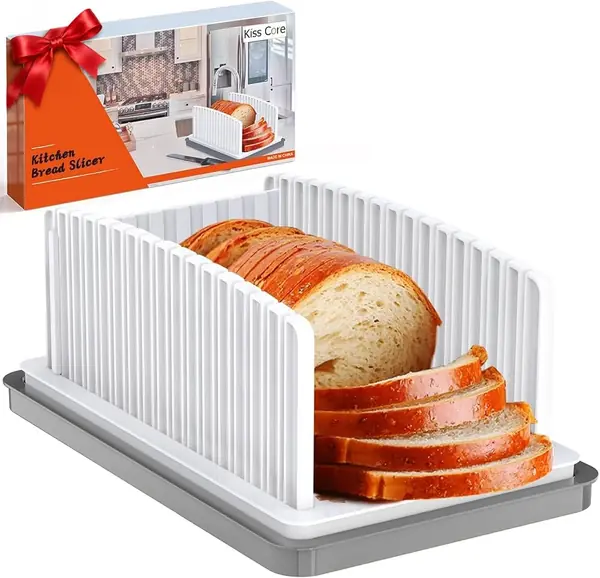
Kiss Core white plastic bread slicer guide with adjustable side walls and crumb tray

Tight budgets

Bake Score 87/100
Slice Thickness
0.47 inch
Footprint
14 x 9 x 2 inches
Material
PP plastic
Loaf Fit
2-pound bread machine loaves
View on Amazon

The Kiss Core solves for the loaf before it solves for the slice. Its two side walls slide to whatever width you need, so a two-pound bread-machine loaf sits cradled between them instead of skidding, and the crumb tray underneath catches what falls. Adjustable width is the feature most folding guides skip, and for pan loaves it is the difference between a guide and a suggestion.

For the money this is the least fussy route to straight slices. It assembles and breaks down in seconds with no tools, the tray stores underneath, and the whole thing goes flat enough for a drawer. The slot is a single 0.47 inch, though, and no dial changes that. For sandwiches it lands about right; for deli-thin toast, or a proper thick cut for French toast, this is the wrong tool.

One thing to plan for: you need a serrated knife long enough to ride both slots at once. A short blade angles out and scores the plastic walls, which is cosmetic on a guide this cheap but adds up over a year of loaves. A 10-inch bread knife is about the minimum here.

Worth Noting

  • Walls flex under a hard crust
Our Verdict

The least expensive way to get dead-straight slices out of a 2-pound machine loaf, as long as one slice thickness suits you.

Check Latest Price
4

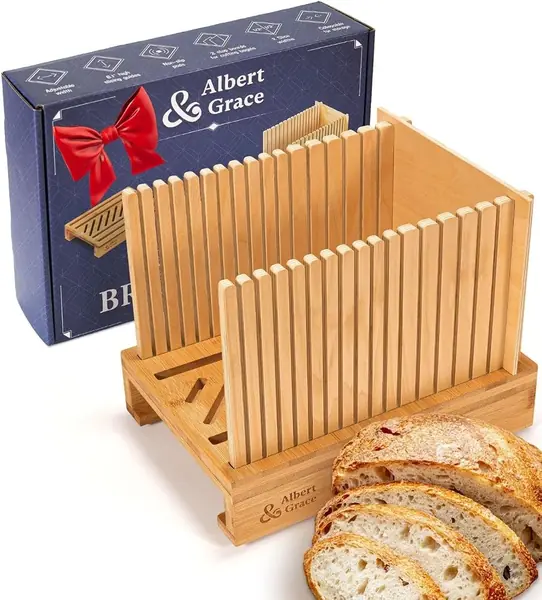
Albert & Grace Bamboo Bread Slicer Best for Tall Loaves

Albert & Grace bamboo bread slicer with tall folding guides and adjustable width settings

Tall, domed loaves

Bake Score 86/100
Loaf Widths
5.9, 4.6, 3.3 inches
Guide Height
6.1 inches
Folded Thickness
2.1 inches
Slice Thicknesses
Two settings
View on Amazon

Six-point-one inches of guide is the number to look at. Bread-machine loaves rise above the pan, and a wall that stops at the shoulder of the loaf lets the knife ride up over the crown, which is how the first and last slices of a loaf end up half the thickness of the middle ones. The taller walls here keep the blade level from heel to heel.

Three width settings — 5.9, 4.6, and 3.3 inches — let you snug the loaf instead of chasing it around the tray, and the cross-laminated bamboo is heavier and flatter than the single-layer boards on cheaper guides. It folds down to 2.1 inches with no assembly to fight, sits on non-slip pads, and gives you two slice thicknesses to choose between.

Buy it when your loaves clear the top of a standard guide; skip it if your machine turns out flat sandwich loaves, where that extra wall is height you never use. It also wants a 10- to 12-inch serrated knife, because a short blade cannot span walls that tall at a straight angle. Keep the blade in the slot rather than dragging it across the base, and the board will outlast the knife.

Worth Noting

  • Bamboo base can splinter along the cut line
Our Verdict

The pick for loaves that dome above the pan, where a shorter guide lets the knife climb the crown and ruin the ends.

Check Latest Price
5

CAWIU Bread Slicing Guide Best for Small Kitchens

CAWIU white plastic bread slicing guide with foldable walls and a crumb tray

Small kitchens

Bake Score 85/100
Slice Thickness
0.48 inch
Footprint
13.58 x 8.46 x 5.85 inches
Material
Polypropylene
Cleaning
Dishwasher safe
View on Amazon

This is the least expensive pick on the page, and it does the one thing a bread slicing guide has to do: hold both sides of the loaf so the knife goes down instead of around. The back piece holds the bread in place, the width slides to fit, and the tray underneath catches the crumbs and then doubles as a plate for what you cut.

At 13.58 inches long it takes a full bread-machine loaf with room at both ends, and it comes apart completely — which is how it goes in the dishwasher and how it stores flat in a drawer. Assembly is two pieces into two slots, and there is nothing small to lose.

Where it earns its place is the small-kitchen calculation: barely any money, barely any space, and slices that look like you know what you are doing. A loaf a week is well inside its comfort zone. If you want to choose your thickness, though, the fixed slot is the wall you hit — this one cuts 0.48 inch and nothing else.

Worth Noting

  • Panels feel light and flex under pressure
Our Verdict

The smallest outlay here for even slices and the easiest to store, provided a 0.48-inch slice is the slice you want.

Check Latest Price
6

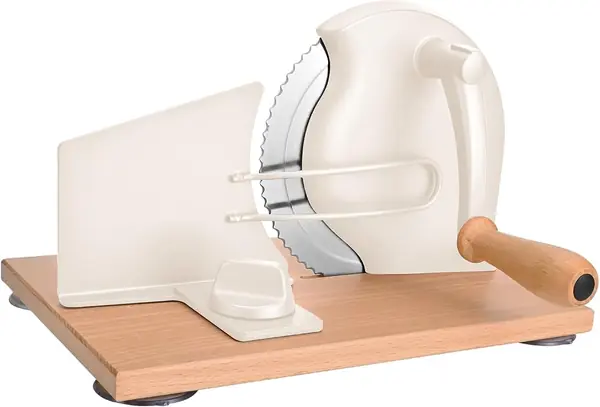
SOWKIPE Manual Bread Slicer

SOWKIPE white manual bread slicer with wood base, hand crank, and metal wire guide

Clean slice release

Bake Score 84/100
Slice Thickness
Up to 0.9 inches
Blade
6.3-inch serrated stainless steel
Weight
5.5 lb
Guide
Metal wire
View on Amazon

The wire guide is the detail that separates this crank from the two above it. On most hand-crank slicers the finished slice leans back into the crank as it comes off the loaf, and you end up fishing it out with your free hand; here a metal wire holds the slice clear so you can keep cranking.

Everything else is familiar: a knob that runs up to nine-tenths of an inch, a 6.3-inch serrated stainless blade, four suction cups under a solid wood base, and 5.5 pounds of machine. It also takes less counter run than the Brvclon or the vanerepok — 11.8 inches against their 13.8 — which matters when your workspace is the strip between the sink and the stove.

The open question is the base. The cups hold hard on a clean, smooth counter and can let go on anything textured or matte, and a crank machine that slides makes wedges. Wipe the counter and the cups before each loaf and it behaves.

Between this and the vanerepok, the deciding difference is that wire. If curled slices and a hand near the blade annoy you, this is the calmer machine, and it gives up very little of the Brvclon's fitted feel in exchange. It is the one we reach for when the loaf is dense and the phone is ringing.

Worth Noting

  • Hand wash only
Our Verdict

The wire guide is the reason to choose this crank over the others: slices stay clear of the handle instead of curling into it.

Check Latest Price
7

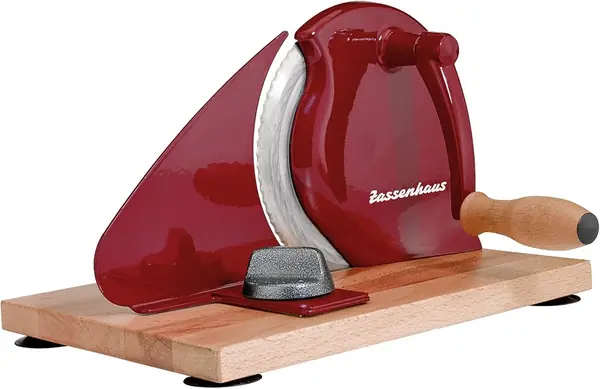
Zassenhaus Original Classic Bread Slicer Best for Crusty Artisan Loaves

Zassenhaus red adjustable bread slicer with aluminum frame, wood base, and crank

Crusty artisan loaves

Bake Score 83/100
Slice Thickness
Up to 0.7 inches
Blade
6.5-inch 18/8 stainless steel
Footprint
11.8 x 10.1 x 11.8 inches
Body
Aluminum and wood
View on Amazon

There is a version of this purchase where the slicer lives on the counter and looks good doing it, and the Zassenhaus is that version: aluminum frame, wooden base, a deep red finish, an 18/8 stainless blade, and a crank that feels machined rather than stamped. At the premium end of this set you are paying for the finish and the name, and you can see where the money went.

It also has the shortest thickness range here at 0.7 inch, which is plenty for toast and sandwiches but leaves out the near-zero setting the Brvclon offers for paper-thin slices. The straight, heavy frame does produce a beautiful cut on a crusty loaf, and the adjustment knob moves in clear, positive steps rather than drifting.

The base is where the money stops buying you things. On marble and polished stone the suction cups can let go mid-loaf, and a crank machine that skates makes wedges — the same problem the cheaper cranks have, at several times the price. Smooth laminate and butcher block are kinder to it.

Worth Noting

  • Base and blade mount can crack
Our Verdict

Buy it for crusty sourdough if the finish and the German build matter to you; soft bread-machine sandwich loaves are its weakest case.

Check Latest Price

How We Tested Bread Slicers for Bread Machine Loaves

We built the shortlist from every manual slicer we could find that claimed adjustable thickness or width, then filtered to models meant for homemade loaves rather than bakery or commercial bread — checking guide height, whether the guides folded flat, whether there was a crumb tray, and what the base was made of. That left 11 slicers, ranging from collapsible cutting guides to hand-crank cradles on solid wood and bamboo bases. For six months I baked bread machine loaves weekly, let each one cool for the same amount of time, and cut at least one loaf a week on every slicer.

Slice quality came first. On each slicer I cut the same loaf at its thinnest and widest settings, then stacked the slices to see whether they lined up square or came out wedge-shaped, and noted whether a still-warm loaf squashed under the guides. Stability got tested by dragging the whole setup sideways mid-slice, first on a butcher block counter and then on laminate; the slicers with suction cups that actually held needed two hands to budge, while others skated and left ragged cuts. I also timed setup and the first slice, since anything that takes a minute to assemble tends to stay in the cabinet.

Cleanup and storage settled a few close calls. I counted how much crumb landed on the counter versus in the tray, brushed each one out, and folded the collapsible models to see how flat they packed. Durability got a long look: I checked hinges and guide slots for wiggle after months of use and noted which bases and plastic guides picked up scratches or loosened screws. Thick-cut settings, wider loaves, and bagels each got their own trial runs.

How to Choose a Bread Slicer for Bread Machine Bread

Match the Guide to Your Loaf's Shape

Bread-machine loaves rise above the pan and bulge at the crown, and a wall that stops at the shoulder of the loaf lets the knife ride up and shave the last slices thin. Height comes first: the Albert & Grace model's 6.1-inch guides exist for exactly this problem.

Width comes second. Three settings — its 5.9-, 4.6-, and 3.3-inch positions, for instance — let a loaf sit snug instead of sliding, while a single fixed width only works if your pan turns out the same loaf every time. Measure the widest point of a cooled loaf before you buy, not the pan, because the crown is what jams.

Decide Between a Dial and a Slot

Folding guides cut one thickness, because the knife simply rides in a fixed slot. Hand-crank machines adjust continuously, up to 0.9 inch on the Brvclon, the vanerepok, and the SOWKIPE. That range is the difference between a sandwich loaf and a loaf you can only toast.

Here is the trap. Sellers call a guide adjustable when they mean the side walls slide, not the slice thickness. Read the listing for which part moves before you order, and if thin sandwiches are non-negotiable, buy a dial.

Crank or Knife: Effort Against Control

A bread slicing guide plus your own serrated knife costs less, stores flatter, and lets you feel the cut — but you supply the steadiness, and you need a blade long enough to span both walls. On a tall guide that means 10 to 12 inches.

A crank machine holds the blade at a fixed angle and moves it for you, which is why it goes through dense bread with so little effort and keeps your fingers out of the path. You pay for that in counter space, hand washing, and blades that eventually need replacing.

Stability Beats Every Other Feature

A slicer that moves makes wedges, no matter how sharp the blade or how carefully you set the thickness. Suction cups work on smooth, non-porous counters and lose grip on textured wood, matte tile, and polished stone; non-slip pads are gentler but hold less.

Check your counter before you choose. Polished stone calls for a wide wooden footprint and a wiped cup before each loaf; butcher block wants a light, steadying hand on the frame. The heaviest machine here is 5.5 pounds, and that weight is doing work.

Storage and Cleaning Before You Commit

Crank machines do not fold. If your counter is a landing strip between the sink and the stove, measure the run before you buy — the models here span 11.8 to 13.8 inches — and check you have a cupboard shelf for it.

Folding guides break down flat, and the two plastic models store about two inches thick. Plastic goes in the dishwasher; wood and bamboo are hand wash only and should never soak. If you would rather rinse than wash, that decides it.

Frequently Asked Questions

Final Verdict

Buy the Brvclon if you want one slicer for a weekly bread-machine loaf. Nine-tenths of an inch of adjustment covers sandwiches, toast, and French toast from the same loaf, and the suction base keeps the cut square without a second pair of hands.

If counter space is what you do not have, the Kiss Core folds into a drawer and costs a fraction as much — it just cuts one thickness. And if your loaves dome well above the pan, pay for the Albert & Grace's 6.1-inch guides.