The 6 Best Bread Slicers of 2026

The hardest part of baking sourdough isn't the starter — it's the ten minutes after the loaf leaves the oven, when the crust crackles and the crumb is still too soft to hold a line. I've sawed enough boules to know how that ends: a wedge, a slope, a heel nobody wants. A bread slicer holds the loaf square and sets the gap, so every slice comes out the same thickness — and even slices are what make toast brown properly and sandwiches stack flat.

We worked through 12 of them: hand-crank guides on wood bases, folding guides, and a couple that ship with their own serrated blade. Most don't cut anything — they hold the loaf while your knife does the work, so stability is everything. A slicer that creeps across the counter is worse than none, and the suction cups they rely on grip granite and do almost nothing on a butcher block.

Slice thickness is a preference, not a spec to max out: half an inch is toast, three-quarters is French toast. What separates the picks below is how steadily they hold a round boule and how solid they still feel after a month of crumbs.

Our Top Picks

The Best Bread Slicers

1

Brvclon Manual Bread Slicer Best Overall
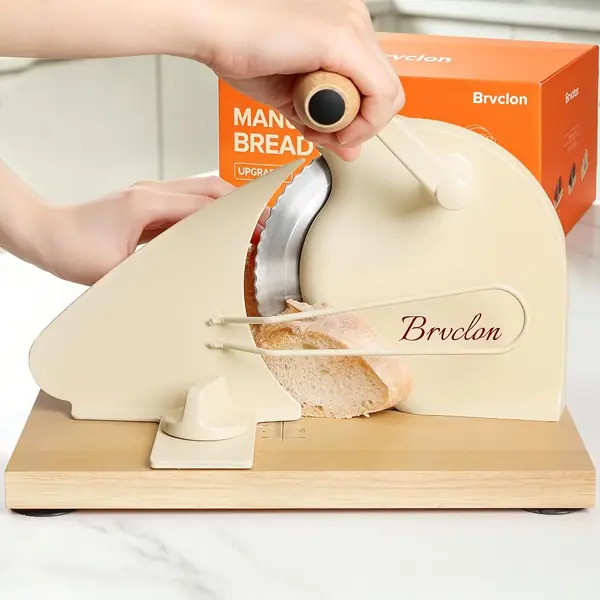
Brvclon manual bread slicer with cream wood base, hand crank, and stainless blade

Everyday even slicing

Bake Score 90/100
Slice Thickness
0–0.9 inches
Footprint
13.8 x 11.3 x 7.5 inches
Blade Length
6.69 inches
Base Material
Solid oak and aluminum
View on Amazon

The moment you stop pushing is the moment this slicer makes sense. On the Brvclon, the crank feeds the loaf into a 6.69-inch stainless blade and the slice lands square from the bottom crust to the top — the stretch of a loaf where a knife usually wanders. Loaf after loaf, this was the machine that left us the fewest ragged edges, on soft sandwich bread and on a two-day-old sourdough whose crust fought back. That consistency is the whole reason it takes the top spot.

The rest of the design exists to keep that cut honest. The base is solid oak on four suction cups that held so hard on a smooth counter we had to work a fingernail under a cup to move it. The thickness knob runs from paper-thin up to 0.9 inch, with a printed scale you can read without crouching. One thing to know before you start: the dial can creep if you bear down on the loaf while you crank. Let the blade do the cutting and the setting holds; push, and your last slices come out thicker than your first.

Cream paint over oak gives it a retro look we didn't mind leaving out on the counter, which matters for a tool this size. The blade lifts out for cleaning or replacement when it dulls, and everything else is hand wash and a thorough dry. If your kitchen is tight, the CAWIU does similar work in less space; if you want the most consistent slices on this page, stay right here.

Worth Noting

  • Hand wash only; oak base needs full drying
  • Large footprint at 13.8 inches wide
Our Verdict

For regular bakers, this is the one we hand people: the Brvclon produced the most even slices on our test loaves, and its suction base keeps a heavy sourdough from drifting mid-cut.

Check Latest Price
2

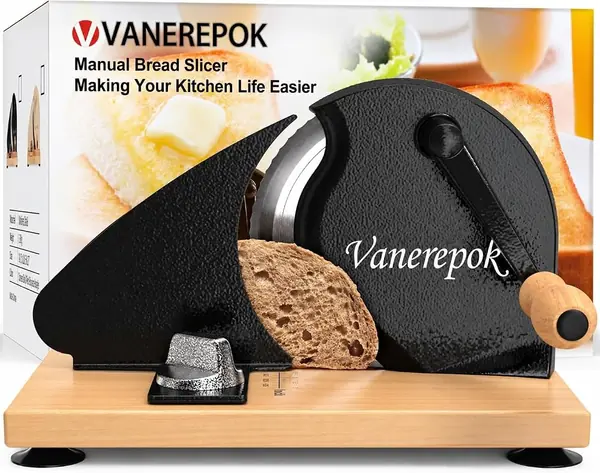
vanerepok Manual Bread Slicer Best for Dense Sourdough

vanerepok hand crank bread slicer with black aluminum frame and wood base

Dense, crusty loaves

Bake Score 89/100
Slice Thickness
Up to 0.9 inches
Weight
5 lb
Blade Length
6.6 inches
Body Material
Aluminum alloy and wood
View on Amazon

Five pounds is a lot for a bread slicer, and you feel every one of them lifting the vanerepok off a shelf. It's also the reason it slices the way it does. The aluminum frame and solid wood base sit still while the crank turns, so the loaf stays square instead of skating along with the blade. If you've ever chased a boule around a cutting board, that steadiness is what the weight buys.

The blade is 6.6 inches of serrated stainless, and the knob opens the gap to 0.9 inch, so thick toast and a proper doorstep sandwich are both on the table. Tight-crumb loaves are where it earns its place: rye, a low-hydration sourdough, a loaf a day past its best that would otherwise crush under a knife. The crank takes the bread in one steady pass rather than the saw-and-press routine, and the slices come out the same thickness from end to end without tearing the crust.

It's also, frankly, the best-looking of the hand cranks — brushed metal over a dark wood base, closer to vintage kitchen equipment than an appliance. Nothing about it feels disposable, and it's the one we've been happy to leave out between bakes rather than tucking into a cabinet.

Worth Noting

  • Suction needs a smooth, non-porous counter
  • Wood base can crack after months of use
Our Verdict

We reach for the vanerepok when the loaf is dense and the slices need to be thick: five pounds of aluminum and wood that won't walk across the counter while you crank.

Check Latest Price
3

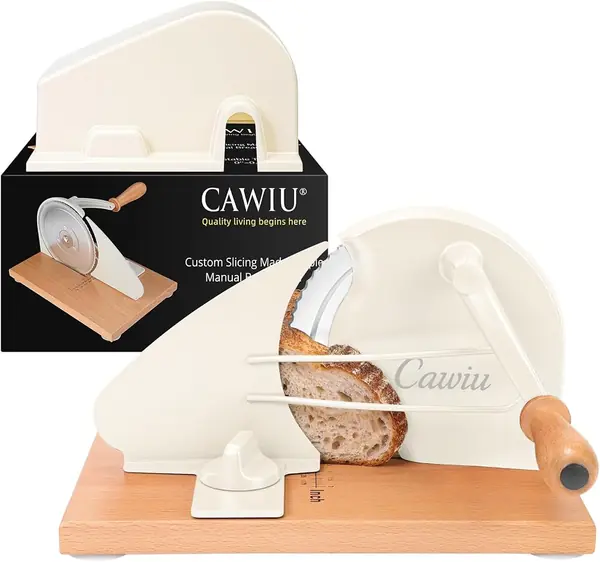
CAWIU Manual Bread Slicer Best for Small Counters

CAWIU cream manual bread slicer with wood base, crank, and clear protective cover

Tight counter space

Bake Score 88/100
Slice Thickness
0–0.9 inches
Weight
4.5 lb
Footprint
11.8 x 7.9 x 7.3 inches
Base
0.8-inch beech wood
View on Amazon

A bread slicer with a cover sounds like a minor thing until you've stored one without it. The CAWIU's clear guard clips over the blade while it's still in the frame, so the whole unit goes into a cabinet without you reaching around a bare edge. That's the detail we appreciated most, and it's the reason this one is easier to live with than its size suggests.

Compact is relative, but this is the smallest of the hand cranks in this group: 11.8 by 7.9 by 7.3 inches, 4.5 pounds, on a beech base just under an inch thick with four suction cups underneath. The knob covers 0 to 0.9 inch, and a metal guide runs alongside the loaf so a tall sourdough round can't lean into the blade as you crank. On a smooth counter it stayed put through a full loaf and the slices came out even enough to stack. If your kitchen is stone or tile and your cabinets are shallow, this is the hand crank that fits.

Worth Noting

  • Small suction cups need a smooth counter
  • Thickness setting can slip mid-loaf
Our Verdict

If your counter is short on space, the CAWIU is the hand crank we point to: a compact base, a genuinely useful blade cover, and even slices without the wrestling match.

Check Latest Price
4

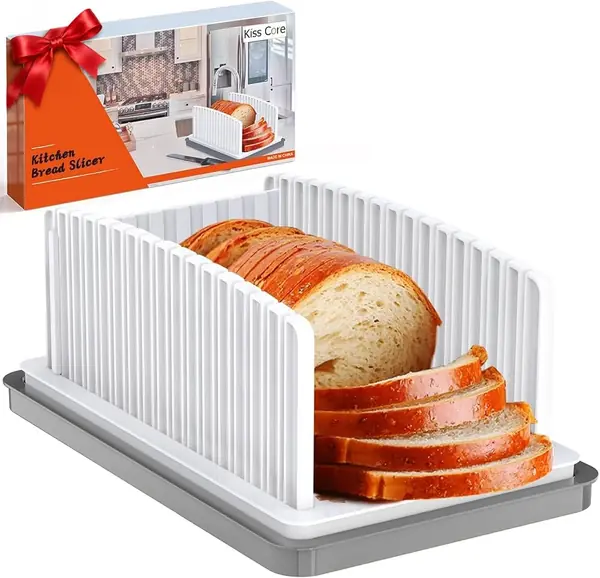
Kiss Core Bread Slicing Guide Best Budget

Kiss Core white plastic folding bread slicing guide with crumb tray underneath

First-time budget buyers

Bake Score 87/100
Slice Thickness
0.47 inch, fixed
Weight
2 lb
Footprint
14 x 9 x 2 inches
Material
PP plastic
View on Amazon

Two walls, an adjustable cradle, and a crumb tray: the Kiss Core does nothing clever, and that's the appeal. You set the cradle to the width of the loaf, drop the bread in, and run your knife down the slot. It folds flat, stacks in a drawer, and costs less than anything else on this page. For someone baking a loaf a week who doesn't want another appliance competing for the counter, that's a persuasive combination.

The catch is thickness. This guide sets a single slice at about 0.47 inch and adjusts to the width of the loaf, not the thickness of the slice, so every piece comes out the same chunky size. Great for toast, bread-machine loaves, and quick breads; less so for a thin cucumber sandwich. Because it's plastic, a sharp knife will score the guides over time, and at this thickness a standard loaf yields only about eight slabs.

One practical check before you order: your bread knife has to be long enough to span both guides in one stroke, or you'll saw at the walls instead of through the loaf. A 10-inch serrated knife clears it comfortably; a short utility knife doesn't. Get that right and this is the least expensive straight slice here.

Worth Noting

  • One fixed slice thickness near a half inch
  • Knife scores the plastic guides
Our Verdict

The Kiss Core is the cheapest way to get straight slices, and a smart first guide — as long as a half-inch slab is the slice you actually want.

Check Latest Price
5

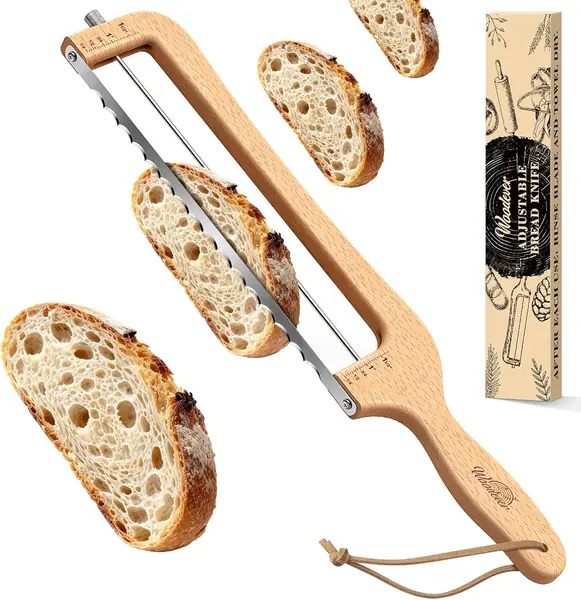
Woodever Bow Bread Slicer Best for Small Kitchens

Woodever bow bread slicer with beechwood frame and long serrated stainless blade

Small kitchens

Bake Score 86/100
Slice Thickness
1/4 to 2 inches
Blade Length
10.6 inches
Frame
Beechwood
Overall Length
16.5 inches
View on Amazon

There's no crank and no suction cup here. The Woodever is a bow: a 10.6-inch serrated blade strung between two beechwood arms, with the frame itself doing the guiding. You rest it over the loaf and draw down, and the arms hold the blade square. It's the least machine-like bread cutter on this page, and for a kitchen where nothing stays out on the counter, it's also the easiest to own.

The arms adjust from a quarter inch to two inches, the widest range in this group, which covers everything from a thin sandwich slice to a slab for French toast. It takes a full-length stroke rather than a short saw, which is quicker than it sounds once you find the rhythm. A guard slips over the blade for storage, and the whole thing takes up less room than a cutting board.

It's a knife in a frame, so it repays the care you'd give any good blade: dry it after washing and don't lever the arms. It's also slower per loaf than a crank, because you're still doing the work — just with much better aim. For one loaf a week and a drawer to put it in, that's a fair trade.

Worth Noting

  • Blade can snap at the frame screw
  • Frame needs the loaf near the counter edge
Our Verdict

A bow slicer rather than a machine, the Woodever stores in a drawer and sets slices anywhere from a quarter inch to two.

Check Latest Price
6

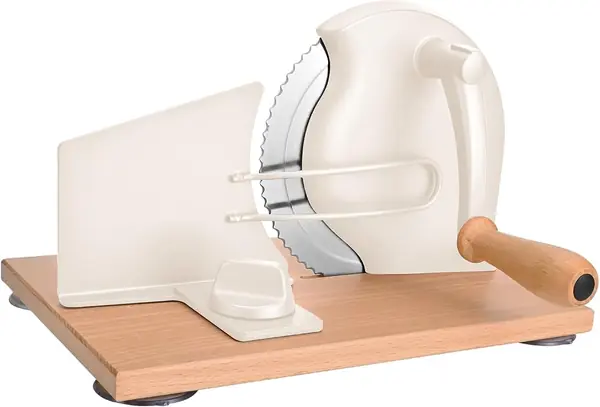
SOWKIPE Manual Bread Slicer Best for Tall Sandwich Loaves

SOWKIPE white hand crank bread slicer with wood base and wire slicing guide

Tall sandwich loaves

Bake Score 85/100
Slice Thickness
Up to 0.9 inches
Weight
5.5 lb
Footprint
11.8 x 7.87 x 7.48 inches
Blade Length
6.3 inches
View on Amazon

Tall loaves are where hand-crank slicers usually stumble: the slice curls into the crank handle, catches, and the whole cut stutters. The SOWKIPE answers that with a metal wire guide running alongside the loaf, holding the slice upright and away from the handle. It's a small piece of design that we noticed on the first boule and appreciated more by the third.

Everything else is familiar ground. A 6.3-inch stainless serrated blade, a knob that opens to 0.9 inch, four suction cups under a solid wood base, and a white finish that's tidier than the usual chrome-and-wood look. At 5.5 pounds it's the heaviest of the cranks, which is a good thing while you're slicing and a nuisance when you're putting it away.

What keeps it out of the top tier is consistency. The suction and the blade edge are less dependable here than on the Brvclon or the vanerepok, so on some counters the base needs a re-press mid-loaf. The slices themselves are clean and the thickness dial does what it promises — it's simply a less certain bet than the two cranks above it.

Worth Noting

  • Suction cups can stop holding after weeks
  • Heaviest hand crank here at 5.5 pounds
Our Verdict

The wire guide is the draw here — it keeps tall slices clear of the crank handle — and it's a sensible pick if jamming loaves have been your problem.

Check Latest Price

How We Tested Bread Slicers — and What Actually Mattered

I started by pulling every manual slicer I could find that would fit a whole round boule, not just a sandwich loaf, and cross-checked listings against buyer reviews to see which ones really adjust in marked increments instead of just claiming to. Twelve made the cut, and I baked through them over five months, two or three loaves a week: sourdough rounds, sandwich loaves, bagels, and baguettes, sliced on a granite counter and on a wood butcher block.

Every loaf went through the same routine. I set each slicer to its middle thickness and cut a full round, then measured the first, middle, and last slice with calipers at three points to see how far the thickness drifted, and watched whether the slices stood up straight or slumped into wedges. I noted how much of the loaf disappeared into an unusable heel, and whether a full-size boule or only a narrow one fit between the guide posts. For stability, I cranked with one hand and kept the other off the loaf, then nudged the base mid-cut to see if it slid.

Where a slicer came with its own serrated blade, I cut 20 loaves on it and checked the teeth in good light for rolling or dulling; where it didn't, I used the same bread knife on every guide so the comparisons stayed fair. Ease of use came down to setup and cleanup — how many parts had to be lined up before the first cut, and how hinges and clamps held up to being wiped down. After five months I looked at what had loosened, what had warped, and whether the price still made sense next to a sharp knife and a steady hand.

How to Choose a Bread Slicer

A Guide or a Machine

A folding guide like the Kiss Core just walls the loaf in with two plastic sides. You supply the knife and the effort, it costs the least, and it stacks flat in a drawer. A hand-crank bread cutter clamps down with suction cups and feeds the blade through the bread for you, which is why the most consistently even slices in this group come from the cranks. Bake once a month and a guide is plenty; bake weekly and the crank is what you'll still be using next year.

The trap with a guide is knife length. Your serrated blade has to span both walls in a single stroke. A 10-inch knife clears most guides comfortably; an 8-inch one leaves you sawing at the plastic instead of the crust.

Check What Adjustable Actually Adjusts

Two different settings get sold as adjustable. On the hand cranks here, a knob sets slice thickness anywhere from paper-thin to 0.9 inch. On the Kiss Core, the adjustment is the width of the cradle so the loaf fits snugly — the slice itself is fixed at about a half inch. Look for the word thickness before you assume, and check whether it is a dial or a set of slots.

If you want thin cucumber sandwiches and thick French toast from the same loaf, you need a dial. If everyone in the house wants toast, one good slot is enough.

The Base Decides Whether the Slices Are Even

Suction cups are the difference between a slicer and a paperweight, and they only work on smooth, non-porous surfaces: granite, quartz, tile, laminate. On butcher block, textured stone, or a wooden board they lose their bite and the whole machine walks with the knife. Four cups hold better than two, and a wide, heavy base resists tipping when a tall boule leans against the guide.

Check the counter you'll actually use, not the one in the product photos, and give the cups a firm press before the first cut rather than halfway through a loaf.

Plan for the Footprint and the Washing Up

These are not small tools. The hand cranks here run from 11.8 to 13.8 inches long and weigh between 4.5 and 5.5 pounds, which is a permanent patch of counter in a lot of kitchens. The wooden ones are hand wash only and need a full dry before they go back on the shelf, while the plastic guide is the one you can rinse and stack.

Decide up front whether the slicer lives out or comes out of a cabinet, because that answer picks the product for you more often than the blade does.

Frequently Asked Questions

Final Verdict

The Brvclon is the slicer we recommend first. Its suction base holds a heavy sourdough still, the crank keeps the blade square through the crust, and the slices come out even enough to stack and wrap without trimming. For a household that bakes every week, it ends the crooked-slice argument.

Buy the vanerepok instead if your loaves are dense and dark and you want a heavier machine that feels like shop equipment. If counter space is the real constraint, the CAWIU does the same work in a smaller footprint and stores with its blade covered.