The 8 Best Japanese Bread Knives of 2026

A serrated knife doesn't so much slice bread as saw it: the points catch the crust on the first stroke and the scallops carry the cut down through the crumb. Get that geometry wrong and you don't find out until you're leaning on a loaf you waited all day for, watching the whole thing compress under the blade. I bake sourdough most weekends, and for years I made do with whatever serrated thing was rattling around the block.

The spec almost nobody prints on the box is blade thickness, and it's the one that decides whether a knife glides or wedges. Too thick behind the edge and a crusty boule splits instead of slicing; too thin and the blade feels like it might flex on you mid-stroke. We cut with 12 Japanese and Japanese-inspired bread knives, watching how each handled crust, crumb and the small stuff — bagels, tomatoes, a pineapple that needed quartering.

What we found is that price and sharpness don't track as neatly as you'd hope, and that handle shape matters more than most shoppers expect once you're cutting a dozen bagels in a row.

Our Top Picks

The Best Japanese Bread Knives

1

Tojiro F-737 Bread Knife Best Overall
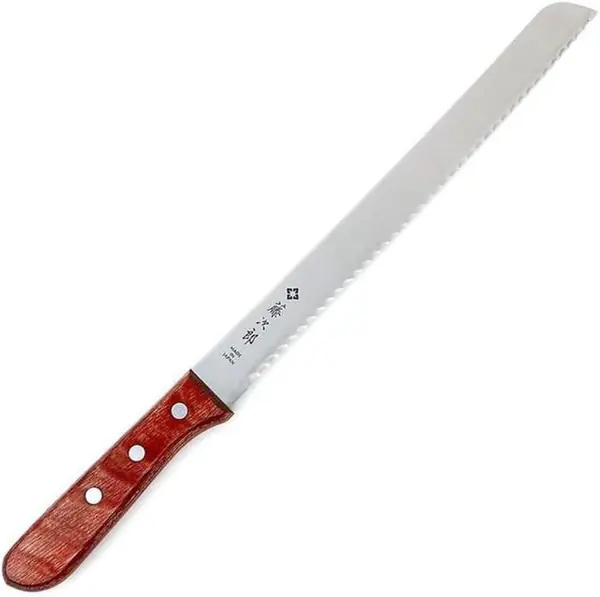
Tojiro F-737 bread knife with stainless serrated blade and natural wood handle

Artisan sourdough loaves

Bake Score 98/100
Blade Steel
Stainless steel
Blade Length
9.3 inches
Handle
Natural wood
Weight
3.9 oz
View on Amazon

The Tojiro's blade is thin — 9.3 inches long, 110 grams in the hand, flexing slightly if you press it between your fingers. That thinness is the whole argument. Where a heavier knife shoulders its way into a sourdough crust, this one finds the line of least resistance and follows it.

We put it through week-old sourdough, ciabatta, and soft sandwich loaves, and it produced the cleanest cross-sections in this group: no torn crumb, no compressed band just under the crust, and slices thin enough to see light through when we wanted them that way. That's geometry rather than magic. A thin blade displaces less bread on the way down, so the loaf stays where it was.

The same flex becomes a liability in dense, wet doughs. Through a heavy whole-grain boule the blade can wander off your line, and it rewards long, patient strokes over a confident push. Give it a steady hand and it gives you the best slice of the eight knives here.

The edge is what keeps it on the board. It arrives sharp enough to catch on a paper towel, and the shallow teeth slice rather than saw, so there's very little of the back-and-forth that crushes a soft interior. Of everything we tested, this is the one that changed how our bread looked on the plate.

Worth Noting

  • Natural wood handle must be hand washed
Our Verdict

We recommend the Tojiro to anyone who bakes seriously: its thin 9.3-inch blade gives the cleanest slices in this group without tearing the crumb.

Check Latest Price
2

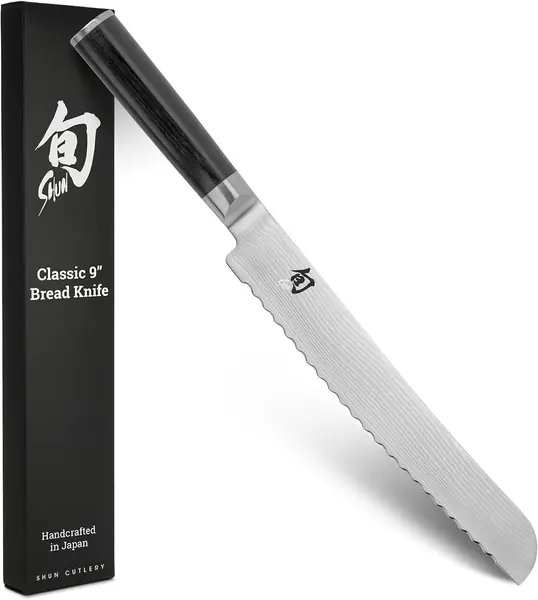
Shun Classic 9-Inch Bread Knife Best Splurge

Shun Classic 9-inch bread knife with Damascus-patterned blade and dark pakkawood handle

Heirloom-quality slicing

Bake Score 97/100
Blade Steel
VG-MAX core, Damascus clad
Blade Length
9 inches
Handle
Pakkawood
Weight
7.4 oz
View on Amazon

The Shun Classic costs roughly twice what our top pick does, and it looks it. Sixty-eight layers of Damascus cladding wrap a VG-MAX core, the pattern ripples down a 9-inch blade, and the pakkawood handle is carved into a D that sits in the palm rather than across it.

It cuts the way the price suggests it should. Wide teeth bite into a hard crust and carry through the soft interior without a sawing contest, and the 16-degree edge leaves the crumb almost polished. It's handcrafted in Japan and covered by a lifetime warranty.

At 210 grams it's the heaviest of the Japanese-style picks here, which steadies a long draw through a wide boule and lets the knife do work your wrist would otherwise do. Whether that reads as luxury or as an adjustment depends on what you're used to holding.

The honest case for it isn't slicing power — the Tojiro cuts just as cleanly for far less. It's everything around the cut: the finish, the balance, the way the blade pattern catches the light every time you pick it up. We think that's worth paying for once and keeping for twenty years, the same way a good pan earns its place in a kitchen.

Worth Noting

  • The most expensive pick in this guide
Our Verdict

The best-finished knife here: Damascus-clad VG-MAX steel that cuts soft crumb and hard crust in one stroke, for readers who want a single heirloom bread knife.

Check Latest Price
3

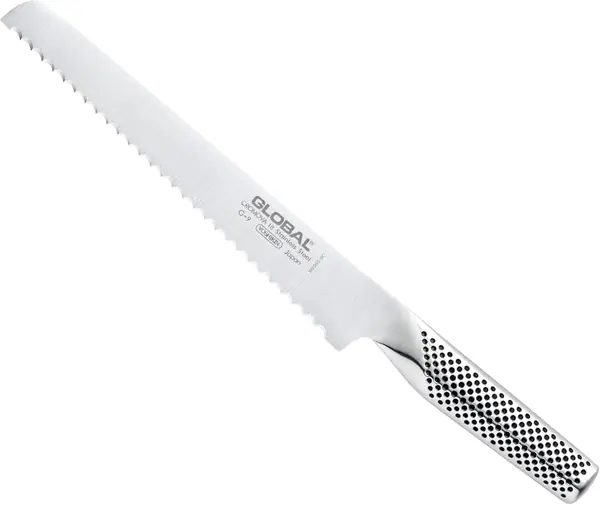
Global G-9 Bread Knife Best for Small Hands

Global G-9 bread knife with all-stainless dimpled handle and serrated blade

Small, tired hands

Bake Score 96/100
Blade Steel
Molybdenum vanadium
Handle
Dimpled stainless steel
Weight
5.9 oz
Construction
Stamped
View on Amazon

Global builds around a different hand than everyone else. The G-9 has no bolster, no rivets, and no separate handle — the whole knife is one piece of stainless steel, dimpled along the grip. If your hands are small, or they ache twenty minutes into a chopping session, that shape is the reason to look here.

It also cuts a straighter line than most serrated knives. The teeth are set aggressively and evenly, so the blade tracks where you point it instead of skating across a baguette, and the molybdenum-vanadium steel takes a keen edge and holds it. Wet hands don't bother it; the dimples are there for exactly that.

At 166 grams it stays comfortable through a whole bake day, and of everything in this guide it asks the least of your grip. For hands that need the lighter knife, that's worth more than a spec sheet can show — this is a case where the handle decides the purchase.

Worth Noting

  • Stamped blade priced like a forged one
Our Verdict

Our pick for small or aching hands: the all-steel Global is the lightest knife of the Japanese picks here and tracks a straight line through ciabatta.

Check Latest Price
4

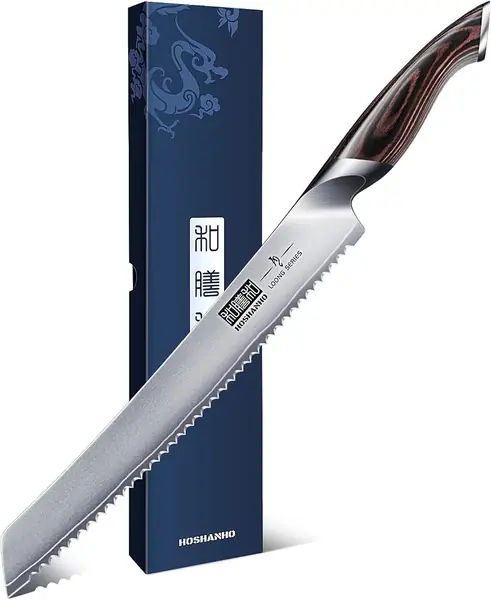
HOSHANHO 10-Inch Bread Knife Best for Wide Boules

HOSHANHO 10-inch bread knife with silver serrated blade and engineered wood handle

Wide sourdough boules

Bake Score 95/100
Blade Steel
10Cr15CoMoV high carbon
Blade Length
10 inches
Handle
Engineered wood
Weight
8 oz
View on Amazon

Ten inches of blade with eight ounces behind it — the HOSHANHO is the biggest-feeling knife here after the Shun. The steel is Japanese 10Cr15CoMoV, vacuum heat treated and sharpened to 15 degrees, and the engineered-wood handle is straight, comfortable, and a little more modern than the usual pakkawood.

That weight is why we keep reaching for it on sourdough. A wide boule asks the blade to travel a long way through a tough bottom crust, and this one carries the cut instead of stalling halfway and leaving you to saw. If your loaves are big and your slices are thick, this is the shape that works.

Ten inches is also a lot of knife for a small board or a shallow drawer, and eight ounces makes itself known if you're slicing a dozen loaves in a row. Neither is a reason to pass on it for a home baker turning out a couple of boules a week — it's a reason to check your drawer first.

Our Verdict

For wide sourdough boules this is the blade we reach for: ten inches and eight ounces carry the cut through in a single stroke.

Check Latest Price
5

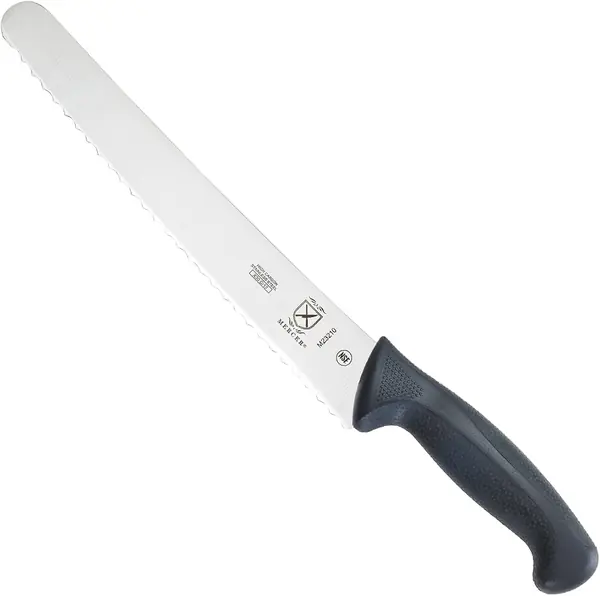
Mercer Culinary M23210 Bread Knife Best Value

Mercer Culinary M23210 bread knife with 10-inch wavy edge and black handle

First bread knife

Bake Score 94/100
Blade Steel
High-carbon Japanese steel
Blade Length
10 inches
Weight
4.8 oz
Construction
Stamped
View on Amazon

The Mercer is the knife we hand to anyone who wants a bread knife without making a project of it. Ten inches of one-piece high-carbon Japanese steel, a textured handle that stays put with flour on your hands, and a price that takes the question of value off the table before you've cut a slice.

The teeth are few and wide, which matters more than steel snobbery suggests: broad scallops trap less crumb and start a cut with less downward pressure than the fine-toothed blades on cheap bread knives. On a wide artisan loaf the length gives you one clean pass instead of two, and at 4.8 ounces it's light enough to forget you're holding it.

What the money doesn't buy is heft. The blade is stamped and light, and through a very dense whole-grain loaf it flexes where a heavier knife would push straight down. Everything else about it is easy: this is the knife we take to a rental kitchen or a friend's house for the weekend, and the one we don't worry about.

Worth Noting

  • Hand wash and dry after every use
Our Verdict

Ten inches of Japanese high-carbon steel for very little money — we think it's the best first bread knife you can buy.

Check Latest Price
6

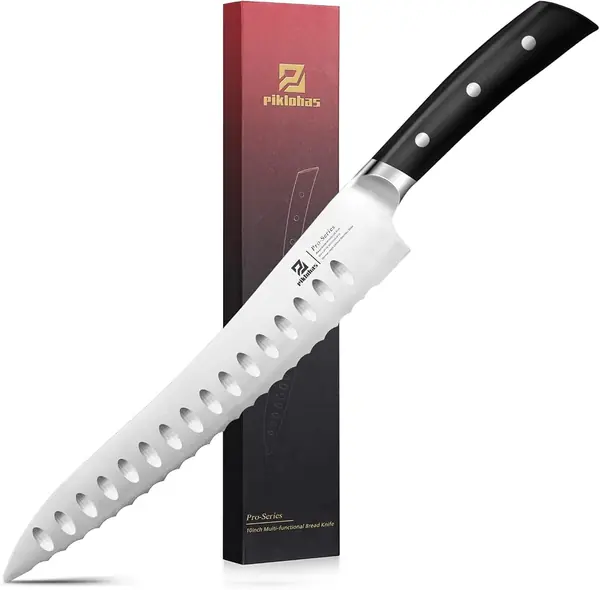
Piklohas 10-Inch Bread Knife Best for Long-Term Upkeep

Piklohas 10-inch bread knife with offset black handle and hollow-edge serrated blade

Long-term edge upkeep

Bake Score 93/100
Blade Steel
High-carbon stainless
Blade Length
10 inches
Handle
Offset ABS
Edge
Resharpenable serrated
View on Amazon

Every serrated knife here shares one flaw: you can't really sharpen it. Run a stone down a scalloped edge and you grind the points flat, which is why most bread knives get replaced instead of maintained. The Piklohas is built to be the exception — its serrations are shaped so a standard honing rod can restore them, which changes the arithmetic on owning one.

The rest of the design is unusual too. The handle sits above the blade line, an offset that keeps your knuckles off the cutting board when you reach the bottom of a tall loaf, and shallow grooves run down both sides of the blade so moist crumb releases rather than clinging.

It's a 10-inch forged blade in high-carbon stainless, and it arrives in a gift box with a manual, the kind of packaging that says it's meant to be given. In use it went through sourdough and the tough bottom crust that usually stops a knife, and the offset handle earned its keep on the last inch of every loaf.

Where it gives ground is precision. The teeth are aggressive and the knife carries real weight forward, so it's built for thick, even slices rather than paper-thin ones, and it isn't the one to reach for when you're cutting a delicate cake. Keep a rod in the drawer, though, and this is a knife you stop shopping for.

Our Verdict

Our pick for anyone tired of replacing bread knives: the serrations can be brought back with a honing rod, and the offset handle keeps your knuckles clear.

Check Latest Price
7

Kai Pure Komachi 2 Bread Knife Best for Drawer Storage

Kai Pure Komachi 2 bread knife with orange coated blade and fitted sheath

Small kitchens, drawers

Bake Score 92/100
Blade Steel
Carbon-coated stainless
Blade Length
8 inches
Handle
Molded resin
Includes
Fitted sheath
View on Amazon

The Pure Komachi 2 is what we point people toward when counter space is short. Eight inches of blade, a molded handle, and a fitted sheath, which means it can live in a drawer instead of on a magnetic strip. The orange coating is not subtle, and that's part of the appeal: you will always find it.

Kai hand-sharpens these to a 16-degree single bevel, and the serrations are wide and smooth rather than jagged, so they slice through crust instead of chewing it. It went through a baguette and then a tomato with the same motion in our testing, and it's light enough to steer with your fingertips. It now lives in the drawer with the spatulas and takes up less room than they do.

Worth Noting

  • Coated finish can wear with heavy use
  • Eight inches is short for wide loaves
Our Verdict

A light, sharp 8-inch knife with a sheath that keeps it safe in a drawer — our pick for small kitchens and first-time bakers.

Check Latest Price
8

Henckels Statement 8-Inch Bread Knife Best for Busy Shared Kitchens

Henckels Statement 8-inch bread knife with serrated stainless blade

Busy shared kitchens

Bake Score 91/100
Blade Steel
Stainless steel
Blade Length
8 inches
Weight
6.4 oz
Cleaning
Dishwasher safe
View on Amazon

The Henckels Statement is the only knife in this guide rated for the dishwasher, and in a house where knives get dropped in the sink at the end of the night, that's not a small thing. It's an 8-inch stamped stainless blade with a lifetime warranty against manufacturing defects.

It also cuts better than its construction suggests. The serrations went through a heavy-crusted sourdough loaf without bruising the crumb, and it sliced a tomato without crushing it — the test a lot of serrated knives quietly fail. At 6.4 ounces it feels light and quick in the hand.

We kept it out of the top tier because a stamped blade this light asks more of your hand on a dense loaf: you saw more and lean less. For sandwiches, bagels, and a quick slice off the end of a loaf, it's the one to grab when nobody wants to wash up afterwards.

Worth Noting

  • Eight inches is short for a wide boule
Our Verdict

We like it for a busy shared kitchen: it handles crusty loaves and the dishwasher without complaint, though it's the least capable here on dense sourdough.

Check Latest Price

How We Chose and Tested Japanese Bread Knives

We built the shortlist by researching serrated bread knives with Japanese-style blade geometry — high-carbon stainless steels, hand-sharpened edges, wavy or pointed scallop patterns — then filtered by handle material, blade length, and availability across price bands, from budget-friendly stamped blades up to handcrafted laminated ones. That left 12 knives, which we put through six months of ordinary home baking rather than a lab bench.

Testing revolved around a weekly sourdough bake, plus supermarket baguettes, bagels, layer cakes, and a summer's worth of tomatoes and pineapple. We counted strokes to get through a crust, then pressed the cut face to see how much the crumb had been crushed. We measured spine thickness at the heel and mid-blade with digital calipers, because that number predicted wedging better than anything else we tracked.

For ease of use, we noted how each handle sat in the hand during a long session, whether an offset or straight neck gave better knuckle clearance on tall loaves, and how much hand fatigue built up after a dozen bagels. We checked whether the heel and tip were actually usable or just decorative, and we watched how the edge held up over six months of regular use — which knives still bit into a crust in September the way they did in March.

Finally, we weighed performance against what each knife asked of you in care and upkeep, since a blade that dulls fast is a false economy no matter how it cuts on day one. The ones below are the knives we kept reaching for even after testing was officially over.

How to Choose a Japanese Bread Knife

Match the Blade to the Loaves You Actually Bake

A boule that's ten inches across can't be crossed in one pass by an eight-inch blade, and two passes is how you get a stepped, ragged slice. If you bake wide sourdough or buy unsliced rounds, a 9- to 10-inch blade earns its drawer space. If your bread is baguettes, sandwich loaves, and the occasional bagel, an 8-inch knife is quicker to handle and easier to put away.

Measure the widest loaf you actually bake, then add an inch. Anything longer than that is blade you'll be maneuvering around rather than slicing with — and on a small cutting board, that extra length works against you.

Japanese Steel Is Not the Same as a Japanese Knife

'Japanese steel' on a box tells you about the alloy, not the country of manufacture. The Mercer in this guide is a stamped knife in high-carbon Japanese steel, while the Tojiro and the Shun are forged and finished in Japan.

The steel name is the more useful clue. VG-MAX and 10Cr15CoMoV are fine-grained high-carbon alloys that take a keen edge, and both turn up in knives at very different prices. A maker who names the steel is usually proud of it; one who says only 'premium steel' is telling you less.

Weight and Handle Shape Decide How Long You Can Slice

Bread knives here run from roughly 4 ounces to nearly 8, and the difference shows up on the tenth loaf rather than the first. A light stamped blade is quick to steer; a heavier forged one carries itself through a tough bottom crust.

Handle material matters just as much. Pakkawood and engineered wood feel warm in the hand but want drying afterward, while an all-steel handle like the Global's grips when wet and suits a smaller grip. Shape is the one thing you can't read off a spec sheet, so buy where you can return it.

Plan for Care and Storage Before You Buy

Almost every knife here is a hand-wash knife, and the wood-handled ones need drying before they go back in the drawer. Dishwasher heat and detergent dull an edge and can lift a handle, which makes the Henckels' dishwasher rating worth noticing — it's the exception in this group, not the rule.

Storage matters too. A 10-inch serrated blade loose in a drawer will find something to chew on. A sheath, a guard, or a magnetic strip keeps the teeth intact and your fingers out of them.

Frequently Asked Questions

Final Verdict

Buy the Tojiro. It made the biggest difference to how our loaves looked once they hit the board — thin, clean slices with no torn crumb and no compressed band under the crust — and it costs a fraction of the Shun while cutting every bit as cleanly.

If the budget is tighter, the Mercer gives you a full 10-inch Japanese-steel blade for very little and handles everything short of the densest whole-grain loaf. If you want the last bread knife you'll buy, the Shun's finish, balance, and heft are what the premium pays for.