The 8 Best Bread Knives of 2026

Any sharp chef's knife gets through a baguette, but it does it by pressing straight down — which is why a soft loaf comes out flattened and the crust tears instead of cuts. A serrated bread knife saws through the crust and finishes the cut before the crumb is crushed. The trick is teeth deep enough to grab crackly sourdough and fine enough not to shred a sandwich loaf.

I bake a couple of loaves most weekends, and blade length and thickness matter more than the steel: a 10-inch blade clears a wide boule in one pull, an 8-inch is handier for bagels, and a spine that's too thick wedges in a dense loaf. After 14 bread knives and a lot of crumbs, the gaps in sharpness and durability were obvious.

A serrated edge is nearly impossible to sharpen at home, so buy one that starts sharp and holds it — a couple of the least expensive knives outcut pricier ones.

Our Top Picks

The Best Bread Knives

1

Mercer Culinary Millennia 10-Inch Bread Knife Best Overall
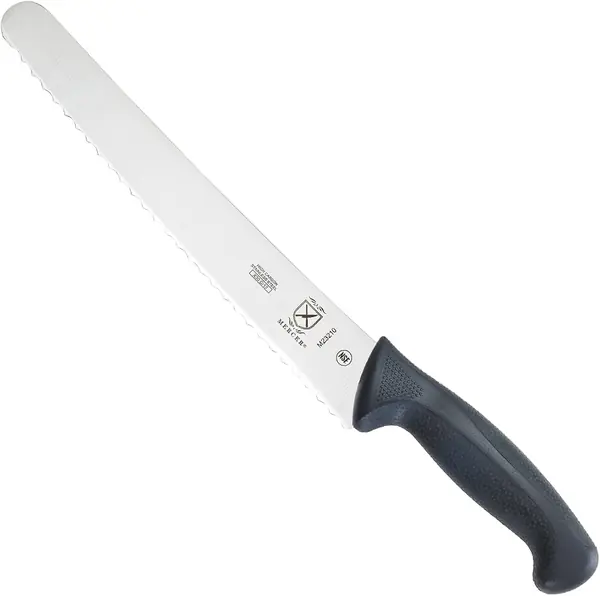
Mercer Culinary Millennia bread knife with black textured handle and silver serrated blade

Everyday loaves

Bake Score 99/100
Blade Length
10 inches
Weight
4.8 oz
Construction
Stamped
Edge
Wide wavy serrated
View on Amazon

Ten inches of blade is the reason this knife ends up in our hands more often than anything else here. A wide boule or a long batard goes through in a single draw, and a single draw is what keeps the crumb intact — the sawing a short blade forces on you is what crushes the soft middle. What surprised us is how few teeth it uses. The serrations are wide and deep rather than fine and crowded, so they bite a dark crust and clear it instead of skating across the top, and the slices come away cleaner than we expected at this price.

At 4.8 ounces it stays light through a whole loaf, which matters more than it sounds: a heavy 10-inch knife is tiring long before the second boule is sliced. The molded handle has textured finger points and a curve that puts your index finger somewhere useful when you choke up for control, and it doesn't turn slippery against a warm loaf. It costs a fraction of the Tojiro, and on an everyday country loaf we didn't feel we were giving anything up.

Two things to know before you order. The blade is stamped rather than forged, so it flexes if you lean on it; cut with the teeth and the flex never shows up. And a serrated edge can't be brought back on a whetstone the way a chef's knife can. Plan on a professional sharpening every few years, or on replacing something this affordable.

Worth Noting

  • Hand washing required to keep the warranty
  • Stamped blade flexes if you press hard
Our Verdict

We recommend it to anyone who bakes or buys whole loaves: a 10-inch blade, a secure grip, and a price that makes the inevitable resharpening painless.

Check Latest Price

2

Victorinox Swiss Army 8-Inch Serrated Bread Knife Best 8-Inch for Control

Victorinox Fibrox bread knife with black textured handle and 8-inch serrated steel blade

Smaller hands

Bake Score 98/100
Blade Length
8.3 inches
Weight
3.52 oz
Handle
Fibrox
Warranty
Lifetime against defects
View on Amazon

Fibrox is the handle material, and it's the first thing you notice. It's a textured thermoplastic rubber, dimpled and slightly soft, and it stays grippy when your hand is damp from a loaf that's still cooling — a small thing until you've handled a smooth metal handle under the same conditions.

Where it earns a place in this guide is control. The blade runs 8.3 inches, short enough to steer through a small round loaf or a baguette held at an angle, and short enough to sit inside a slotted bread guide without the frame getting in the way. The steel is ice-tempered high-carbon stainless with a conical grind, the same specification the company sells into commercial kitchens, and the NSF mark on the handle is there because of it. We found the edge holds noticeably longer than the budget picks here.

What you give up is length. On a very wide boule you take two passes where the Mercer takes one, and very soft sandwich bread drags slightly against the broader blade before the teeth catch. Neither has been a problem for a small household slicing at the counter. The lifetime warranty against manufacturer defects is the backstop that makes the premium easier to justify.

Worth Noting

  • Hand washing recommended for the Fibrox handle
  • Costs more than the top pick for a shorter blade
Our Verdict

The one we hand to anyone who wants a shorter blade and a grip that stays put: commercial-grade steel, a lifetime warranty, and no drama.

Check Latest Price
3

Tojiro F-737 Bread Knife Best for Thin Slices

Tojiro bread knife with natural wood handle and long thin serrated stainless blade

Thin, even slices

Bake Score 97/100
Blade Length
23.5 centimeters
Weight
3.88 oz
Handle
Natural wood
Blade Steel
Stainless steel
View on Amazon

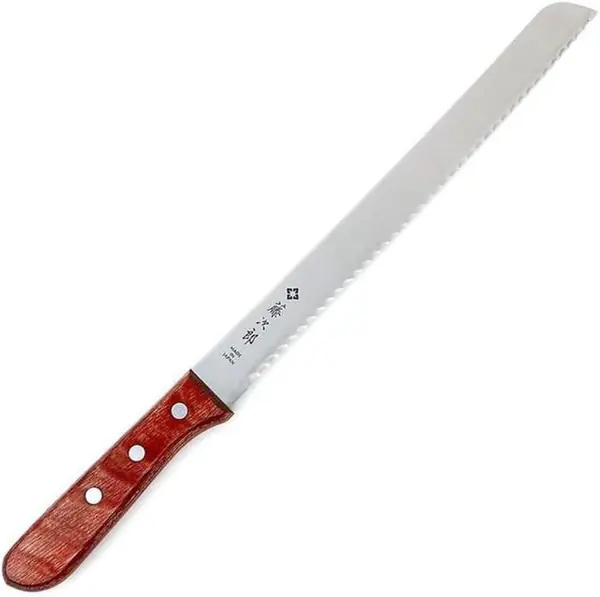
This is the knife we reach for when the loaf is going on a board in front of people. The blade runs 23.5 centimeters — a touch over nine inches — and it's ground thin enough that a slice you can see light through is an ordinary result rather than a trick. On a light country loaf, nothing else in this guide comes close on evenness.

The handle explains the rest of the appeal. It's natural wood, tapered and light, and it's the only pick here we're happy to carry to the table alongside the bread. The whole knife weighs 110 grams, lighter than most of the 10-inch blades in this guide, so a long single-direction cut doesn't tire your wrist. The stainless blade takes a very fine edge and moves through a light crust with almost no pressure at all.

The thinness cuts both ways. In a dense whole wheat or a tight-crumb rye, a blade this flexible wanders if your stroke isn't level, and you finish with one thick slice and one thin one. It rewards a confident, single-direction cut and punishes a wobble. Wash and dry it by hand as well — the wood handle doesn't want a soak.

Worth Noting

  • Thin blade wanders in dense, tight-crumb loaves
  • The priciest knife in this guide
Our Verdict

Worth the splurge if you want wafer-thin, even slices and a knife that looks right on the table — just keep the cut level.

Check Latest Price
4

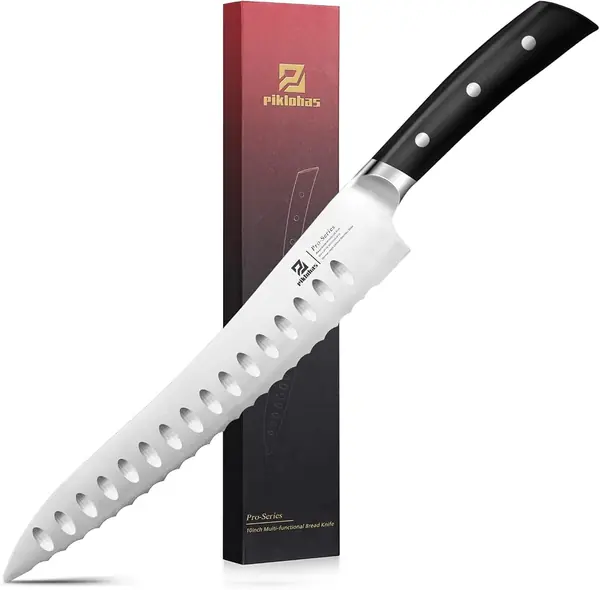
Piklohas Resharpenable 10-Inch Bread Knife Best for Knuckle Clearance

Piklohas bread knife with offset black handle and hollow-edge serrated blade

Knuckle clearance

Bake Score 96/100
Blade Length
10 inches
Weight
15.8 oz
Handle
Offset ABS
Edge
Resharpenable serrated
View on Amazon

Nearly a pound of knife is the first thing you notice. At 15.84 ounces this is by a wide margin the heaviest pick here — more than three times the Mercer — and by the end of a second loaf your wrist knows it. The offset handle, which lifts your knuckles above the cutting board, is what keeps that weight from turning into a problem.

The reason to accept the heft is the edge. Those serrations are cut so an ordinary honing rod can bring them back, and none of the other knives here allow that. A standard serrated edge needs a tapered file or a professional, and most people simply live with a dull knife until they replace it.

The rest is thoughtful. Grooves on both faces of the blade break the suction that makes moist bread stick, the 10-inch length handles a full boule, and the knife arrives in a gift box with a manual. The ABS handle is the plainest part of the package and feels a little slick next to the Mercer's molded grip.

What settles it for us is that this is the only knife on the page that solves sharpening rather than postponing it. A serrated blade that stays sharp for years is worth a heavier handle and a homelier grip, and the offset design means the extra weight lands on the board rather than on your knuckles.

Worth Noting

  • Heavy at 15.84 ounces
  • ABS handle feels plainer than wood or textured grips
Our Verdict

Buy it if you want the one serrated knife here you can actually bring back to sharp with a honing rod, and you don't mind a heavy blade.

Check Latest Price
5

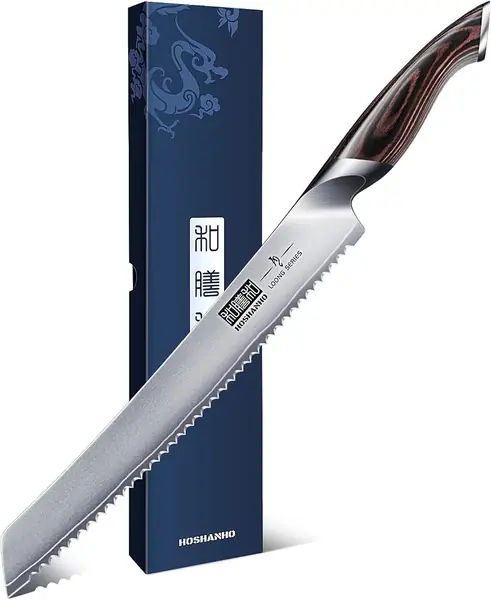
HOSHANHO 10-Inch Japanese Bread Knife Best for Dense Sourdough

HOSHANHO bread knife with engineered wood handle and polished serrated blade

Dense sourdough

Bake Score 95/100
Blade Length
10 inches
Weight
8 oz
Blade Steel
10Cr15CoMoV high carbon stainless
Edge Angle
15 degrees
View on Amazon

Where the Mercer disappears into the job, this one lets you know you're holding something. It runs 8 ounces against the Mercer's 4.8, the handle is engineered wood rather than molded plastic, and the balance sits further back toward the palm — which is what you want when the crust in front of you is dark, thick and unyielding.

The steel is Japanese 10Cr15CoMoV, vacuum heat treated, and sharpened to a 15-degree edge — unusually acute for a serrated knife, and the reason it bites into a hard crust on the first pass instead of skating over it. The 10-inch blade gives you a full boule in one stroke, and the polished finish wipes clean without dragging the cloth.

For volume, this is where the extra spend goes furthest: the weight steadies a long cut and the edge geometry does most of the work. If your hands are small or the counter is cramped, the 8-inch Victorinox serves the same kitchen with less knife to manage.

Worth Noting

  • Eight-ounce weight is a lot for long sessions
  • Wood handle needs hand washing and drying
Our Verdict

When the crust is dark and hard, this is the knife that keeps its composure: extra weight, an acute edge and a handle that looks the part.

Check Latest Price
6

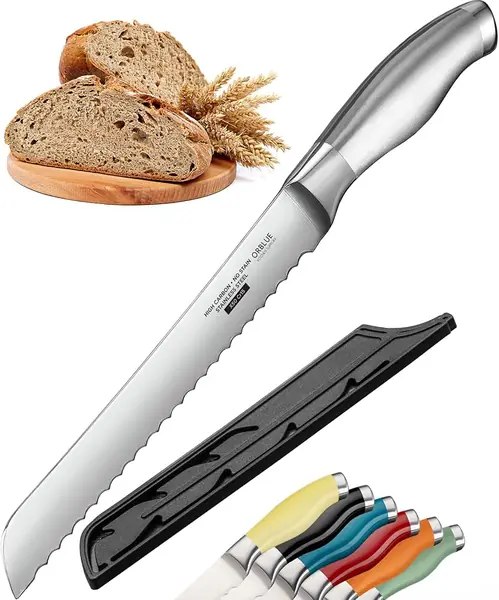
Orblue Serrated Bread Knife, 8-Inch Best Budget

Orblue one-piece stainless steel bread knife with serrated blade and metal handle

First bread knife

Bake Score 94/100
Blade Length
8 inches
Handle
Stainless steel
Construction
One-piece stainless
Blade Thickness
2.2 millimeters
View on Amazon

What a single piece of steel buys you is the whole point of this knife. There's no seam between blade and handle, no rivets, no plastic to crack — the entire thing is one continuous run of stainless steel, so it wipes clean in a motion and there's nothing to work loose over the years it spends in a drawer.

The blade is 8 inches and 2.2 millimeters thick, wavy-edged, and thin enough to move through a crusty loaf without much downward pressure. It's the least intimidating knife here: short enough for a compact loaf, light in the hand, and priced so nobody in the household thinks twice about using it.

Where it comes up short is at the soft end. Very soft sandwich bread compresses slightly before the coarse teeth catch, so the slices aren't as square as the ones the Mercer turns out. It's also the pick here most likely to spot with rust if it goes through a dishwasher, so wash it by hand and dry it straight away.

Buy it for the drawer that already holds a good chef's knife, for a vacation rental, or as the one you don't mind a neighbor borrowing. It slices good bread well and asks nothing of you; it just won't be the last bread knife you own.

Worth Noting

  • Edge dulls faster than our pricier picks
Our Verdict

One piece of stainless steel with nothing to loosen, at a price that makes it the easiest knife here to buy on a whim.

Check Latest Price
7

Cuisinart Triple Rivet 8-Inch Bread Knife Best for Drawer Storage

Cuisinart Triple Rivet bread knife with black handle, steel rivets and blade guard

Drawer storage

Bake Score 93/100
Blade Length
8 inches
Weight
6.4 oz
Construction
Forged
Includes
Blade guard
View on Amazon

The blade guard is a small thing that decides a lot. It means this knife can live loose in a drawer without a magnetic strip or a block, and it's the only pick here that arrives with one — which matters more in a small kitchen than any figure on the box.

Under the guard is a forged blade with an extra-wide bolster and three stainless rivets through a full tang. That construction is why it weighs 6.4 ounces and why it feels planted in the hand: the bolster gives your thumb a place to rest and keeps your fingers back from the edge without you thinking about it.

In use it feels old-fashioned in the best way — substantial, stable, unhurried on a hard crust. Against the others, the Victorinox has the better grip and the Mercer has the better blade length, but neither feels this solid on a crusty baguette, and neither arrives with a guard.

Worth Noting

  • Plain hard plastic handle
  • Heavy for an 8-inch blade
Our Verdict

Forged, weighty, and the only pick here that arrives with a guard — a sturdy all-rounder for someone who wants one serrated knife.

Check Latest Price
8

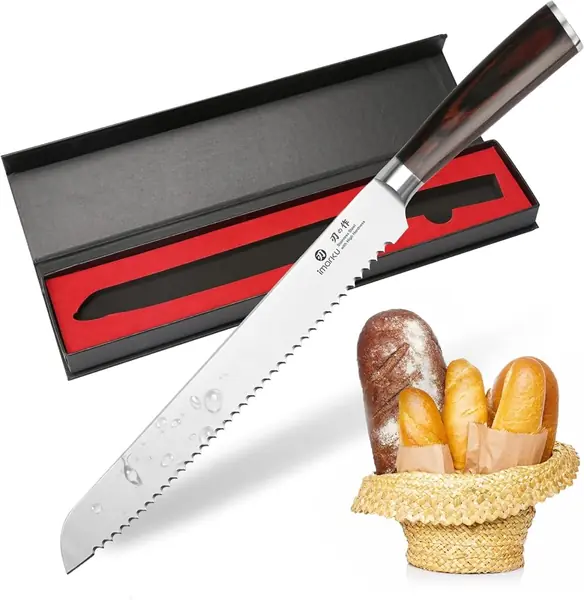
imarku 10-Inch Pakkawood Bread Knife Best for Gifting

imarku bread knife with deep brown pakkawood handle and long serrated steel blade

Gifting

Bake Score 92/100
Blade Length
10 inches
Weight
9.17 oz
Handle
Pakkawood
Warranty
Lifetime plus one-year replacement
View on Amazon

Presentation is the first thing this knife gets right. It arrives in a rigid gift box with a flannel lining, and the handle is pakkawood — laminated hardwood that keeps the look of real wood without the movement — in a deep brown that reads more expensive than the knife does.

The blade behind that handle is a 10-inch length in German high-carbon stainless with a serrated edge meant for crusty loaves, and the balance is what makes it feel different from the Mercer: at 0.26 kilograms the weight sits back in the palm, so the knife seems to do part of the work itself. We think it's the better-looking of the two, and the one that suits a board left out for guests.

Two things to plan for. Pakkawood wants hand washing and immediate drying, more so than a molded plastic handle. And it costs noticeably more than the Mercer for the same blade length — money spent on the handle and the box rather than on cutting. The lifetime warranty with a one-year replacement is the backstop.

Worth Noting

  • Costs noticeably more than the top pick
  • Pakkawood handle needs prompt hand drying
Our Verdict

A 10-inch serrated blade in a pakkawood handle, balanced and good-looking enough to leave on the counter, and boxed well enough to give away.

Check Latest Price

How We Chose and Tested the Best Bread Knives

We started by rounding up every serrated bread knife we could find in the 8- to 10-inch range and filtering on blade steel, handle material, and whether the maker says the edge can be resharpened. We also measured spine thickness on each one with calipers, because blade thickness is the spec almost nobody advertises and everybody feels the moment they hit a dense loaf. That research narrowed the field to 14 knives, which we then used for six months.

Testing looked like a normal weekend of baking. We cut through crackly sourdough boules, baguettes, soft sandwich loaves, bagels, tomatoes, and the occasional pineapple, counting how many slices we got per loaf and whether the crumb compressed under the blade. We noted if the crust shattered and threw crumbs across the counter, and whether the first cut wandered off our line on a hard heel.

Each knife also had to survive the things that dull a blade in a real kitchen: scraping across a wooden board, hand washing, and the occasional accidental run through the dishwasher. We checked handles for lifting wood and loose rivets, gripped each one with floury hands to see if it turned in our palm, and tracked sharpness by noticing how much downward pressure a loaf started to demand. The thinnest blades flexed and skated on hard crust, the thickest wedged and crushed the slice, and knuckle clearance on a tall boule separated the handles that worked from the ones that bruised. At the end we set every knife's performance against what it cost.

How to Choose a Bread Knife

Match the blade to the loaf

A 10-inch blade is the right answer for wide boules, long batards and anyone who wants one clean pass from crust to board; the Mercer and the HOSHANHO both show what that length buys. An 8-inch blade is easier to steer through a small round loaf, kinder to small hands, and the safer choice in a cramped kitchen, which is the case the Victorinox makes.

The trap is buying length for its own sake. A 10-inch blade wants a long drawer or a magnetic strip, and on a soft roll it's more knife than the job needs. If you bake mostly sandwich loaves and the occasional baguette, 8 inches is not a compromise.

Look at the teeth, not just the steel

Tooth spacing changes what the knife does. Widely spaced, deep serrations bite into a hard crust and clear it; fine, closely packed teeth are gentler on soft sandwich bread but skate across a dark bake. We favor the wider spacing for anything with a real crust, because a knife that grabs is a knife you don't have to press.

Serrated edges are also the one thing you can't restore at home with a whetstone. A rod run along the flat side buys time, and a design built to be resharpened, like the Piklohas, buys years. Otherwise plan on professional sharpening or on replacing the knife when it gives up.

Weigh grip and heft

Bread knives here run from about 3.5 ounces to nearly a pound, and heavier isn't better so much as different: weight steadies a long single-pass cut but tires your wrist over a second loaf. Handle material matters just as much — textured rubber stays put when your hand is damp from a warm loaf, and smooth metal doesn't.

Check the handle shape too. Offset handles lift your knuckles clear of the board, which is worth having if you slice on a low counter, and a wide bolster gives your thumb somewhere to sit when you choke up.

What the price steps actually buy

At the low end you get stamped steel, a molded or metal handle, and a knife that cuts well until it dulls. Step up and you're paying for forged construction, harder steel that holds an edge longer, and better handle materials. At the top you're buying a thin grind and the evenness that comes with it.

The Mercer is proof that the budget tier isn't a compromise for most bakers; the Tojiro is proof of what the extra money genuinely changes. Neither is the wrong purchase — they answer different questions about how often you bake and how much you care what the slice looks like.

Wash it by hand and give it a home

Every knife here is happiest hand washed and dried straight away. Heat and detergent dull an edge and can spot stainless steel, and wood or pakkawood handles suffer most — a pakkawood handle left wet will show it long before the blade does.

Then give the blade somewhere to live: a guard, a block slot or a magnetic strip. A drawer full of loose utensils knocks the points off serrations, and a bread knife with flattened teeth is a bread knife that tears instead of slices.

Frequently Asked Questions

Final Verdict

The Mercer Culinary M23210 is the bread knife we point most people toward. Ten inches of blade for wide loaves, teeth that clear a dark crust instead of skating over it, and a body light enough to get through a whole loaf without a second thought — at a price that makes sharpening or replacing it a non-event.

Spend more only for a reason. The Tojiro if you want wafer-thin, table-ready slices, the Victorinox if you want a shorter blade with a grip that never slips, or the Piklohas if bringing a serrated edge back yourself is the thing you've been missing.