The 7 Best Kitchen Scales for Sourdough of 2026

Sourdough is arithmetic: 500 grams of flour, 350 of water, 10 of salt, and a starter you feed by weight. That makes your scale the instrument everything else is measured against. I once baked with one that drifted a gram on every tare, and my salt landed nearly a fifth off — you could taste it. A scale worth keeping settles fast, holds a tare through a sticky feed, and stays readable behind a bowl of wet dough.

We weighed flour, fed starters and divided dough on 16 scales, from pocket-size models to high-capacity ones built for double batches. The surprise: capacity and bowl weight are the same number. A 5-pound scale reads fine until a 700-gram mixing bowl sits on it and you're still adding 1,500 grams of dough.

Shoppers also overrate the unit list — grams and ounces on the box says nothing about resolution, and 1-gram steps are what sourdough actually asks for. We weren't grading looks or apps; flour did the sorting.

Our Top Picks

The Best Kitchen Scales for Sourdough

1

Nicewell Food Scale 22lb Best Overall
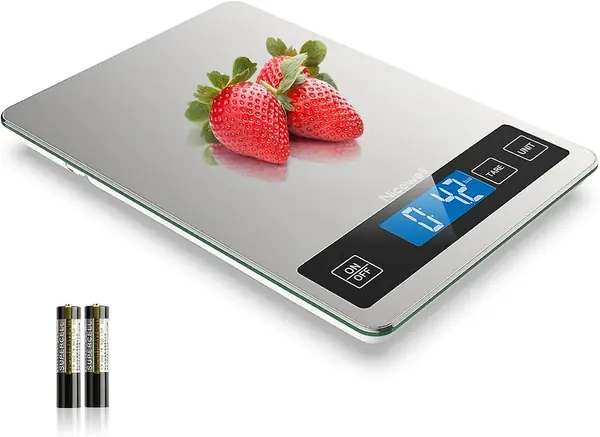
Nicewell digital kitchen scale with silver stainless steel platform and large backlit LCD

Everyday sourdough batches

Bake Score 97/100
Readout
1 g / 0.1 oz
Capacity
22 lb
Units
g, kg, lb:oz, fl oz, ml
Platform
9 x 6.3 in
View on Amazon

The first thing we noticed about the Nicewell is how much bowl it can hold: the platform measures 9 by 6.3 inches, and the 22-pound capacity means a double batch of dough isn't a squeeze. For sourdough, that combination matters more than a long feature list. We set a wide mixing bowl on it, tared, and had room to add flour and water without the bowl overhanging the platform. The backlit LCD is easy to read from standing height, and the 1-gram increments are the right resolution for salt, starter, and water.

The scale switches among grams, kilograms, pounds and ounces, fluid ounces, and milliliters, but we stayed in grams for bread. Tare is a single press, and the add-and-weigh rhythm is simple: bowl, zero, flour, zero, water, zero. The 1-gram readout is the sourdough standard, and we didn't feel the need for finer increments when adding salt. If you also bake pastry or measure yeast by the tenth of a gram, this isn't that tool; for sourdough's 1-gram world, it's enough.

Cleanup is a wipe rather than a disassembly job. The glass-and-steel top has no raised rim for flour to pack into, and the two-year warranty is a reasonable safety net at this price. We did notice the stainless surface picks up fingerprints, especially if you handle it with doughy hands, so a quick wipe before storage keeps it looking sharp. The real reason it stays out on our counter is the bowl clearance.

Worth Noting

  • Whole-gram readout only
Our Verdict

We recommend the Nicewell as the default sourdough scale because its large platform and 22-pound capacity handle a full mixing bowl without making you squint at a tiny display.

Check Latest Price
2

OXO Good Grips 11-Pound Scale Best for Large Bowls

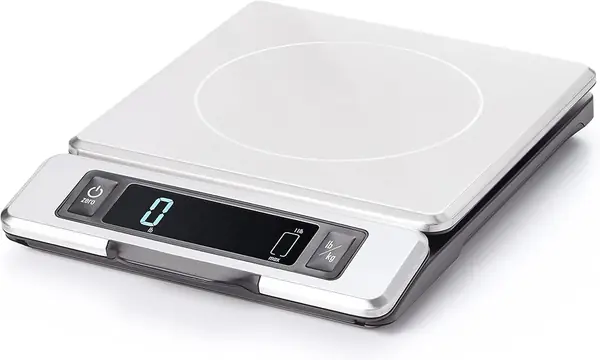
OXO Good Grips stainless steel food scale with pull-out display and removable platform

Large bowls

Bake Score 96/100
Readout
1 g / 0.1 oz
Capacity
11 lb
Display
Pull-out
Platform
Removable stainless steel
View on Amazon

The OXO's pull-out display is the feature that makes it worth considering for sourdough. A wide bowl on a fixed-display scale can hide the numbers exactly when you're adding the last of the water. The OXO slides its display forward, so you can read it from the side or above the bowl. The platform also lifts off, which makes flour and dried dough much easier to deal with than a scale with a fixed stainless deck.

We found the pull-out display more useful than it sounds—it's the scale we choose when a recipe uses a big bowl and a lot of small additions. The 11-pound capacity handles a standard two-loaf batch, and the 1-gram increments are precise enough for salt and starter. If you routinely mix double or triple batches, one of the 22- or 33-pound scales is a better fit.

The stainless finish resists smudges, and the removable platform can go to the sink while the body stays put. We did find the display's magnetic mount can slide loose if you carry the scale by the display rather than the base; carry it by the body and it stays put. For a serious home baker who wants the numbers visible and the cleanup simple, that's a small accommodation.

Worth Noting

  • Premium price
Our Verdict

The OXO is worth it if a big dough bowl constantly hides your numbers; the pull-out display and removable platform make it the most thoughtful scale here for large-batch bakers.

Check Latest Price
3

Ozeri Pronto Digital Scale Best for Small Additions

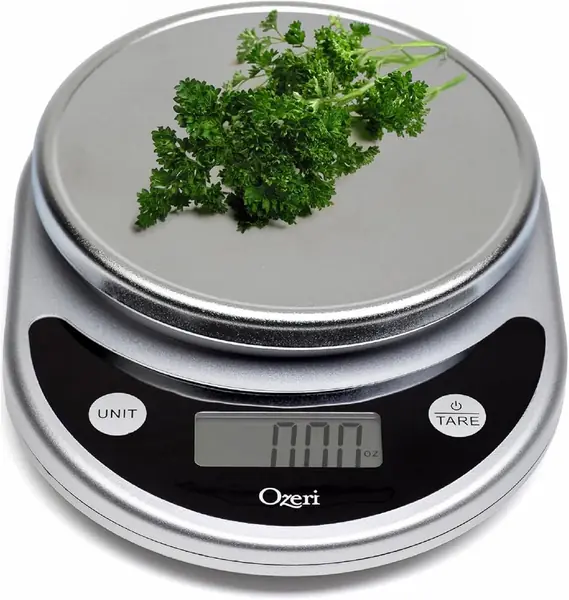
Ozeri Pronto digital kitchen scale with polycarbonate platform and dedicated tare buttons

Small additions

Bake Score 95/100
Readout
0.04 oz
Capacity
11 lb
Units
Six, including g and kg
Buttons
Dedicated tare and unit
View on Amazon

The Ozeri Pronto is the scale we reach for when a formula calls for a small amount of something—salt, starter, a splash of water. It starts at 0.5 grams, so it registers the first few grams instead of sitting at zero until you've added a handful. The readout itself moves in 1-gram steps, which is all sourdough needs, and the dedicated tare and unit buttons are separated from the platform. That last detail matters: you can tare without pressing on the weighing surface and jolting the reading.

The six units include grams, kilograms, pounds, pounds and ounces, ounces, and milliliters. The body is compact and light, and the polycarbonate platform wipes clean after flour or starter. The buttons have a tactile click that makes tare easy to confirm. It's a simple scale, not a smart one—no app, no timer, no bowl—and that's part of the appeal if you want a dedicated bread scale that lives on the counter.

The polycarbonate platform wipes clean with a damp cloth, and the compact body is easy to store. For a starter feed or a single loaf, it's a precise little workhorse. The one thing to know is that the platform doesn't lift off, so cleanup is a wipe-down rather than a sink job.

Worth Noting

  • Platform is not removable for washing
Our Verdict

We like the Ozeri for bakers who add salt and starter in small increments and want dedicated buttons that don't jostle the platform.

Check Latest Price
4

Escali Primo Digital Scale Best Simple Design

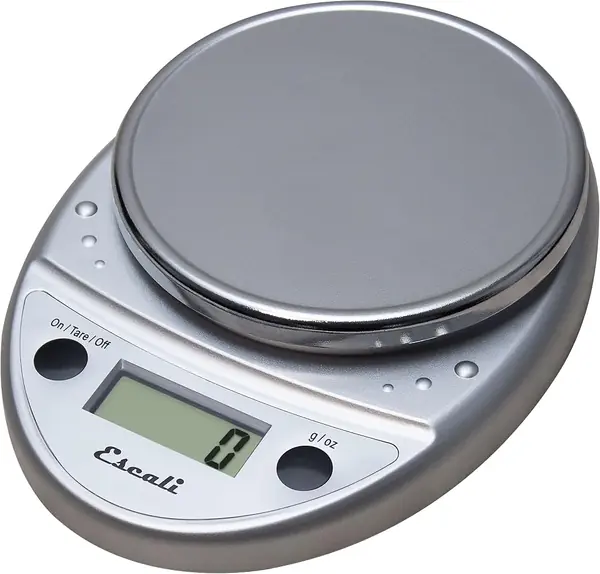
Escali Primo chrome digital food scale with rounded body and two-button control panel

Simple sealed controls

Bake Score 94/100
Readout
1 g / 0.05 oz
Capacity
11 lb (5,000 g)
Controls
Sealed two-button panel
Warranty
5-year limited
View on Amazon

The Escali Primo looks almost plain next to the glass-and-steel scales here, and that's the point. Its control panel is sealed under a protective shield, with just two buttons: one for power and tare, one for units. Flour doesn't collect around a row of membrane keys, and you can wipe the whole front without worrying about crumbs working their way in.

We like it for the bakes where you want to set a bowl on the scale, zero it, and not think about the interface again. It reads in 1-gram increments up to 11 pounds, has a tare function, and shuts itself off automatically. The five-year limited warranty is the longest here, which says something about how the maker expects it to hold up. The two-button layout is easy to learn and easy to wipe.

The body is small enough to keep on the counter without stealing workspace, and the rounded corners are easy to wipe. It isn't the scale for someone who wants a pull-out display or a built-in bowl; it's for someone who wants a simple, sealed tool that does the same two things every bake.

Worth Noting

  • Compact platform crowds wide mixing bowls
Our Verdict

The Escali is the one we choose when we want a simple, sealed scale that wipes clean and doesn't ask for a manual.

Check Latest Price
5

Etekcity Food Scale with Bowl Best All-In-One Bowl

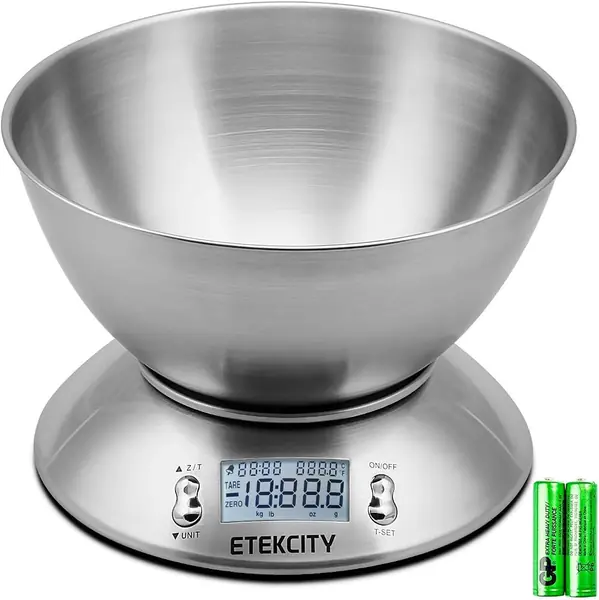
Etekcity digital food scale with detachable stainless steel bowl and blue backlit display

Single-loaf batches

Bake Score 93/100
Readout
1 g / 0.1 oz
Capacity
11 lb (5 kg)
Bowl
2.06 qt, detachable
Extras
Timer and temperature sensor
View on Amazon

The Etekcity bowl scale is the one we pick for a single loaf or a starter feed because the bowl is part of the tool. The 2.06-quart stainless bowl detaches, so you can weigh flour and water directly in it, lift it off, and mix without dirtying another vessel. The scale underneath reads in 1-gram increments up to 11 pounds, and the tare function zeroes the bowl before you start.

We also used the built-in timer more than we expected. It's handy for an autolyse rest, and the temperature readout gives you a room-temperature check rather than a dough probe. The blue backlight is bright and easy to read, and the detachable bowl goes to the sink while the base stays dry. For small-batch sourdough, the all-in-one design earns its counter space.

The bowl is the reason to choose this one over a flat scale, but it's also the limit. At 2.06 quarts, it's sized for a single loaf or a levain, not a double batch. If you routinely bake two or three loaves at once, you'll be using your own bowl on the scale's small platform, which gives up the main advantage. For a starter feed or a weekly single loaf, it's a tidy solution.

Worth Noting

  • Bowl too small for double batches
  • Loud confirmation beep
Our Verdict

We recommend the Etekcity bowl scale for small-batch bakers who want one vessel to weigh, mix, and carry dough without chasing a separate bowl.

Check Latest Price
6

Amazon Basics Digital Kitchen Scale Best Budget

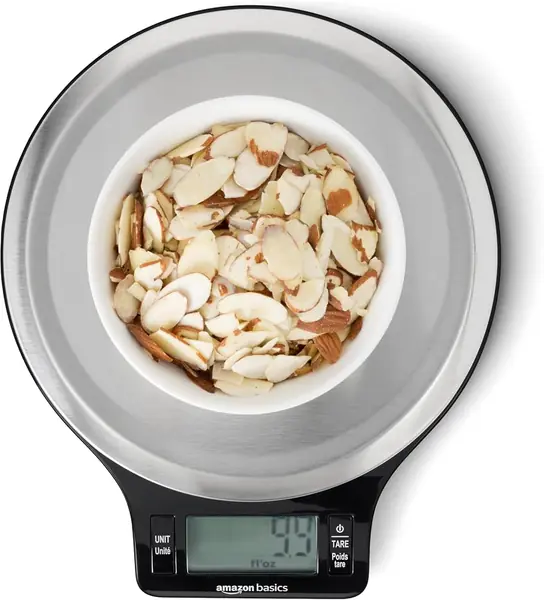
Amazon Basics digital kitchen scale with stainless steel platform and black body

Tight budgets

Bake Score 92/100
Readout
0.04 oz
Capacity
11 lb
Units
g, oz, lb, fl oz, ml
Power
2 AAA batteries
View on Amazon

The Amazon Basics scale is the least expensive way into this group, and it covers the fundamentals: 11 pounds of capacity, 1-gram increments, a tare button, and a stainless platform that wipes clean. It runs on two AAA batteries and switches among grams, ounces, pounds, fluid ounces, and milliliters. The body is compact enough to stand on its side between appliances, which is more than some of the larger scales here can manage.

We kept it around as a second scale for starter feeds and small weigh-ins because it's light and easy to grab. The display is straightforward, and the tare button is where you expect it. It's a simple scale, and the compact body is the reason it fits in a drawer. The 2-gram minimum means it's not the tool for tiny yeast measurements, but sourdough additions are usually well above that.

The light body and simple sensor are what the low price buys. It isn't the scale for someone who wants a pull-out display or a built-in bowl, and the compact platform leaves less room for a wide mixing bowl. For a first sourdough scale or a backup, it's an easy yes; for daily baking and one-scale ownership, the Nicewell or Escali is the safer spend.

Worth Noting

  • Mixed long-term durability
Our Verdict

The Amazon Basics is our budget pick for a reason: it covers the sourdough basics in a compact body, as long as you accept some risk in long-term durability.

Check Latest Price
7

CROWNFUL 33lb Food Scale Best for Very Large Batches

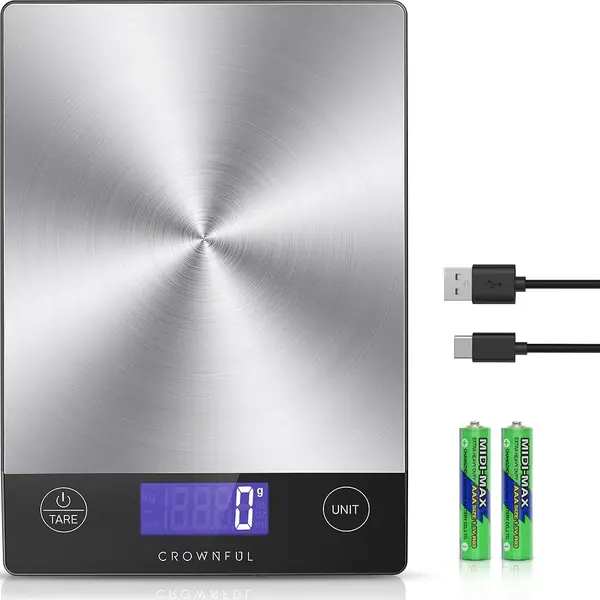
CROWNFUL stainless steel food scale with slanted LCD and 33-pound capacity

Very large batches

Bake Score 91/100
Readout
0.04 oz
Capacity
33 lb (15 kg)
Power
USB-C or 2 AAA
Display
Slanted LCD
View on Amazon

The CROWNFUL's 33-pound capacity is the headline, and it's not just numbers on a box: the stainless platform is large enough for a big dough bowl, and the slanted LCD sits up where a wide bowl is less likely to cover it. If you mix three or four loaves at once, or weigh a full bag of flour into a storage bin, this is the scale in this group that won't make you switch to a bucket.

It reads in 1-gram increments, switches among six units, and runs from a USB-C charge or two AAA batteries. We like that dual power source because a dead rechargeable shouldn't take the scale out of commission during a bake. The tare button is a single press, and the slanted display is easy to read from the side.

Accuracy is the caveat. The gram reading can drift enough that we check it against a known weight before relying on it for salt or starter. That check takes a few seconds and makes the scale trustworthy for bulk weighing, which is where its capacity earns its keep. For small, precise additions, the Ozeri or Nicewell is the better tool.

For very large batches, the CROWNFUL earns its place: the capacity and slanted display solve a real problem that the smaller scales can't. We just don't trust its gram readings for the final pinch of salt without a check. If your sourdough habit runs to multiple loaves and bulk flour, that's a reasonable trade.

Worth Noting

  • Battery life is inconsistent
Our Verdict

The CROWNFUL makes sense for bakers weighing very large batches, with 33 pounds of capacity and a slanted display that stays visible behind a wide bowl.

Check Latest Price

How We Tested Kitchen Scales for Sourdough

We started with around 60 listings and cut down to 16 scales by filtering on stated resolution, maximum capacity, and footprint — anything that couldn't read in 1-gram increments, or that would swallow half a small countertop, was out before we ever plugged it in. Testing ran for four months, which worked out to about a dozen bake days plus a daily starter feed, and each scale lived on the counter the way yours would: out in the open, dusted with flour, wiped down with a damp cloth, and operated with wet hands.

For accuracy, I weighed 100- and 500-gram calibration weights on each scale at the start, again at the midpoint, and once more at the end, logging any drift. Repeatability got its own test: I tared the same heavy ceramic bowl five times in a row and watched whether the display actually returned to zero. On bake days I poured flour in a steady stream and timed how long the numbers kept creeping after I stopped, because a scale that takes three seconds to settle makes you over-correct every addition.

Ease of use meant taring with a 700-gram bowl already on the platform, mashing the buttons with flour-caked fingers, and reading the display from the angle you actually stand at with a dough-filled bowl in front of it. I noted the footprint against a 6-quart mixing bowl and whether the platform was wide enough that the bowl didn't overhang the edge. Durability and battery life got the least glamorous treatment: four months of dust and dough scraps, a running log of every battery change or recharge, and a note each time one shut itself off mid-mix.

The last question we asked about each scale was the blunt one — did the extra money buy anything you could feel on an ordinary Tuesday morning?

How to Choose a Kitchen Scale for Sourdough

Start With Gram Resolution, Not Maximum Capacity

Sourdough formulas are written in grams for a reason: flour settles differently in a cup, and a few grams of salt or starter can change the ferment. A 1-gram scale is the practical standard. You don't need 0.1-gram resolution unless you also weigh yeast or other tiny quantities. What matters more is whether the scale settles quickly and holds a stable number when you add a few grams at a time. A scale that jumps between readings is worse than one with a lower maximum capacity.

Before you trust any new scale, check it with a known weight—a calibration weight if you have one, or a nickel, which should read 5 grams. If it's off by more than a gram at that weight, return it. That quick check tells you more about sourdough suitability than a long list of modes.

Match the Platform and Display to Your Bowl

A scale can have plenty of capacity and still be annoying if your everyday mixing bowl covers the display. Look for a platform around 9 by 6 inches, or a display that pulls out or sits up at an angle. The Nicewell's 9-by-6.3-inch platform is a comfortable size for a standard dough bowl; the OXO's pull-out display solves the same problem a different way. If you often mix double batches, go for 22 pounds or more.

Don't confuse capacity with bowl fit. A 22-pound scale with a small platform still forces you to balance a wide bowl on its edges. Set your favorite bowl on a piece of paper, trace the base, and compare that footprint with the platform dimensions before you buy. The bowl should sit fully on the platform, not overhang it.

Prioritize Tare, Buttons, and Auto-Off

Tare is the button you'll press most: it zeroes the bowl, then the flour, then the water, so you can build a dough in one vessel. A dedicated tare button is easier than a combination key, and buttons separated from the platform let you press without shifting the bowl. Check where the controls sit—if they're under the bowl's edge, you'll be reaching around dough every time.

Auto-off is useful for battery life but irritating if it kicks in during a slow autolyse. Most scales here shut off after a few minutes; if you like long rests, tare again when you come back, or choose a model with a longer timeout. The Escali's two-button layout is the simplest version of this workflow; the OXO's pull-out display is the most useful upgrade if bowl clearance is your main frustration.

Decide How Much Cleanup and Spend You'll Accept

Flour gets everywhere, and dough dries like cement. A removable platform or a detachable bowl makes cleanup much easier; a sealed control panel is the next best thing. Wipe a battery-powered food scale with a damp cloth rather than rinsing it, unless the maker explicitly rates it waterproof. Stainless and glass look clean quickly but show fingerprints; matte plastic hides flour better but can stain.

A budget scale can absolutely weigh flour and water. Spend more when you want a display that stays visible under a big bowl, a platform that lifts off, or a longer warranty. We think the midrange Nicewell is the sweet spot for most sourdough bakers, while the premium OXO earns its price for large bowls and easy cleaning. The cheapest models are best treated as starter scales, not heirlooms.

Frequently Asked Questions

Final Verdict

After testing, we recommend the Nicewell for most sourdough bakers. Its 9-by-6.3-inch platform and 22-pound capacity leave room for a full mixing bowl, and the 1-gram readout handles every addition from starter to salt.

If a wide bowl constantly covers your display, the OXO's pull-out screen and removable platform are worth the premium. If you want the lowest-cost way to start, the Amazon Basics covers the basics, provided you accept a smaller platform and less proven long-term durability.