The 4 Best Kitchen Scales with 0.1-Gram Accuracy of 2026

Recipe writers toss around phrases like "a scant gram" as though any kitchen scale can manage it. In practice, the cheap ones fall apart right where precision matters most — at the bottom of the range, where 0.3 grams of yeast lands on a number that won't hold still. The right scale reads a pinch and a full batch of dough without making you give up display size or a platform wide enough to hold a mixing bowl.

I bake bread most weekends, and I've ruined more than one loaf because my old scale couldn't decide between 4 and 6 grams. We weighed, tared and re-weighed 12 scales — palm-size coffee models, bakery units with wide stainless pans — and the gap between a good one and a maddening one shows up in the first ten seconds of use.

The feature I didn't expect to care about was the percentage button, which scales a recipe off your flour weight instead of making you convert every line by hand.

Our Top Picks

The Best Kitchen Scales with 0.1-Gram Accuracy

1

Etekcity 0.1g Food Scale Best Overall
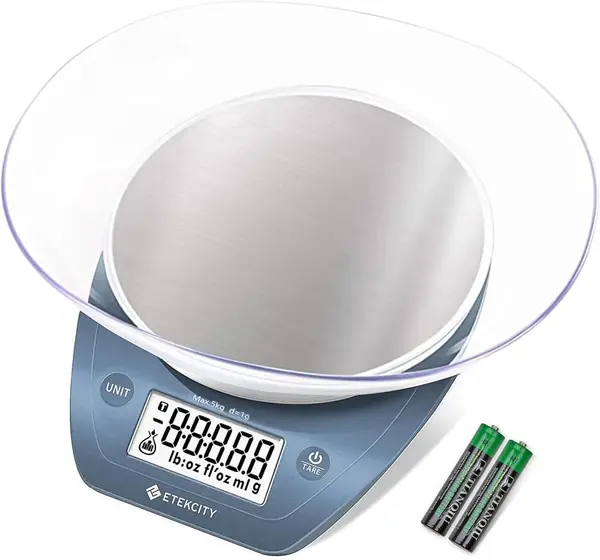
Etekcity EK5250 digital food scale in Prussian Blue with detachable stainless steel bowl

Everyday baking

Bake Score 95/100
Capacity
11 lb / 5 kg
Resolution
0.1 g under 1 kg, then 1 g
Display
2.4 x 1.1 in backlit LCD
Included Bowl
Detachable BPA-free bowl
View on Amazon

The bowl is what put this scale on our counter and kept it there. It clips on top, so a batch of dough or a few scoops of flour goes straight in, then flips over to become a cover — one object on the shelf instead of a scale plus a bowl to wash. Underneath, the sensor works in two gears: tenths of a gram for anything under a kilogram, whole grams above that.

That split is worth understanding before you buy, because it's where a lot of 0.1-gram shopping goes wrong. Four grams of instant yeast or two grams of fine salt reads to a tenth; push past a kilogram — a big sourdough batch, a bowl of batter — and the display steps to whole grams, which is perfectly usable for dough and no use at all for a pinch. The detail we didn't expect to care about is the density setting: switch it from water to milk and the fluid-ounce and milliliter readings correct for the heavier liquid, so a recipe written in milliliters doesn't quietly overshoot.

Readings settle fast, the backlit display stays legible under a cabinet, and the tare zeroes without argument. Five kilos of capacity swallows a holiday dough with room to spare. It also carries a two-year warranty, the only stated one among our picks.

Worth Noting

  • Loud beep every time it powers on
  • Bowl holds less than shoppers expect
Our Verdict

This is the one we hand to most bakers: a bowl that flips into a cover, 0.1-gram readings for yeast and salt, and eleven pounds of capacity.

Check Latest Price
2

Vitafit 11lb Digital Food Scale Best for Baker's Percentages

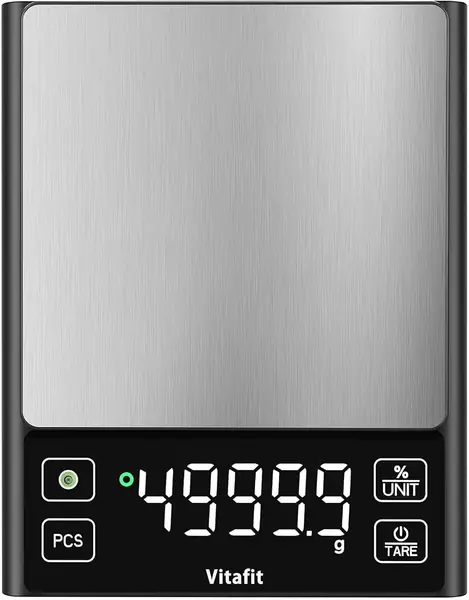
Vitafit VT703 black digital kitchen scale with stainless steel platform and large LED display

Scaling recipes

Bake Score 91/100
Capacity
11 lb
Units
g, oz, lb:oz, fl.oz, ml
Display
3.2 x 1.3 in LED
Percentage Mode
0.1% to 1,000%
View on Amazon

Press the percentage button, weigh your flour, and every addition after that appears as a share of the flour instead of a number you have to work out yourself. That's the whole case for this scale: a 68% hydration dough or a 2% salt addition becomes a glance rather than a calculator session, and the percentage range runs from 0.1% to 1,000%, so a large preferment doesn't run out of room.

The display is the other reason we like it. At 3.2 by 1.3 inches it's the largest of the four, LED-lit, and readable from arm's length while your hands are covered in dough — which matters more than any spec once you're pouring. Eleven pounds of capacity and a stainless platform cover everything from a single macaron batch to a full loaf, and it remembers the unit you last used, so you aren't cycling through grams and ounces at every switch-on.

This is a newer name than our top pick, so give it a five-gram check when it arrives — a nickel on the platform is a convenient stand-in — before you trust it with a two-gram salt addition. Do that once and the percentage key becomes the feature you stop thinking about because you use it every time.

Worth Noting

  • No bowl or tray in the box
Our Verdict

We reach for this one when a recipe is written in percentages — it does the baker's math for you and shows it large.

Check Latest Price
3

GRAM PRES 3kg Digital Kitchen Scale Best for Small Kitchens

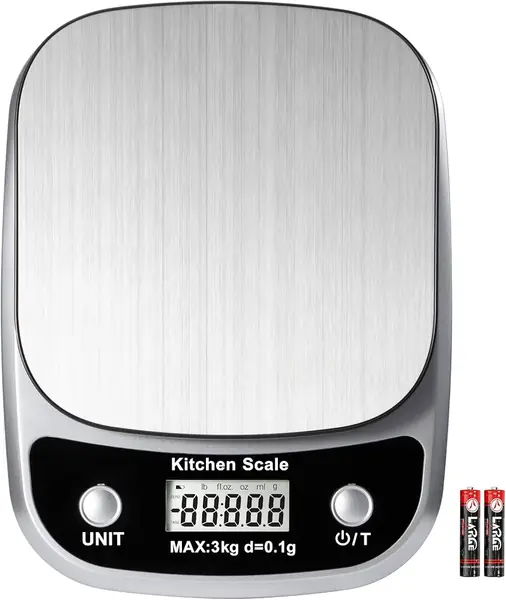
GRAM PRES GP-K1905 silver digital kitchen scale with stainless steel platform and round buttons

Small kitchens

Bake Score 90/100
Capacity
3,000 g
Resolution
0 oz
Units
g, oz, lb:oz, fl.oz, ml
Platform
Stainless steel
View on Amazon

Plenty of inexpensive scales advertise 0.1-gram resolution and then quietly drop to whole grams once the load passes a kilogram. This one holds tenths all the way to its ceiling, which is why it stayed in the roundup even though it tops out lower than the 11-pound models here.

The display sits forward and below the weighing surface, so a wide mixing bowl doesn't hide the numbers — a small thing until you're leaning around a bowl to read a weight. It cycles through five units, including fluid ounces and milliliters, and remembers the last one, so you aren't pressing a button at every switch-on. Rounded corners, a stainless platform, and a body light enough to park in a drawer round it out.

It's the pick for a small kitchen where single loaves and small batches are the norm and counter space is the argument. If a holiday bake means two kilos of dough plus the bowl it's mixed in, the Etekcity is the better buy.

Worth Noting

  • 3 kg maximum rules out very large batches
Our Verdict

Our pick for a tight counter: 0.1-gram resolution holds across its whole range, and it disappears into a drawer.

Check Latest Price
4

BOMATA Large Kitchen Scale Best for Large Batches

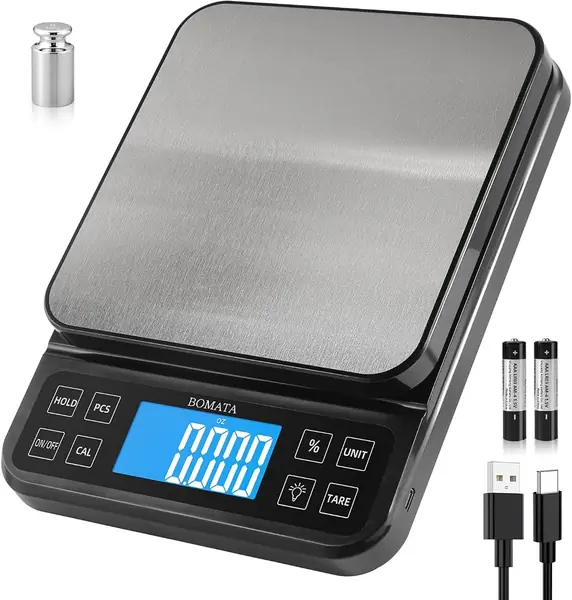
BOMATA B613-3U black kitchen scale with large square stainless steel weighing pan

Large batches

Bake Score 89/100
Capacity
11 lb
Resolution
0 oz
Platform
7.2 x 7.2 in
Power
USB-C rechargeable or 2 AAA
View on Amazon

Seven inches square is the number that matters here. The pan takes a full mixing bowl without overhanging the sensor, and it holds a piece of dough that otherwise has to be weighed in two goes. The HOLD function freezes the reading when a big bowl blocks the screen, so you can shift the load and still see the number.

It's also the only scale here you can charge. USB-C tops up the built-in battery, and a pair of AAAs keeps it running if you forget — a small thing that turns into a big one when a recipe is half mixed and the display goes dark. The percentage function works like the Vitafit's, so baker's math is a button press, and the pan is stainless, so cleanup is a wipe.

Consistency is our reservation: readings on this one are the least steady of the four, which matters most at the small end — half a gram of salt, a gram of yeast. Re-zeroing between additions and checking against a known weight before a delicate bake keeps it honest. It also costs the most of the group, which is a lot to pay for pan size unless you regularly mix big.

Worth Noting

  • Display times out and clears the reading
Our Verdict

Choose this if you weigh big doughs and hate hunting for batteries — that pan swallows a full mixing bowl.

Check Latest Price

How We Tested 0.1-Gram Kitchen Scales

We started by pulling every scale we could find that advertised 0.1-gram resolution, then narrowed the pool by capacity, platform size, price, and whether it was actually in stock. Twelve made it to the counter, and we spent four months with them. None of them lived in a test kitchen: they went into morning coffee routines, weekend bread bakes, and weeknight meal prep, where a scale gets used three times in an hour and then sits untouched for a week.

Accuracy came first. We weighed the same nickel — 5.0 grams on the nose — ten times in a row on each scale and wrote down every reading that wasn't 5.0, then repeated it with a single raisin to see which displays could hold a 0.1-gram number without flickering. For functionality, we tared a heavy ceramic bowl and added flour one spoon at a time to check whether the readout kept up with a slow pour, and we ran the percentage function through a real formula to see if scaling by flour weight saved time or just added buttons. Ease of use was mostly about what we could see: we set a dinner plate on each platform and checked whether the display was still legible from where we were standing.

Durability took some abuse — damp cloths after flour spills, a bump off the counter onto a wood floor, stainless pans collecting scratches, buttons pressed with sticky dough fingers. We tracked battery life throughout, noting how fast each scale drained a set of batteries and whether readings got jumpy before the low-battery warning ever appeared. Size turned out to matter more than we expected, so we measured footprints against a crowded counter and checked which scales slid into a drawer. Value was the final pass: what you actually get per dollar once accuracy, footprint, and build quality are on the table.

How to Choose a 0.1-Gram Kitchen Scale

Where the Tenths Actually Stop

Most scales at this level run in two gears: tenths of a gram for small loads, then whole grams once the weight passes a threshold that the marketing never mentions. That threshold is the number worth hunting for in the manual. The Etekcity switches at a kilogram, which is generous for spices and salt but coarse for a 1,500-gram dough. The GRAM PRES holds tenths all the way up.

The threshold matters most because of your bowl. A heavy mixing bowl counts toward whatever you put on the platform, so a scale that drops to whole grams at a kilogram may already be past that point before the flour goes in.

Capacity and the Bowl That Eats Into It

Tare feels like it buys you room, and it doesn't. Zeroing a 700-gram mixing bowl does not add 700 grams of headroom, so a 3-kilogram scale with a heavy bowl aboard has less capacity than the box suggests. Single loaves, a tray of brownies, and a batch of macarons live comfortably on 3 kilograms; double batches and holiday doughs want 5 kilograms or 11 pounds.

Choose by your largest regular batch rather than your largest annual one. Overshooting capacity costs money and counter space; undershooting means weighing a big dough in two messy rounds.

Bowl, Tray, or Bare Platform

A detachable bowl that flips over to become a cover earns its keep in a small kitchen: fewer dishes, less shelf space, and a lid over the platform. A bare stainless platform is the more flexible choice, since it takes whatever bowl you already own, including a wide one — but you'll wash that bowl separately.

Platform size decides more than any single feature when you weigh straight into a bowl. Seven inches square holds a big mixing bowl steady; a compact pan leaves it perched, and a perched bowl reads slowly and drifts.

Percentage Mode and a Display You Can Read

Percentage mode recalculates every ingredient as a share of the first thing you weigh, which is how professional formulas are written: 100% flour, 68% water, 2% salt. If you scale recipes up and down, it saves real arithmetic, and both the Vitafit and the BOMATA do it.

The display is the unglamorous feature that decides how much you enjoy using the thing. Look for a backlight, digits big enough to read from arm's length, and a readout placed so a wide bowl doesn't sit in front of it.

Frequently Asked Questions

Final Verdict

For most bakers the Etekcity is the easy answer: the bowl flips into a cover, tenths of a gram are there for yeast and salt, and eleven pounds of capacity covers a full batch of dough. The limitation is real but narrow — past a kilogram it rounds to whole grams, which is exactly right for dough and useless for a pinch.

If your small amounts go into a heavy bowl, or your counter is the tightest thing in the kitchen, the GRAM PRES holds 0.1-gram resolution across its entire range. And if you write formulas in percentages, the Vitafit does that math for you.